
[Moderator's note: We have been a bit remiss at splitting this off into a new thread for 2012, but here it is, finally!
Lori]
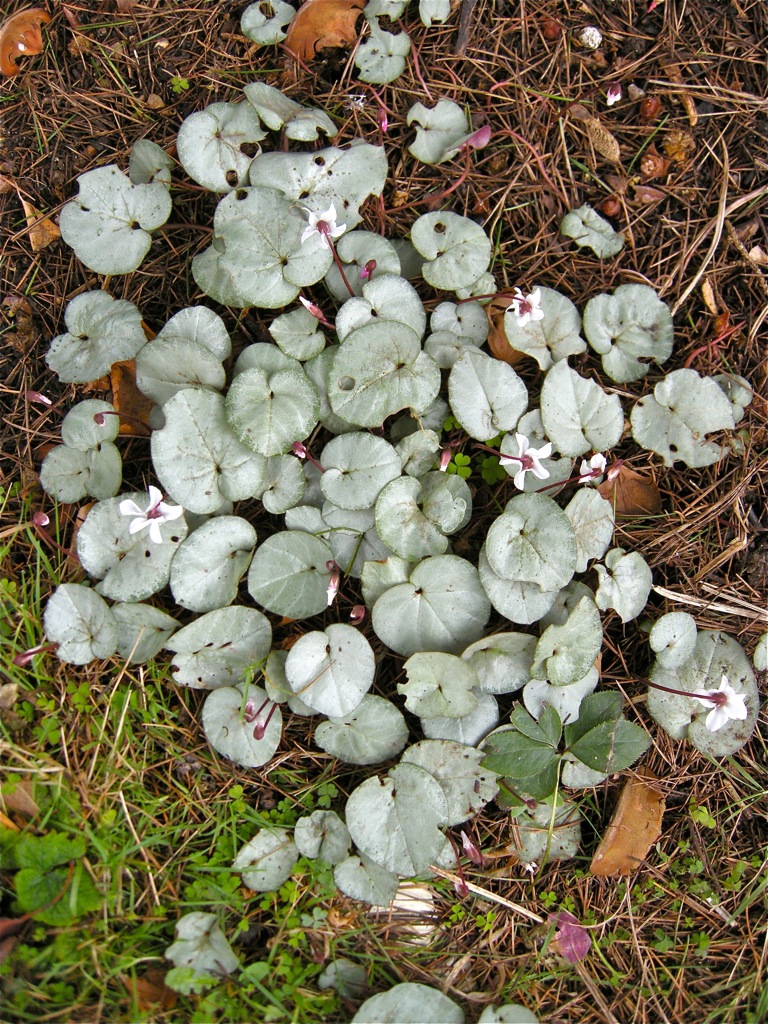
A mix of things flowering or looking interesting in the garden at the moment. The garden is waking up with hellebores and many bulbs soon to come.
Narcissus panizzianus grown from Archibald seed. The flowers are small but always very early.
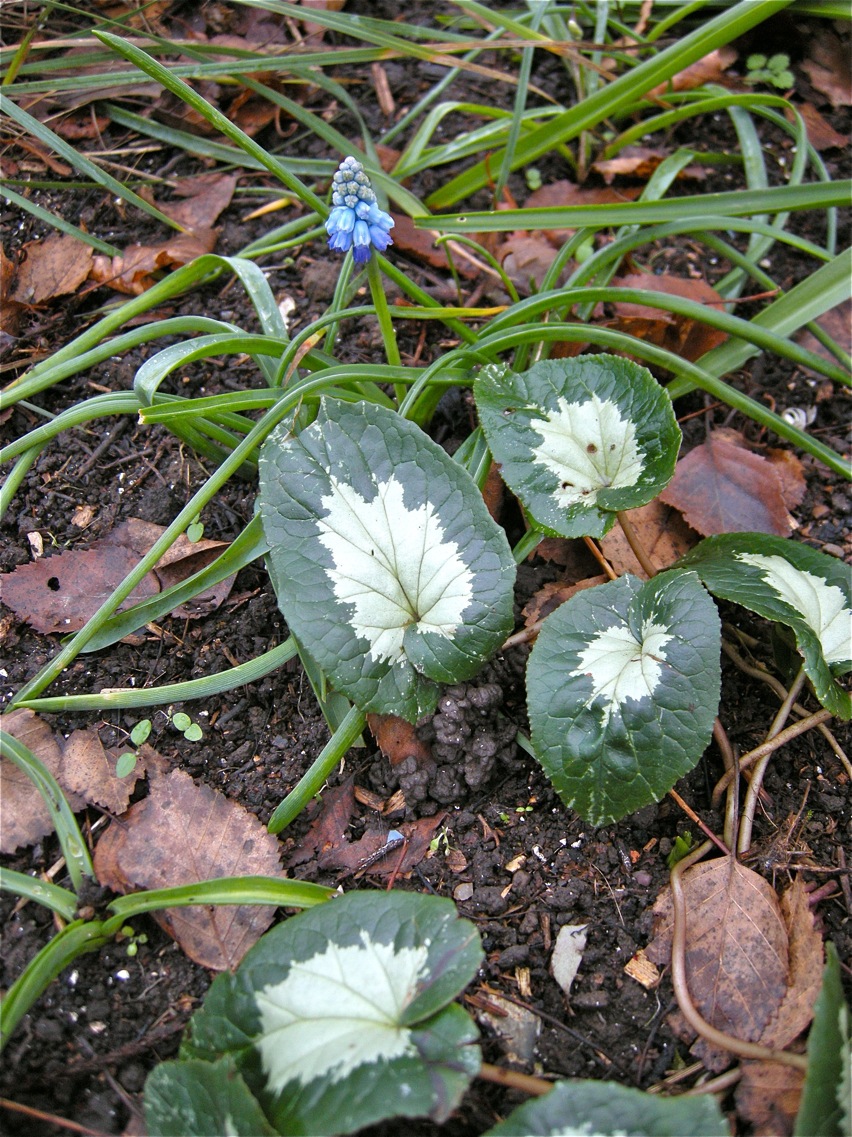
Muscari pseudomuscari, ditto. This is a lovely tidy species, growing here with a selection of Cyclamen hederifolium.
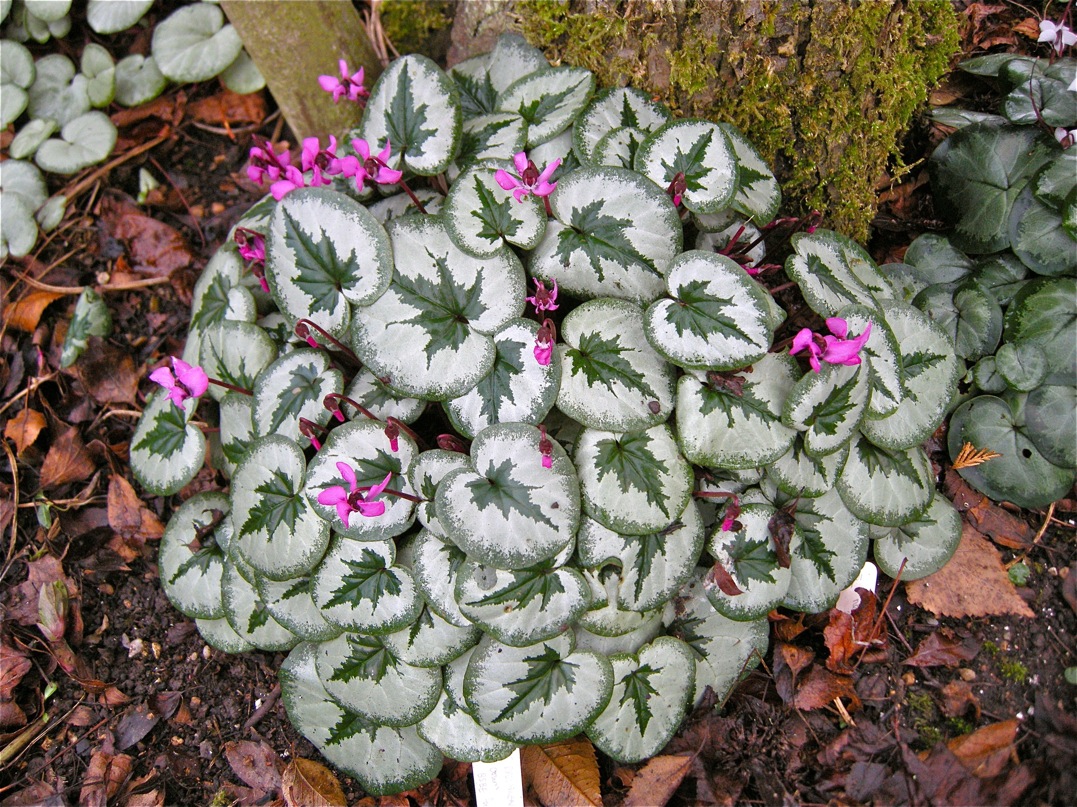
Cyclamen coum. Two forms with very silvered leaves from Tilebarn Nursery.
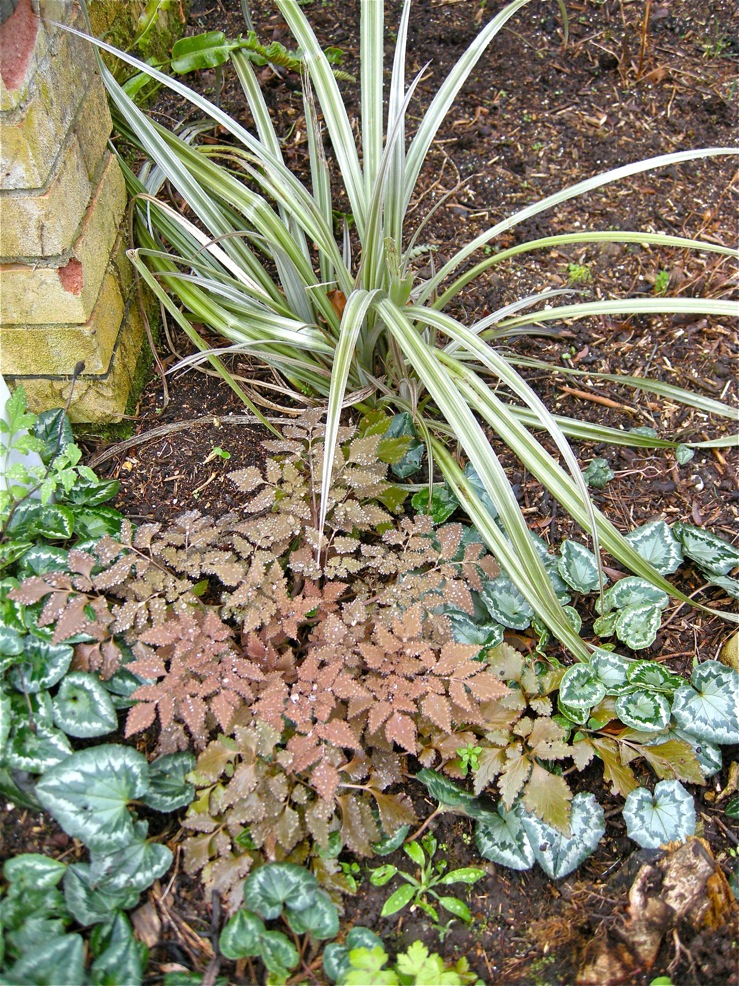
Corydalis quantmeyeriana 'Chocolate Stars' growing with cyclamen and Astelia nervosa. The corydalis is new to me and I haven't yet seen the flowers, but what foliage! I rather like this combination.
Sarcococca confusa. An unassuming shrub but one of the most delightful and scented winter flowers, and usefully tolerant of dry shade.


Comments
Trond Hoy
Re: What do you see on your garden walks? 2012
Sat, 08/25/2012 - 1:28pmPanayoti, Impatiens omeiana is completely hardy here and my climate isn't any better than Todd's! I can't grow the red salvias for instance and Lobelia cardinalis survive only a season or two. I would love to have they all in my garden!
Winter is still some months away here so the cyclamens have not appeared yet.
Richard T. Rodich
Re: What do you see on your garden walks? 2012
Sat, 08/25/2012 - 8:15pmI must first correct a mistake I made recently in this thread (now corrected in that post):
http://nargs.org/smf/index.php?topic=1009.msg19409#msg19409
Not Eryngium yuccafolium, it is Eryngium agavifolium. A slip of the mind, and hard to believe no one caught that! E. yuccafolium is commonly listed by American nurseries offering prairie wildflowers. It is a very different looking plant.
---------------------------
I especially like flowers that open and close and open and close... but that Colchicum is certainly the most dramatic that I've seen! All great plants, Panayoti and Michael!
Trond Hoy
Re: What do you see on your garden walks? 2012
Sat, 08/25/2012 - 9:43pmRick, I once did grow both but I didn't remember which was which ;)
Michael J Campbell (not verified)
Re: What do you see on your garden walks? 2012
Sun, 08/26/2012 - 1:45amColchicum agrippinum
Lori S. (not verified)
Re: What do you see on your garden walks? 2012
Sun, 08/26/2012 - 9:00amWow, terrific plants, everyone!
Not much left that hasn't bloomed already...
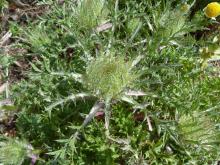
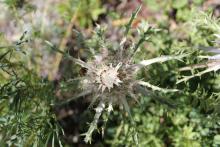
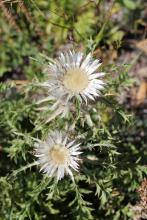
The progression of Carlina acaulis from early bud to flower:
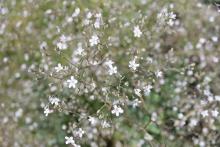
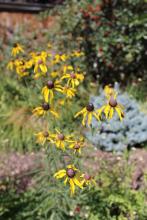
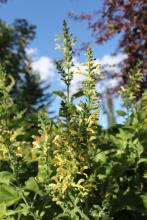
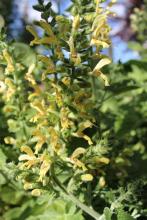
Myriad flowers on Gypsophila oldhamiana x2; Ratibida pinnata; Savia glutinosa x2:
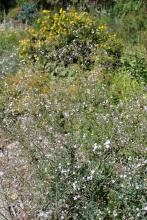
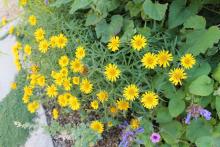
Inula ensifolia:
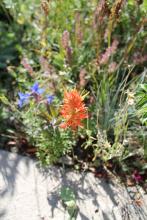
A very late Castilleja miniata seedling:
cohan (not verified)
Re: What do you see on your garden walks? 2012
Sun, 08/26/2012 - 12:06pmStill looking good, Lori- we've had a couple of frost warnings already, though no frost here, I think..
the wild Castillejas here usually have some bloom until killing frost; there were lots ( though I wont try to name) flowering from the foothills through to high elevations when we went out the other day...
Tim Ingram (not verified)
Re: What do you see on your garden walks? 2012
Sun, 08/26/2012 - 12:21pmArtemisia filifolia is a bit of a revelation - I've never seen an artemisia before that you could say is actually attractive in flower! (I now wait to be proved wrong). This is one I would certainly like to grow. We are slowly changing the face of our front garden and the artemisia would fit well here! So far not much has been planted but there is Salvia apiana (possibly not really hardy enough) and a Sphaeralcea species. It has been inspired quite a bit by American gardens and by a desire to 'break the mould' of the typical British garden, mainly because of our very dry climate here in Kent.
Lori S. (not verified)
Re: What do you see on your garden walks? 2012
Sun, 08/26/2012 - 5:52pmArtemisia filifolia is indeed a spectacular plant!
Tim, it struck me that the remnants of the conventional lawn border around the unconventional gravel bed might well be sacrificed one day for other benefits - extensions of the gravel bed gardening space and walkways, while at the same time, freeing up lawn-mowing time for more productive gardening?... Why would I not be surprised if it's in the future plans? ;) ;D
cohan (not verified)
Re: What do you see on your garden walks? 2012
Sun, 08/26/2012 - 6:10pmNice one!
Tim Ingram (not verified)
Re: What do you see on your garden walks? 2012
Mon, 08/27/2012 - 1:10amYou are quite right Lori! But I still have to convince my wife. I would really like to do away with the lawn and gradually develop that sort of planting shown in some of Panayoti's pictures - a gravel walkway between the plants. The history of the garden though means I will never capture such a natural and restrained planting, but we are keen to propagate from as many of these plants as we can.
Michael Peden
Re: What do you see on your garden walks? 2012
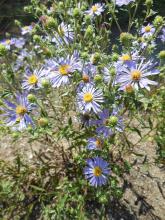
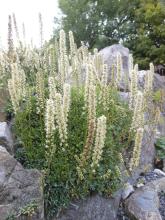
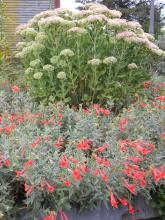
Tue, 08/28/2012 - 9:15amA pine barrens aster; Petrophytum caespitosum in bloom; and Zauschneria more floriferous than ever!
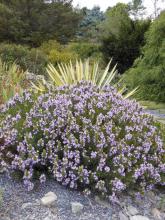
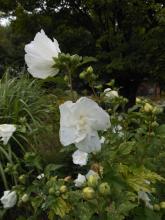
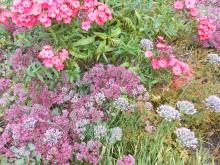
Satureja montana; Hibiscus syriacus 'White Chiffon'; and an Allium, Sedum, Phlox medley.
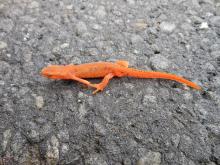
Suicide Newt! Either I interfered or this newt (eft) was lucky I was up early!
Lori S. (not verified)
Re: What do you see on your garden walks? 2012
Tue, 08/28/2012 - 10:43amAbsolutely glorious, Michael! :o :o
Would that be a red-spotted newt? So much for protective coloration... :rolleyes:
Michael Peden
Re: What do you see on your garden walks? 2012
Tue, 08/28/2012 - 2:41pmYeh; protective coloration not so useful in the automobile age. This will probably tell you more than I could from what I know:
http://en.wikipedia.org/wiki/Eastern_newt
They are quite common in the summer woods here.
Anne Spiegel
Re: What do you see on your garden walks? 2012
Wed, 08/29/2012 - 6:12amWonderful plants, Michael, especially the petrophytum with the zauschneria not far behind. The last is so welcome at this time of year.
Panayoti Kelaidis
Re: What do you see on your garden walks? 2012
Thu, 08/30/2012 - 9:09pmI shall be sure to collect lots of Artemisia filifolia this autumn--it is a very graceful plant. I am very fond of the Artemisias--probably because it was my mother's first name! And I like silver plants (and they like me). I am also very impressed with Michael's Petrophytum--I had some fabulous gnarly old specimens at my old garden, but this garden ithey are still a bit young (although four or five are bloomning). Still beastly hot here--but the cooler nights and shorter days seem to bring out a lot of autumn bulbs despite not having rain...Isaac, do take a turn West!
Panayoti Kelaidis
Re: What do you see on your garden walks? 2012
Fri, 08/31/2012 - 11:53amFinally downloaded some images...alas! Nothing alpiny. My rock garden does have a lot blooming, but not so photogenic apparently as the xeriscape.
1) a view of Westridge--my xeriscape dedicated to North American plants. Mostly wild sunflowers and the backlit tower of Giant Sacaton grass (Sporobolus wrightii).
2) Backlit young Cylindropuntia whipplei 'Snow Leopard'--vicious but indispensible
3) One of my many favorite Muhlenbergias, this one is M. torreyi (fairy ring muhly is the common name)--they are too young to form rings yet--but what a wonderful foil to the cacti! Artemisia filifolia in the background (again)
4) Salvias and annual Cleome serrulata on the xeriscape with morning backlight
5) A better shot of Salvia greggii 'Furman's red' with Nasella tenuissima behind it glowing.
6-9) are a series of shots of Lobelia fulgens x cardinalis, showing it in different angles and two different lights. This is one of the spectacles of the garden, and the other morning I woke up and saw a sunbeam lighting up just it, so I had to go and photograph it, and now you have to look at it! I love brilliant reds in the garden...
10) Aha! there is one more pic--this is our poor vegetable garden, almost completely draped in Ipomoea--Jan Fahs (my companion) refuses to weed it out--it is awfully lovely in the morning. But what about my veggies?
cohan (not verified)
Re: What do you see on your garden walks? 2012
Fri, 08/31/2012 - 2:51pmReally nice, Panayoti, especially with the morning light! I like the westridge a lot- I need to do something like this where I can make some larger plants happy, but have to pick a good spot for it, still struggling a bit with issues of scale and proximity between larger plant beds and rock gardens etc...
cohan (not verified)
Re: What do you see on your garden walks? 2012
Fri, 08/31/2012 - 3:02pmA few flowers from just under a week ago
Potentilla nepalensis Ron McBeath I have a couple of forms of this species now, and really like the flowers; this one I think I have sited a bit better, and the more upright plants around it (Veronica, Achillea etc) seem to be keeping it a bit more vertical. The other one I have (Miss Wilmott) is sprawled a couple of feet in each direction- I think it might be best planted under an open shrub..
Geranium himalayense The big flush of flowering is much earlier on our extensive patches of this, but there is occasional rebloom; this particular patch has been mowed twice- once after flowering and a couple of weeks later when my friend thought it was supposed to be mowed all the time...lol; The young foliage is perhaps nicer than the flowers, of which I really don't like the colour...
Echinacea- I'd have to go check the rest of the name; supposed to be white, not sure if it will ever get much past this stage this year.. I bought this as an end of season $1.00 plant some weeks back, it was still very healthy, with one bud which has very slowly got to this point..
Michael Peden
Re: What do you see on your garden walks? 2012
Fri, 08/31/2012 - 5:02pmWow! Let There Be Light! Wonderful images Panayoti! The sun never sets on the rock garden! Nice to see some proof of this theory.
cohan (not verified)
Re: What do you see on your garden walks? 2012
Fri, 08/31/2012 - 5:07pmIs this also Lobelia cardinalis, Michael? Equally striking in its natural setting! This is one I definitely need to test for hardiness :)
Trond Hoy
Re: What do you see on your garden walks? 2012
Sat, 09/01/2012 - 1:24amPanayoti, a beautiful Lobelia!
I am sorry but Lobelia cardinalis and hybrids doesn't like my climate :( Too wet in winter I suppose :-\
However I'm intended to try at my summerhouse.
Cohan, I like the colour of G himalayense flowers! ...and P nepalensis ;)
cohan (not verified)
Re: What do you see on your garden walks? 2012
Sat, 09/01/2012 - 11:54amThanks, Trond. I'm not sure if the Geranium colour comes through fully in my photos- I like violet flowers, or blue, or pink, but these are a kind of almost fluorescent shade I just don't like up close-one of the few flower colours I don't like (along with the funny muddled colours of hybrid daylilies and hibiscus :-X ) from farther away they are just 'purple' :) I think I've shown pics of the whole beds in flower? The P nepalensis I like a lot- this hot pink and the other is a mixed orangey colour..
I thought L cardinalis was a sort of swamp plant in nature? though I could be mixing it up with something else...
Trond Hoy
Re: What do you see on your garden walks? 2012
Sat, 09/01/2012 - 12:22pmNo you are right! But it doesn't seem to like the changing wet - cold - mild - wet weather here during winter.
Lori S. (not verified)
Re: What do you see on your garden walks? 2012
Sat, 09/01/2012 - 12:53pmFabulous plants, Panayoti!
Michael, with great rock gardens, as Panayoti and you both have, your saying is definitely true!
I lusted after Lobelia cardinalis for many years but don't recall ever having one winter over (or only weakly, if it did). First off, plants that were sold around here in those days that were named L. cardinalis were often actually hybrids of tender species, and seemingly doomed. Even presumably-true L. cardinalis from seed hasn't wintered over though. However.... if other people around here do find it to be hardy, I've love to hear about it (and so be encouraged to try it again!)
Michael J Campbell (not verified)
Re: What do you see on your garden walks? 2012
Sat, 09/01/2012 - 1:39pmFuchsia procumbens 'Wirral'
Fuchsia procumbens 'Wirral', flower detail.
cohan (not verified)
Re: What do you see on your garden walks? 2012
Sat, 09/01/2012 - 5:35pmThat's a pretty cool plant, Michael! Is it small? what sort of conditions do you keep it in?
Michael J Campbell (not verified)
Re: What do you see on your garden walks? 2012
Sun, 09/02/2012 - 1:51amIt is a creeping plant about two inches(5cm) high. At the moment it is in a pot as I am not sure how hardy it is yet, but I will try it out in the garden next summer.
Howey (not verified)
Re: What do you see on your garden walks? 2012
Sun, 09/02/2012 - 4:27amMichael - how on earth do you get it to bloom? I have had one (from a cutting from New Zealand) for several years in a pot - lots of foliage but only during it first year were there any blooms. It gets 20 20 20 fertilizer once a week in summer. It is in a "hanging" pot - perhaps it needs to climb? Have actually set up some string trellises for some of the non-performers and they look much better but now, with fall coming on and less daylight, it may be too late for blooms this year. Fran
Frances Howey
London, Ontario, Canada
Zone 5b
Michael J Campbell (not verified)
Re: What do you see on your garden walks? 2012
Sun, 09/02/2012 - 5:26amFrances, It is in a soil-less compost with slow release fertilizer. I wasn't aware that there was a problem flowering it, probably won't flower for me anymore now that I know. I will blame you if it don't ;D ;D ;D
fleurbleue (not verified)
Re: What do you see on your garden walks? 2012
Sun, 09/02/2012 - 5:56amA friend has said me than its variegated Fuschia procumbens flowered more and better than its green one. She keeps them in'doors during winter ;)
Trond Hoy
Re: What do you see on your garden walks? 2012
Sun, 09/02/2012 - 8:15amI had Fuchsia procumbens for some years in a pot (outside in summer, inside in winter) and it flowered sparsely. I decided to plant it out - shouldn't have done it. It disappeared, probably due to frost in winter.
Howey (not verified)
Re: What do you see on your garden walks? 2012
Mon, 09/03/2012 - 3:58amAfter reading about your F.procumbens, Michael, I went outside to have another look at mine and, lo and behold, there was one flower. Is there something about the air in New Zealand and Australia that creates flowers which do well only there?? I have the luxury of being able to winter over some of my plants in a greenhouse nearby and, in the case of this fuchsia, it didn't help. Although I suspect that the some of the plants that get the "greenhouse treatment" pick up more bugs inside that when they are outside - in summer, that is...something like our hospitals. Fran
Frances Howey
London, Ontario, Canada
Zone 5b
Howey (not verified)
Re: What do you see on your garden walks? 2012
Mon, 09/03/2012 - 3:41pmAfter this almost non-stop drought we've been having (and are still) this summer, it is heart warming to see some of the survivors- a couple of ferns, Adiantum pedatum and a Wood Fern, plus some nice Thalictrum rochbruneanum- not sure I can get them all onto this one e-mail. Up until the new growth appeared on the ferns, it looked like there had been a fire. Fran
cohan (not verified)
Re: What do you see on your garden walks? 2012
Tue, 09/04/2012 - 9:50amGood to see some survivors, Fran!
Trond Hoy
Re: What do you see on your garden walks? 2012
Tue, 09/04/2012 - 12:39pmFerns are remarkably drought tolerant! They can seem completely dessicated but revive when they get water. Th rochebrunianum is one of my favorits too!
Richard T. Rodich
Re: What do you see on your garden walks? 2012
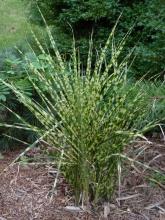
Thu, 09/06/2012 - 6:26pmMiscanthus 'Gold Bar' seems to be hardy in zone 4, at least for the last four winters... Not sure if it will ever get very big, though.
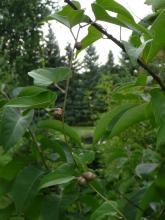
As is the Cinnamon vine (Discorea batatas) complete with bulbils, and climbing on a Meader persimmon.
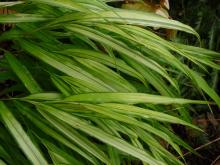
Three cultivars of Japanese Forest grass...
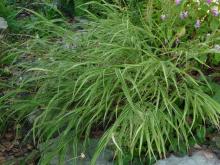
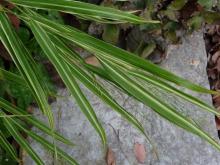
Hakonechloa macra 'Albo Striata'
Hakonechloa macra 'Aureola' and 'All Gold'.
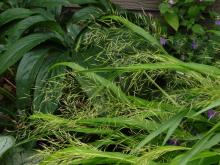
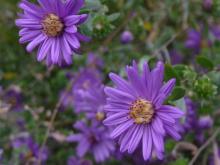
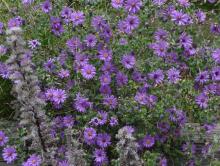
Aster sericeus. The second photo also shows the silver seed stalks of Echium russicum.
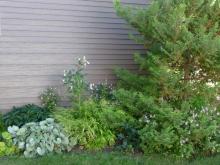
Part of a garden, showing Jeffersonia dubia, Brunnera 'Jack Frost', a couple of hellebores, Hakonechloa macra 'All Gold', a couple species impatiens (balfourii and glandulosa) and a cultivariant of Chamaecyparis pisifera 'Sulphurea Nana'.
cohan (not verified)
Re: What do you see on your garden walks? 2012
Thu, 09/06/2012 - 11:32pmSome nice colours and textures, Rick!
I can't quite tell from the photo, what sort of plant is Miscanthus- a grass?
The 'cinnamon yam' I think was said by Richter's Herbs to be hardy for at least one grower in z3 in Alberta; I killed one a couple of years ago, but can't quite remember how/why -- I don't think it was winter, maybe it took me too long to find a permanent spot for it and it expired in the small pot, long before winter...lol I'll have to try again when I have a spot pre-prepared! Do you harvest the tubers?
Anne Spiegel
Re: What do you see on your garden walks? 2012
Fri, 09/07/2012 - 4:41amRick, is the Miscanthus 'Gold Bar' a named form of Miscanthus zebrinus? I have the latter and they are remarkably similar. Miine is at the 5' mark and doing well. It seems hardy so far (4 winters, but not what I call normal winters as far as cold goes).
Richard T. Rodich
Re: What do you see on your garden walks? 2012
Fri, 09/07/2012 - 8:00amThe pic of the Gold bar miscanthus isn't very indicative of the genus. Most of the species cultivars normally grow 3-6ft. Gold Bar hasn't shown up here until the last several years, and I haven't seen any hardly any larger than mine yet. Certainly no flower heads. I use to have a few different kinds, but they take up so much room that I now only still have 'Flamingo'. It's kinda behind with the white fluff in the far right in this fall 2011 photo.
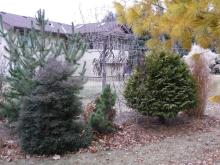
Zebrinus is a Miscanthus cultivar, too. Both come from Miscanthus sinensis, and Gold Bar is a section originating from M. sin. 'Strictus'. Zebrinus leaves are more than half green with yellow horizontal bands. Gold Bar is 50% or less green, with the remainder yellow, less vigorous, more compact, and shorter. Unlike Zebrinus, I am not even sure if it flowers. At least, you never seen pics of it flowering.
In my zone 4 climate, Zebrinus is hardy, but in some winters, clump will reduce severely. Consequently, division is seldom needed. With most miscanthus cultivars, plants must be divided every 3-5 years if you want to keep the size in check. Gold Bar is thought to be less hardy.
Lori S. (not verified)
Re: What do you see on your garden walks? 2012
Fri, 09/07/2012 - 8:07amRick, what are the trees you are showing in your photo above?
Richard T. Rodich
Re: What do you see on your garden walks? 2012
Fri, 09/07/2012 - 2:14pmPic taken 30 Nov 2011. From left to right:
Pinus sibirica
Chamacyparis
pisiferathyoides 'Heatherbun'Pinus strobus 'Densa'
(senna seed pods above)
Thuja occidentalis 'Warreana Lutescens'
Pinus strobus 'Wintergold' (foreground branch)
Lori S. (not verified)
Re: What do you see on your garden walks? 2012
Fri, 09/07/2012 - 6:26pmWow, very nice, Rick! The Chamaecyparis and Pinus strobus are especially striking!
I wonder if the Chamaecyparis would do OK here? Has anyone out there tried it?
I noticed that some sites refer to a cultivar called 'Heatherbun' (one word) as Chamaecyparis thyoides, an eastern North American species... a different plant from yours, I take it?
Richard T. Rodich
Re: What do you see on your garden walks? 2012
Fri, 09/07/2012 - 8:30pmI looked in the World Checklist of Conifers and you are correct, Lori, and the thyoides cultivar is what I have. Note that the official description is round-topped, which mine was for many years, and I had contemplated taking it out many times because of the bland outline, but never got around to it. After 13 years it is getting some character, and I like it much more.
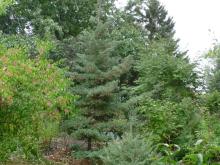
I have tried a couple other C. thyoides dwarfs here in zone 4, without much success. The tree is native to wetter areas in the east. Back in 1996 I bought a dwarf named Chamaecyparis pisifera 'Glauca Nana'. Well it was hardly a dwarf, and when it coned I discovered it was not that species at all, and was actually this blue form of C. thyoides (the tree). Every year it winterburns, and some years very severely, but it always recovers nicely. It kinda has an alpine look for us here in the "flatlands". Here it is in the center of the photo. Peaking up in the foreground is the Qinghai spruce (Picea crassifolia).
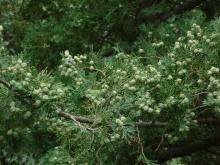
I neglected to comment on the Cinnamon vine. Four years ago someone offered me some bulbils in a trade. I planted them in a few places, and I only noticed them emerge in one area, and they didn't return the following year. I though I had lost them all. But now this season I found this one in a another of the places! So I am far from using it as a edible crop. I suspect the Apios americana I received this year will react similarly, as I have no constantly moist areas for it to be happy in. From what I here, that may be a good thing (!).
Trond Hoy
Re: What do you see on your garden walks? 2012
Sun, 09/09/2012 - 1:33pmChamaecyparis thyoides is hard to get here, however I grow several other of the genus. The problem is, they are no dwarfs any longer! Neither are the other conifers I have.
Cunninghamia lanceolata has no hurry but has reached almost 3m now. Metasequoia glyptostroboides is far quicker. I can't see the top any longer although the stem is very slender. Also the Sciadopitys verticillata has increased the growth speed and is 4-5m tall and very slim. The picture lies. (The dead tree is a birch I have killed - it was getting too big)
I got this redwood (Sequoia sempervirens) as a cutting some years ago. Wonder how it looks in 1000 years :o Taxodium distichum isn't yet like those I encountered in Florida! The Wollemi pine (Wollemia nobilis) is my last acquisition (from Kew Garden). This Aussie has survived 2 years outside till now!
Had a walk in a forest of Monkey Puzzle trees (Araucaria araucana) in Bergen last week!
cohan (not verified)
Re: What do you see on your garden walks? 2012
Sun, 09/09/2012 - 3:42pmSome nice trees, Rick and Trond! I have very few spots where I'd like to plant anything taller than about 5-7m. I did stick a few Acer rubrum seedlings in the edges of the natural forest here, and have a couple spots where native birches are dying that I might be able to put something- I have seeds of Honey Locust (I think? forgetting the Latin just now.. seeds are a few years old, hoping they'll still germinate...),, there are no pea trees at all here- I don't count Caragana arborescens as a tree, regardless of what the specific name says, and wouldn't want it on my acreage...
Mark McDonough
Re: What do you see on your garden walks? 2012
Sun, 09/09/2012 - 5:56pmThis is my favorite topic on the forum, so many good things to see and learn about here. I can't tell you all how many times I started to prepare a posting here, then ran out of time and thought to myself "I'll post something next weekend", and on and on it goes.
So here are some garden walks scenes from last weekend and this weekend.
Left: garden scene with one of my selected Epimedium hybrids that has red leaves all season long, brighter red in late summer. Pulmonarias and Corydalis lutea surround.
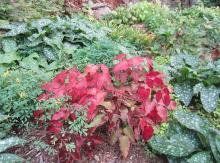
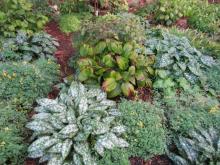
Right: great late summer foliage on Pulmonaria seedlings, red-brown tinged leaf tips on Cypripedium parviforum var. pubecsens.
Left: Gentiana clausa, regular blue form, from along the Nashua River about 1 mile from my house. In cultvation, it grows larger and more floriferous.
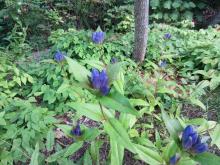
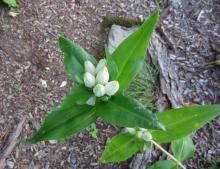
Right: Gentiana clausa alba, a robust white form, now a mature plant 30" tall x 30" wide, each stem with 4 verticillasters or whorls of bloom.
Left: Kirengeshoma palmata is still going strong, although foliage got tatty with 6 weeks of drought. The flowers are a late season delight.
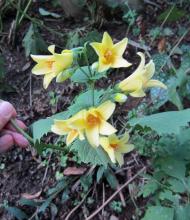
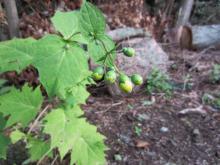
Right: Kirengeshoma koreana, planted as a perennial nursery fine last year, is still small, less that 2', with enlarging yellow egg-like buds that have stayed as buds forever, and the first thick waxy bloom opened today (my photo is from last weeks while still in bud). I wonder is this species will stay smaller, it certainly is much later blooming.
Left: Ariseama seed fruits are setting, this one in an impressive extra-robust form of Arisaema triphyllum x tashiroi.
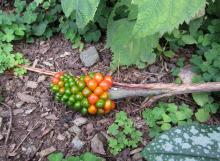
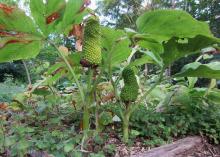
Right: Two seed cones on Arisaema sikokianum, still green and maturing, amazingly surviving the fall of an ancient massive Sugar Maple just 2 meters away and surviving the trampelling of two tree cutting crews to do the cleanup.
Left: Agastache - 4' tall hybrids from High Country Gardens that have been in splendid full bloom for months.
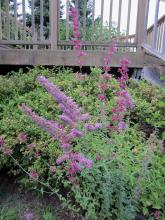
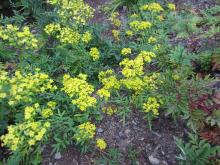
Right: Patrinia rupestris, all those that were planted on enbankments seeded into low-lying paths, for more moisture perhaps, very pretty toothed foliage and abundant yellow flowers late in the season.
Richard T. Rodich
Re: What do you see on your garden walks? 2012
Sun, 09/09/2012 - 8:35pmThat's the thing about dwarf woody plants, Trond. They may be half or less the normal size, but they never stop growing. You're showing a lot of interesting normal sized species, and I never tire of that most excellent Sciadopitys. :o And those Monkey Puzzle trees are AWESOME !!!
I've heard that the Wollemi pine isn't taking to human cultivation very well in general. A lot of individual growers (not production growers) seem to be having problems. Kudos to you, Trond!
Honeylocust (Gleditsia triacanthos [inermis]) are nice trees, and with the "no leaf raking" in the fall, I've wondered why they are not chosen more. Nectria canker is supposedly a problem, but not in my area.
My neighbor just had an old River birch removed. I was kibitzing with him while the deed was being done, and ended up having the guy come over and remove my big Green ash. (With the Emerald Ash borer only 40 miles away and closing, it's only a matter of time before it dies anyway.) Now I have a rare opportunity: room for another full size tree!
Mark, that red epimedium is a show stopper. It might be too red for me, but I can see how the general public would go ga-ga over it! I was at another chapter member's garden last week; their kirengeshoma was seven naked sticks. Mark, those Arisaema sikokianum fruit heads are enormous! :o I grew some from seed once. For reasons unknown, they all succumb the third winter. Wouldn't mind trying again sometime...
Did I mention yet that my Agastache aurantiaca (planted in 2011) never returned this year? I hadn't cut it back at all for winter, as per your advice.
Todd Boland
Re: What do you see on your garden walks? 2012
Tue, 09/11/2012 - 5:27pmGreat show Mark! Rick, I am really taken with the Aster sericeus...and all those conifers are stunning. I have a few 'dwarf' chamaecyparis which are no longer so dwarf as I like! Money puzzle have been tried outside here but only survived one winter, and that was with lots of protection.
Just survived Tropical Storm Leslie...hit here this morning with 75 mph winds...lots of fallen trees all over the city and I lost electricity for 11 hours. My garden was spared thankfully but I have yet to see the damages at our Botanical garden...tomorrow will reveal all.
Anne Spiegel
Re: What do you see on your garden walks? 2012
Wed, 09/12/2012 - 4:16amJust a few things in the garden. Zauschneria has started blooming in a natural crevice on the back side of the cliff. Seeing that makes all the work cleaning out the crevices and preparing them worthwhile. In the upper crevice garden daphne and astragalus are reblooming.
Panayoti Kelaidis
Re: What do you see on your garden walks? 2012
Wed, 09/12/2012 - 5:12amYour Zauschneria, Ann, looks like a form of Z. californica. You must obtain Z. garrettii which starts blooming much earlier (June here--and still in bloom!)...Our astragalus are long done blooming--it has been terribly dry, although the rain has been steady today finally after a month and a half of no rain...aaaah!
Your garden, Mark, must be awesome! I really hoped I'd get to Boston in July, but didn't work. Maybe next year?
Pages