
[Moderator's note: We have been a bit remiss at splitting this off into a new thread for 2012, but here it is, finally!
Lori]
A mix of things flowering or looking interesting in the garden at the moment. The garden is waking up with hellebores and many bulbs soon to come.
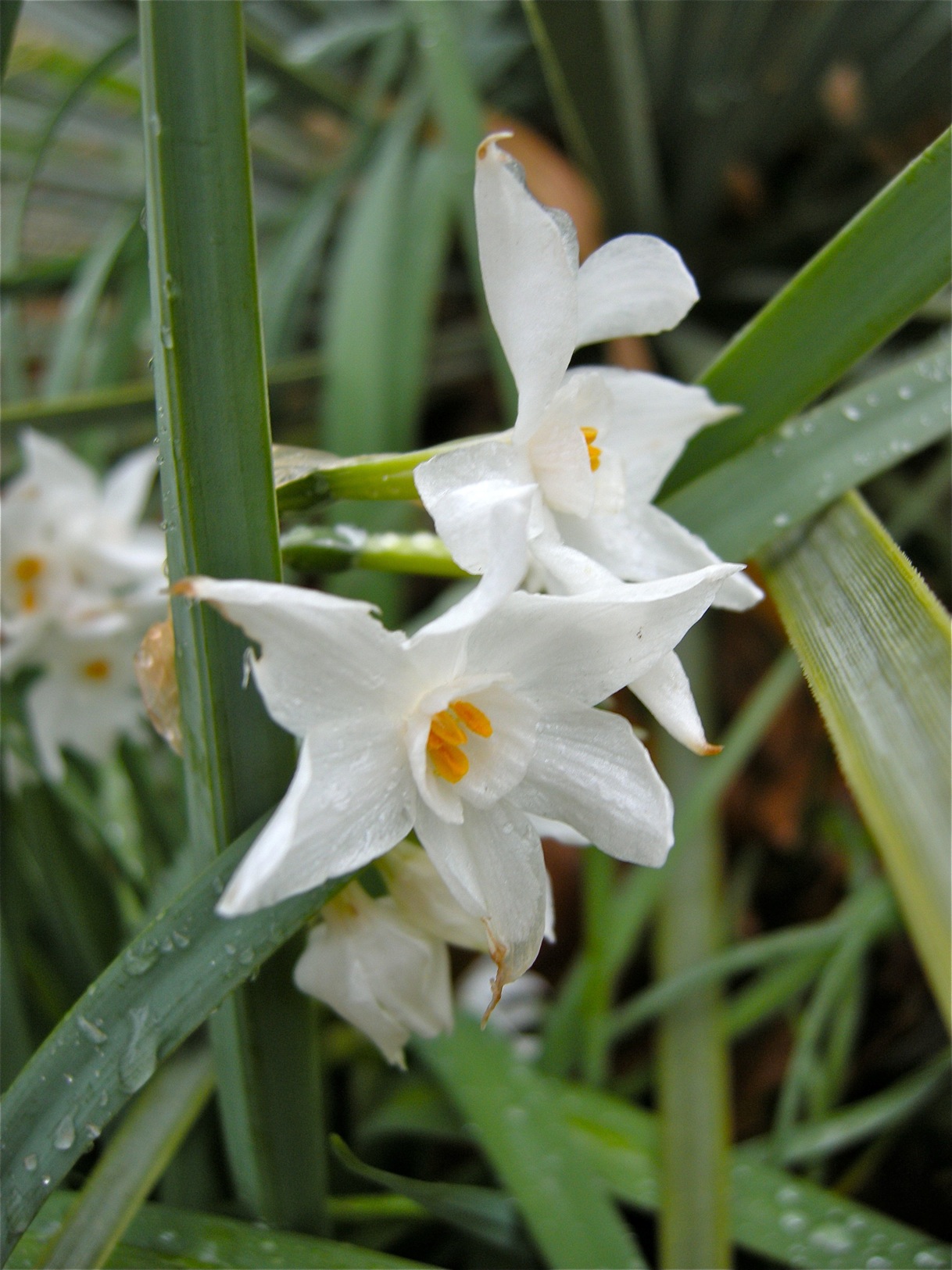
Narcissus panizzianus grown from Archibald seed. The flowers are small but always very early.
Muscari pseudomuscari, ditto. This is a lovely tidy species, growing here with a selection of Cyclamen hederifolium.
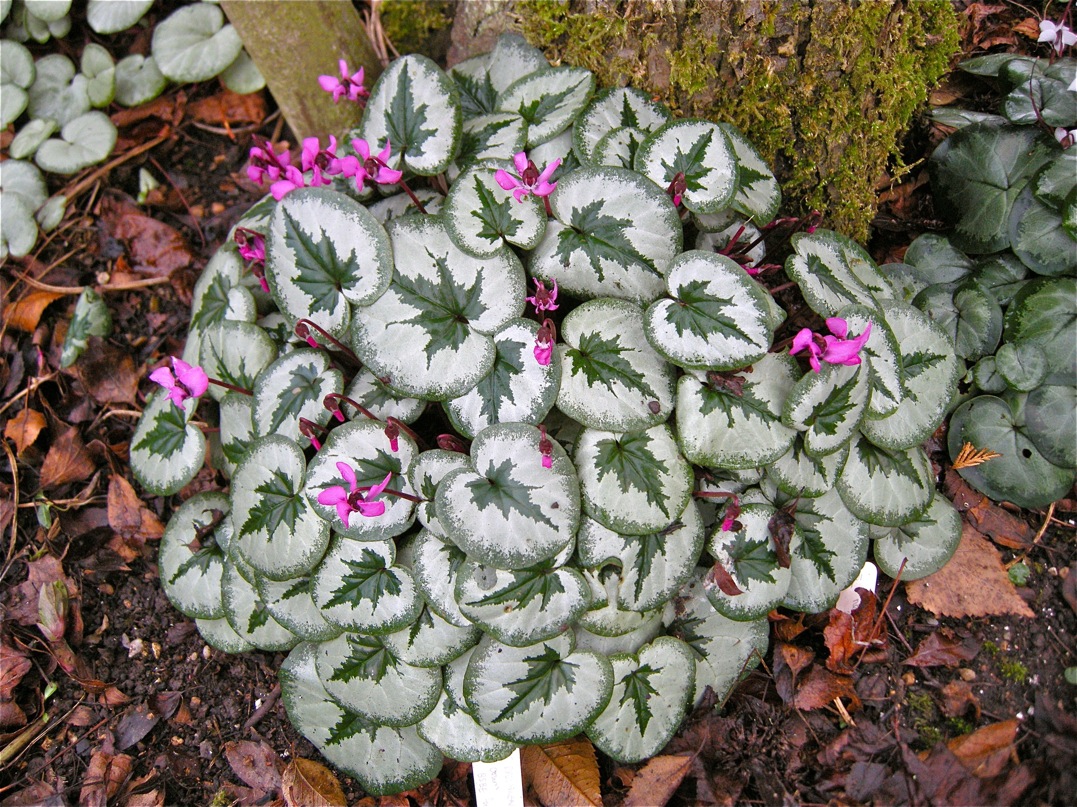
Cyclamen coum. Two forms with very silvered leaves from Tilebarn Nursery.
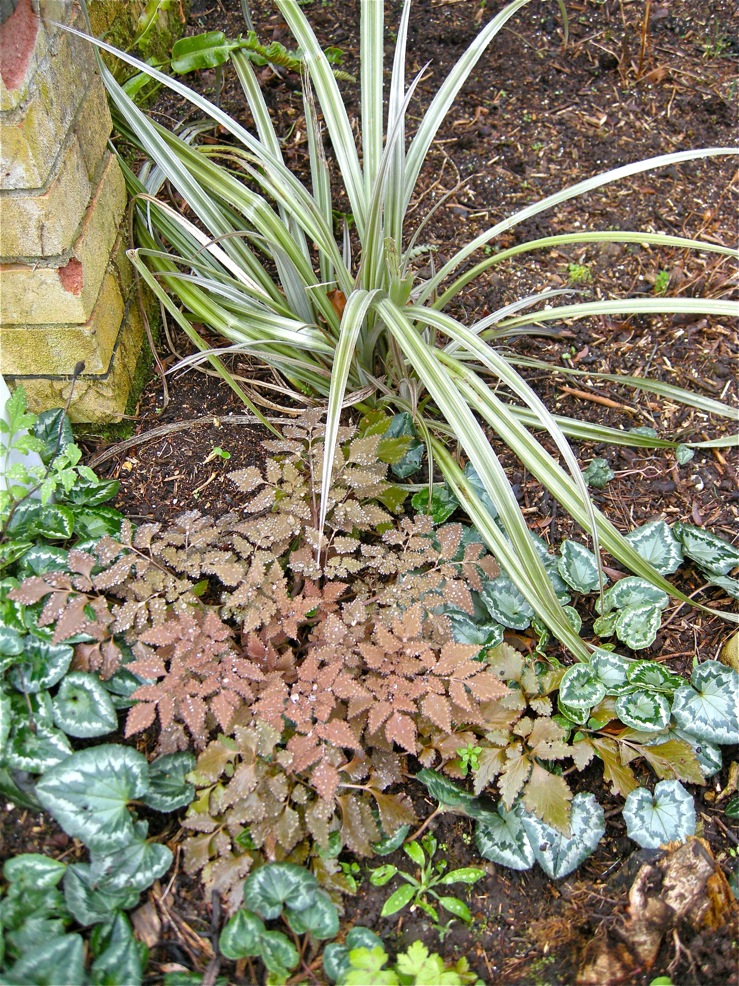
Corydalis quantmeyeriana 'Chocolate Stars' growing with cyclamen and Astelia nervosa. The corydalis is new to me and I haven't yet seen the flowers, but what foliage! I rather like this combination.
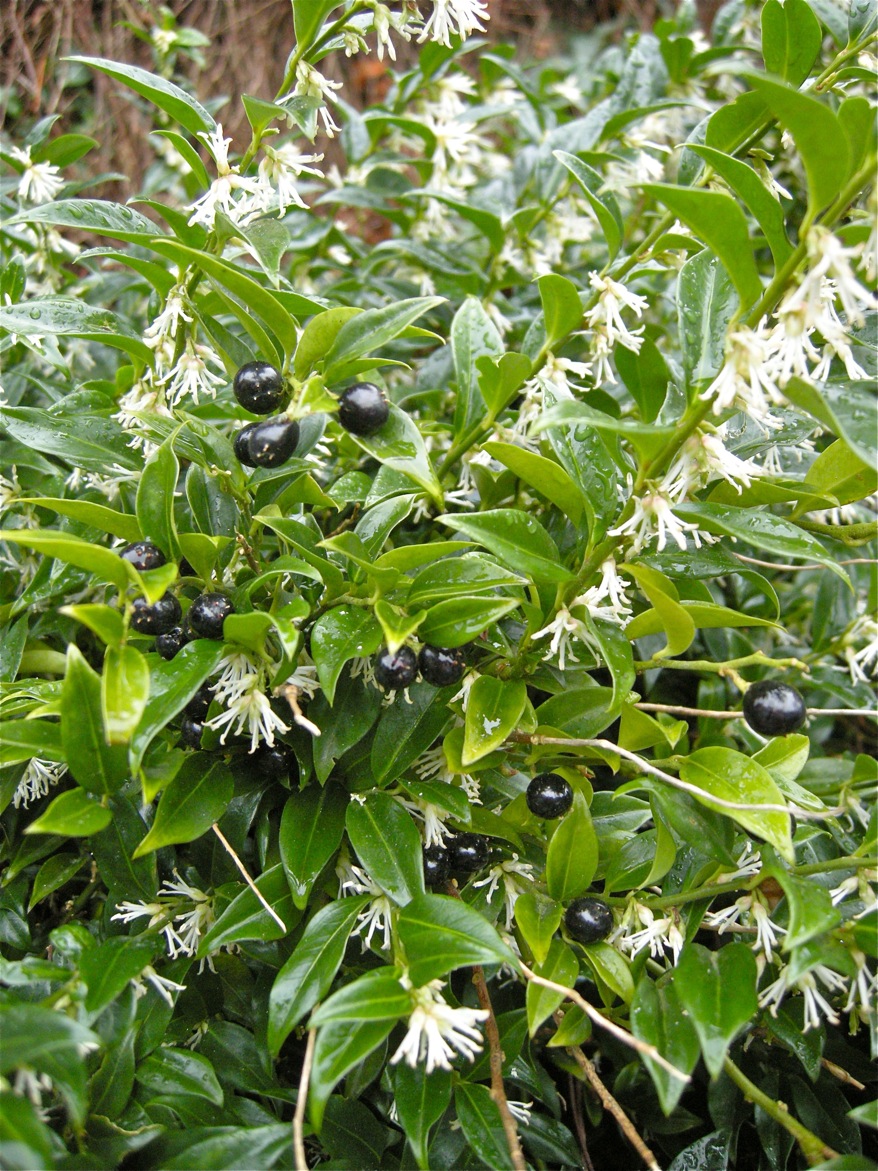
Sarcococca confusa. An unassuming shrub but one of the most delightful and scented winter flowers, and usefully tolerant of dry shade.


Comments
Trond Hoy
Re: What do you see on your garden walks? 2012
Mon, 08/13/2012 - 3:42amLots of goodies, Panayoti! I wouldn'tmind growing that Opuntia ;)
Congratulation with growing peaches, Bundraba! What's the flowers like on that Oxalis?
Tim, when I get time I will pay your redeveloped nursery a visit! It looks, and so does your garden, terrific!
Anne Spiegel
Re: What do you see on your garden walks? 2012
Mon, 08/13/2012 - 8:41amTim, that riased bed looks full of promise. Please keep posting pictures as you develop it.
cohan (not verified)
Re: What do you see on your garden walks? 2012
Mon, 08/13/2012 - 11:55amPanayoti - I forgot to comment on the white 'fluffy' mass behind the Salvia- in thumbnail, I thought it was composite seedheads, but full size I realised there must be a cactus under all that white!
Congrats on the peaches, Michael! Lots of fungi here this time of year, too..
Tim- good luck on the project to educate local gardeners- even in places in North America with totally unsuitable climates, people still try for the cliche of the English garden, I suppose within Britain there must be a real struggle to get the average gardener to break the mould? On the other hand, there does seem to be a real gardening culture there, so maybe people will be more adventurous :)
Trond, beach people are so boring...lol the Eryngium is very nice!
Michael Peden
Re: What do you see on your garden walks? 2012
Tue, 08/14/2012 - 5:33pmTrond, if Oxalis decaphylla blooms, I'll try and remember to get a photo posted.
Gentiana farreri (ex 'Alex Duguid') begins bloom in August. Bupluerum spinosum is new to the garden and Silene schafta gives us pink.
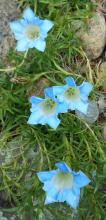
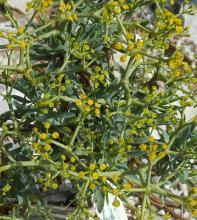
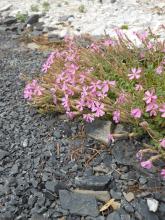
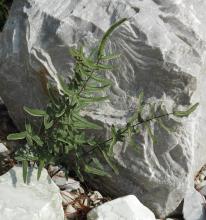
A small Sphaeralcea from the San Mateo Mountains and another great rock fern: Pellaea atropurpurea.
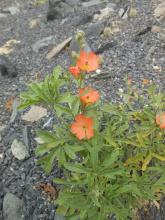
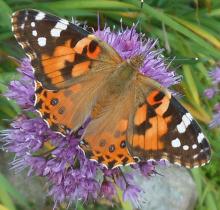
There's been a lot of these Frittilary butterflies this year
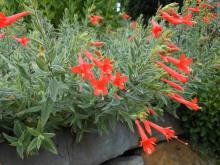
Epilobium canum ssp. 'garretii' (Zauschneria)
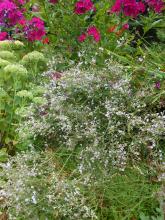
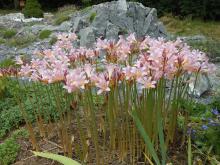
I thought Limonium vulgare(?) might go well with these Phlox: and more Lycoris!
cohan (not verified)
Re: What do you see on your garden walks? 2012
Tue, 08/14/2012 - 6:44pmAll nice, Michael- great shade on the Silene;
The Lycoris is a bit of a surprise, not that I know that much about them, but had thought they were only hardy to z6 or so...
Trond Hoy
Re: What do you see on your garden walks? 2012
Wed, 08/15/2012 - 1:47amYes please!
You still impress, Michael! The butterfly is nice too. Similar to one flying here now.
I'm impressed by the Lycoris too. Seems not to be on sale in Europe, anyway I haven't found any sources. Do they set seed?
Panayoti Kelaidis
Re: What do you see on your garden walks? 2012
Wed, 08/15/2012 - 7:45amWhat great pix you all have: can't wait to visit your garden, Tim! You grow so many plants I love (and have either lost or merely long for)...and as for YOU, Mr. Michael Peden, your cursed garden puts botanic gardens to shame: are you sure you do not have a staff to help you? Love your Southwestern Oxalis (could be O. grayi?)...I have not succeeded with this and thought it might be tender...WRONG! eh?
Cohan: that white cactus is Cylindropuntia whipplei 'Snow Leopard'--commonly grown in Denver. it can get massive (over a meter tall and across) and it's vicious. But stunning too!
The Veratrum formosanum is essentially a micro-V. nigrum, mine are very dwarf--mostly under 15"...but I starve and torture my plants. In a more typical garden where they have richer soil and moisture it can get twice as big--but still svelte and manageable (unlike most Veratrums). The black color is super: I got my first plants from seed from Jack Elliot, but Beaver Creek has listed it...well worth the investment!
The weather is mercifully cooling just a tad, and the plants show it: lots in bloom. This is my first installment:
1) My waterfall bog bed with Solidago I should remove and Lobelia cardinalis starting up: hot yellow and red is a combo I enjoy.
2) Clematis hexapetala--this taken at DBG. Mine are finished blooming. The most spectacular herbaceous clematis from Mongolia. It's been blooming two months.
3) Hosta clausa--the strangest of the genus with NO basal rosettes...love that dark color! At DBG
4) A miniature Hosta (couldn't find the label...will seek it out if need be) at DBG--love these little ones.
5) Impatiens are horrible weeds, especially this I. balfourii--but I would hate to be without them. There is always a woodsy corner to tuck them into...
6) This is my favorite Impatiens, I collected it in Pakistan in 2001: just as weedy as the preceeding, and even more distinctive co
7) Jovibarba heuffellii 'Hot Lips' growing to enormous heights at Denver Botanic Gardens. One of my faves.
8) A smaller J. heuffellii--looking almost snake-like
9) Ligularia (I believe 'Desdemona') in our Asian garden: amazing it looks so good after two months of colossal heat...but we do water the bejesus out of things there!
10) Our last big clump of Silphium perfoliatum in the Cottonwood border at DBG (removed elsewhere due to massiveness and spreading): a great spectacle when in bloom--love it but don't have room for it in my garden, alas!
Michael Peden
Re: What do you see on your garden walks? 2012
Wed, 08/15/2012 - 9:05amThat may be going just a bit far Panayoti! And; no staff just clever camera angles! the Oxalis goes under ground for the winter (it's very late up too), thus none of the winter burn that might normally affect many other plants from that region. For example, I have a small birch leaved Cercocarpus that barely survived last year's mild winter. That said, those mountain meadows down there must get pretty chilly. I observe that the summer "heat zone" as mapped for the mountains north and east of Phoenix is the same, or nearly so, as ours here. I've been messing around with Agaves too. These surprise me! I'll get a photo or two for one of these posts. Is your Hosta "stilletto"? This wouldn't qualify as a miniature in my garden but the flowers are excellent. I don't collect the miniatures but have accumulated a few. They are cute but I'll refrain from posting a lot of slug damage here; unless y'all really want to see it :)
Trond; like the Daffs and Snowdrops I have; no seed on Lycoris to date; and those clumps are pretty old.
cohan (not verified)
Re: What do you see on your garden walks? 2012
Wed, 08/15/2012 - 11:15amPanayoti- I thought that might be a Cylindropuntia but wasn't sure --definitely impressive! These are among the few plants that really give me zone envy- there are tons of other plants that will grow here, but I will never have those sorts of cactus displays (there are lots that will grow here, but nothing at all tall)..
this is the Veratrum Alplains lists: Veratrum formosanum (Melanthiaceae) (70x30,Z5,P,C,3:8w) ............................................ 30 seeds / $4.00 30854.01 Ex Nantou, Taiwan, 3000m. Almost unknown to horticulture is this fantastic, late-flowering relative of the Lily family with drooping spikes of numerous deep purple-black flowers over quickly-clumping, grass-like foliage. Usually starts blooming by its third year from seed.
One I'd like to try sometime- on the endless 'list'..lol
Richard T. Rodich
Re: What do you see on your garden walks? 2012
Wed, 08/15/2012 - 2:45pmPK, those are very healthy Cup plants. They don't look like they are in a very moist place, which I thought they needed. Are they?
I wondered if that was an old patch of Lycoris, Michael...
I thinned mine last year for the Chapter sale, but they seem to be doing well. They always look like they will produce seed, but I've always cut them down before they have a chance. I'll let some go this time, and see what comes up for you, Trond. ;D
Trond Hoy
Re: What do you see on your garden walks? 2012
Thu, 08/16/2012 - 10:33amThat's kind of you, Rick :)
I had to buy this Penstemon, it was named Penstemon 'Rick R' ;D
cohan (not verified)
Re: What do you see on your garden walks? 2012
Thu, 08/16/2012 - 10:38amRick- another person growing Lycoris in z4- clearly my idea they were z6 was mistaken ;D
Good find, Trond- both for the name and colour :)
Trond Hoy
Re: What do you see on your garden walks? 2012
Thu, 08/16/2012 - 12:47pmMy garden is not particularly well-tended at the moment due to our long absence but some plants do bloom anyway.
I have several Clematis and many are flowering at the moment, Clematis (forgotten name), C x jouiniana 'Praecox', Francoa appendiculata (the main flower stem finished for the season), and a untidy corner with a mophead Hydrangea and an Anemone.
The Lonicera periclymenum is a weed but have showy flowers and a very pleasant fragrance, here the cv 'Serotina', a Malva struggle through the dense growth of weedy plants - notice the bindweed, the fern Osmunda regalis, the new growth of Rhododendron bureavii is almost as good as its flowers.
cohan (not verified)
Re: What do you see on your garden walks? 2012
Thu, 08/16/2012 - 2:22pmNice to come home and find lots of things in flower :)
Richard T. Rodich
Re: What do you see on your garden walks? 2012
Thu, 08/16/2012 - 5:04pmRemember guys, only Lycoris squamigera is fully zone 4 hardy. Other Lycoris not so much. I've had a couple L. chinensis that I've missed digging come through, but not happy looking. And Lycoris radiata survives here for 7 years so far, but never adapting. They come up in the fall, get frozen back, and limp along into the summer. Leaves never surpass a pitiful 5 inches and they don't look that happy. They apparently are cold hardy enough, but never amount to anything.
Michael Peden
Re: What do you see on your garden walks? 2012
Thu, 08/16/2012 - 5:34pmIdyllic late summer: There's a lot of "fade". Iris have stopped growing, Daylily leaves are tinged with browns and yellows, the air is still and thick but not uncomfortably so. There is a lot of rot in some of the "alpines" -this is unfortunately normal -but I really like the scene in the garden now, composed of only a few plants, but so glorious; the slow turn-over into autumn! The blues in Platycodon and Gentiana add a touch of magic but they must be sought by the eye in this garden right now as they are not common.
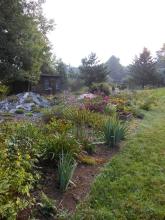
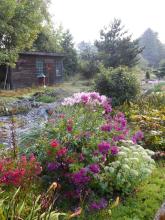
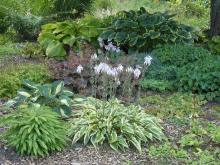
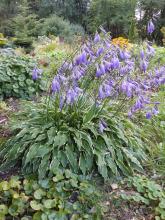
An expanded view of My Little Shade Garden and an excellent Hosta for flower color; H. 'stilletto'.
Tim Ingram (not verified)
Re: What do you see on your garden walks? 2012
Fri, 08/17/2012 - 12:36amVery nice shade plantings with the hostas. Do you not have slugs in the garden?! By this time in the year we are normally very dry (naturally and due to too many woody plants), so many late flowering perennials struggle. I give the alpines on the sand bed a good soaking every now and again...
Lori S. (not verified)
Re: What do you see on your garden walks? 2012
Fri, 08/17/2012 - 8:33amAll those beautiful plants and plantings, Michael, and peaches too! I never would have thought that was possible in zone 4.
Heck, I'm amazed at Lycoris squamigera being hardy... must give them a try now.
Wow, nice penstemon,
RickTrond - it is an amazing colour.(Hey, knowing that you are a lover of language, note that that plant will give you the chance to use the word "eponymous" ;D ;D... a rare enough opportunity!)Trond Hoy
Re: What do you see on your garden walks? 2012
Fri, 08/17/2012 - 10:07amSeems I should try any Lycoris I come across!
Michael, my favorite time of the year is the spring although all the other seasons have their charm too ;) Have to look for Hosta 'Stiletto' too ;)
Have been warm and dry for some days. However I don't need to water the garden but a few pots.
Bacopa 'Blue Shower' and an Agapanthus
Mark McDonough
Re: What do you see on your garden walks? 2012
Sat, 08/18/2012 - 3:24pmRick, did I miss previous mention of Penstemon 'Rick R'? Please tell us about it, the color is amazing!
Lori S. (not verified)
Re: What do you see on your garden walks? 2012
Sat, 08/18/2012 - 3:38pmOoops, sorry! I think I have caused everyone to go astray - I just backtracked and realized it was Trond who bought Penstemon 'Rick R', not Rick! :-[ Scratch my comment about using the word "eponymous"... unless you can come across that one, Rick. Any idea of the heritage of that penstemon, Trond?
cohan (not verified)
Re: What do you see on your garden walks? 2012
Sat, 08/18/2012 - 3:44pmMichael- your garden looks as dreamy at this time as ever :) I'm especially happy to see the larger views, since I am just now thinking about how far to space regular perennial beds from raised rock beds, and have not yet come to any conclusions (except that I have one that is way too close, since the Achilleas are flopping over onto the edge of the rock garden...lol) Anyone else that has shots that show how the two types of beds relate to one another in your landscape, I'd love to see!
Tim, always nice to see your sand bed-- not dry here, although we are having some warm sunny days, after tomorrow, the whole week has 30-70% chance of rain again...
Trond- nice blue on the Bacopa- is that an annual or can you overwinter it?
Trond Hoy
Re: What do you see on your garden walks? 2012
Sun, 08/19/2012 - 11:56amLori, I wondered who you talked to and what you talked about ;D
I can't find the label although I am sure I put it somewhere. I think it was Penstemon superbus 'Rick R'. I'll report on hardiness next year!
It is a perennial although I assume it is difficult to overwinter inside. I'll try though.
Richard T. Rodich
Re: What do you see on your garden walks? 2012
Sun, 08/19/2012 - 12:09pmYou just won't stop the charade, Trond! Fun, but I'm on to you, though... ;D ;D ;D
I thought that bacopa was extra nice, too. The white form has been around for decades here, but only now is it catching on with the general gardener.
Trond Hoy
Re: What do you see on your garden walks? 2012
Mon, 08/20/2012 - 12:59pmI'll shut up now, Rick!
It's the second flush on that Bacopa. It flowered in June and beginning of July and had a break in late July. Then started again in August!
Todd Boland
Re: What do you see on your garden walks? 2012
Mon, 08/20/2012 - 2:44pmBeen a while since I stepped in...been too busy to breathe this summer. Here are a few Gentians which are currently open. G. decumbens, G. macrophylla and G. walujewii var. kesselringii
Todd Boland
Re: What do you see on your garden walks? 2012
Mon, 08/20/2012 - 2:45pmA couple of alliums....good ole A. flavum and A. togasii
Mark McDonough
Re: What do you see on your garden walks? 2012
Mon, 08/20/2012 - 5:19pmMMMmm, I like each and every one of those Gentians! But I particularly like the light blue blooms on the last one (G. walujewii), contrasting with the spotted yellowish centers and brownish-purple tipped buds.
In my garden, it would be impossible for Allium flavum and A. togasii (also spelled togashii) to bloom at the same time, A. flavum blooms starting the end of June into July, and togasii starts late August and into September, your season must be very contracted to have them bloom together.
Richard T. Rodich
Re: What do you see on your garden walks? 2012
Mon, 08/20/2012 - 7:32pmThat light blue gentian is also my favorite.
How it comes up with that arrangement of open blooms is a mystery to me.
cohan (not verified)
Re: What do you see on your garden walks? 2012
Mon, 08/20/2012 - 10:49pmNice Gentians, Todd, I like A flavum, too..
Todd Boland
Re: What do you see on your garden walks? 2012
Tue, 08/21/2012 - 3:21amDelphinium grandiflorum..amazed the slugs missed this one! Blooming first year from seed. Inula rhizocephala..slugs DO love the blossoms. Guess blooming the first year from seed means its monocarpic. And my newest addition, the hardy Impatiens omeiana.
Anne Spiegel
Re: What do you see on your garden walks? 2012
Tue, 08/21/2012 - 5:30amTodd, I've grown Inula rhizocephala before, but don't recall it having much longevity and I was away when it produced seed. How long has it lasted for you? Should you ever have extra seed, please think of me.
Todd Boland
Re: What do you see on your garden walks? 2012
Tue, 08/21/2012 - 7:43amMy understanding is that Inula rhizocephala is monocarpic....I have two plants...one blooming, the other appears to be waiting until next year. I saw it first in Lori's garden...maybe she will comment in regards to how long her's lived.
Lori S. (not verified)
Re: What do you see on your garden walks? 2012
Tue, 08/21/2012 - 10:34amI've actually had Inula rhizocephala last for multiple years (I'm guessing ~3? - not a long time, but not monocarpic though) as well - that was with the original plants I had out along the sidewalk in regular soil. I also heard one account of it being perennial here in another garden. The plants I later put in phase 1 of the tufa garden did act as monocarps... not sure if that was due to excessive moisture in that area (a low spot, underlain by rich soil).
cohan (not verified)
Re: What do you see on your garden walks? 2012
Tue, 08/21/2012 - 11:27amGreat looking Impatiens, Todd!
Todd Boland
Re: What do you see on your garden walks? 2012
Tue, 08/21/2012 - 1:23pmI have a blooming mystery Aquilegia. Sown from seed this year as A. parviflora but while the flower is minute, it is not that species. I cannot find anything in Nold's book that comes close. I am thinking a hybrid between viridiflora and one of the canadensis types, based on size and shape.
Michael Peden
Re: What do you see on your garden walks? 2012
Wed, 08/22/2012 - 4:06pm:( I'll apologize in advance for this rather blighted post. It may not be suitable for all audiences.
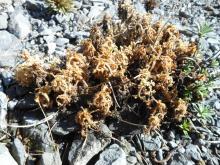
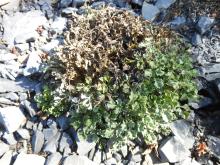
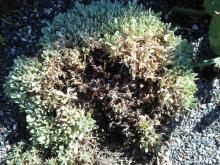
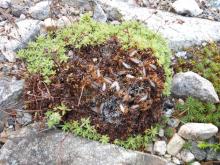
Erigeron compositus, Centaurea simplissicaulis, Eriogonum flavum 'xanthum': The fungus/mold fibers were quite evident on the last. below: Are these ants (termites) foraging on the fungus that attacks alpines? They are pouring out of this blighted cushion of Saxifraga bronchialis. Some plants survive the fungus period. Others do not. In some cases I'm able to out fox or out propagate the attrition rate or, at least, it seems to seem so.
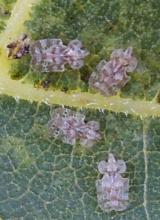
The Psylid (on sunflower leaf) that makes growing the Aster family (most) an ugly challenge in my garden. There have been curious, usually brief, exceptions.
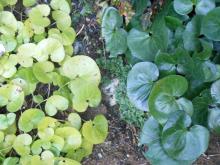
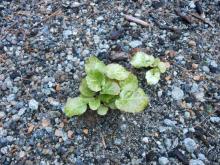
Finally here is a conundrum, one of many we face. These Asarum europeum are growing side by side. In the second photo; Shortia galacifolia planted in my experimental "New Sand Barren". Some green is beginning to creep into the sickly yellow leaves. I've been applying a gravel and crushed stone (feldspar?) as well as some peat to the barren sand. The yellowing might be due to excessive nutrient (and magnesium) in the soil or other imbalance.
I do see this stuff on my garden walks.
Michael Peden
Re: What do you see on your garden walks? 2012
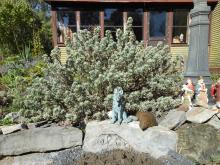
Wed, 08/22/2012 - 5:24pmA rare instance: This sage brush (Bighorn Mountains, 2004) seems less prone to Psylid attack than many other plants on the garden. I think its the pewter shepherd dog!
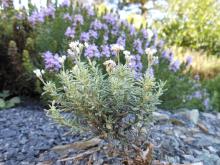
Here's a nice little late blooming buckwheat backed by Satureja montana.
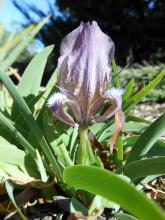
The odd flower on Iris suaveolens 'rubromarginata'.
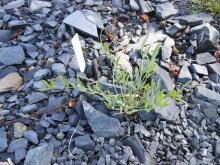
Three little Western peas grown from 2009 seed. They will all bloom gloriously next year of course. The third is an orophaca and (all/any) up there pretty high on my "must grow" list.

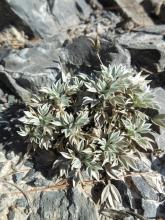
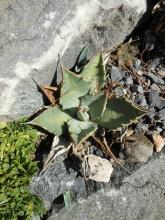
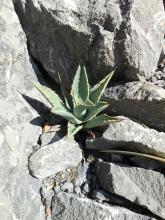
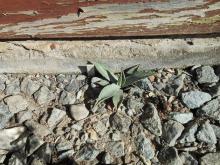
Three agaves that survived last winter. The last, planted right at the south foot of my house has come through two winters. Note two tiny pups off of the first. It is planted in a crevice pocket with probably scant root run due to construction. I consider these a horticultural stunt to trump sage brush but a fun idea! They are: First is from SW New Mexico at 8500' or so (estimate). The other two hail from central Arizona (8000' estimate). The Arizona population seems just a bit tougher. I've just now obtained another try at A. utahensis which grows yet farther to the north and west.
Anemonopsis macrophylla
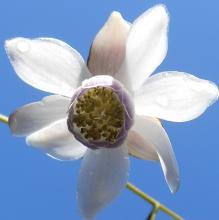
cohan (not verified)
Re: What do you see on your garden walks? 2012
Wed, 08/22/2012 - 11:06pmMust be a pain to lose so much growth on slow-growing plants!
I've never heard of that pest on Asteraceae :o
Nice to see the other set of plants still thriving- great sage brush, and the Agaves are looking good, what species are they?
Michael Peden
Re: What do you see on your garden walks? 2012
Thu, 08/23/2012 - 3:26pmI've been aware of this pest in other gardens, even in other parts of the country, but seemingly not so bad as here, which really makes me wonder if growing conditions contribute to the problem: The plants may have a defense, but if it isn't available to them via the environment, they are lost. In your case, Cohan, I suspect the lack of certain pests might have something to do with that -49 degrees you post. That would probably deter me!
Unless the splitters have been busy the Agave is still A. parryi.
cohan (not verified)
Re: What do you see on your garden walks? 2012
Fri, 08/24/2012 - 2:49pmProbably the cold winters help with some pests- though you'd never know it by the bazillions of bugs in general- and they are out before the snow is gone (though maybe its the large number of bugs that keep pests limited)! To be accurate, though, I've never seen that -45C-49F in person, its just a record low, usually nothing lower than -40C/-40F and not always that even. Nonetheless, there are some days in mid-winter when I find it hard to believe that anything- animal or vegetable- can still be alive out there!
Interestingly, there has been a need for sub -40 winters to slow the eastward spread of pine beetles (not right here) and we just haven't had much of it. Last I've heard, though, the beetles have slowed a bit for some other reason....
Richard T. Rodich
Re: What do you see on your garden walks? 2012
Fri, 08/24/2012 - 7:14pmScilla scilloides is putting on a much better show this season compare to recent years.
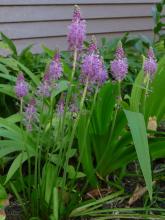
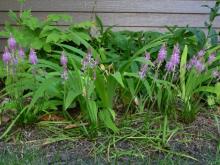
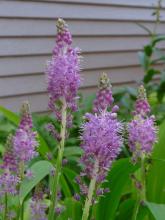
Apparently, eryngiums are quite tasty; I suppose that is why the are usually so darn thorny. Something ate one of my two Eryngium agavifolium planted out this year in the garden. A 3 inch divot was left, and the culprit had eaten right into the soil. I could still feel the primary roots radiating out from what would have been the crown. Eryngium agavifolium is not prickly at all.
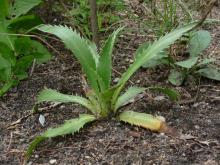
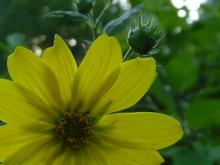
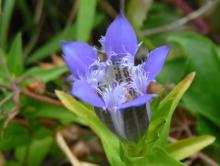
A Helianthus cultivar. Sometimes the buds are more interesting than the flowers. And Gentiana septemfida, not liking the heat stress.
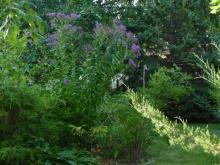
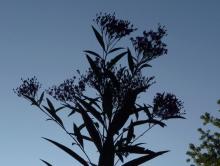
Vernonia gigantea topped out at 9ft 10 inches. Yes, I measured, and how else but on a ladder can I get pics of the flowers?
Richard T. Rodich
Re: What do you see on your garden walks? 2012
Fri, 08/24/2012 - 7:43pmEuonymus hamiltonianus var. sieboldianus is beginning to color up for its last year in the yard. :'( After ten years it is beginning to sucker, and I don't want the next door neighbor having to deal with it. On the bright side, E. planipes (thanks, Mark!) or a medlar will be replacing it.
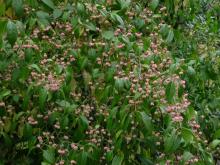
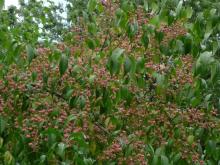
Pics of sieboldianus from above and below.
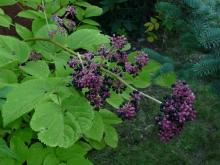
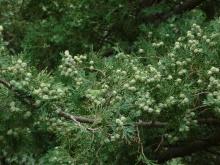
The herbaceous Aralia continentalis replaced the woody Aralia elata that had threatened to invade my other neighbor's lot. Chamaecyparis thyoides always has heavy cone set for me.
Tim Ingram (not verified)
Re: What do you see on your garden walks? 2012
Fri, 08/24/2012 - 11:51pmRick - the Vernonia must be really stunning to have in the garden! I wonder how tall Eupatorium purpureum can get under ideal conditions? Your mention of Eryngium yuccifolium reminded me of the New Zealand aciphyllas, another formidable group of umbellifers. Many of the family have the same chemistry as things like carrot and parsnip, and if you smell the roots you can often make this out. With the aciphyllas their form must have evolved to counteract grazing by the many flightless moas of past times. Having said this I have had rabbits eat the leaves in the garden here so they must be particularly tasty!
fleurbleue (not verified)
Re: What do you see on your garden walks? 2012
Sat, 08/25/2012 - 4:28amKelaidis, what a nice Salvia is your S. penstemonoides ! I didn't know it.
Panayoti Kelaidis
Re: What do you see on your garden walks? 2012
Sat, 08/25/2012 - 9:37amSalvia penstemonoides was thought to be extinct, but was rediscovered near Dallas, Texas--it is a beautiful thing that seems to be hardy for us. I am amazed that Impatiens omeiana is hardy in Newfoundland, Todd! Or has it not been through a winter? Inula rhizocephala has always been monocarpic here, Lori--you must have very special conditions to have it rebloom twice more. I am relieved we do not have Psyllids, however. This time of year the garden seems to have a second spring, and the botanic gardens has almost too much to relate, but my own garden is more manageable. Here are some of the highlights from the last day or two...
1) This pale form of Allium cyaneum came to me as A. sikkimense (Joy Creek Nursery)--it's better sited than others of this species, and shows off more. Needs something contrasting next to it, though...
2) Artemisia filifolia is the only shrubby sagebrush in this area, always growing on sandy soils. It was native to my property, and this one magically appeared in just the right spot. I love its extravagant swirls.
3) Colchicum (Merendera) pyreneicum is always the first of its clan, inducing a bit of panic (which is why its Spanish name is "I scare the shepherds" [with the approach of winter]/ I love it in the evening when it closes,
4) And in the daytime when it is wide open.
5) I take my tender cacti outdoors for the summer, where they are happier, and often bloom: here Coryphantha elephantipes
6)-7) I've grown Cyclamen purpurascens long enough that seedlings are popping up all sorts of places--here in among sempervivums, and elsewhere--often in full sun!
8) Not much blooming here on my dry xeriscapes (east and west Ridges), except for Mexican hair grass (Nasella tenuissima) which I must cut back before it takes over...
9) Eriogonum allenii is well into its second month of blooming, alongside Seseli gummiferum: two of the mainstays of my summer garden.
10) Hedeoma hyssopifolium from the Chiricahua Mts. of New Mexico, its first year here. It makes a dense mound of bloom with time.
Only down to the H's--must post another note next for the rest...
Panayoti Kelaidis
Re: What do you see on your garden walks? 2012
Sat, 08/25/2012 - 10:00am1) This time of year the Hylotelephiums make a great show: just planted this H. 'Bertram Anderson'' a rew weeks ago...
2) Hylotelephium cauticolum must be one of its parents: it makes a great show on a dry corner of my rock garden where it's hard to grow most alpines.\
3) The Star Performer in my garden right now is this Lobelia cardinalis, or probably a hybrid with the Mexican species, come to think of it. It's been in this spot then or more years.
4) Even the vegetable garden is decorative with Ipomoea (draped, bloomsin the morning) and crimson Amaranth everywhere.
5) Salvia microphylla 'Hot Lips' has been blooming much of the summer, but lulls at the height of heat--now that its cooled off a bit it's kicking in. Amazing a plant from southern Mexico is so hardy.
6) I love the scarlet of Salvia darcyi, which I finally have growing well at home.
7) Just to prove I am not a rock garden snob, I do grow a few annuals (here in a brash combination: petunias, callibrachoa and Angelonia)
8) Kniphofia porphyrantha finally blooming after half a dozen years!
9)The black spikes on Veratrum formosanum--one of my favorites, dark though it be..
Panayoti Kelaidis
Re: What do you see on your garden walks? 2012
Sat, 08/25/2012 - 10:03amNoticed the last two did not show up: will try posting them again:
7) Just to prove I am not a rock garden snob, I do grow a few annuals (here in a brash combination: petunias, callibrachoa and Angelonia)
Kniphofia porphyrantha finally blooming after half a dozen years!
9)The black spikes on Veratrum formosanum--one of my favorites, dark though it be..
Trond Hoy
Re: What do you see on your garden walks? 2012
Sat, 08/25/2012 - 1:08pmRick, I don't think I'll ever grow a plant that I need a ladder to admire! At least not in one season.
I had several Eryngiums once and they were never touched by slugs ;)
Scilla scilloides looks pretty. Seems to be a nice plant.
cohan (not verified)
Re: What do you see on your garden walks? 2012
Sat, 08/25/2012 - 1:13pmRick, Scilla looks good, and Vernonia impressive! I have yet to try and fall blooming bulbs here, curious to know if any of them will be early enough to make it...lol We've already had a couple of frost warnings- for Rocky Mountain House (30km west), but I think my yard is not as quick to freeze..
Panayoti- second spring indeed! lots of good reds :) A couple of tiny C purpurascens are flowering here right now, too..
Pages