Looking back over the 2011 thread is very stimulating. We sowed quite a bit of home collected seed last autumn and this is mostly outside in a cold frame; germination probably won't occur for a couple of months, though our mlld winter so far may not be sufficient to provide the stratification that is necessary for some plants. I am now going through seed from Alplains, Holubec and other collectors, and the seed exchanges to divide it into groups requiring different conditions. Quite a bit will go into the fridge after sowing for 6 to 8 weeks. We have sown other seed that needs no cold treatment in a propagator in the greenhouse but the lower light levels in the winter do lead to etiolation in some species (though not all). Great way of spending a winter's day...

Seed starting chronicles 2012
Forums:
Comments
Amy Olmsted
Re: Seed starting chronicles 2012
Fri, 01/20/2012 - 6:27amAgreed!! ;D I plan on sowing seed today from the American Primrose society exchange and putting them under the growlights indoors. My NARGS seed haven't arrived yet, so I need to save space for them, which will be a struggle as there is only so much space under the lights and always way too many seeds to sow!
Tim Ingram (not verified)
Re: Seed starting chronicles 2012
Fri, 01/20/2012 - 6:38amEuphorbia rigida - sown in greenhouse, germinated rapidly (seed had been stored for 7 years so very pleasing to get good germination)
Lesquerella intermedia & fendleri (SWNS)
Stachys coccinea (SWNS)
Chilopsis linearis (SWNS)
Erysimum wheeleri (SWNS) - all these sown with bottom heat in greenhouse
(there are also several yuccas germinating as above from 10/11 year old seed from Ron Ratko, and a couple of dudleya of similar age)
Lupinus versicolor - sown as the Euphorbia after chipping seed
Lomatium utriculatum - home saved seed sown outside in a cold frame (hadn't expected such rapid germination)
(I now have to remove the food from our fridge in the garage to make room for all the pots sown this January!)
Trond Hoy
Re: Seed starting chronicles 2012
Fri, 01/20/2012 - 2:10pmBe glad you have that huge property! Where else should you plant all those plants ;)
Mark McDonough
Re: Seed starting chronicles 2012
Fri, 01/20/2012 - 4:15pmTim, so glad you started this 2012 topic, one of my favs for sure. And thanks for making your photo large enough to see it full size to see all those perky seedlings and read the plant labels. Good crop of southwesterners coming up there. I've always wanted to try growing Desert Willow (Chilopsis linearis); but I don't think it could survive our New England climate. It is rated zone 7-10, and for some smaller plants I will sometimes try "pushing the hardiness envelope" a bit, but my few attempts at doing that with shrubs (like Cistus, some maples) have failed, the winter cold is just too much for them. In a few (very few) cases, I've had some luck with southwestern shrubbies, one of my favorites is Philadelphus microphyllus from SWNS a number of years ago, and perfectly hardy.
Richard T. Rodich
Re: Seed starting chronicles 2012
Fri, 01/20/2012 - 5:44pmTim, did these all (except the Erysimum) germinate at room temperature?
And except for the mentioned chipping, was there any pretreatment?
cohan (not verified)
Re: Seed starting chronicles 2012
Fri, 01/20/2012 - 11:39pmAny tips for sowing/germinating Geranium fremontii? I came across a mention of scarification and a 24 hour soak, which I have not heard of for other Geraniums??
Lori S. (not verified)
Re: Seed starting chronicles 2012
Sat, 01/21/2012 - 1:15amIt seemed like unusual advice to me too, Cohan, but I was surprised to see that scarification is recommended in the Alplains catalogue for G. viscosissimum (after which just the usual 70-degree-ish conditions are recommended, if I'm remembering the meaning of the codes correctly).
I had to look that species up. This article suggests that "Geranium fremontii" may be more correctly known as G. caespitosum, and that fremontii may be just a variety, which USDA Plants seems to agree with.
http://www.swcoloradowildflowers.com/Pink%20Enlarged%20Photo%20Pages/ger...
http://plants.usda.gov/java/profile?symbol=GECAF
The 24 hour soak recommendation is still odd, though. Dr. Deno's work (First Supplement to the Second Edition of Seed Germination Theory and Practice) doesn't support it. He reports that pre-soaking prior to germinating in moist conditions either did not give significantly faster germination, or actually risked seed death by inhibiting its access to oxygen and causing asphyxiation. I know it's something some people like to do, however.
Tim Ingram (not verified)
Re: Seed starting chronicles 2012
Sat, 01/21/2012 - 2:38amI have sometimes tried chipping geranium seed and think it can be effective, especially if you only have a few seed of something really special. I've not soaked them but normally just sit seed pots in water overnight which is likely to imbibe the seed pretty well. (When I was working in science I was chastised for watering all the freshly sown seed of Sweet Peas being used in genetic studies of their flowering - I was looking after the greenhouse over the weekend! - I have been very wary of soaking legume seed for too long ever since!).
Rick - all these seed except the Lomatium and Euphorbia were started off with bottom heat in the greenhouse - I suppose equivalent to 'room temperatures' and then removed to the lightest spot in the greenhouse once germinated. So they will now experience quite warm days and cool nights and I am not too keen that they grow too quickly! (probably should have sown some of them rather later in the spring but there is always too much to do then).
Michael K. Young
Re: Seed starting chronicles 2012
Sat, 01/21/2012 - 7:19amWith respect to Geranium viscosissimum, I have had excellent success using a couple methods. Scarifying the seeds between folds of 100-grit sandpaper and exposing them to conventional (warm, moist, and well-illuminated) growing conditions resulted in 80% germination within two weeks. I achieved comparable germination by enclosing the seeds in a foil packet and submerging them in boiling water for 10 seconds, exposing them to 8 weeks of cold-moist stratification, than transferring them to a warm environment. Germination began during the cold treatment and continued during the warm phase. I'd guess that the cold treatment was unnecessary for this species, but it did no damage. Failure to scarify, or to expose the seeds to a longer period of boiling water, resulted in no germination. Alternatively, direct seeding (also known as neglecting to deadhead) resulted in many seedlings in the garden.
Peter George
Re: Seed starting chronicles 2012
Sat, 01/21/2012 - 8:10amNow why would 'direct seeding' result in a high germination rate when there was neither scarification nor the boiling water treatment? I know nature is always 'right,' but what is it about plants just dropping seeds that makes the germination rates so high when if we do the same thing, we get nothing?
Lori S. (not verified)
Re: Seed starting chronicles 2012
Sat, 01/21/2012 - 9:57amNot to imply that the conditions are the same, but it's interesting that Bob Nold grows it in Denver, far from the Sonoran and Chihuahuan desert washes that I tend to associate it with from fondly-remembered trips long ago (re. High and Dry: Gardening with Cold-hardy Dryland Plants). I hope this mention of his name will get his spider senses tingling, so he can pop in and tell us about it in person!
Tim, you have a great start to the season. I've started earlier than usual this year, but only have 4 pots of sprouts so far - eager beavers that need nothing more than scarification or just moisture to trigger them: Astragalus coccineus (so easy to germinate, so hard to grow!!), Oxytropis lagopus, Acantholimon saxifragiforme. Salvia pachyphylla also germinated in a few days, which kind of surprises me.
Michael K. Young
Re: Seed starting chronicles 2012
Sat, 01/21/2012 - 5:08pmI assume that the hard seed coat prevents too-early germination (read: autumn) in G. viscosissimum.
I regret that I had no difficulty in killing Chilopsis linearis a few years ago. But that record-setting cold snap--4 days of lows near -10 C in early October, which constituted the first frost of the year--took out quite a few marginally hardy plants (including all of our cactus).
cohan (not verified)
Re: Seed starting chronicles 2012
Sat, 01/21/2012 - 6:27pmI also don't see why direct garden seeding results in germination without scarification ( I could see if it was just a matter of much larger numbers of seed and low germination percentages).. I suppose the sown seeds that were not scarified and did not germinate were just given cold stratification without freezing? So then maybe outdoor treatment over winter would work without scarfication? I have to see how many seeds I have, whether or not there are enough to experiment....
Lori, I did also gather from googling that fremontii is considered by some to be a sub-species of caespitosum.. Ironically, the seed for this North American came to me from Philippe in France...lol
Mark McDonough
Re: Seed starting chronicles 2012
Sat, 01/21/2012 - 6:34pmJust make sure you don't end up with Geranium robertianum after that world-wide trek ;)
Lori S. (not verified)
Re: Seed starting chronicles 2012
Sat, 01/21/2012 - 7:58pmWelcome, Michael! I just realized that these are your first postings here. It sounds from your Chilopsis linearis account that you are an adventuresome gardener! Hope to find out more about what you are growing in Montana!
Richard T. Rodich
Re: Seed starting chronicles 2012
Sat, 01/21/2012 - 8:04pmRemember too, that we really don't know how old germinating seeds are that were naturally dispersed. Given enough time in the natural environment, the breakdown of the seed coat an subsequent germination might not be so vexing after all.
cohan (not verified)
Re: Seed starting chronicles 2012
Sat, 01/21/2012 - 9:35pmI'm hoping Philippe would know better since seed comes from the botanic garden..lol-- though mistakes can happen anywhere! In fact any Geranium is okay if its pink, or even white, or any colour other than that neon blue-purple of himalayense which we have many many square meters of.... :-X
cohan (not verified)
Re: Seed starting chronicles 2012
Sat, 01/21/2012 - 9:38pmI wanted to add that a friend in Nebraska successfully grew Chilopsis linearis a for a couple of years, from AZ seed (I think it was just seed gathered around metro Phoenix by another friend)- if I recall the sequence of events, he had it planted in ground, and mulched heavily the first winter; if died back to the mulch, but grew several feet or more next season and flowered; second winter he was not well enough to mulch and the plant died.. I forget what his lows were, but I could ask if anyone would like to know..
Trond Hoy
Re: Seed starting chronicles 2012
Sat, 01/21/2012 - 11:05pmIt is the strategy of the plant! When seeds are ripe or almost so before late fall it can be beneficial for the species that some seed sprout immediately if it is moist enough. A little later the seeds have gone into a dormancy which is hard to break and not all germinate the next season either but need more than one season to break dormancy. This is often the case with seed from plants where the seasons can be a little unpredictable and the plant build up a kind of seedbank in the soil.
Lori S. (not verified)
Re: Seed starting chronicles 2012
Wed, 01/25/2012 - 9:49pmMany of the easy ones are sprouting now.
I started some very old seeds of Ipomoea leptophylla, and in two days, after strenuous filing of the very hard seeds, the sprouts are practically heaving the soil out of the pot!
Smelowskia calycina is an eager sprouter; the first germination was after 2 days, and lots are up after 4 days.
It's the same with Arenaria pseudoacantholimon, Silene nigrescens and Gastrolychnis apetala!
Tim Ingram (not verified)
Re: Seed starting chronicles 2012
Thu, 01/26/2012 - 1:10amLori - I am trying Ipomaea leptophylla and Silene nigrescens too, both germinating well. I assume you sow under artificial light?
For me both of these are etiolating considerably (although other seedlings are not) and I think I need to give them much higher light intensities, or possibly prolonged daylength?
Lori S. (not verified)
Re: Seed starting chronicles 2012
Thu, 01/26/2012 - 5:28amYes, I start most seeds indoors under fluorescent lights - each shelf of the plant stand has two double-light ballasts. I'll have to check the wattage of the bulbs (can't remember). Some are stratified in the cold room then brought out to the plant stand for germination, or after they germinate in the cold room. Alpines tend to grow a little looser than they should in my setup, but may tighten up after they are planted outdoors, so I don't see this as a huge problem, usually, though more intense light would certainly always be an improvement. I think the permanent growing conditions may be more important overall to the plants ending up with the desired small, tight forms that we expect or hope for... ?? (See: http://nargs.org/smf/index.php?topic=317.0 ) We did use very high intensity metal halide lighting at one time (for wintering-over water lilies and tropicals, mainly) but it was pretty unpleasant to be around - I imagine there have probably been improvements to these sorts of set ups now. Starting them outside here doesn't give any particular advantage (in my opinion) in terms of getting seedlings to a good size prior to planting out, which I like to do as soon as possible. (I don't usually have the patience to take care of seedling pots for extended periods of time.)
NB. Edited to add details. This isn't meant to be taken as a recommendation to anyone - it's just a description of how I've been doing things, and needless to say, there is lots of room for improvement to it!! :o
Michael K. Young
Re: Seed starting chronicles 2012
Thu, 01/26/2012 - 6:27amLori, thanks for the welcome. I've grown around 1000 species in the garden here, not to say that all or even most of them are still with me. I'm particularly fond of species from the U.S. Southwest, particularly penstemons. Given the tendency for this part of Montana to have rain and -20 to -30 C nights each winter, many of these plants are grown, unintentionally, as annuals. Or were grown; I subscribe to the notion that after killing a species three times, one can declare victory and move on to others. Thus Chilopsis linearis has two more chances. Lauren Springer profiled a reputedly hardier cultivar in her revised edition of The Undaunted Garden, so I know my next victim.
I started my one-hundred-ninety-third seed dish of the winter last night. These all represent species that prefer, require, or at least tolerate cold stratification. The warm germinators, 75 or so additional species, will get started in late February. My intent is to have most things germinating by 1 March so I can move them to a cold (and still occasionally freezing) greenhouse. But there are always surprises (or my unwillingness to accept their germination patterns despite repeated observation). Lewisia rediviva, Erysimum asperum, and Leptodactylon watsonii, for example, always seem to begin germinating during cold stratification, usually early January after an early December start, and I have to figure out what to do with the germinants before they rot. Starting these outdoors would be a lot easier, but I would miss the entertainment of expending large amounts of energy on configuring some contraption involving artificial lights and a propagation box to keep them growing during the depths of winter.
And it's not like I have room for 250+ species--that may be why so many are no longer here...
Michael Loos
Re: Seed starting chronicles 2012
Fri, 01/27/2012 - 6:03amOff to a roaring start this year. Last summer included Narcissus asturiensis collected from a friend's house. That is already showing a few grassy leaves emerging from the seedling pot. The Cyclamen are succulent and the Erythronium have swollen from a 24 hour soak. I hope to at LEAST see leaves this year.
Cold chill needed for the Campanulas, Silphium, Liatris, and Prunus. (Anyone growing P. prostrata? In the Seed Ex this year, it looked curious, if not lovely for the rock garden.)
The Lilium superbum are in vermiculite at 20C until I see a bit of something happening. Oy... and then for the 5 or 6 years until flowering. Rick, I think that scaling is the way to go!
The darn red squirrel came into the house (!) and ate all the Platycodon from last year. I guess ate is not quite accurate - rather, made to disappear, as I don't know what he did with them afterward. There was NOTHING! Including the nothing of the 8 Chamaecyparis obtusa 'Nana' (the really nice, true one) grown from cutting last winter. Vanished... into thin air, like he carefully removed them from their quarters, tossed them into his backpack, and off he went. So much for my protected cold room...
Many more seeds to go.
Michael
Interlaken, NY Zone 6a (officially now...)
Lori S. (not verified)
Re: Seed starting chronicles 2012
Fri, 01/27/2012 - 5:49pmSound like a great start to your growing season, too, Michael... other than what the squirrel made off with. ;D
I grow Prunus prostrata (or at least what was sold as Prunus aff. prostrata) though not particularly well. It's been in a trough since I got it in 2008 where it has been very slow growing. If I get up the nerve, I may try to move it to a tufa bed and see if it will take on a prostrate form.
http://nargs.org/smf/index.php?topic=372.msg6962#msg6962
Anyone else out there growing it?
Trond Hoy
Re: Seed starting chronicles 2012
Sat, 01/28/2012 - 12:49amNo, but now you have made me aware of it ;) You say yours is from seed or did you buy a small plant?
Lori S. (not verified)
Re: Seed starting chronicles 2012
Sat, 01/28/2012 - 8:37amTrond Hoy
Re: Seed starting chronicles 2012
Sat, 01/28/2012 - 11:36amLori, I knew it! My memory is as long as my tail :-[
But what kind of hieroglyphs have you added here? Déjà vu, Trond: ??
Lori S. (not verified)
Re: Seed starting chronicles 2012
Sat, 01/28/2012 - 12:04pmDéjà vu is just the French phrase for the feeling that something has been seen before. :)
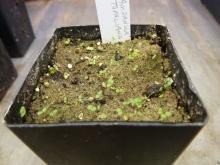
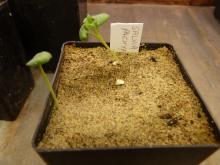
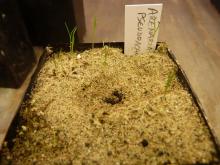
A few seedlings:
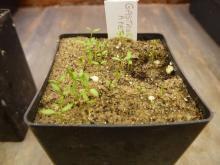
Gastrolychnis apetala (syn. Silene uralensis ssp. apetala); germination started in 2 days after sowing at room temp, several seedlings after 4 days):
Campanula topaliana; germination started the day after sowing :o, lots of seedlings after 4 days:
Salvia pachyphylla; germination in 7 days at room temp, though only 2 seedlings:
Arenaria pseudoacantholimon (germinated in 6 days from sowing, room temp conditions):
I'm sure we have all, from time to time, puzzled over the identity of a mystery seedling! I think it would be useful to post some photos of seedlings as they progress to more-recognizable stages... a modest start towards building up a bit of a reference database, and carrying on from some efforts in last year's seed season. Any thoughts on this?
Trond Hoy
Re: Seed starting chronicles 2012
Sat, 01/28/2012 - 12:36pmI know that ;) I'm talking about the strange signs jà between the j and the à! and these: following my name!!
They're like squares with a two zeros and a number in (the numbers are 17, 11, 17, 05, 12 and 05). Thought they were some ascii code. Don't yousee them?
Lori S. (not verified)
Re: Seed starting chronicles 2012
Sat, 01/28/2012 - 12:42pmNo, I don't. All I see is the semi-colon right after your name, followed on the next line by the link I posted. ??? ???
Edit: I was experimenting in the post, prior to sending it, trying to remember what keystrokes were used for acute and grave accents, and did type out a string of symbols, but I deleted it all prior to sending... that's what it sounds like you are seeing, but I can't imagine why you might be seeing it after I deleted it, and why I can't see it now? One of the mysteries of computers, perhaps? I have a Mac - do you happen to have a PC? I do notice weirdness sometimes when linking from Macs to PCs at work... ?
Bah, it's all black magic! ;D
Edit: Trond, I went back and retyped the "deja vu" bit... I hope that has corrected it and removed the weird symbols from your view!?
Edit: Errr, okay, I guess it's something to do with the keystrokes for the accents then, not the other stuff I deleted.
Richard T. Rodich
Re: Seed starting chronicles 2012
Sat, 01/28/2012 - 5:22pmYou are not going crazy, Trond. I see them, too.
There must have been something that Lori left behind in her message, or something the computer did itself as a result, that our computers don't recognize. Consequently, another symbol was put in its place. I'm sure they must mean something in computer lingo, because I see them exactly as you describe.
Amy Olmsted
Re: Seed starting chronicles 2012
Sat, 01/28/2012 - 5:25pmAnd I am NOT seeing them! How strange!
Richard T. Rodich
Re: Seed starting chronicles 2012
Sat, 01/28/2012 - 5:28pmCould we make a separate Seed and Seedling photo gallery in our Wiki?
--- That would be awesomely cool! 8)
cohan (not verified)
Re: Seed starting chronicles 2012
Sat, 01/28/2012 - 10:00pmLori's message showed properly for me, with the french accents in place, and no extra symbols; I do know the sort of symbols Trond is talking about though-- I have seen them sometimes when viewing pages or words in other languages and clearly my operating system or browser or something is not recognising them.. some conflict between different systems I guess, that some of us are seeing proper French and some not...
BTW, my keyboard can be set to various formats, to make those accents, but then they displace other regular characters- one would have to learn a whole other keyboard (the other characters are not marked on the keys!).. when I need to make 'foreign' characters, I use this:
http://www.tedmontgomery.com/tutorial/ALTchrc.html
Lori S. (not verified)
Re: Seed starting chronicles 2012
Sat, 01/28/2012 - 11:20pmYes, I use similar guides... for Macs, though.
Trond Hoy
Re: Seed starting chronicles 2012
Sun, 01/29/2012 - 12:23amLori, I have a Mac :-) and your retyping moved the weird symbols in front of the sentence ;D ;D
Don't bother- I was just curious and wondered if you had used some symbols I didn't have ;)
Richard T. Rodich
Re: Seed starting chronicles 2012
Thu, 02/02/2012 - 1:00pmGood germination information in this pdf for those wanting to germinate eriogonums native to Utah:
--- E. alatum
--- E. bicolor
--- E. brevicaule
--- E. corymbosum
--- E. heracleoides
--- E. jamesii
--- E. ovalifolium
--- E. racemosum
--- E. shokleyi
--- E. umbellatum
http://www.google.com/url?sa=t&rct=j&q=&esrc=s&source=web&cd=2&ved=0CCoQ...
Lori S. (not verified)
Re: Seed starting chronicles 2012
Sat, 02/04/2012 - 6:24pmThat sounds like a great idea!
Until that, or something like it comes about, here are some new ones and some updates on others:
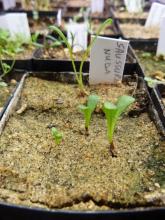
There is a definite familial similarity between seedlings of the locally native Saussurea nuda var. densa and Saussurea nupuripoensis... (both of these have been easy to germinate... if there is a challenge, it will be in growing them!)
Here is Saussurea nuda var. densa; the seeds germinated in 9 days in room temperature conditions:
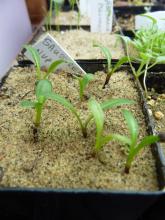
Here is Saussurea nupuripoensis which germinated in 5-6 days at room temperature; the seeds were from Vojtech Holubec, and collected in Zhdanko, Sakhalin, Russia at 400m elevation from a scree habitat (description: "caespitose plant, 20cm high, lanceolate tomentose leaves, lilac flowers in terminal cymes, 2011 seed").
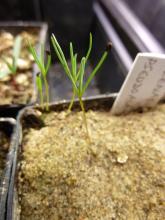
Arenaria pseudoacantholimon; seeds also from Vojtech Holubec, ex. Palandoken, Turkey at 2300m elevation, from limestone scree (description: "compact cushions like Acantholimon, 5-10cm wide, spiny leaves, 8 mm long, white flowers on thin 10-15 cm stems"; seeds collected in 2011):
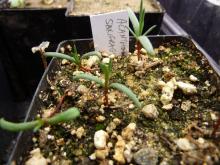
Acantholimon saxifragiforme is taking on an acantholimon-like look as the true leaves emerge:
What very timely references to starting Eriogonum, Rick. I will need to peruse those too!
Trond Hoy
Re: Seed starting chronicles 2012
Sun, 02/05/2012 - 1:14amThanks again, Rick! I have about 20 pck of eriogonums :rolleyes:
Sellars (not verified)
Re: Seed starting chronicles 2012
Mon, 02/06/2012 - 10:01pmThat germination information is very interesting Rick. I was particularly struck by Table 3 that indicates to me that chilling is required for at least 2 months and maybe 4 or 5 months for high altitude species, based on their experiments with Eriogonum.
I use two strategies for seed starting. Those that need cold stratification are left outside with a cover to experience alternating temperatures. Those seeds that need warm temperatures I start in a greenhouse. If I get seed from the exchange at the end of January the challenge is that, in our climate, I don't have 2 months of suitable cold stratification weather remaining before spring. I have observed that I get better germination if I sow outside seeds in November so that there is a full winter period for cold stratification. So some seeds that I receive in late January I now save for planting the following November.
I have outside seed trays of Lewisia rediviva and Douglasia nivalis sown last November that germinated in January.
Todd Boland
Re: Seed starting chronicles 2012
Tue, 02/07/2012 - 10:44amHere are some of my results. I have about 200 pots on the go. Many are being stratified and some were just sown and stratified today so they will not see heat until April. Having said that, here's what is germinated
Direct Sown Jan 27/12, germinated Feb.7/12 (some germinated earlier than this but I essentially make notes once a week, they are growing at 10 C nights, 15 C days)
Alyssum borzeanum
Alyssum pulvinare
Achillea clavinae
Erigeron foliosus
Erigeron simplex
Hymenoxys subintegra
Heliosperma pusillum
Heterotheca pumila
Scorzonera austriaca
Townsendia hookeri
T. incana
T. rothrockii
T. scapigera
T. florifera
T. mensana
Stratified Dec. 21/11, brought into heat Feb. 2/12, germinated Feb. 7/12
Primula cortusoides
Penstemon pachyphyllus
P. fendleri
Draba parnassica
Incarvillea mairei
Onosma cinerea
Onosma helvatica
Stratified Nov. 10/11, brought into heat Jan. 9/12, germinated Jan. 23/12
Androsace obtusifolia
Allium stellatum
Campanula celsii
Symphandra armena
Delphinium smithianum
Saxifraga cherleroides v. rebunshirensis
I'll post an update in a week!
Trond Hoy
Re: Seed starting chronicles 2012
Tue, 02/07/2012 - 12:13pmTodd, those sown Nov/Dec last year, are the seed fresh or stored from another year?
I never get seeds that early in the season?!
Richard T. Rodich
Re: Seed starting chronicles 2012
Tue, 02/07/2012 - 6:19pmI do that more and more now, too, waiting to plant seeds next season. Maybe partly because I don't get it all done as early as I should. It seems to be preferred by a lot of fritillaria people, and certainly could be better for seed that might do better when aged, like penstemon and some cactus.
Todd Boland
Re: Seed starting chronicles 2012
Wed, 02/08/2012 - 1:27pmYes Trond, they were last years seeds. Some of the seed exchanges I use don't send seed until April which is too late for strat. And then I also get excess NARGS seed and they don't arrive until April-May, so I have plenty of seed that sits around until the following fall.
Todd Boland
Re: Seed starting chronicles 2012
Thu, 02/09/2012 - 9:55amLatest germination:
Stratified Nov. 10, heat Feb 2, germination Feb. 9
Draba norvegica (native)
Armeria maritima ssp. siberica (native)
Stratified Dec 2, heat Feb. 2, germination Feb 9
Draba brunifolia
Arabis parishii
Lori S. (not verified)
Re: Seed starting chronicles 2012
Thu, 02/09/2012 - 10:04pmA few recent ones:
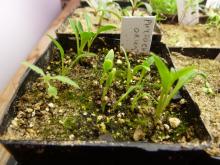
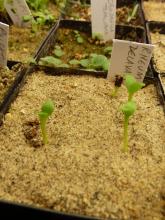
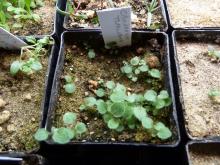
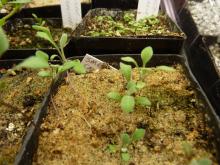
Physochlainia orientalis (the leftmost seedling is an imposter); Rheum delavayi; Campanula topaliana; Smelowskia calycina:
Some info:
Physochlainia orientalis- seeds from Gardens North; germinated at 6 days at room temp; an interesting, early-blooming hardy Solanaceae; this photo is from the Reader Rock Garden in Calgary: http://www.flickr.com/photos/14980862@N03/2494136461/
http://www.rareplants.de/shop/product.asp?P_ID=9059
http://www.efloras.org/florataxon.aspx?flora_id=120&taxon_id=242442760
Rheum delavayi - seeds collected by Holubec in China, Beima Shan, Yunnan, 4800m elevation, slate scree, 2008.
http://www.efloras.org/florataxon.aspx?flora_id=2&taxon_id=242343374
Campanula topaliana - seeds from NARGS in 2010; whereas many Campanula seem to require stratification, this one sprouts readily at room temp; in the first attempt in 2010, germination took 8 days; this year, from the same seeds, germination started the day after planting; I'm growing some more of these in case they do turn out to be monocarpic, and to disperse at the CRAGS plant sale, if there is any interest in it:
http://nargs.org/smf/index.php?topic=24.msg13116#msg13116
Smelowskia calycina - a native alpine Brassicaceae:
http://nargs.org/smf/index.php?topic=934.msg13941#msg13941
_________________________________________________________________________
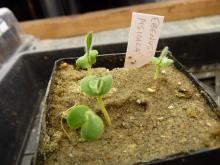
Plantago urvillei; Microula tibetica; Scutellaria megalaspis:
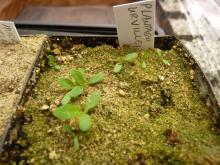
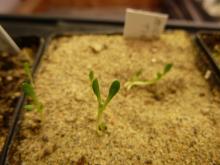
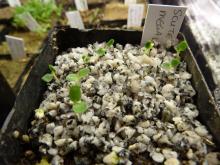
Plantago urvillei - seeds from Holubec, ex. Olkhon, Siberia, grassland, collected 2011.
http://www.fotomontaro.com/flora/plantagina/plantago_urvillei01.shtml
Microula tibetica - seeds from Holubec, collected "China, Shengli Daban, Borohorshan, 3500m, open erosion gullies, compact caespitose cushion, 2-3 cm high, scabrous lanceolate lvs in ground rosettes minor blue sessile flws, 2011"; Boraginaceae.
http://holubec.wbs.cz/3Borohoro-Shan_-Xinjiang.html
http://www.efloras.org/florataxon.aspx?flora_id=2&taxon_id=200019128
Scutellaria megalaspis - seeds from Pavelka, 1500m, Hekinham, Turkey; Bigger cushions, branched stems, 15-25 cm, violet-blue flws, dry stoney slopes, 2010 seed.
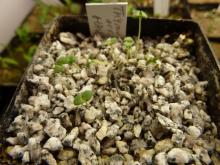

_________________________________________________________________________
Thymus aff. haussknechtii; Ebenus pisidica; Cynoglossum lanceolatum:
Thymus aff. haussknechtii - seeds from Pavelka, "1600m, Kop Dag, Turkey; dense dwarf subshrub, 10-20cm, strongly bluish-glaucous lvs, big white to pink flws, very good, 2008 seed"; seeds germinated in 5 days at room temp.
Ebenus pisidica - seeds from Pavelka, "1600m, Dirmil Pass, Turkey; cushions of silky-silver lvs, 10-15cm, red-purple flws in globose inflorescence, stoney slopes, 2009 seed"; seeds germinated in 2 days after being scarified by rubbing against a file.
http://www.treknature.com/gallery/photo232044.htm
Cynoglossum lanceolatum - seeds from Pavelka, "3300m, Zhongdian Range, Yunnan, China; short lived perennial, silky hairy leaves, erect scapes, 10-50cm, many sky blue flws, stoney slopes, 2009 seed".
http://www.efloras.org/florataxon.aspx?flora_id=2&taxon_id=200018962
Edited to add details.
Lori S. (not verified)
Re: Seed starting chronicles 2012
Thu, 02/09/2012 - 10:06pmAlso Syncalathium soulei or more correctly(?), Melanoseris souliei and Cancrinia tianshanica:
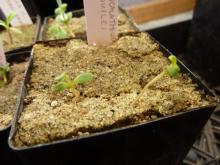
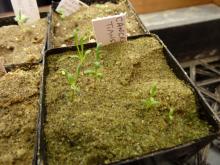
Syncalathium soulei - seeds from Holubec, China, Hong Shan, Yunnan.
http://nargs.org/smf/index.php?topic=963.msg14996#msg14996
http://www.efloras.org/florataxon.aspx?flora_id=2&taxon_id=250097510
Cancrinia tianshanica - seeds from Holubec, "China, Shengli Daban,Borhoroshan, 3600m, alpine sandy deposits, caespitose pl, 3-7cm high, hairy pinnate lvs, 2-3 cm long, ball-like capituli, 15mm wide, yellow flws, 2011".
http://holubec.wbs.cz/3Borohoro-Shan_-Xinjiang.html
These also germinated in a few days at room temperature.
Edited to add details.
Fermi de Sousa
Re: Seed starting chronicles 2012
Thu, 02/09/2012 - 10:53pmThis Ebenus creticus was sown a few weeks ago and germinated yesterday - I hadn't been hopeful as mice had gotten into the packet and I didn't know if anything viable (edible!) was left to sow! Seeing Lori's Ebenus psidica made me think I should post this pic!
cheers
fermi
Mark McDonough
Re: Seed starting chronicles 2012
Fri, 02/10/2012 - 3:49pmFun seeing all these little babies pop up.
Lori, I don't even know the genus on some that you show. I looked up the genus Syncalathium in Flora of China, there's a note at the bottom about S. souliei being ascribed to the genus Melanoseris (as M. souliei)
http://www.efloras.org/florataxon.aspx?flora_id=2&taxon_id=132065
This link discusses related genera (I know none of them) and some photos of very interesting looking plants:
http://english.kib.cas.cn/rh/rp/201104/t20110406_67336.html
Syncalathium souliei on the Holubec site, 3rd photo from the bottom:
http://holubec.wbs.cz/6Tibet_-China.html
...terrific looking form and large clear photo on the Database of Chinese Plants site:
http://www.plant.csdb.cn/details?guid=photo:cfh@8f4d0a7e-e01a-4ce0-a69a-c995db946e2b
http://www.plant.csdb.cn/details?guid=photo:cfh@fb9c051b-f560-44bc-ab8c-e2d41b621f47
Pages