Looking back over the 2011 thread is very stimulating. We sowed quite a bit of home collected seed last autumn and this is mostly outside in a cold frame; germination probably won't occur for a couple of months, though our mlld winter so far may not be sufficient to provide the stratification that is necessary for some plants. I am now going through seed from Alplains, Holubec and other collectors, and the seed exchanges to divide it into groups requiring different conditions. Quite a bit will go into the fridge after sowing for 6 to 8 weeks. We have sown other seed that needs no cold treatment in a propagator in the greenhouse but the lower light levels in the winter do lead to etiolation in some species (though not all). Great way of spending a winter's day...

Seed starting chronicles 2012
Forums:
Comments
Richard T. Rodich
Re: Seed starting chronicles 2012
Wed, 04/25/2012 - 3:33pmI am in no way an expert at this, but I use sandpaper to scarify seeds, too. Except I don't use sandpaper with a block of wood. Seeds are rolled between sandpaper on the table and a piece above with bit of downward pressure from my fingers only. Logically, one would think that with a block the larger seeds would be be scarified while small seeds in the same batch would not; the small seeds would be protected from abrasion by the larger seeds that would prevent significant sandpaper contact. ??? Or perhaps the larger seed would be scarified too much?
------------------------------------------ sandpaper
*** ***
****** ** ****** **
****** **** ****** **** seeds
*** ** *** **
----------------------------------------- sandpaper
cohan (not verified)
Re: Seed starting chronicles 2012
Sun, 04/29/2012 - 11:01pmI've thought a magnifying light like that would be very useful for sorting/cleaning seeds!
I was very pleased to notice that seeds of Sorbus sp cf wilsoniana sown last spring are now coming up abundantly!
I don't know much about what this will look like, especially being 'cf', but here's a description of the species:
http://www.efloras.org/florataxon.aspx?flora_id=2&taxon_id=200011724
interesting that they say fruit orangish red, when many pics you can find online show pink berries (darn, I'd rather have had pink! maybe the cf will take care of that...).. and 5-10 m-- 5 would be preferred, but I'll have to wrap it in something to keep the moose from eating it- it took decades for our regular Sorbus ( I never remember which it is- americana or acuparia? the one with hairy buds, I think) to become more than a multi-stemmed shrub, what with annual pruning by them- it finally shot some trunks higher, and now they eat around lower levels...
I also have S reducta seedlings from last year planted out already and showing slight signs of life... that one might stay low enough to be below snow when the worst predations occur...
Trond Hoy
Re: Seed starting chronicles 2012
Mon, 04/30/2012 - 2:25amRick, I always scarify only one species at the time and the seeds tend to be rather similar in size. When I use the block the larger seeds tend to roll a little and the they get separated from the smaller and I can tilt the block if necessary. Anyway it works fine!
Cohan, if you want pink berries I can send you some S hupehensis seed!
cohan (not verified)
Re: Seed starting chronicles 2012
Mon, 04/30/2012 - 11:50pmSure! Love those pink berries :) Though I don't know if its hardy, that hasn't stopped me before ;) (VanDusen seed collectors lists it as z 6-8, but I think most of these people don't know anyone in zone 3 ;D
Then, it occurred to me that its funny to look for shrubs for berry colour when most berries are ripe for about 5 minutes here before the birds get them....lol
Schier (not verified)
Re: Seed starting chronicles 2012
Tue, 05/01/2012 - 9:07amI scarified seeds awhile back, I managed to scarify my fingertips as well! I managed to hold most of the needs with a finger, and used an emery board. For the smaller ones I put them in a baggie and "cornered the seeds" and then went at them with the emery. Seemed to work, most have germinated. I need to find a better way....
Richard T. Rodich
Re: Seed starting chronicles 2012
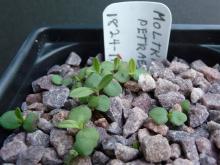
Thu, 05/10/2012 - 11:54pmAll photos taken 9 May 2012.
All were winter sowed the first few days of February:
Alyssum stribrnyiRomneya coulteri and Alyssum oxycarpum germinated in a warm spell of mid March.Iris were soaked for one day before winter sowing. Iris (setosa interior x hookeri ‘Labraska’) x self emerged 8 April.
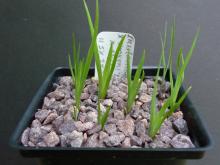
Other Iris seed sprouting dates so far:
Iris hookeri x ensata F3 – 4 April
Iris setosa nana – 25 April
Iris tectorum ex ‘Burma Form’ – 25 April
Moltkia petraea germinated 4 April, and Mysotis decumbens 20 March.
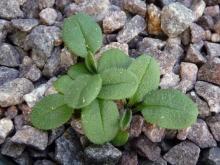
Petrocoptis pyrenaica emerged 20 March.
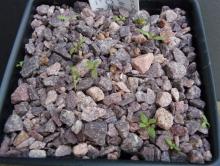
Phemeranthus sediformis emerged 31 March and Physaria alpina 19 March.
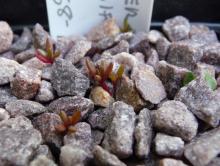
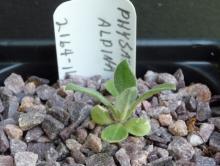
Pulsatilla halleri ssp. rhodopaea emerged 30 April.
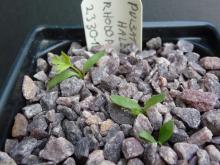
Other pulsatilla emergence dates:
Pulsatilla halleri – 25 April
Pulsatilla grandis ‘Budapest’ – 28 April
Richard T. Rodich
Re: Seed starting chronicles 2012
Fri, 05/11/2012 - 12:12amAll these were sowed at room temperature:
Acantholimon kotchyi, germinated in 8 days.
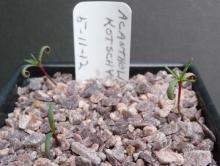
Other acantholimon emergence dates:
A. caryophyllaceum – 7 days
A. venustum – 7 days
It was interesting the these species first emerged as brown seedlings, and only turned green later.
Delosperma ashtonii germinated in 9 days. But subsequent placement outside has yielded very little growth. Delosperma are usually very fast growers, at least in warm weather…
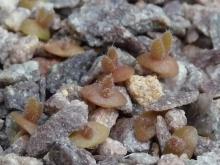
Dianthus haematocalyx ssp. pindicola emerged in 5 days, and Dierama pendulum 22 days. It's easy to see which dianthus seedlings emerged inside the house (with etiolated stems), and which emerged a little later after being place outhside.
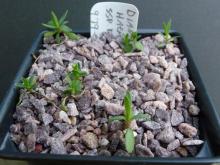
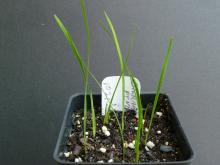
Globularia trichosantha germinated in 15 days. I've tried winter sowing G. trichosantha twice before with no luck.
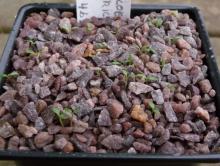
Townsendia hookeri emerged in 11 days.
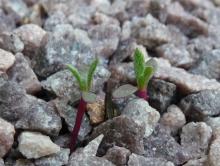
Other townsendia emergence dates:
Townsendia rothrockii – 7 days.
Townsendia scapigera – 7 days.
Richard T. Rodich
Re: Seed starting chronicles 2012
Fri, 05/11/2012 - 6:24amLewisia rediviva began germinating (April 18) in the refrigerator at 34-38F(1-3C) in 49 days. I wish I would have taken photos when they first emerged because cotyledons were not elongated at all; they were perhaps only twice as long as wide.
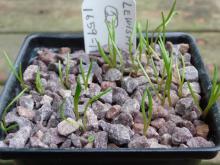
Phacelia campanularia also germinated in the refrigerator in 35 days.
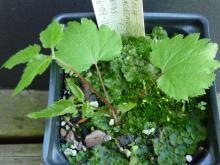
Not a new seedling, this one is in its second season. But I thought the difference in the earlier, simple leaves versus the newer compound leaf was interesting with this Aralia cachemirica.
Trond Hoy
Re: Seed starting chronicles 2012
Fri, 05/11/2012 - 10:24amRick, you are competing with Lori in interesting species ;)
Mark McDonough
Re: Seed starting chronicles 2012
Mon, 05/28/2012 - 11:55amMy flat of Anemonopsis, which germinated this spring, is showing some first true leaves, so far on at least 6 seedlings (can you find all 6?). So, it seems I don't need to wait until the second year to see true leaves.
Trond Hoy
Re: Seed starting chronicles 2012
Mon, 05/28/2012 - 2:10pmMark, I have 3 different batches of Anemonopsis seed germinating now and they all show true leaves now.
cohan (not verified)
Re: Seed starting chronicles 2012
Mon, 06/11/2012 - 11:24pmGermination over the last couple of weeks of some seeds sown around the beginning of May (I think- some of the tags were made earlier and then I didn't get the sowing done, didn't change them all!) and put out in the last patch of snow which soon became a bin of cold water! but still many cool days and near/frosty nights-- Some Violas (have to go out with a notepad to get the names...lol)- several Hieracium (I doubt they really needed the cool period, though the references I found were mixed, so I figured what the heck!) villosum, intybaceum and most recently aurantiacum (hope none of these will be weeds!) and the similar Hypochoeris maculatum; Prenanthes (purpurea, I think-have to look at the tag or find the packet..lol), And some things sown end of May and set outside for (occasionally!) warm days, though nights are still (always!) cool--Sempervivum arachnoideum, Polemonium boreale, probably some other things I'm forgetting now-- I have pics of most, but they don't look like much yet!
externmed (not verified)
Re: Seed starting chronicles 2012
Sun, 06/17/2012 - 3:00pmHave seen suggestions for germination of Paeonia and Roses on paper towels the latter initially cold and the former initially warm, on wet paper towels. Some rose people suggested using a solution of 1.5% hydrogen peroxide.
Anyone "stratify" on paper towels?
Charles Swanson MA USA
Gene Mirro (not verified)
Re: Seed starting chronicles 2012
Sun, 06/17/2012 - 3:07pmRickR, your Alyssum stribrnyi seedlings look exactly like Romneya coulteri.
Lori S. (not verified)
Re: Seed starting chronicles 2012
Sun, 06/17/2012 - 4:06pmI used to use Deno's method a lot - moistened paper towel inside of baggie - but have just gone to direct sowing in pots in the last few years. It certainly saves space (Deno's method, that is). It can be a little tricky to detach roots from the paper towel, so I'd just tear away as much as possible and plant it with the seedling. I was not using it for peonies and roses though.
Richard T. Rodich
Re: Seed starting chronicles 2012
Sun, 06/17/2012 - 4:58pmThanks, Gene. Years ago, I had a plant of Alyssum stribrnyi and I didn't remember any jaggedy leaves like that either. I'll bet you are right. ;D
Brandhorst (not verified)
Hepatica seedlings
Tue, 07/03/2012 - 7:28amI just found a nice thick cluster of Hepatica transsilvanica seedlings under the mother plant. Any suggestions on whether to divide them this year or wait till next spring. They are growing in a very tight group, on top of each other in some circumstances. Only a few have their true leaves yet.
Mark McDonough
Re: Hepatica seedlings
Tue, 07/03/2012 - 7:21pmMark, I would be tempted to wait for a not-too-hot day, then transplant them soon, separate out the seedlings into smaller clumps of 2-3 seedling each, then mulch and keep them well watered. I don't have direct experience with Hepatica seedlings, but with other spring ephemerals, I separate and move the seedlings in early to mid summer, with good results.
Brandhorst (not verified)
Re: Seed starting chronicles 2012
Wed, 07/04/2012 - 4:02pmThanks Mark. I'll give it a try.
Toole (not verified)
Re: Seed starting chronicles 2012
Sat, 07/07/2012 - 3:14amFull of promise ,not far from their first flowering ---- Seed sown June 2009 and potted on once, they don't appear to have suffered from not being separated into individual pots.
That being said i think I'll be potting on/ planting out a few Hepaticas soon as well. :)
Cheers Dave.
cohan (not verified)
Re: Seed starting chronicles 2012
Sun, 07/08/2012 - 7:38pmLooking good, Dave! I have some smaller than that (first year) and some maybe about the same size/age.. I sowed them in an old hanging basket planter (not hung though!) expecting to leave them several years till ready to go in the ground.. they are looking good- finally like real, though small, plants, this year.. Maybe I will plant them out this summer/fall, not sure yet... I rarely do anything with seedlings between sowing and planting out...
Toole (not verified)
Re: Seed starting chronicles 2012
Wed, 07/11/2012 - 1:06amThanks Cohan
I also sowed a number of wonderful different coloured japanese 'Heps' a year later in 2010 --a check yesterday and i think a small number of them are budding up .....Fingers crossed.
Cheers Dave.
Trond Hoy
Re: Seed starting chronicles 2012
Thu, 07/12/2012 - 10:28pmNice Dave! But don't you think they need to be separated soon?
Toole (not verified)
Re: Seed starting chronicles 2012
Sat, 07/14/2012 - 3:15amYip Trond --i'll let them flower first --see if there is any variation within a pot --repot any 'nice ones' and plant out a small number if i can find some room ;D and probably give away the rest.
Cheers Dave.
Trond Hoy
Re: Seed starting chronicles 2012
Sun, 07/15/2012 - 1:30pmUnderstandable with liverworts ;) When I grow rhododendrons from seed I have to give away a lot of thembefore I have seen the flowers :-\ Have to judge on foliage!
Toole (not verified)
Re: Seed starting chronicles 2012
Sat, 08/18/2012 - 2:57amHere's a shot of one of the pots taken today.
Cheers Dave.
Trond Hoy
Re: Seed starting chronicles 2012
Sat, 08/18/2012 - 11:34pmA nice bunch and very reminding of spring!
It is two flowers that I associate with spring. The first I usually found in spring as a child was hestehov (coltsfoot Tussilago farfara) and the second which heralded the real spring was blåveis (liverwort Hepatica nobilis). I had some favorite places I visited regularly :)
cohan (not verified)
Re: Seed starting chronicles 2012
Wed, 08/22/2012 - 3:05pmGreat colours!
Tim Ingram (not verified)
Re: Seed starting chronicles 2012
Thu, 08/23/2012 - 11:36amHaving chipped a lot of legume seed earlier in the spring I decided I should get on and sow it. Summer temperatures are perfect, around 25-30°C and the seed germinated in a couple of days. So far so good. And then an influx of slugs out of nowhere discovered them, causing much cursing and a quick transfer to the greenhouse and scattering of slug pellets. Fortunately some are growing away OK and more have germinated, so at least most pots will produce a modicum of seedlings. Next year I will take more care.
The first photo shows Sophora arizonica with probably half of the seedlings chomped below the cotyledons. The second group were less effected: Lupinus excubitis, Sophora stenophylla and Robinia neomexicana. The third shows Oxytropis prenja, Ebenus pisidica and Hedysarum pestalozzae. Many of these are not likely to be too easy to grow even without slugs around but they are such fascinating plants, and like the final picture of Lupinus chamissonis often have very beautiful foliage even in the absence of any flowers.
Trond Hoy
Re: Seed starting chronicles 2012
Thu, 08/23/2012 - 1:35pmI know that feeling perfectly well! Unfortunately I have no slugfree place at all except inside the house :-\
Howey (not verified)
Re: Seed starting chronicles 2012
Tue, 08/28/2012 - 4:54amMy allotment of seeds from NZAGS arrived a week and a half ago. I immediately planted a few indoors at room temp. covered with clear plastic and they germinated within a week - leading the pack is Townsendia hookeri, Gentiana verna, Ranunculus lyallii and Pterocephalus perennis. Also coming along is some of Gene Miro's Ourissia coccinia. In the past, when I have planted these in early spring, when most of my seeds come in, there is a problem with damp off and some just don't germinate at all. Hope springs eternal. Fran
Frances Howey
London, Ontario, Canada
Zone 5b
cohan (not verified)
Re: Seed starting chronicles 2012
Tue, 09/04/2012 - 10:39amGood luck with all of those Fran :)
I collected a few berries of Arctous rubra, which is now one of my very favourite sub-shrubs, so I'd really like to get some going! Does anyone have any successful germination tips? Sounds like it could be a bit tough.. I will put them out over winter.. right now I have them in a bit of water with a touch of vinegar and kefir, in a highly unscientific effort to give them some simulation of passing through a digestive tract! then, barring any specific advice, I'll sow them on top of gravel...
Howey (not verified)
Re: Seed starting chronicles 2012
Tue, 09/04/2012 - 12:08pmCohan - never heard of Arctous rubra but, after looking at Google shots of it, I'm impressed - sort of related to Arctostaphylus, n'est pas? Your handling of its propagation is rather heroic, in the medical sense, I'm thinking. Hope you will keep us informed about your progress with this most interesting plant. Fran
Frances Howey
London, Ontario, Canada
Zone 5b
cohan (not verified)
Re: Seed starting chronicles 2012
Tue, 09/04/2012 - 10:41pmFran- yes, close to Arctostaphylos, in fact I think some authors may still retain it under Arctostaphylos.
I'll be sharing some recent photos of it when I get them all sorted, and I think I need to put together a set of it in several seasons- I've now seen it in early spring just emerging and flowering, in mid-summer in its full velvety greenness (I actually thought it was a low Salix until I saw it in flower!) and beginning fall colour on my recent visit..
I have seen some photos where it did not look so different from common Arctostaphylos uva-ursi, but the plants I am most familiar with, near the foot of Athabasca Glacier, look very different from it- with larger leaves, and many stems coming from rhizomes rather than above ground persistent stems (apparently they do both). It is also variously described as deciduous or 'marcescent' which apparently in this case means the leaves seasonally die but do not necessarily fall off- the plants I've seen mostly seem to shed them, as I only saw fresh leaves in spring.. I wonder if this relates to winter weather- how much snow/wind/rain there is to strip them off? If I do get any seedlings it will be interesting to compare habit here to the alpine location..
I'll never really know if my heroic intervention will help --well, if there is no germination, I'll know it didn't help! but if there is germination, I wont know if its just due to outdoor winter stratification..lol.. I don't really have enough of the small seeds to try many different things, so there is no control group!
Trond Hoy
Re: Seed starting chronicles 2012
Wed, 09/05/2012 - 7:44amCohan, your description could be of the species growing here, A. alpina. Do you know it? What are the main differences, do you know?
I've gotten germination of some Ourisis coccinea from Gene too ;D (Thanks, Gene)
cohan (not verified)
Re: Seed starting chronicles 2012
Wed, 09/05/2012 - 4:19pmThere may be some other differences (I've read the descriptions but forget), but the obvious one is black berries on alpina vs red berries on rubra.
We only have rubra in Alberta, I think- oddly, Flora of Alberta only mentions rubra, but efloras North America mentions alpina as occurring in Alberta, though rubra is sometimes labelled as a subspecies of alpina or of Arctostaphylos alpinus..
I went to check the efloras genus description to see the difference in the species, but the page is down for maintenance..
Lori S. (not verified)
Re: Seed starting chronicles 2012
Sat, 09/08/2012 - 5:14pmDave, what a range of flower colour!
Tim, legume seedings must be among the cutest... Lupinus chamissonis is a beauty - I must look that one up.
Well done, Fran. I seem to recall having lousy luck with Pterocephalus... must try again.
Toole (not verified)
Re: Seed starting chronicles 2012
Sun, 10/21/2012 - 2:01amSilene petersonii.
Finally some colour today in a pot of seedlings sown ,(x Ron Ratko's seedlist), way back in March 2009.
Having been potted on only once ,maybe well over two years ago, probably accounts for the foliage ,including flowering stem,only being 5 cm in height.
I love how the macro shot shows the prominent veining on the fringed petals of this little beauty.
Cheers Dave.
Richard T. Rodich
Re: Seed starting chronicles 2012
Sun, 10/21/2012 - 5:12amWell worth the wait! :o
I wonder what kind of seed pod it will have...
Lori S. (not verified)
Re: Seed starting chronicles 2012
Sun, 10/21/2012 - 10:51amCute little plant, Dave. I wouldn't be surprised if the striping on the calyx remains prominent on the seed pods, as with Silene uralensis (below) and many other Silene:
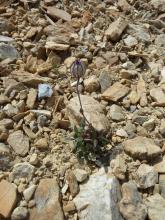
It would be interesting to see another photo later on when it's in seed.
cohan (not verified)
Re: Seed starting chronicles 2012
Mon, 10/22/2012 - 10:47amIts a cutie, Dave!
Trond Hoy
Re: Seed starting chronicles 2012
Mon, 10/22/2012 - 1:41pmA handsome little cutie, Dave! Much better than most native Silenes here ;)
Mark McDonough
Re: Seed starting chronicles 2012
Mon, 10/22/2012 - 2:48pmDave - congratulations on flowering Silene petersonii, it's one that I have always wanted to grow.
Found an excellent image of Silene petersonii, the plants growing among a jumble or rock, alongside the North Loop trail on the NW slope of Charleston Peak, Spring Mountains, southern Nevada (elev. about 3500 m).
On this wikipedia page, there are a number of images sizes, select a large image to see the details.
http://commons.wikimedia.org/wiki/File:Silene_petersonii_1.jpg
Amy Olmsted
Re: Seed starting chronicles 2012
Tue, 10/23/2012 - 4:45amI think I'll have to try that neat little Silene! And wouldn't you know we sell them at Rocky Dale Gardens! It has nevered flowered in the pot and looked a bit on the weak side so I didn't take much interest. The plants came from Sunny Border and they use a pretty heavy mix. A repotting with a much lighter soil mix might be in order for these to do their best.
Toole (not verified)
Re: Seed starting chronicles 2012
Sun, 12/02/2012 - 11:11pmThanks all regarding the Silene --it never set seed ........ :'(
Here's an Ixiolirion tataricum flowering from my own 'home' seed . :P :P
Cheers Dave.
Lori S. (not verified)
Re: Seed starting chronicles 2012
Tue, 01/29/2013 - 11:39amComparing my methods and results to yours in general, it appears to be the scarification that's the key, not the soaking. I don't soak any pea family seeds (or any other seeds with exception of a few drops of GA-3 solution for gentians), yet get comparably rapid germination.
Pages