Amy, The variety odorata has been separated out into a different species from cernua. If you really want to know you will have to get out a ruler and take some measurements. I have read that 'Chadds Ford' originated in Delaware. Delware is within the range of both S. cernua and S. odorata. I would not trust the label from the nursery. Some of the best botanists in the country have trouble correctly identifying Spiranthes.
It is very possible that S. odorata is hardy in Vermont. Mark makes a very good case with his trillium example. I grew 'Chadds Ford' in a pot in Illinois. It survived the first season but not the second. Maybe it would have survived if I had planted it in the ground.
In stark contrast to events in the US, we are having the mildest November weather for over 100 years. At the weekend, I counted over 80 species still in flower. Here are a selection (see the file names for ID):
I know I said my bunnies like to stay in the backyard where there is more cover. This picture of a bunny in my front yard is making a liar out of me. I am posting it anyway because it is too cute.
I think this little guy abandoned his hiding place because he was cold. The mulch is a much drier place to sit than in wet grass. The shrub also offered some cover from the rain.
...and this gave me the opportunity to make a seasonally untypical flowery salad!
Stephen, what kind of dressing and seasoning do you put on such a flowery salad? I wonder what it is like to eat such a thing when I see these attractive salads you show us. Do you ever stir-fry those types of ingredients?
You certianly have lots in flower still! The funny thing is, here too, we've had a very long warm (sometimes hot) autumn, no frost until near the end of October, many very warm summer-like days, then our freak snowstorm just before Halloween on Oct. 30th, and a week of nighttime temperatures dipping below freezing but days still sunny and warm to the mid 50s F, followed by a recent succession of sunny days in the 60s and even up to 70 F.
However, the 14" snow and sudden freezing pretty much put the kabosh (http://www.urbandictionary.com/define.php?term=KABOSH) on the season, and most things are done blooming, with the exception of one late Allium thunbergii form, a tall Aconitum sp, several autumn crocus, a single Galanthus reginae-olgae bloom, and of course Corydalis lutea which never stops blooming until the ground is solidly frozen. The autumn seasons have been peculiar in recent years, this year no exception, where deciduous trees and shrubs seem confused, not dropping their foliage in timely manner, fall color not as good as normal or skipped on some plants, the late leaf drop making them more susceptible to winter storm breakage.
Euonymus alatus 'Compactus', growing outside my dining room window suddenly turned brilliant color, after staying totally green until rather late in the season and giving little indication it would color up, Here are two photos from today, one taken from inside, the other outside.
Mark: I use a simple dressing of (outsourced!) olive oil, wine vinegar, salt and pepper with some crushed home-grown garlic. The flowers are undressed, added after the dressing... I've served this kind of diversity salad many times over the last 10 years or so, usually with upwards of 100 species and only one person has declared (openly) that they disliked it (and that was before said person even tried it). This one only had 30 species as darkness descended before I was finished...
I was astonished by how quickly the snow disappeared in your garden and greenery returned! We finally had a proper frost today - had to turn back on my bikeride to work as it was dangerously slippery (still using my summer bicycle without studs in the tyres!)
We have very nice weather now - and it has lasted a week! Although the night temperature has fallen to 2-5C the day temperature is still nice. And there is absolutely no wind; we are not familiar with this kind of weather ;D
A leaf of the tulip tree with dew and the last leaves of the tree against a clear blue sky!
[attachthumb =1]
I am no rosegrower roses usually don't like the maritime climate here as you can see of the blackspots infested leaf of the rose (Blaze). But it flowers all summer and autumn.
Ouch! That Euonymus, Mark, is painful to the eyes! We have them in great color around Denver right now too, although we don't have that glowy Maritime air that makes things brighter (you cheaters!)...
We are having a wonderful bout of Indian summer, highs in the sixties F, but still chilly at night (we had 8" snowfalls last week and the week before: there are still big mounds of snow in parking lots!), but plants are rousing a bit with the sun and warmth, although we've been having nights in the low 20F and even dipping into the teens: fascinating to see what can take that...below you can see that there are quite a few things out. All were taken yesterday (the memorable date of 11-11-11), and today I noticed that a new patch of Crocus nudiflorus just opened up and one Crocus banaticus, although the other patches of both of these were blooming over a month ago! Go figure...
1) First picture is of an unspotted individual of Gazania linearis blooming at Denver Botanic Gardens yesterday. This can bloom every month in the winter if we have long enough thaws... 2) The gazania's cousin, Hirpicium armerioides, is blooming in several spots. It always amazes me how late this likes to bloom (although we can have flowers opening in May too!). 3) I've noticed flowers on a half dozen species of Delosperma, this being typical (they all look a bit tatty). Not something to plant for winter flowers obviously! Unlike the many winter flowering cousins in Rabiea, Ebracteola, Titanopsis, which are budding up! And only bloom in winter. 4) Now for the real glories: the crocuses Crocus goulimyi is out in force! ONe of my faves. 5) Lots of flowers still out on Crocus speciosus everywere at DBG and at my house... 6) Cyclamen hederifolium still has a few feeble flowers out today. 7) And even 'Waterlily' produced some fresh bloom... 8) I end with Geranium harveyi: no flowers, but who needs flowers with foliage like this? My favorite geranium by far because of those silvery leaves....now if it were only reliably hardy (most of the plant dies most winters, but some piece regenerates it...and the occasional seedling pops up. Hopefully with hardier genes selected out!) Can't find my picture of our lingering rose...oh well. This ought to be enough to prove the plains are not completely desolate in November!
PK, lots of stuff still blooming for you! I tried Geranium harveyi a couple times, but each time it didn't overwinter, too bad, as the foliage is indeed wonderful. Also, our weather sounds similar to yours, a brief and damaging interlude with winter for a couple days (14" freak pre-Halloween snowstorm) followed by more Indian summer days. It's finally turned seasonably brisk... almost all the Euonymus leaves shed the following day.
Remarkable what the sun does ;D Although we have had much sunny weather the last weeks, the sun is so low in the sky that it doesn't bring much warmth to my garden.
The Indian summer is going on and on...which is a blessing for me since I still have a few last flats to plant. Although I finally did get in my last hundred bulbs or so yesterday! We had a bit of a windstorm that blew many leaves off, but the rowans, the oaks and the Ussurian and Bradford pears are really glowing in scarlets, gold and purple (everyone is badmouthing the pears hereabouts--they shattered in the heavier snow load areas, but they seem to recover amazingly)...A few more pix from the last few luminous days (almost falling in love with November: no mean feat!)
1) burnished pears on my commute to work 2) Crocus speciosus 'Albus' has been blooming for five weeks or more: I was shocked to see more flowers emerge on this (as well as fresh flowers on C. nudiflorus and C. banaticus) in the last week...what other surprises are lurking this month? 3) I noticed a large new patch of Crocus speciosus out in the Perennial Border at the Gardens, and me without my camera: there had to be a hundred fresh flowers in a square yard... 4) Agave havardiana in the Watersmart Garden: not blooming, but the rosette looks just like a giant gray rose! Boy, do the agaves pay rent this time of year! 5) A lingering rose alongside newly planted pansies along the "Orangerie": our recent capital project has replaced an area that was an eyesore with a stunning , vast new garden and greenhouse complex. We can't get over the transformation! 6) At least six species of Delosperma have lingering flowers...real "ice" plants (they do freeze every night!) 7) Although technically in seed (or nearly in seed) Vernonia lindheimeri is prettier than most flowers right now! What a great plant this is. 8) A bird planted Berberis thunbergii near the entrance to the Rock Alpine Garden. It's been therer for decades: when it turns golden in fall, it is a beacon. 9) Annually it covers with thousands of berries all winter, attracting no end of interest and questions: I got so sick of saying "It's Berberis thungbergii"...amazing that a plant that is banned nowadays in much of the USA because of its invasive tendencies could be so admired! I have to admit I am one of the admirers, however grudging. 10) The rainmaker and other sculptures by Alan Hauser are all being removed this week: it is sad to see them lined up oin the parking lot in a sort of rogues gallery. Next year, Japanese artists will be doing something new and strange (II understand)...and negotiations are going on with Chihuly for another year beyond...meanwhile plants pose sculpturally with little hoopla and expense!
Panayoti, I'm totally smitten with your photo of Vernonia lindheimeri, and a bit puzzled by the color. Is the lovely old burgandy color just a temporary dried state where the flower color fades to seed heads. I have searched online, but I can't find anything that comes close to that awesome color as shown in your photo. To give context to the links I posted below, here's a link to Panayoti's original photo to compare: http://nargs.org/smf/index.php?action=dlattach;topic=274.0;attach=24544;...
Due to the strong silver color of the leaves, do you think it is actually Vernonia lindheimeri v. leucophylla? I photographed several Vernonia species at Garden In The Woods in Massachusetts in late summer, including the Arkansas native V. lettermannii, and if I have time will post them here... some really interesting species, and they're not all giants.
It looks like the plant near the Garrya flavescens at DBG. Mike Kintgen identified it as Vernonia larsenii. Lindheimeri, larsenii, whatever. I like it. I wonder if it still has seed. Hmm. I own a car, and a coat with pockets. And I always maintain a very innocent expression on my face. As is evident by the "avatar". Bob
Our worst iweeds (cheatgrass and all the classic rabble of chenopods and suchlike) were hitchhikers on crops.
We horticulturists can sleep soundly in the Rockies! It's the agronomists who should be having nightmares (and developers, miners and recreational vehicle yahoos who tear up the desert)...
On my garden walk recently some of the plants just want to sleep but some are visibly preparing for next spring - just can't wait to get on with things..e.g. Arum italicum. Brought back as a plant (bare rooted of course) from Wisley Garden in UK, it has not only survived but just got better and better. I must be doing something right?? Fran
Notice: Topic Split(s) The latest lengthy discussions about invasive species has been moved to it's own topic, to keep this topic on track. http://nargs.org/smf/index.php?topic=830.0
On my garden walk recently some of the plants just want to sleep but some are visibly preparing for next spring - just can't wait to get on with things..e.g. Arum italicum. Brought back as a plant (bare rooted of course) from Wisley Garden in UK, it has not only survived but just got better and better. I must be doing something right?? Fran
Frances Howey London, Ontario, Canada Zone 5b
Fran, that's a noteworthy report... if Arum italicum is hardy for you it must be hardy here too, lovely winter foliage. As I walk around the garden this time of year, it is mostly the few evergreen plants that provide pleasure, the many evergreen Epimediums looking fine right now, some coloring up nicely. It gives me an idea, to consider introducing Arum to a mixed planting with variegated Cyclamen purpurescens and variegated Viola grypoceras var. exilis, see: http://nargs.org/smf/index.php?topic=781.msg11521#msg11521
For those who have grown this in a fairly cold northern climate, how hardy is it, and can someone comment on how aggressively or moderately it spreads.
If it likes you Arum italicum can spread alarmingly by seed and can be prone to appear in the middle of more choice plants! It delves very deep. On the other hand it makes very nice company with other woodland perennials and I wouldn't be without it!
If it likes you Arum italicum can spread alarmingly by seed and can be prone to appear in the middle of more choice plants! It delves very deep. On the other hand it makes very nice company with other woodland perennials and I wouldn't be without it!
Thanks for the advice Tim. It might be something similar to warnings about Pinellia pedatisecta, or the genus Pinellia in general, however I've had P. pedatisecta for many years, it has barely spread at all.
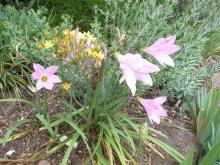
We're heading out of spring into another hot summer but maybe not as dry as our drought years. There are still plenty of flowers to see when we walk in our garden. Firstly, here's a bulb from North America, good ol' Triteleia laxa
Another Triteleia, this time T. ixioides with the magnificent Habranthus robustus "Russell Manning"
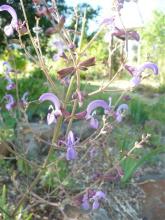
A "volunteer" in the bulb bed - some sort of Salvia and quite attractive.
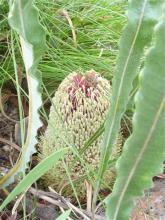
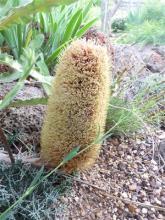
A marvelous ground-hugging banksia, B. petiolaris,
Fermi, the last one, the Banksia, is a gem! I have always wanted to try some Banksias and other Proteaceaes but never succeeded. How hardy is B petiolaris?
[i]A. italicum appears perfectly hardy here in Centra lNew York and has not spread aggressively in the three years it's been in the ground. We are in the snow belt and usually have good snow cover in winter. They are looking quite beautiful right now.
Hardly any banksias could be said to be really hardy - the only species grown in the UK (except in the very mild south-west) is the Tasmanian B. marginata. A few others are probably nearly as hardy (maybe to -10°C or a little below) but so few gardeners grow them. But the more tender species do very well in large pots kept overwinter in a cool greenhouse, and the foliage of many of them is spectacular, let alone the flowers! In 'Banksias' by Kevin Collins, Kathy Collins & Alex George B. petiolaris is described as 'quite frost hardy', which probably means short intervals to around -5°C. Some of the dryandras are very good too, and smaller and more manageable in a greenhouse.
Hardly any banksias could be said to be really hardy
True. Life isn't fair. If someone wants to take up a collection....for me....to buy a decaying villa on the Italian Riviera, I'll be happy to grow as many banksias (and hakeas and proteas) as I can, and report back.
One of Cindy's most prized books was a signed copy of Celia Rosser's banksia book. Stunning watercolors of some totally cool plants.
Fermi, the last one, the Banksia, is a gem! I have always wanted to try some Banksias and other Proteaceaes but never succeeded. How hardy is B petiolaris?
Hi Trond, Tim has given the best advice (apart from Bob's suggestion of moving!) for growing these in your climate. We experience occasional to frequent frosts of -7oC but mostly around -3oC, so it would hardly be the same for you. Where we are on the east side of Australia we have problems with the flamboyant species from Western Australia but we're trying whatever ones come our way in raised beds and sand-beds with some success (and some losses!). cheers fermi
Thank you Bob and Fermi. Probably it is safer to grow Banksias and relatives in pots, however, if the temperature continue to rise like this fall I end up growing tropical plants in my garden ;D The coldest night and the only one below 0C so far this autumn is -0.7C! The last two winters were exceptionally cold, usually we experience -7 - -8C some days in row but not for long. The mean temperature for the coldest month is February with +0.5C. However the main problem is lack of high summer temperatures. . . .and of course getting seed/plants!
Bob - I have a fine copy of Celia Rosser's 'The Banksias' Vol III published by Monash University. I don't think I've seen such fine botanical paintings, even from the masters of old. They are quite extraordinary. I've seen the originals at the Natural History Museum and they took my breath away. I had quite an interest in these plants some years ago and grew a number of species (along with the incomparable 'Silver Tree' from South Africa). They were quite amenable in very sandy acid soil in large pots and have fascinating adaptations for such poor soils. They are also very long flowering and intriguing to watch as the flowering head develops. The sort of plant that makes you wish you had the Mediterranean biome of the Eden Project in your back garden!!
[i]A. italicum appears perfectly hardy here in Central New York and has not spread aggressively in the three years it's been in the ground. We are in the snow belt and usually have good snow cover in winter. They are looking quite beautiful right now.
Thanks Harold, this is important feedback, exactly what I was hoping to hear, and since your climate is rather similar to mine, it's all the more encouraging to learn of your experience with Arum italicum. There are a number of plants like this, that in more southern climes plants grow and spread too aggressively, but when reaching their northern hardiness limit are much better behaved (they're in check or balance with the climate), thus perfectly reasonable to introduce into the garden without trepidation. At the moment with the growing season at its end, I'm so enjoying evergreen plants that provide interest and color, such as evergreen and semi-evergreen Epimedium, Pulmonaria foliage, and Cyclamen foliage; hope to add the Arum in the near future.
Hardly any banksias could be said to be really hardy
True. Life isn't fair. If someone wants to take up a collection....for me....to buy a decaying villa on the Italian Riviera, I'll be happy to grow as many banksias (and hakeas and proteas) as I can, and report back.
One of Cindy's most prized books was a signed copy of Celia Rosser's banksia book. Stunning watercolors of some totally cool plants.
Bob
I hear ya Bob, I've come to terms with what I can reasonably grow and not grow (although still quite willing to experiment). When I visited Strybing Arboretum in San Francisco, California, my head spins with all of the fabulous plants like Banksia, Protea, Leucadendron, and innumerable others. Even when I visit my in-laws in the Baltimore Maryland - Washington DC area, I marvel at spectacular Magnolia grandiflora trees, growing just like any other common oak or maple, each specimen is a horticultural spectacle. Here in Massachusetts, I'm amused by the few examples of this species I see planted (near Boston), each year cut back and "bonsai'd", having no chance to even begin to replicate their splendor just 500 miles to the south. So far, what I've seen of so-called hardy M. grandiflora in Massachusetts are pathetic, although I admit that I have not seen any on Cape Cod or the islands (Martha's Vineyard) where supposedly nice specimens do grow, but such areas are easily 1 full zone higher than where I am. I'd rather rejoice in Magnolia grandiflora's magnificence when visiting my wife's family, than struggle with something that truly doesn't succeed this far north.
I can't seem to find my picture of Magnolia grandiflora I took last year in Lakewood, Colorado (just west of Denver)...there are several large grandifloras around my area looking pretty respectable. The one in Lakewood is about 20 years old and nearloy 30' tall, and very full and showing no winter damage in our zoned 5B. As a consolation I am posting my picture of Magnolia virginiana v. glauca in seed: this is off the state champion specimen at Denver Botanic Gardens: I think both of these are viable trees in Denver.
I really must add Magnolia virginiana to my garden, there are a number of good forms. Never makes a big floral impression but the flowers are lovely, fragrant, and appear over a long and late season. I meant to post photos earlier in the year of my first flowering on Magnolia sieboldii- Korean form (grown from Magnolia Society seed, I believe in their 4th or 5th year from seed). Flowers started the end of May and kept on coming all through June. Wonderful fragrance and pristine blooms.
That's really a beautiful form, Mark. Flowers are more upright than any of the ones I have seen. And doubly awesome, considering they are maiden flowers! It seems quite precocious, too.
My Magnolia sieboldii flowers are completely pendent. :(
Mark, I have never really considered to try magnolia from seed. However after seeing your plants I've got courage to try! I bought 4-5 specimens in the fall sale and hope for at least some flowers ;)
We have had some very bad weather recently. Last night a hailstorm from northwest made it difficult to sleep. However no damage in my garden and no frost yet except one night down to -0.7C. But the weather forecast says snow next week ???
Some plants have set out on an early spring growth. Leucojum vernum is not native in Norway but has been used here as a garden plant in 1k years! Erica carnea is not that old as a garden plant but is completely hardy and starts blooming with the first sun in winter. And of course the hellebores, always some in flower ;D All pictures taken today.
The Magnolia flowers are truly exquisite! We grew a batch of seed from Jim Archibald of sieboldii and I was amazed how quickly they started to flower, having heard tales of how so many can take decades to reach flowering size. A friend has been growing campbellii (or a hybrid) in his garden for some 15 years and is excited by the first signs of flower buds this autumn.
Magnolia seed does not have to be kept moist like an ehemeral, but they don't like to be dried out too much either. They say it is best to remove the pulp, but in my one experience growing M. sieboldii from seed from my tree: about 100 seeds gave 100% germination (I think) with natural cold stratification and without pulp removed.
Our local Magnolia guru, Stephen Cover (runs the Magnolia Society seed exchange) gives directions for Magnolia seed. He suggests soaking the seed in water for several days to a week, to soften up the fleshy outer cover. The water gets plenty putrid, so best to change the water a couple times. Then squish the big black seed out, like pitting olives, a messy job. Towel dry the seed, then store in zip-lock baggies with sphagnum and just a hint of moisture, put them in your vegetable drawer in the fridge for the winter. When weather has warmed up in spring after most danger of frost, sow, water, leave the flats outside, and they come up quickly, they don't need any stratification (tho' it could be that stratification doesn't hurt). I do get a few self sown Magnolia as well (rare), so I don't know whether the pulp truly needs to be removed or not.
Rick, I didn't get seed on my young M. sieboldii, but when I do some year, I'll try an experiment sowing with and without de-pulping. It is interesting that you get such strong germination without removing the pulp. Most M. sieboldii trees I have seen in person, have had pendant flowers... nice to have them look straight out on this Korean form.
Tim, I have other Magnolia trees grown from seed or bought as young whips, and years have gone by without any bud set, even though the trees are getting big; so I was indeed pleased to get buds on little M. sieboldii plants so quickly.
He suggests soaking the seed in water for several days to a week...then store in zip-lock baggies with sphagnum and just a hint of moisture, put them in your vegetable drawer in the fridge for the winter.
--- This IS cold stratification. ;D Most of the time, the method is to place dry seed in a moist medium for a cold period, during which time the seed absorbs moisture and does its chemical transformations. Since the magnolia seeds have already imbibed all the water they will take, they need only be kept from dehydrating while in the fridge.
He suggests soaking the seed in water for several days to a week...then store in zip-lock baggies with sphagnum and just a hint of moisture, put them in your vegetable drawer in the fridge for the winter.
--- This IS cold stratification. ;D Most of the time, the method is to place dry seed in a moist medium for a cold period, during which time the seed absorbs moisture and does its chemical transformations. Since the magnolia seeds have already imbibed all the water they will take, they need only be kept from dehydrating while in the fridge.
Thanks Rick, I had assumed stratification referred to actually freezing the seed in some medium to simulate winter conditions, but that's not necessarily the case, I'm embarrassed to admit :-[.
In the following link, Southern Magnolia (M. grandiflora) is mentioned, with the suggestion to remove the pulp, with moist pre-chilling period of 2-4 months. http://www.ces.ncsu.edu/depts/hort/hil/hil-8704.html The seed germinates like beans in a week or two in the spring.
indeed. I have only had one experience growing any magnolia seed. Hardly anything to make an assumption about. Just sayin'.
For the benefit of all: Actual freezing is not part of cold stratification. The whole point of cold seed stratification is to allow chemical processes that only occur (or occur efficiently) at cold temperatures, to go forward. Within the seed, these processes remove their associated chemical inhibitions to germination so the seed can subsequently sprout. Even Dr. Deno could never say what that exact best temperature is, only that it is about 40F (4C). When a seed is frozen, the chemical processes that are triggered at these temperatures stop.
It is interesting to note that often distributions of a species in very cold areas need less stratification time than the same species from a warmer region. This is because a much greater percentage of the species northern distribution's winter is in a frozen state, when the stratification processes are halted. Therefore, even though the winter is longer, the usable stratification temperatures occur only in the fall-to-winter and winter-to-spring intervals - resulting in a much shorter cumulative time frame.
Contrast this with the warmer climate, where the ground may hardly freeze at all: cold temperatures hover above freezing for a much longer time period, through most of the winter. The species phenotype native here, would adapt to requiring a longer cold stratification interval to match its climate.
--- This IS cold stratification. ;D Most of the time, the method is to place dry seed in a moist medium for a cold period, during which time the seed absorbs moisture and does its chemical transformations. Since the magnolia seeds have already imbibed all the water they will take, they need only be kept from dehydrating while in the fridge.
And to add to this, "stratification" (or "conditioning", which is the term Dr. Deno seems to prefer in his publications, in the sense of getting the seeds into the condition where germination can occur due to the breakdown of chemical inhibitors) may also begin with a warm period, followed by a cold period for some species, and sometimes repetition of the cycle is needed. Dr. Deno's publications are fascinating reading!
A few alpines producing flowers rather early! Our autumn has been exceptionally long and mild, only just now beginning to get light frosts. Rather nice to see a gentian in December!
Summer :o it is still one week till the sun "turns". It is dark when I leave home in the morning and dark when I come home in the evening! Still, nice to see your lilies, Fermi, reminds me that winter has an end.
Raised from seed sown November 08-- Dicentra peregrina with 4 flowers so far .
At one stage a few seasons back i had about 25 small seedling plants coming along --yes i was going to rule the world i thought ;D,(well at least my little patch down here in New Zealand.... :rolleyes: ;) ), but as befalls the 'plans of mice and men' they all, including a couple of good sized parent plants i had coaxed on for a number of years, perished over a winter..... :'( :'(



Comments
Mark McDonough
Re: What do you see on your garden walks?
Mon, 11/07/2011 - 6:35pmSee the earlier thread:
http://nargs.org/smf/index.php?topic=232.msg11449#msg11449
Anonymous (not verified)
Re: What do you see on your garden walks?
Mon, 11/07/2011 - 8:25pmAmy, The variety odorata has been separated out into a different species from cernua. If you really want to know you will have to get out a ruler and take some measurements. I have read that 'Chadds Ford' originated in Delaware. Delware is within the range of both S. cernua and S. odorata. I would not trust the label from the nursery. Some of the best botanists in the country have trouble correctly identifying Spiranthes.
It is very possible that S. odorata is hardy in Vermont. Mark makes a very good case with his trillium example. I grew 'Chadds Ford' in a pot in Illinois. It survived the first season but not the second. Maybe it would have survived if I had planted it in the ground.
James
Stephen Barstow
Re: What do you see on your garden walks?
Tue, 11/08/2011 - 1:08amIn stark contrast to events in the US, we are having the mildest November weather for over 100 years. At the weekend, I counted over 80 species still in flower. Here are a selection (see the file names for ID):
Stephen Barstow
Re: What do you see on your garden walks?
Tue, 11/08/2011 - 1:10am..and a few more. Viola canadensis has been continuously in flower since May!
Stephen Barstow
Re: What do you see on your garden walks?
Tue, 11/08/2011 - 1:13am...and this gave me the opportunity to make a seasonally untypical flowery salad!
Anonymous (not verified)
Gardening With Rabbits
Tue, 11/08/2011 - 10:32amI know I said my bunnies like to stay in the backyard where there is more cover. This picture of a bunny in my front yard is making a liar out of me. I am posting it anyway because it is too cute.
I think this little guy abandoned his hiding place because he was cold. The mulch is a much drier place to sit than in wet grass. The shrub also offered some cover from the rain.
Trond Hoy
Re: What do you see on your garden walks?
Tue, 11/08/2011 - 1:30pmFargerik salat, Stephen!
What about bunny meat to the salad?
Mark McDonough
Re: What do you see on your garden walks?
Thu, 11/10/2011 - 9:35amStephen, what kind of dressing and seasoning do you put on such a flowery salad? I wonder what it is like to eat such a thing when I see these attractive salads you show us. Do you ever stir-fry those types of ingredients?
You certianly have lots in flower still! The funny thing is, here too, we've had a very long warm (sometimes hot) autumn, no frost until near the end of October, many very warm summer-like days, then our freak snowstorm just before Halloween on Oct. 30th, and a week of nighttime temperatures dipping below freezing but days still sunny and warm to the mid 50s F, followed by a recent succession of sunny days in the 60s and even up to 70 F.
However, the 14" snow and sudden freezing pretty much put the kabosh (http://www.urbandictionary.com/define.php?term=KABOSH) on the season, and most things are done blooming, with the exception of one late Allium thunbergii form, a tall Aconitum sp, several autumn crocus, a single Galanthus reginae-olgae bloom, and of course Corydalis lutea which never stops blooming until the ground is solidly frozen. The autumn seasons have been peculiar in recent years, this year no exception, where deciduous trees and shrubs seem confused, not dropping their foliage in timely manner, fall color not as good as normal or skipped on some plants, the late leaf drop making them more susceptible to winter storm breakage.
Euonymus alatus 'Compactus', growing outside my dining room window suddenly turned brilliant color, after staying totally green until rather late in the season and giving little indication it would color up, Here are two photos from today, one taken from inside, the other outside.
Stephen Barstow
Re: What do you see on your garden walks?
Fri, 11/11/2011 - 4:00amMark: I use a simple dressing of (outsourced!) olive oil, wine vinegar, salt and pepper with some crushed home-grown garlic. The flowers are undressed, added after the dressing... I've served this kind of diversity salad many times over the last 10 years or so, usually with upwards of 100 species and only one person has declared (openly) that they disliked it (and that was before said person even tried it). This one only had 30 species as darkness descended before I was finished...
I was astonished by how quickly the snow disappeared in your garden and greenery returned! We finally had a proper frost today - had to turn back on my bikeride to work as it was dangerously slippery (still using my summer bicycle without studs in the tyres!)
Trond Hoy
Re: What do you see on your garden walks?
Fri, 11/11/2011 - 10:11amWe have very nice weather now - and it has lasted a week! Although the night temperature has fallen to 2-5C the day temperature is still nice. And there is absolutely no wind; we are not familiar with this kind of weather ;D
A leaf of the tulip tree with dew and the last leaves of the tree against a clear blue sky!
[attachthumb =1]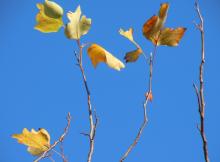
I am no rosegrower roses usually don't like the maritime climate here as you can see of the blackspots infested leaf of the rose (Blaze). But it flowers all summer and autumn.
Panayoti Kelaidis
Re: What do you see on your garden walks?
Sat, 11/12/2011 - 4:56pmOuch! That Euonymus, Mark, is painful to the eyes! We have them in great color around Denver right now too, although we don't have that glowy Maritime air that makes things brighter (you cheaters!)...
We are having a wonderful bout of Indian summer, highs in the sixties F, but still chilly at night (we had 8" snowfalls last week and the week before: there are still big mounds of snow in parking lots!), but plants are rousing a bit with the sun and warmth, although we've been having nights in the low 20F and even dipping into the teens: fascinating to see what can take that...below you can see that there are quite a few things out. All were taken yesterday (the memorable date of 11-11-11), and today I noticed that a new patch of Crocus nudiflorus just opened up and one Crocus banaticus, although the other patches of both of these were blooming over a month ago! Go figure...
1) First picture is of an unspotted individual of Gazania linearis blooming at Denver Botanic Gardens yesterday. This can bloom every month in the winter if we have long enough thaws...
2) The gazania's cousin, Hirpicium armerioides, is blooming in several spots. It always amazes me how late this likes to bloom (although we can have flowers opening in May too!).
3) I've noticed flowers on a half dozen species of Delosperma, this being typical (they all look a bit tatty). Not something to plant for winter flowers obviously! Unlike the many winter flowering cousins in Rabiea, Ebracteola, Titanopsis, which are budding up! And only bloom in winter.
4) Now for the real glories: the crocuses Crocus goulimyi is out in force! ONe of my faves.
5) Lots of flowers still out on Crocus speciosus everywere at DBG and at my house...
6) Cyclamen hederifolium still has a few feeble flowers out today.
7) And even 'Waterlily' produced some fresh bloom...
8) I end with Geranium harveyi: no flowers, but who needs flowers with foliage like this? My favorite geranium by far because of those silvery leaves....now if it were only reliably hardy (most of the plant dies most winters, but some piece regenerates it...and the occasional seedling pops up. Hopefully with hardier genes selected out!)
Can't find my picture of our lingering rose...oh well. This ought to be enough to prove the plains are not completely desolate in November!
Mark McDonough
Re: What do you see on your garden walks?
Sat, 11/12/2011 - 5:20pmPK, lots of stuff still blooming for you! I tried Geranium harveyi a couple times, but each time it didn't overwinter, too bad, as the foliage is indeed wonderful. Also, our weather sounds similar to yours, a brief and damaging interlude with winter for a couple days (14" freak pre-Halloween snowstorm) followed by more Indian summer days. It's finally turned seasonably brisk... almost all the Euonymus leaves shed the following day.
Trond Hoy
Re: What do you see on your garden walks?
Sun, 11/13/2011 - 9:06amRemarkable what the sun does ;D
Although we have had much sunny weather the last weeks, the sun is so low in the sky that it doesn't bring much warmth to my garden.
Panayoti Kelaidis
Re: What do you see on your garden walks?
Mon, 11/14/2011 - 10:20pmThe Indian summer is going on and on...which is a blessing for me since I still have a few last flats to plant. Although I finally did get in my last hundred bulbs or so yesterday! We had a bit of a windstorm that blew many leaves off, but the rowans, the oaks and the Ussurian and Bradford pears are really glowing in scarlets, gold and purple (everyone is badmouthing the pears hereabouts--they shattered in the heavier snow load areas, but they seem to recover amazingly)...A few more pix from the last few luminous days (almost falling in love with November: no mean feat!)
1) burnished pears on my commute to work
2) Crocus speciosus 'Albus' has been blooming for five weeks or more: I was shocked to see more flowers emerge on this (as well as fresh flowers on C. nudiflorus and C. banaticus) in the last week...what other surprises are lurking this month?
3) I noticed a large new patch of Crocus speciosus out in the Perennial Border at the Gardens, and me without my camera: there had to be a hundred fresh flowers in a square yard...
4) Agave havardiana in the Watersmart Garden: not blooming, but the rosette looks just like a giant gray rose! Boy, do the agaves pay rent this time of year!
5) A lingering rose alongside newly planted pansies along the "Orangerie": our recent capital project has replaced an area that was an eyesore with a stunning , vast new garden and greenhouse complex. We can't get over the transformation!
6) At least six species of Delosperma have lingering flowers...real "ice" plants (they do freeze every night!)
7) Although technically in seed (or nearly in seed) Vernonia lindheimeri is prettier than most flowers right now! What a great plant this is.
8) A bird planted Berberis thunbergii near the entrance to the Rock Alpine Garden. It's been therer for decades: when it turns golden in fall, it is a beacon.
9) Annually it covers with thousands of berries all winter, attracting no end of interest and questions: I got so sick of saying "It's Berberis thungbergii"...amazing that a plant that is banned nowadays in much of the USA because of its invasive tendencies could be so admired! I have to admit I am one of the admirers, however grudging.
10) The rainmaker and other sculptures by Alan Hauser are all being removed this week: it is sad to see them lined up oin the parking lot in a sort of rogues gallery. Next year, Japanese artists will be doing something new and strange (II understand)...and negotiations are going on with Chihuly for another year beyond...meanwhile plants pose sculpturally with little hoopla and expense!
Mark McDonough
Re: What do you see on your garden walks?
Wed, 11/16/2011 - 6:34pmPanayoti, I'm totally smitten with your photo of Vernonia lindheimeri, and a bit puzzled by the color. Is the lovely old burgandy color just a temporary dried state where the flower color fades to seed heads. I have searched online, but I can't find anything that comes close to that awesome color as shown in your photo. To give context to the links I posted below, here's a link to Panayoti's original photo to compare:
http://nargs.org/smf/index.php?action=dlattach;topic=274.0;attach=24544;...
Due to the strong silver color of the leaves, do you think it is actually Vernonia lindheimeri v. leucophylla? I photographed several Vernonia species at Garden In The Woods in Massachusetts in late summer, including the Arkansas native V. lettermannii, and if I have time will post them here... some really interesting species, and they're not all giants.
Googling around, I gathered up some Vernonia lindheimeri links:
http://www.sbs.utexas.edu/bio406d/images/pics/ast/vernonia_lindheimeri.htm
http://davesgarden.com/guides/pf/showimage/142039/
Vernonia lindheimeri v. leucophylla
http://www.highcountrygardens.com/catalog/product/97308/
http://blog.highcountrygardens.com/archives/1084
Vernonia lindheimeri at Lady Bird Johnson Wildflower Center:
...budded:
http://www.wildflower.org/gallery/result.php?id_image=11480
...flowers:
http://www.wildflower.org/gallery/result.php?id_image=16181
...dried heads:
http://www.wildflower.org/gallery/result.php?id_image=27718
Any seed available? (wink wink nod nod)
Robert Nold
Re: What do you see on your garden walks?
Wed, 11/16/2011 - 6:40pmIt looks like the plant near the Garrya flavescens at DBG. Mike Kintgen identified it as Vernonia larsenii.
Lindheimeri, larsenii, whatever. I like it.
I wonder if it still has seed. Hmm. I own a car, and a coat with pockets. And I always maintain a very innocent expression on my face. As is evident by the "avatar".
Bob
John P. Weiser
Re: What do you see on your garden walks?
Wed, 11/16/2011 - 9:35pmHear! Hear!! Don't forget whitetop (Lepidium draba)
Howey (not verified)
Re: What do you see on your garden walks?
Thu, 11/17/2011 - 3:32amOn my garden walk recently some of the plants just want to sleep but some are visibly preparing for next spring - just can't wait to get on with things..e.g. Arum italicum. Brought back as a plant (bare rooted of course) from Wisley Garden in UK, it has not only survived but just got better and better. I must be doing something right?? Fran
Frances Howey
London, Ontario, Canada
Zone 5b
Mark McDonough
Re: What do you see on your garden walks?
Wed, 11/23/2011 - 7:50amNotice: Topic Split(s)
The latest lengthy discussions about invasive species has been moved to it's own topic, to keep this topic on track.
http://nargs.org/smf/index.php?topic=830.0
Early posts debating native plants and invasives moved to:
http://nargs.org/smf/index.php?topic=833.0
Mark
nargs forum moderator
Mark McDonough
Re: What do you see on your garden walks?
Thu, 11/24/2011 - 11:57amFran, that's a noteworthy report... if Arum italicum is hardy for you it must be hardy here too, lovely winter foliage. As I walk around the garden this time of year, it is mostly the few evergreen plants that provide pleasure, the many evergreen Epimediums looking fine right now, some coloring up nicely. It gives me an idea, to consider introducing Arum to a mixed planting with variegated Cyclamen purpurescens and variegated Viola grypoceras var. exilis, see:
http://nargs.org/smf/index.php?topic=781.msg11521#msg11521
For those who have grown this in a fairly cold northern climate, how hardy is it, and can someone comment on how aggressively or moderately it spreads.
Tim Ingram (not verified)
Re: What do you see on your garden walks?
Thu, 11/24/2011 - 2:14pmIf it likes you Arum italicum can spread alarmingly by seed and can be prone to appear in the middle of more choice plants! It delves very deep. On the other hand it makes very nice company with other woodland perennials and I wouldn't be without it!
Mark McDonough
Re: What do you see on your garden walks?
Thu, 11/24/2011 - 6:35pmThanks for the advice Tim. It might be something similar to warnings about Pinellia pedatisecta, or the genus Pinellia in general, however I've had P. pedatisecta for many years, it has barely spread at all.
Fermi de Sousa
Re: What do you see on your garden walks?
Mon, 11/28/2011 - 11:30pmWe're heading out of spring into another hot summer but maybe not as dry as our drought years. There are still plenty of flowers to see when we walk in our garden.
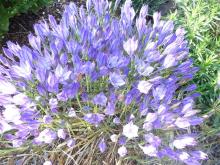
Firstly, here's a bulb from North America, good ol' Triteleia laxa
Another Triteleia, this time T. ixioides with the magnificent Habranthus robustus "Russell Manning"
A "volunteer" in the bulb bed - some sort of Salvia and quite attractive.
A marvelous ground-hugging banksia, B. petiolaris,
cheers
fermi
Trond Hoy
Re: What do you see on your garden walks?
Tue, 11/29/2011 - 2:59amFermi, the last one, the Banksia, is a gem! I have always wanted to try some Banksias and other Proteaceaes but never succeeded.
How hardy is B petiolaris?
Harold Peachey
Re: What do you see on your garden walks?
Tue, 11/29/2011 - 5:16am[i]A. italicum appears perfectly hardy here in Centra lNew York and has not spread aggressively in the three years it's been in the ground. We are in the snow belt and usually have good snow cover in winter. They are looking quite beautiful right now.
John P. Weiser
Re: What do you see on your garden walks?
Tue, 11/29/2011 - 5:57amYes I want to know also.
Tim Ingram (not verified)
Re: What do you see on your garden walks?
Tue, 11/29/2011 - 1:38pmHardly any banksias could be said to be really hardy - the only species grown in the UK (except in the very mild south-west) is the Tasmanian B. marginata. A few others are probably nearly as hardy (maybe to -10°C or a little below) but so few gardeners grow them. But the more tender species do very well in large pots kept overwinter in a cool greenhouse, and the foliage of many of them is spectacular, let alone the flowers! In 'Banksias' by Kevin Collins, Kathy Collins & Alex George B. petiolaris is described as 'quite frost hardy', which probably means short intervals to around -5°C. Some of the dryandras are very good too, and smaller and more manageable in a greenhouse.
Robert Nold
Re: What do you see on your garden walks?
Tue, 11/29/2011 - 3:39pmTrue. Life isn't fair. If someone wants to take up a collection....for me....to buy a decaying villa on the Italian Riviera, I'll be happy to grow as many banksias (and hakeas and proteas) as I can, and report back.
One of Cindy's most prized books was a signed copy of Celia Rosser's banksia book. Stunning watercolors of some totally cool plants.
Bob
Fermi de Sousa
Re: What do you see on your garden walks?
Tue, 11/29/2011 - 9:10pmHi Trond,
Tim has given the best advice (apart from Bob's suggestion of moving!) for growing these in your climate. We experience occasional to frequent frosts of -7oC but mostly around -3oC, so it would hardly be the same for you.
Where we are on the east side of Australia we have problems with the flamboyant species from Western Australia but we're trying whatever ones come our way in raised beds and sand-beds with some success (and some losses!).
cheers
fermi
Trond Hoy
Re: What do you see on your garden walks?
Wed, 11/30/2011 - 12:27pmThank you Bob and Fermi.
Probably it is safer to grow Banksias and relatives in pots, however, if the temperature continue to rise like this fall I end up growing tropical plants in my garden ;D
The coldest night and the only one below 0C so far this autumn is -0.7C! The last two winters were exceptionally cold, usually we experience -7 - -8C some days in row but not for long. The mean temperature for the coldest month is February with +0.5C. However the main problem is lack of high summer temperatures. . . .and of course getting seed/plants!
Tim Ingram (not verified)
Re: What do you see on your garden walks?
Wed, 11/30/2011 - 2:25pmBob - I have a fine copy of Celia Rosser's 'The Banksias' Vol III published by Monash University. I don't think I've seen such fine botanical paintings, even from the masters of old. They are quite extraordinary. I've seen the originals at the Natural History Museum and they took my breath away. I had quite an interest in these plants some years ago and grew a number of species (along with the incomparable 'Silver Tree' from South Africa). They were quite amenable in very sandy acid soil in large pots and have fascinating adaptations for such poor soils. They are also very long flowering and intriguing to watch as the flowering head develops. The sort of plant that makes you wish you had the Mediterranean biome of the Eden Project in your back garden!!
Mark McDonough
Re: What do you see on your garden walks?
Wed, 11/30/2011 - 6:11pmThanks Harold, this is important feedback, exactly what I was hoping to hear, and since your climate is rather similar to mine, it's all the more encouraging to learn of your experience with Arum italicum. There are a number of plants like this, that in more southern climes plants grow and spread too aggressively, but when reaching their northern hardiness limit are much better behaved (they're in check or balance with the climate), thus perfectly reasonable to introduce into the garden without trepidation. At the moment with the growing season at its end, I'm so enjoying evergreen plants that provide interest and color, such as evergreen and semi-evergreen Epimedium, Pulmonaria foliage, and Cyclamen foliage; hope to add the Arum in the near future.
Mark McDonough
Re: What do you see on your garden walks?
Wed, 11/30/2011 - 6:29pmI hear ya Bob, I've come to terms with what I can reasonably grow and not grow (although still quite willing to experiment). When I visited Strybing Arboretum in San Francisco, California, my head spins with all of the fabulous plants like Banksia, Protea, Leucadendron, and innumerable others. Even when I visit my in-laws in the Baltimore Maryland - Washington DC area, I marvel at spectacular Magnolia grandiflora trees, growing just like any other common oak or maple, each specimen is a horticultural spectacle. Here in Massachusetts, I'm amused by the few examples of this species I see planted (near Boston), each year cut back and "bonsai'd", having no chance to even begin to replicate their splendor just 500 miles to the south. So far, what I've seen of so-called hardy M. grandiflora in Massachusetts are pathetic, although I admit that I have not seen any on Cape Cod or the islands (Martha's Vineyard) where supposedly nice specimens do grow, but such areas are easily 1 full zone higher than where I am. I'd rather rejoice in Magnolia grandiflora's magnificence when visiting my wife's family, than struggle with something that truly doesn't succeed this far north.
Panayoti Kelaidis
Re: What do you see on your garden walks?
Sat, 12/03/2011 - 6:33amI can't seem to find my picture of Magnolia grandiflora I took last year in Lakewood, Colorado (just west of Denver)...there are several large grandifloras around my area looking pretty respectable. The one in Lakewood is about 20 years old and nearloy 30' tall, and very full and showing no winter damage in our zoned 5B. As a consolation I am posting my picture of Magnolia virginiana v. glauca in seed: this is off the state champion specimen at Denver Botanic Gardens: I think both of these are viable trees in Denver.
Mark McDonough
Re: What do you see on your garden walks?
Sat, 12/03/2011 - 7:51amI really must add Magnolia virginiana to my garden, there are a number of good forms. Never makes a big floral impression but the flowers are lovely, fragrant, and appear over a long and late season. I meant to post photos earlier in the year of my first flowering on Magnolia sieboldii - Korean form (grown from Magnolia Society seed, I believe in their 4th or 5th year from seed). Flowers started the end of May and kept on coming all through June. Wonderful fragrance and pristine blooms.
Richard T. Rodich
Re: What do you see on your garden walks?
Sat, 12/03/2011 - 8:46pmThat's really a beautiful form, Mark. Flowers are more upright than any of the ones I have seen. And doubly awesome, considering they are maiden flowers! It seems quite precocious, too.
My Magnolia sieboldii flowers are completely pendent. :(
Trond Hoy
Re: What do you see on your garden walks?
Sun, 12/04/2011 - 4:34amMark, I have never really considered to try magnolia from seed. However after seeing your plants I've got courage to try!
I bought 4-5 specimens in the fall sale and hope for at least some flowers ;)
We have had some very bad weather recently. Last night a hailstorm from northwest made it difficult to sleep. However no damage in my garden and no frost yet except one night down to -0.7C. But the weather forecast says snow next week ???
Some plants have set out on an early spring growth. Leucojum vernum is not native in Norway but has been used here as a garden plant in 1k years! Erica carnea is not that old as a garden plant but is completely hardy and starts blooming with the first sun in winter. And of course the hellebores, always some in flower ;D All pictures taken today.
Tim Ingram (not verified)
Re: What do you see on your garden walks?
Sun, 12/04/2011 - 8:43amThe Magnolia flowers are truly exquisite! We grew a batch of seed from Jim Archibald of sieboldii and I was amazed how quickly they started to flower, having heard tales of how so many can take decades to reach flowering size. A friend has been growing campbellii (or a hybrid) in his garden for some 15 years and is excited by the first signs of flower buds this autumn.
Richard T. Rodich
Re: What do you see on your garden walks?
Sun, 12/04/2011 - 4:54pmMagnolia seed does not have to be kept moist like an ehemeral, but they don't like to be dried out too much either. They say it is best to remove the pulp, but in my one experience growing M. sieboldii from seed from my tree: about 100 seeds gave 100% germination (I think) with natural cold stratification and without pulp removed.
Mark McDonough
Re: What do you see on your garden walks?
Sun, 12/04/2011 - 5:12pmOur local Magnolia guru, Stephen Cover (runs the Magnolia Society seed exchange) gives directions for Magnolia seed. He suggests soaking the seed in water for several days to a week, to soften up the fleshy outer cover. The water gets plenty putrid, so best to change the water a couple times. Then squish the big black seed out, like pitting olives, a messy job. Towel dry the seed, then store in zip-lock baggies with sphagnum and just a hint of moisture, put them in your vegetable drawer in the fridge for the winter. When weather has warmed up in spring after most danger of frost, sow, water, leave the flats outside, and they come up quickly, they don't need any stratification (tho' it could be that stratification doesn't hurt). I do get a few self sown Magnolia as well (rare), so I don't know whether the pulp truly needs to be removed or not.
Rick, I didn't get seed on my young M. sieboldii, but when I do some year, I'll try an experiment sowing with and without de-pulping. It is interesting that you get such strong germination without removing the pulp. Most M. sieboldii trees I have seen in person, have had pendant flowers... nice to have them look straight out on this Korean form.
Tim, I have other Magnolia trees grown from seed or bought as young whips, and years have gone by without any bud set, even though the trees are getting big; so I was indeed pleased to get buds on little M. sieboldii plants so quickly.
Richard T. Rodich
Re: What do you see on your garden walks?
Sun, 12/04/2011 - 6:54pm--- This IS cold stratification. ;D
Most of the time, the method is to place dry seed in a moist medium for a cold period, during which time the seed absorbs moisture and does its chemical transformations. Since the magnolia seeds have already imbibed all the water they will take, they need only be kept from dehydrating while in the fridge.
Mark McDonough
Re: What do you see on your garden walks?
Sun, 12/04/2011 - 7:19pmThanks Rick, I had assumed stratification referred to actually freezing the seed in some medium to simulate winter conditions, but that's not necessarily the case, I'm embarrassed to admit :-[.
In the following link, Southern Magnolia (M. grandiflora) is mentioned, with the suggestion to remove the pulp, with moist pre-chilling period of 2-4 months.
http://www.ces.ncsu.edu/depts/hort/hil/hil-8704.html
The seed germinates like beans in a week or two in the spring.
Richard T. Rodich
Re: What do you see on your garden walks?
Sun, 12/04/2011 - 8:28pmindeed. I have only had one experience growing any magnolia seed. Hardly anything to make an assumption about. Just sayin'.
For the benefit of all:
Actual freezing is not part of cold stratification. The whole point of cold seed stratification is to allow chemical processes that only occur (or occur efficiently) at cold temperatures, to go forward. Within the seed, these processes remove their associated chemical inhibitions to germination so the seed can subsequently sprout. Even Dr. Deno could never say what that exact best temperature is, only that it is about 40F (4C). When a seed is frozen, the chemical processes that are triggered at these temperatures stop.
It is interesting to note that often distributions of a species in very cold areas need less stratification time than the same species from a warmer region. This is because a much greater percentage of the species northern distribution's winter is in a frozen state, when the stratification processes are halted. Therefore, even though the winter is longer, the usable stratification temperatures occur only in the fall-to-winter and winter-to-spring intervals - resulting in a much shorter cumulative time frame.
Contrast this with the warmer climate, where the ground may hardly freeze at all: cold temperatures hover above freezing for a much longer time period, through most of the winter. The species phenotype native here, would adapt to requiring a longer cold stratification interval to match its climate.
Lori S. (not verified)
Re: What do you see on your garden walks?
Sun, 12/04/2011 - 9:38pmAnd to add to this, "stratification" (or "conditioning", which is the term Dr. Deno seems to prefer in his publications, in the sense of getting the seeds into the condition where germination can occur due to the breakdown of chemical inhibitors) may also begin with a warm period, followed by a cold period for some species, and sometimes repetition of the cycle is needed. Dr. Deno's publications are fascinating reading!
Tim Ingram (not verified)
Re: What do you see on your garden walks?
Thu, 12/15/2011 - 8:20amA few alpines producing flowers rather early! Our autumn has been exceptionally long and mild, only just now beginning to get light frosts. Rather nice to see a gentian in December!
Trond Hoy
Re: What do you see on your garden walks?
Thu, 12/15/2011 - 12:46pmTim, are you sure it is early and not late blooming? I had liked to see a gentian here too at this time of the year!
Although we haven't had much frosts either not much are blooming. Instead everything is dripping wet and the soil is completely saturated.
Fermi de Sousa
Re: What do you see on your garden walks?
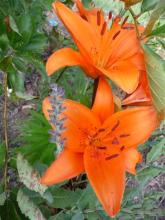
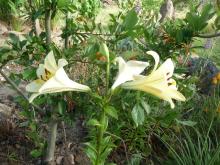
Thu, 12/15/2011 - 1:49pmIt's summer now and the asiatic lilies are in bloom.
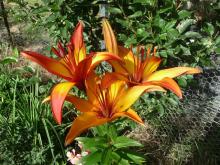
Lilium "Giraffe"
Lilium "Tresor"
The Lilium longiflorum hybrid "Deliana"
cheers
fermi
Trond Hoy
Re: What do you see on your garden walks?
Thu, 12/15/2011 - 2:03pmSummer :o it is still one week till the sun "turns". It is dark when I leave home in the morning and dark when I come home in the evening!
Still, nice to see your lilies, Fermi, reminds me that winter has an end.
Fermi de Sousa
Re: What do you see on your garden walks?
Thu, 12/15/2011 - 10:25pmTrond,
In Australia summer is decreed to start on December 1st!
:rolleyes:
cheers
fermi
Toole (not verified)
Re: What do you see on your garden walks?
Fri, 12/16/2011 - 1:14amSome nice plants there Tim amd Fermi.
Raised from seed sown November 08-- Dicentra peregrina with 4 flowers so far .
At one stage a few seasons back i had about 25 small seedling plants coming along --yes i was going to rule the world i thought ;D,(well at least my little patch down here in New Zealand.... :rolleyes: ;) ), but as befalls the 'plans of mice and men' they all, including a couple of good sized parent plants i had coaxed on for a number of years, perished over a winter..... :'( :'(
I'll be more careful this time .
Cheers Dave.
Pages