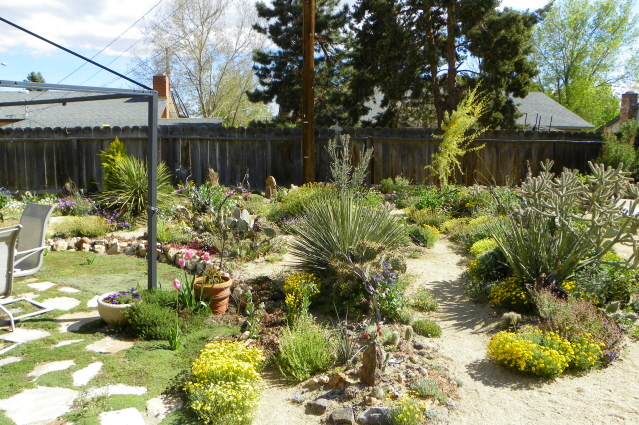
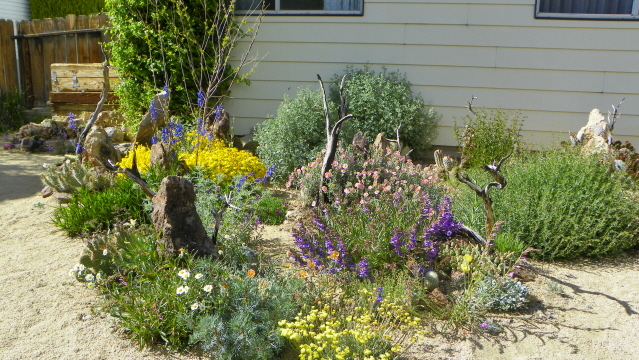
Boy, John, your garden looks terrific right now: I'd sure love to visit again.
Although not really MY garden, I will post three pictures I took yesterday at Denver Botanic Gardens of Plantasia Steppe, the South African Plaza, and Dryland Mesa
PK Thank you so much for your kind compliment. It's been very cool to cold around here. With a little warmth it should explode, with color. I will keep an eye on it and post more shots later.
Your garden is very nice! I would love to take a stroll in your garden and study plants on close encounter if possible. My garden is very untidy and quite different from yours. Here are some shots I took this afternoon. The first is from my front door.
Apart from some 30 rhodos I have not many plants in flower for the moment - or rather they are dispersed all over my property.
So lush and green. That is one color we don't have enough of around here. Lots more of the Gray tones. Do I spy a couple of Yuccas by the steps in the first photo??? :-\ I must say your woodland with the Rhododendrons is very natural appearing and that woodland slope is assume!!
So lush and green. That is one color we don't have enough of around here. Lots more of the Gray tones. Do I spy a couple of Yuccas by the steps in the first photo??? :-\ I must say your woodland with the Rhododendrons is very natural appearing and that woodland slope is assume!!
Lush and green are the right words! Even my house become green due to green algae so I (or my wife really) wash it every second or third year! Moss grows everywhere and other plants like grasses germinate where they shouldn't.
But I have to disappoint you - it is not Yuccas but Cordylines (C. australis 'purpurea'). They stand in pots because I have to move them indoors in the worst winter days. It is also two New Zealand flax (Phormium tenax) there. They are hardy here but stand in pots too.
My garden is steep and difficult to access with heavy tools so I have to carry what is needed. The vegetation is mostly natural but I put in plants I think fit there like the big Skunk Cabbages in the background.
I have a couple of Yuccas (Y. filamentosa) though but they don't flower for me. I haven't found the right site then for they flower in other gardens.
June 26, 2010 Photographed in the garden this morning. 1. Daphne velenovskyi 'Balkan Rose' 2. Daphne sp (label indecipherable) 3. Daphne (planted in natural rock crevice and regularly pruned by deer)
1. Zinnia grandiflora 2. Paederota bonarota setting seed 3. Onosma albo-rosea with left-over seedheads 4. Tufa cliff in Irish stone trough 5. Acantholimon sp finishing bloom 6. mystery grown from seed and not what the seed pack said! I.D. please sorry, 5 and 6 interchanged
Your mystery plant is Pterocephalus: I will let you check my three pix and choose the one you think. They are notoriously bad germinators from seed, incidentally...
I am very fond of these, and am very anxious to obtain their cousin, Pterocephalus spathulatus, from Spain where I trod upon it one October by the acre in the Sierra Cazorla. It has powerdery white leaves and stunning pink flowers for contrast...and NEEDS to be in my garden...
The first is P. depressus from Morocco (the easiest in my experience, blooming all summer) P. parnassii (or P. perennis v. parnassii) from Greece and the last P. pinardii from Turkey.
The genus is much larger, including taller, coarse herbs from Eurasia that I have not hitherto succeeded in overwintering.
Pterocephalus spathulatus caught Dwight Ripley's eye too; "... heads of rose-colored flowers sit almost stemless on the wide, chalk-pale cushions .." There's been an empty space in my garden for this plant, ever since I read that description.
I am seeing a lot of Opuntia polyacatha blossoms scattered around the Garden this time of year. Here are a few, to wet your appetites. Opuntia polyacantha var. polyacantha (North Dakota) Opuntia polyacantha var. polyacantha (Idaho ) Opuntia polyacantha var. polyacantha Opuntia polyacantha var. erinacea- syn. var. ursina (Mt. Charleston,NV) Opuntia polyacantha var. hystrucina Opuntia polyacantha var. polyacantha ("Crystal Tide") Opuntia polyacantha aff. nicholii Opuntia polyacantha var. polyacantha-syn. var. rhodantha (Idaho) Opuntia polyacantha hybrid “Snowball” Opuntia polyacantha hybrid Claude Barr selection
Your mystery plant is Pterocephalus: I will let you check my three pix and choose the one you think. They are notoriously bad germinators from seed, incidentally...
I am very fond of these, and am very anxious to obtain their cousin, Pterocephalus spathulatus, from Spain where I trod upon it one October by the acre in the Sierra Cazorla. It has powerdery white leaves and stunning pink flowers for contrast...and NEEDS to be in my garden...
The first is P. depressus from Morocco (the easiest in my experience, blooming all summer) P. parnassii (or P. perennis v. parnassii) from Greece and the last P. pinardii from Turkey.
The genus is much larger, including taller, coarse herbs from Eurasia that I have not hitherto succeeded in overwintering.
I think it must be P. pinardii. That seems to ring a bell. It seems OK in the lime bed. Thanks
Mark, I'll definitely post a photo of the allium when it's in bloom. I bought it labelled as Allium senescens ssp. montanum var. glaucum - dang, have to correct those records again, but Allium nutans sure rolls off the tongue a lot more easily! Thanks for the ID!
Ann, I always collect seeds from the incarvillea for the seedex, so let me know if you would like to try it. I must say, that particular plant is looking pretty good this year, but Todd Boland's incarvilleas, grown in his alpine beds, always look much better than mine!
Here's the first flower on Telesonix jamesii var. heucheriformis , bought this year from Beaver Creek and stuck in the new tufa bed... and what an interesting flower!
I am jealous on those Opuntias! Here the Incarvilleas have gone to seed and the Sedums rule. It is very dry here now at the south east coast of Norway where I have my summerhouse.
Hoy I like the habitat shot. Have you ever tryed growing Opuntia fragilis or it's hydrids in that area? It grows in similar enviroments in Canada. I think it may do well for you planted in the shallow soils that thread through the rock outcroppings. Two others that would be worth a try are Opuntia macrorhiza and Opuntia humifusa.
Mark, I'll definitely post a photo of the allium when it's in bloom. I bought it labelled as Allium senescens ssp. montanum var. glaucum - dang, have to correct those records again, but Allium nutans sure rolls off the tongue a lot more easily! Thanks for the ID!
Ann, I always collect seeds from the incarvillea for the seedex, so let me know if you would like to try it. I must say, that particular plant is looking pretty good this year, but Todd Boland's incarvilleas, grown in his alpine beds, always look much better than mine!
Here's the first flower on Telesonix jamesii var. heucheriformis , bought this year from Beaver Creek and stuck in the new tufa bed... and what an interesting flower! Lori, thank you, I'd love to try some seed.
Hoy I like the habitat shot. Have you ever tryed growing Opuntia fragilis or it's hydrids in that area? It grows in similar enviroments in Canada. I think it may do well for you planted in the shallow soils that thread through the rock outcroppings. Two others that would be worth a try are Opuntia macrorhiza and Opuntia humifusa.
That's an idea! I think I will try. I have never tried cacti here. Maybe the deer don't eat them either although they seemingly prefere plants with thorns like my roses. I'll look out for seed.
1, 2) Asyneuma limonifolium, from seed last year - an impressive number of flower stems for such young plants! 3) Carduncellus pinnatus 4) Spiraea decumbens
Lori, wonderful pictures. Your asyneuma seems much tighter than mine. Do you grow it in full sun? Mine has a little shade, maybe that's a problem? The carduncellus is marvelous and has just made it on my want and need list. Have you had it long? What can you tell me about it?
Thanks, Anne! The asyneuma is in full sun; the tallest stems are 5-6" (although there are also a couple of little cuties in the same bed with blooming stems only 1.5" tall!) Having only grown it this short time, I don't know anything more about it, other than that it does seem to like lime, as I had read. The carduncellus is a bit of a conundrum... I've had it for many years, and have sent seed to the seedex for a long time, but unbeknownst to me, apparently it is very difficult to start from seed or possibly even self-sterile... ??? (Upon hearing this, I did give it a try last summer and got no germination at all from fresh seed after a couple of months (moist paper towel/baggie method). A very experienced grower over at SRGC has, reportedly, tried seed at all different stages with no germination, and hence, suggested that it may be self-sterile.) It does propagate itself by producing the odd offset a few inches away, not at all rambunctiously. Other than the apparent germination problem, it's very carefree in these conditions.
Edit: Hmm, as I do have 2 different plants/little colonies, bought from different sources, I should try cross-pollinating them...
Fabulous gardens, all! How I wish they were in my neighborhood, so that I could walk by and admire them!
Here are some recent pix, some alpine-ish, some not at all. A couple from seed last year... 1) Oxytropis megalantha 2) Penstemon virens
Others: 3) Saxifraga paniculata var. minutifolia 'Red-backed Spider' - I know I showed this one before, but my saxes out front got eaten by rabbits, so I'm asking for indulgence! ::) 4) Saxifraga 'Mrs. Winifred Bevington' - some bird took a liking (or a dislike?) to it this spring and pulled chunks out of the rosette, so there are not so many flower stalks as in previous years, unfortunately. 5, 6) Dracocephalum botryoides 7) Scutellaria orientalis ssp. alpina 8 ) Mimulus guttatus, along the greenhouse edge, where they enjoy the runoff from watering/messing-around-with-the-ponds inside. 9) Oriental poppy 'Dwarf Allegro'. (Actually, there's never been anything particularly dwarfish about them.) 10) Salix x boydii... Hmm, the ant activity on a couple of those stem tips suggests that I need to go out tomorrow and squash some aphids...
What a terrific place you have there, Trond! Pardon my ignorance, but does your fjord connect to the sea (salt water, or at least brackish?), or is it blocked off (hence, fresh water)... ?
1) One bloom each on Erigeron aureus, from seed this spring - a pleasant surprise. 2, 3) The start of bloom on Penstemon speciosus var. kennedyi
What a terrific place you have there, Trond! Pardon my ignorance, but does your fjord connect to the sea (salt water, or at least brackish?), or is it blocked off (hence, fresh water)... ?
Thanks, Lori! We all love to be here. (Now my two daughters are travelling on their own - the eldest is in fact visiting LA these days!) Yes, this fjord connects with the ocean. It's about 10min with my boat and I'll see the open sea (Skagerrak). A lot of small islands and skerries are sheltering us from the oceanic waves.
Are the Erigeron aureus planted out in your new mountain? If so it isn't strange they flower first year in such a pristine environment! I am sorry i have never succeeded with Scutellaria orientalis from seed.
1, 2) Inula rhizocephala - while the plant in the tufa bed looks clean and pristine, these out along the sidewalk collect all manner of fine sand, spent salvia petals, pulsatilla seeds - you name it - on their fuzzy leaves. I actually worked on them for a while with a brush before taking the photo... yeah, the neighbors already know I'm odd. ;D
3, 4) Saponaria suendermannii... I suspect this is a hybrid, as it doesn't seem to produce seed?
5) Phlox hendersonii - the bloom has sparse at any one time, but very extended this year.
6) A new prize, Caragana jubata. (A gift from a gardening friend at work! :) )
4) Scutellaria nana var. sapphirina - this little thing is a bit of a wanderer, but is so tiny, that I hope it will not seem a problem.
Lori, maybe Bob Nold will chime in on Scutellaria nana var. sapphirina. He sent it to me many years ago, along with another small blue one, S. angustifolia, with "you've been warned" warnings about how invasive they can be. Initially I grew mine in pots in a bark mulch "plunge" area, and they of course escaped their confinement in short order. Eventually, S. nana v. sapphirina died out, but I still have S. angustifolia mildly romping about in the decomposing bark mulch layer over hard rocky clay soil. I found a couple pics of S. angustifolia from June 2001.
So, I was checking into Scutellaria nana var. sapphirina, and couldn't find it initially... what's going on I ask? Seems that S. nana and S. sapphirina are now two separate species, but initially using the USDA pages and typical sites I use to find this info, wasn't coming up with much, but I did finally find the following:
Ahhh, thanks for the warning! I think I'll exile it to the hellish conditions of the front yard, where it can fight it out with fireweed, invasive native asters, and the remnants of Euphorbia cyparissias.
S. nana and S. sapphirina are both occur in Nevada. S. sapphirina at high elevation in the southern mountans. S. nana is found locally in northern Nevada. I have been thinking about hunting down S. nana, just haven't taken the time. I think I have a leg-up though! Gary Monroe the Photographer of S. nana on the USDA link is a very good friend, and Warm Springs Valley is only fifteen miles away.
A rainy day here, after a hot one yesterday (28 deg C).
Nice to see the membership slowly rising. Come on, folks - we'd all love to see photo-tours of your gardens! :)
Not a very alpine-ish selection today: 1) Helianthemum nummularium 'Ben Nevis' 2) One of the many self-sown Verbascum phoeniceum... I used to refer to the colour of this plant, somewhat disparagingly, as "puce" but it's grown on me over the years. ;) 3) Silene zawadskii with a groundcover of Linnaea borealis, which also drapes down the side of the raised acid bed (4) 5) Last of the bloom for the Dodecatheon 6) Astrantia 7) Interesting seedpod on Papaver lapponicum 8 ) Talinum sediforme 9) Codonopsis clematidaea 10) Helianthemum oelandicum ssp. alpestre
I have no objections to rampant plants! At least not if I can grow them here at my summerhouse. No formal beds, just seminatural plantings - that is native and foreign plants put down where they are supposed to thrive and spread! They have to cope with summer dryness and deer and trampling of sheep and people. I gladly receive rampant plants!
1, 2) Inula rhizocephala - while the plant in the tufa bed looks clean and pristine, these out along the sidewalk collect all manner of fine sand, spent salvia petals, pulsatilla seeds - you name it - on their fuzzy leaves. I actually worked on them for a while with a brush before taking the photo... yeah, the neighbors already know I'm odd. ;D
3, 4) Saponaria suendermannii... I suspect this is a hybrid, as it doesn't seem to produce seed?
5) Phlox hendersonii - the bloom has sparse at any one time, but very extended this year.
6) A new prize, Caragana jubata. (A gift from a gardening friend at work! :) )
Lori, what a friend to have! Caragana jubata is a marvelous plant that I'm hoping to try. Yours looks really good. Ditto the Inula rhizocephala. I grew that once from seed and loved it. May garden at the moment is the Dolomites, have been taking many pictures but can't look at them on the computer since I left the camera connector at home. The other day I almost sat on Androsace hausmannii by mistake. The season is early and the plants have been fabulous!
Well, where I am usually reluctant to ask for things, he tends to be quite bold, so he got me this fabulous plant from another grower! :D We look forward to your photos, Anne!
1) A rather odd dianthus, Dianthus calocephalus, which has rather stiff grassy foliage and tall flowering stems with widely-spaced narrow leaves. It's native to Iran, Turkey, Armenia and Azerbaijan. From the NARGS seedex. http://www.ars-grin.gov/cgi-bin/npgs/html/taxon.pl?13823
4) Another variation on the puce Verbascum phoeniceum (or hybrid thereof, as these are likely offspring of 'Helen Johnson', bought years ago, which I just read is said to be V. phoeniceum x bombyciferum?), this one approaching a pale yellow.
We have to take the boat 15 min to get there. This island is about 10km long and narrow consisting of glacial sediments from the last ice age. On the sheltered inside the shore consists of fine quartz sand. The interior is mostly covered by deciduous trees and farms. Cars are forbidden.
Nice sandstone outcrop - love the patterns of bedding and fracturing, and the lichen! What sorts of deciduous trees do you see there?
The commonest trees are oaks, hazel, grey and black alder (Norw. names), crabapple, maple, elm, ash, rowan, whitebeam and maybe more. Lots of shrubbery (barberry, sloe and more).
Once again, I'm reminded of how easy it would be, in relative terms, to have a comprehensive knowledge of the native tree species here... which are so very few, by comparison!
Once again, I'm reminded of how easy it would be, in relative terms, to have a comprehensive knowledge of the native tree species here... which are so very few, by comparison!
I almost forgot birch, gean and aspen! This is a species-rich area however. It is not like that everywhere in Norway. On the contrary, birch is the commonest deciduous tree. Two more pictures..
Some of the area is heavily grazed by cattle. This is to keep down the undergrowth in the woods and keep the meadows open. They have too many animals so the meadows are very short-cut, and almost no flowers. Some areas are fenced off to keep the animals out. These are common:
Geranium sanguineum and Galium verum. Especially Lady's bedstraw, you can smell it far out in the sea.
Excuse the diffuse pictures. The camera lens was covered by salt (and so was my spectacles so I didn't notice!)



Comments
Panayoti Kelaidis
Re: What do you see on your garden walks?
Tue, 05/25/2010 - 12:04pmBoy, John, your garden looks terrific right now: I'd sure love to visit again.
Although not really MY garden, I will post three pictures I took yesterday at Denver Botanic Gardens of Plantasia Steppe, the South African Plaza, and Dryland Mesa
John P. Weiser
Re: What do you see on your garden walks?
Tue, 05/25/2010 - 2:14pmPK
Thank you so much for your kind compliment.
It's been very cool to cold around here. With a little warmth it should explode, with color. I will keep an eye on it and post more shots later.
Trond Hoy
Re: What do you see on your garden walks?
Wed, 05/26/2010 - 2:06pmOK I call you John?
Your garden is very nice! I would love to take a stroll in your garden and study plants on close encounter if possible. My garden is very untidy and quite different from yours. Here are some shots I took this afternoon.
The first is from my front door.
Apart from some 30 rhodos I have not many plants in flower for the moment - or rather they are dispersed all over my property.
John P. Weiser
Re: What do you see on your garden walks?
Wed, 05/26/2010 - 2:26pmTrond
So lush and green. That is one color we don't have enough of around here. Lots more of the Gray tones. Do I spy a couple of Yuccas by the steps in the first photo??? :-\ I must say your woodland with the Rhododendrons is very natural appearing and that woodland slope is assume!!
Trond Hoy
Re: What do you see on your garden walks?
Thu, 05/27/2010 - 12:15amLush and green are the right words! Even my house become green due to green algae so I (or my wife really) wash it every second or third year! Moss grows everywhere and other plants like grasses germinate where they shouldn't.
But I have to disappoint you - it is not Yuccas but Cordylines (C. australis 'purpurea'). They stand in pots because I have to move them indoors in the worst winter days. It is also two New Zealand flax (Phormium tenax) there. They are hardy here but stand in pots too.
My garden is steep and difficult to access with heavy tools so I have to carry what is needed. The vegetation is mostly natural but I put in plants I think fit there like the big Skunk Cabbages in the background.
I have a couple of Yuccas (Y. filamentosa) though but they don't flower for me. I haven't found the right site then for they flower in other gardens.
Todd Boland
Re: What do you see on your garden walks?
Thu, 05/27/2010 - 4:59pmOMG! Such greenery! I'm still waiting for the trees to leaf here!
Anne Spiegel
Re: What do you see on your garden walks?
Sat, 06/26/2010 - 8:15amJune 26, 2010
Photographed in the garden this morning.
1. Daphne velenovskyi 'Balkan Rose'
2. Daphne sp (label indecipherable)
3. Daphne (planted in natural rock crevice and regularly pruned by deer)
Anne Spiegel
Re: What do you see on your garden walks?
Sat, 06/26/2010 - 8:26amAnd more .......
1. Zinnia grandiflora
2. Paederota bonarota setting seed
3. Onosma albo-rosea with left-over seedheads
4. Tufa cliff in Irish stone trough
5. Acantholimon sp finishing bloom
6. mystery grown from seed and not what the seed pack said! I.D. please
sorry, 5 and 6 interchanged
Panayoti Kelaidis
Re: What do you see on your garden walks?
Sat, 06/26/2010 - 8:59amYour mystery plant is Pterocephalus: I will let you check my three pix and choose the one you think. They are notoriously bad germinators from seed, incidentally...
I am very fond of these, and am very anxious to obtain their cousin, Pterocephalus spathulatus, from Spain where I trod upon it one October by the acre in the Sierra Cazorla. It has powerdery white leaves and stunning pink flowers for contrast...and NEEDS to be in my garden...
The first is P. depressus from Morocco (the easiest in my experience, blooming all summer)
P. parnassii (or P. perennis v. parnassii) from Greece and the last P. pinardii from Turkey.
The genus is much larger, including taller, coarse herbs from Eurasia that I have not hitherto succeeded in overwintering.
Robert Nold
Re: What do you see on your garden walks?
Mon, 06/28/2010 - 2:18pmPterocephalus spathulatus caught Dwight Ripley's eye too; "... heads of rose-colored flowers sit almost stemless on the wide, chalk-pale cushions .."
There's been an empty space in my garden for this plant, ever since I read that description.
Lori S. (not verified)
Re: What do you see on your garden walks?
Mon, 06/28/2010 - 9:50pmIncarvillea zhongdianensis is in bloom here now:
Mark McDonough
Re: What do you see on your garden walks?
Tue, 06/29/2010 - 5:28amLori, nice plant. I see the ridged winged stems and nodding buds of Allium nutans nearby... would like to see a photo of it when in bloom.
John P. Weiser
Re: What do you see on your garden walks?
Tue, 06/29/2010 - 10:37amGreat garden shots all around!i
I am seeing a lot of Opuntia polyacatha blossoms scattered around the Garden this time of year. Here are a few, to wet your appetites.
Opuntia polyacantha var. polyacantha (North Dakota)
Opuntia polyacantha var. polyacantha (Idaho )
Opuntia polyacantha var. polyacantha
Opuntia polyacantha var. erinacea- syn. var. ursina (Mt. Charleston,NV)
Opuntia polyacantha var. hystrucina
Opuntia polyacantha var. polyacantha ("Crystal Tide")
Opuntia polyacantha aff. nicholii
Opuntia polyacantha var. polyacantha-syn. var. rhodantha (Idaho)
Opuntia polyacantha hybrid “Snowball”
Opuntia polyacantha hybrid Claude Barr selection
Anne Spiegel
Re: What do you see on your garden walks?
Tue, 06/29/2010 - 12:43pmI think it must be P. pinardii. That seems to ring a bell. It seems OK in the lime bed. Thanks
Anne Spiegel
Re: What do you see on your garden walks?
Tue, 06/29/2010 - 12:45pmLori, I'd kill (not really) to see that in my garden, what a gorgeous plant.
Lori S. (not verified)
Re: What do you see on your garden walks?
Thu, 07/01/2010 - 9:58pmMark, I'll definitely post a photo of the allium when it's in bloom. I bought it labelled as Allium senescens ssp. montanum var. glaucum - dang, have to correct those records again, but Allium nutans sure rolls off the tongue a lot more easily! Thanks for the ID!
Ann, I always collect seeds from the incarvillea for the seedex, so let me know if you would like to try it. I must say, that particular plant is looking pretty good this year, but Todd Boland's incarvilleas, grown in his alpine beds, always look much better than mine!
Here's the first flower on Telesonix jamesii var. heucheriformis , bought this year from Beaver Creek and stuck in the new tufa bed... and what an interesting flower!
Trond Hoy
Re: What do you see on your garden walks?
Thu, 07/01/2010 - 11:38pmI am jealous on those Opuntias!
Here the Incarvilleas have gone to seed and the Sedums rule. It is very dry here now at the south east coast of Norway where I have my summerhouse.
Trond Hoy
Re: What do you see on your garden walks?
Thu, 07/01/2010 - 11:46pm...and one unknown (not S. album or anglicum).
Trond Hoy
Re: What do you see on your garden walks?
Fri, 07/02/2010 - 5:40amMy cellphone allow me to post only one picture at the time.
View from summerhouse.
Trond Hoy
Re: What do you see on your garden walks?
Fri, 07/02/2010 - 5:43amThis Tradescantia is nice but the flowers are open only in the morning.
Trond Hoy
Re: What do you see on your garden walks?
Fri, 07/02/2010 - 5:44amBe careful!
John P. Weiser
Re: What do you see on your garden walks?
Fri, 07/02/2010 - 6:22amHoy
I like the habitat shot. Have you ever tryed growing Opuntia fragilis or it's hydrids in that area? It grows in similar enviroments in Canada. I think it may do well for you planted in the shallow soils that thread through the rock outcroppings. Two others that would be worth a try are Opuntia macrorhiza and Opuntia humifusa.
Anne Spiegel
Re: What do you see on your garden walks?
Fri, 07/02/2010 - 7:43amTrond Hoy
Re: What do you see on your garden walks?
Fri, 07/02/2010 - 9:29amThat's an idea! I think I will try. I have never tried cacti here. Maybe the deer don't eat them either although they seemingly prefere plants with thorns like my roses.
I'll look out for seed.
Lori S. (not verified)
Re: What do you see on your garden walks?
Fri, 07/02/2010 - 1:13pm1, 2) Asyneuma limonifolium, from seed last year - an impressive number of flower stems for such young plants!
3) Carduncellus pinnatus
4) Spiraea decumbens
Anne Spiegel
Re: What do you see on your garden walks?
Fri, 07/02/2010 - 1:22pmLori, wonderful pictures. Your asyneuma seems much tighter than mine. Do you grow it in full sun? Mine has a little shade, maybe that's a problem? The carduncellus is marvelous and has just made it on my want and need list. Have you had it long? What can you tell me about it?
Lori S. (not verified)
Re: What do you see on your garden walks?
Fri, 07/02/2010 - 1:43pmThanks, Anne! The asyneuma is in full sun; the tallest stems are 5-6" (although there are also a couple of little cuties in the same bed with blooming stems only 1.5" tall!) Having only grown it this short time, I don't know anything more about it, other than that it does seem to like lime, as I had read.
The carduncellus is a bit of a conundrum... I've had it for many years, and have sent seed to the seedex for a long time, but unbeknownst to me, apparently it is very difficult to start from seed or possibly even self-sterile... ??? (Upon hearing this, I did give it a try last summer and got no germination at all from fresh seed after a couple of months (moist paper towel/baggie method). A very experienced grower over at SRGC has, reportedly, tried seed at all different stages with no germination, and hence, suggested that it may be self-sterile.) It does propagate itself by producing the odd offset a few inches away, not at all rambunctiously. Other than the apparent germination problem, it's very carefree in these conditions.
Edit: Hmm, as I do have 2 different plants/little colonies, bought from different sources, I should try cross-pollinating them...
Lori S. (not verified)
Re: What do you see on your garden walks?
Sat, 07/03/2010 - 9:38pmFabulous gardens, all! How I wish they were in my neighborhood, so that I could walk by and admire them!
Here are some recent pix, some alpine-ish, some not at all.
A couple from seed last year...
1) Oxytropis megalantha
2) Penstemon virens
Others:
3) Saxifraga paniculata var. minutifolia 'Red-backed Spider' - I know I showed this one before, but my saxes out front got eaten by rabbits, so I'm asking for indulgence! ::)
4) Saxifraga 'Mrs. Winifred Bevington' - some bird took a liking (or a dislike?) to it this spring and pulled chunks out of the rosette, so there are not so many flower stalks as in previous years, unfortunately.
5, 6) Dracocephalum botryoides
7) Scutellaria orientalis ssp. alpina
8 ) Mimulus guttatus, along the greenhouse edge, where they enjoy the runoff from watering/messing-around-with-the-ponds inside.
9) Oriental poppy 'Dwarf Allegro'. (Actually, there's never been anything particularly dwarfish about them.)
10) Salix x boydii... Hmm, the ant activity on a couple of those stem tips suggests that I need to go out tomorrow and squash some aphids...
Lori S. (not verified)
Re: What do you see on your garden walks?
Mon, 07/05/2010 - 9:30pmWhat a terrific place you have there, Trond! Pardon my ignorance, but does your fjord connect to the sea (salt water, or at least brackish?), or is it blocked off (hence, fresh water)... ?
1) One bloom each on Erigeron aureus, from seed this spring - a pleasant surprise.
2, 3) The start of bloom on Penstemon speciosus var. kennedyi
Trond Hoy
Re: What do you see on your garden walks?
Mon, 07/05/2010 - 10:19pmThanks, Lori! We all love to be here. (Now my two daughters are travelling on their own - the eldest is in fact visiting LA these days!)
Yes, this fjord connects with the ocean. It's about 10min with my boat and I'll see the open sea (Skagerrak). A lot of small islands and skerries are sheltering us from the oceanic waves.
Are the Erigeron aureus planted out in your new mountain? If so it isn't strange they flower first year in such a pristine environment!
I am sorry i have never succeeded with Scutellaria orientalis from seed.
Lori S. (not verified)
Re: What do you see on your garden walks?
Thu, 07/08/2010 - 2:19pm1, 2) Inula rhizocephala - while the plant in the tufa bed looks clean and pristine, these out along the sidewalk collect all manner of fine sand, spent salvia petals, pulsatilla seeds - you name it - on their fuzzy leaves. I actually worked on them for a while with a brush before taking the photo... yeah, the neighbors already know I'm odd. ;D
3, 4) Saponaria suendermannii... I suspect this is a hybrid, as it doesn't seem to produce seed?
5) Phlox hendersonii - the bloom has sparse at any one time, but very extended this year.
6) A new prize, Caragana jubata. (A gift from a gardening friend at work! :) )
Lori S. (not verified)
Re: What do you see on your garden walks?
Fri, 07/09/2010 - 3:49pmYes, Trond, the Erigeron aureus are in the tufa bed, where I'm sure they will be happy, judging from their natural habitat here.
1) I lost my old Salvia juriscii this year, so was pleased to remember this little one along the sidewalk. What bizarre and interesting flowers!
2) Erigeron pumilus var. condensata
3) Hieracium villosum
4) Scutellaria nana var. sapphirina - this little thing is a bit of a wanderer, but is so tiny, that I hope it will not seem a problem.
5, 6) Silene saxifraga - I like this one a lot - pristine little flowers and a long bloom.
Mark McDonough
Re: What do you see on your garden walks?
Fri, 07/09/2010 - 4:15pmLori, maybe Bob Nold will chime in on Scutellaria nana var. sapphirina. He sent it to me many years ago, along with another small blue one, S. angustifolia, with "you've been warned" warnings about how invasive they can be. Initially I grew mine in pots in a bark mulch "plunge" area, and they of course escaped their confinement in short order. Eventually, S. nana v. sapphirina died out, but I still have S. angustifolia mildly romping about in the decomposing bark mulch layer over hard rocky clay soil. I found a couple pics of S. angustifolia from June 2001.
Mark McDonough
Re: What do you see on your garden walks?
Fri, 07/09/2010 - 4:31pmSo, I was checking into Scutellaria nana var. sapphirina, and couldn't find it initially... what's going on I ask? Seems that S. nana and S. sapphirina are now two separate species, but initially using the USDA pages and typical sites I use to find this info, wasn't coming up with much, but I did finally find the following:
USDA classification for Scutellaria
http://plants.usda.gov/java/ClassificationServlet?source=display&classid...
This USDA classification cites S. nana var. sapphirina as a synonym of S. sapphirina... aha, found it
http://plants.usda.gov/java/nameSearch?keywordquery=Aria&mode=sciname
USDA page on S. sapphirina
http://plants.usda.gov/java/profile?symbol=SCSA6
USDA page on S. nana:
http://plants.usda.gov/java/profile?symbol=SCNA
CalPhotos page on Scutellaria nana (note: some great looking dwarf cream to pinksih-yellow dwarfs)
http://calphotos.berkeley.edu/cgi/img_query?query_src=photos_index&where...
Lori S. (not verified)
Re: What do you see on your garden walks?
Fri, 07/09/2010 - 5:28pmAhhh, thanks for the warning! I think I'll exile it to the hellish conditions of the front yard, where it can fight it out with fireweed, invasive native asters, and the remnants of Euphorbia cyparissias.
John P. Weiser
Re: What do you see on your garden walks?
Fri, 07/09/2010 - 7:57pmS. nana and S. sapphirina are both occur in Nevada. S. sapphirina at high elevation in the southern mountans. S. nana is found locally in northern Nevada.
I have been thinking about hunting down S. nana, just haven't taken the time.
I think I have a leg-up though! Gary Monroe the Photographer of S. nana on the USDA link is a very good friend, and Warm Springs Valley is only fifteen miles away.
Lori S. (not verified)
Re: What do you see on your garden walks?
Sat, 07/10/2010 - 4:17pmA rainy day here, after a hot one yesterday (28 deg C).
Nice to see the membership slowly rising. Come on, folks - we'd all love to see photo-tours of your gardens! :)
Not a very alpine-ish selection today:
1) Helianthemum nummularium 'Ben Nevis'
2) One of the many self-sown Verbascum phoeniceum... I used to refer to the colour of this plant, somewhat disparagingly, as "puce" but it's grown on me over the years. ;)
3) Silene zawadskii with a groundcover of Linnaea borealis, which also drapes down the side of the raised acid bed (4)
5) Last of the bloom for the Dodecatheon
6) Astrantia
7) Interesting seedpod on Papaver lapponicum
8 ) Talinum sediforme
9) Codonopsis clematidaea
10) Helianthemum oelandicum ssp. alpestre
Trond Hoy
Re: What do you see on your garden walks?
Sun, 07/11/2010 - 2:08amI have no objections to rampant plants! At least not if I can grow them here at my summerhouse. No formal beds, just seminatural plantings - that is native and foreign plants put down where they are supposed to thrive and spread! They have to cope with summer dryness and deer and trampling of sheep and people. I gladly receive rampant plants!
Anne Spiegel
Re: What do you see on your garden walks?
Sun, 07/11/2010 - 2:19amLori, what a friend to have! Caragana jubata is a marvelous plant that I'm hoping to try. Yours looks really good. Ditto the Inula rhizocephala. I grew that once from seed and loved it. May garden at the moment is the Dolomites, have been taking many pictures but can't look at them on the computer since I left the camera connector at home. The other day I almost sat on Androsace hausmannii by mistake. The season is early and the plants have been fabulous!
Lori S. (not verified)
Re: What do you see on your garden walks?
Sun, 07/11/2010 - 4:14pmWell, where I am usually reluctant to ask for things, he tends to be quite bold, so he got me this fabulous plant from another grower! :D
We look forward to your photos, Anne!
Lori S. (not verified)
Re: What do you see on your garden walks?
Sun, 07/11/2010 - 10:07pm1) A rather odd dianthus, Dianthus calocephalus, which has rather stiff grassy foliage and tall flowering stems with widely-spaced narrow leaves. It's native to Iran, Turkey, Armenia and Azerbaijan. From the NARGS seedex.
http://www.ars-grin.gov/cgi-bin/npgs/html/taxon.pl?13823
2) Edelweiss, Leontopodium alpinum
3) Athamanta turbith ssp. haynaldii - a long-blooming perennial here.
http://luirig.altervista.org/schedeit/ae/athamanta_turbith.htm
4) Another variation on the puce Verbascum phoeniceum (or hybrid thereof, as these are likely offspring of 'Helen Johnson', bought years ago, which I just read is said to be V. phoeniceum x bombyciferum?), this one approaching a pale yellow.
5) Penstemon lyallii
6) Sideritis glacialis
Trond Hoy
Re: What do you see on your garden walks?
Mon, 07/12/2010 - 12:58pmLori, you have more interesting plants than I have words!
Trond Hoy
Re: What do you see on your garden walks?
Mon, 07/12/2010 - 1:54pmInspired by Lori's biking route!
Not my garden but a nice place to walk and see!
We have to take the boat 15 min to get there. This island is about 10km long and narrow consisting of glacial sediments from the last ice age.
On the sheltered inside the shore consists of fine quartz sand. The interior is mostly covered by deciduous trees and farms.
Cars are forbidden.
Lori S. (not verified)
Re: What do you see on your garden walks?
Mon, 07/12/2010 - 1:58pmVery beautiful, Trond! I love the stone wall and the rustic fence! Lovely meadow and sea view in the first shot.
Trond Hoy
Re: What do you see on your garden walks?
Mon, 07/12/2010 - 2:01pmI had not finished yet! Can upload only one picture at the moment!
Last picture...
Lori S. (not verified)
Re: What do you see on your garden walks?
Mon, 07/12/2010 - 2:09pmNice sandstone outcrop - love the patterns of bedding and fracturing, and the lichen! What sorts of deciduous trees do you see there?
Trond Hoy
Re: What do you see on your garden walks?
Mon, 07/12/2010 - 2:15pmThe commonest trees are oaks, hazel, grey and black alder (Norw. names), crabapple, maple, elm, ash, rowan, whitebeam and maybe more. Lots of shrubbery (barberry, sloe and more).
Lori S. (not verified)
Re: What do you see on your garden walks?
Mon, 07/12/2010 - 2:48pmOnce again, I'm reminded of how easy it would be, in relative terms, to have a comprehensive knowledge of the native tree species here... which are so very few, by comparison!
Trond Hoy
Re: What do you see on your garden walks?
Mon, 07/12/2010 - 11:47pmI almost forgot birch, gean and aspen! This is a species-rich area however. It is not like that everywhere in Norway. On the contrary, birch is the commonest deciduous tree.
Two more pictures..
Trond Hoy
Re: What do you see on your garden walks?
Tue, 07/13/2010 - 12:19amSome of the area is heavily grazed by cattle. This is to keep down the undergrowth in the woods and keep the meadows open. They have too many animals so the meadows are very short-cut, and almost no flowers. Some areas are fenced off to keep the animals out.
These are common:
Geranium sanguineum and Galium verum.
Especially Lady's bedstraw, you can smell it far out in the sea.
Excuse the diffuse pictures. The camera lens was covered by salt (and so was my spectacles so I didn't notice!)
Pages