
A bit of a falsehood for my first posting on this thread :) --(however i promise that my next posting will be of a trip to view alpines at sea level --then into the mountains proper).
I thought members might be interested in seeing what most of New Zealand would have looked like, before land clearance and timber harvesting reduced the size of the native podocarp forests.
These forests can still be found in some parts of the North Island------ and here at the bottom of NZ in my home province of Southland. The largest podocarp forests are on the West Coast of the South Island.
Podocarp forests are a mixture of tall podocarps and smaller trees with an understorey of shrubs, plants and ferns and soil and climate conditions play a major role in determining which species are the most dominant .
In Southland, Totara ,(up to 30 mtrs in height),grows closest to the coast, on almost pure sand. As the soil nutrient levels increase, Mataï and Rimu appear. With Kahikatea ,(up to 60mtrs in height),on the wetter sites.
Although they belong to the conifer family which reproduces using cones, podocarps spread their seeds through berries which are transported by being passed through birds. Because of the abundant range of fruits, podocarp forests also support larger communities of insects and birds such as bellbird and tui .
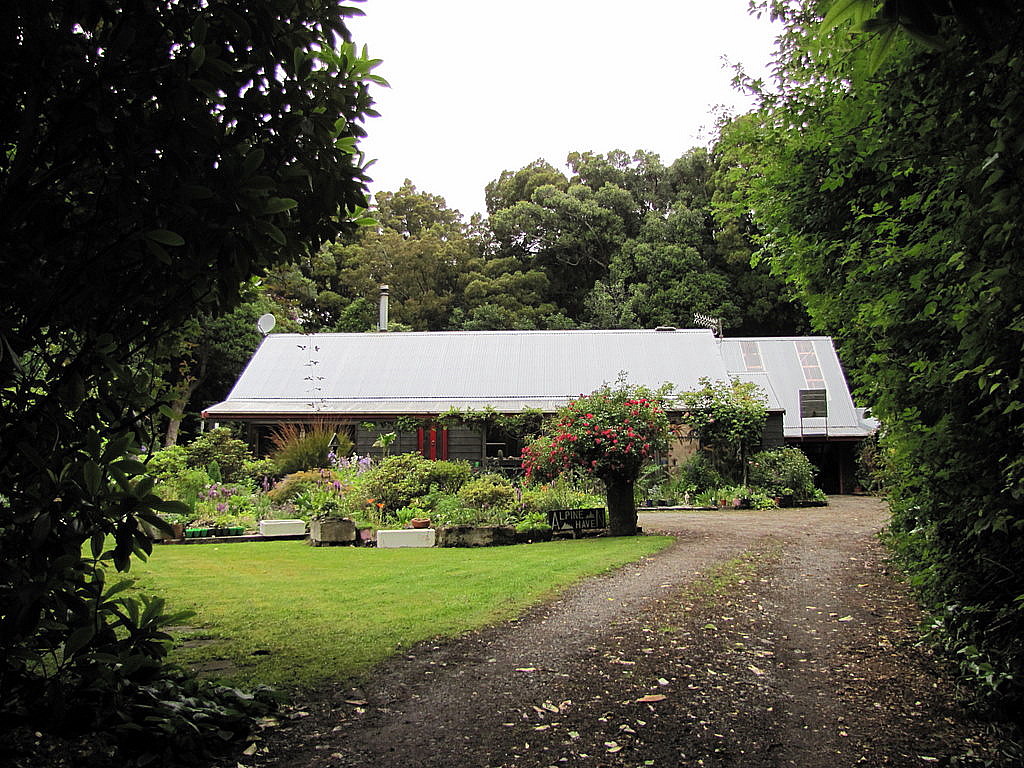
Our residence is situated in one of these forest ,(bush), remnants which backs onto a larger public native reserve and although we are only a couple of ks from the coast our bush has most of the large forest trees mentioned above.
The first pic is of our house surrounded by bush on all sides to give you an idea of scale.
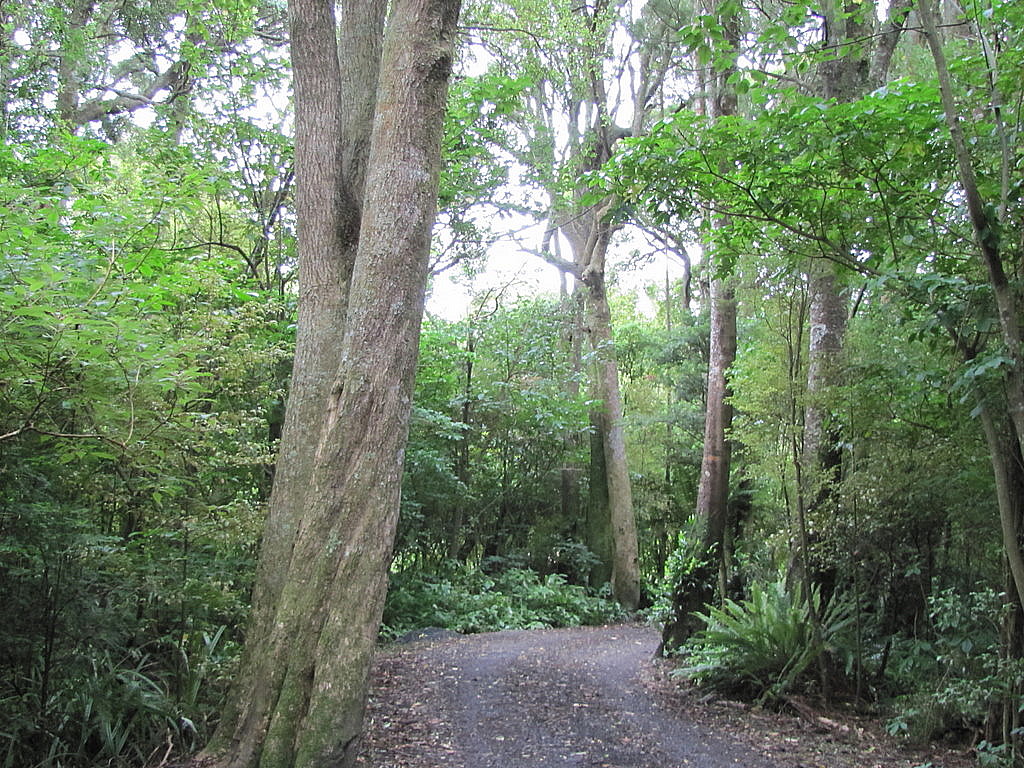
The following pics are of the various genera of dominant trees ,various ferns –Asplenium and Blechnum sps ---–the long strap like leaves of the bush flax ,Astelia ---the stringy bark of a tree Fuchsia and finally the impressive Dicksonia,(tree ferns),all within a few metres of our back door.
Cheers Dave.
Comments
Toole (not verified)
Re: New Zealand Alpine Flora
Sun, 02/17/2013 - 12:44amThe day was still young when we reached the car so off we went for a look up the Ball Pass road .You can only get part of the way before washouts make foot travel the only option.
Steve and Doug and view down the valley.
Raoulia australis in bloom along the way.
Interesting access to gain a view of the Tasman Glacier.
Cheers Dave.
Cliff Booker
Re: New Zealand Alpine Flora
Sun, 02/17/2013 - 8:31amWonderful stuff, Dave ... I can almost smell the liniment from here!!! Looks an exhausting, but profitable hike!! I too have just one small plant of R. godleyanus that I have potted up today. I will compare the foliage to both your images and let you know. R. insignis is in bud at the moment (seven or eight plants), but other buttercups are still resting.
Regards to you all.
Mark McDonough
Re: New Zealand Alpine Flora
Sun, 02/17/2013 - 4:55pmDave and David, I second Cliff's declaration "wonderful stuff", certainly some rough terrain there, thanks for bringing the experience to us on NARGS Forum. Love the netted leaves on Ranunculus godleyanus.
I had no idea that Gentianella saxosa was a coastal plant, growing among sea shells! Is it always a lowland plant?
Myosotis uniflora is heavenly! How fascinating, and perhaps vexing too when trying to put names to things, that there are so many undescribed Myosotis species in the NZ mountains.
Trond, the image link to Myosotis 'Hokonui' still doesn't work here, tried it on two computers, in both Firefox 9.x and Internet Explorer 9.x, gives error: "Not Found, the requested URL /hokpines/myohok.jpg was not found on this server". I suspect the image was removed but that your browser might have it cached. If others in North America can try the original link above and let us know if it works or not, I would appreciate it.
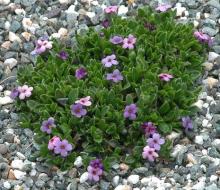
Stuart Murray has since sent me the image, and I post it here to overcome any difficulties with the link. It's a really nice mat-forming Myosotis.
Myosotis 'Hokonui', courtesy of Stuart Murray:
By the way, check out the 1-page list of New Zealand rock garden plants (many with image links), some very choice items there.
Hokonui Alpines Plant Catalogue
New Zealand Alpines and Rock Garden Plants
http://users.actrix.co.nz/hokpines/catalogue-3.html#1
Lori S. (not verified)
Re: New Zealand Alpine Flora
Sun, 02/17/2013 - 6:14pmDoesn't work for me either using Safari on a Mac.
Wonderful scenes and plants! Thank you for posting! Those glacial lateral moraines look pretty recent (at least in geological terms)... was there much plant life growing there?
Tim Ingram (not verified)
Re: New Zealand Alpine Flora
Mon, 02/18/2013 - 2:05amVery interesting list - when Graham Hutchins of County Park Nursery was collecting and distributing NZ plants, this was a wonderful source of plants in the UK and I remember growing a lot of the smaller choice hebes. They are the most intriguing and fascinating plants (all NZers) and the new book that has just been published a 'must have'.
David L (not verified)
Re: New Zealand Alpine Flora
Mon, 02/18/2013 - 2:16amHello Lori,
When I was a student ( some time ago) you could drive to Ball Hut on the road built on lateral moraine that has now collapsed due to the Tasman Glacier retreating. The road was built on the moraine shelf and now the ice has gone (or lowered significantly in parts) the morainic debris just falls down into the void. There is now a big lake at the terminus of the Tasman Glacier and they take tourists out on it in boats. If you are (un)lucky and are close enough you can get a bit of a thrill when the ice collapses into the lake making a big wave. The collapsing moraine is very raw but it is rapidly colonised by a number of plants: nitrogen fixers Coriaria and Carmichaelia. Other species that are common are Muehlenbeckia axillaris, Stellaria gracilenta, Geranium brevicaule, Parahebe decora and various species of Epilobium.
I have located a photo taken in September last year that shows the moraines below the terminal lake of the Mueller Glacier at Mt Cook: it shows a series of moraines of different ages with the successional vegetation. Prominent in the foreground on an old stable moraine ate Podocarpus nivalis, Griselinia littoralis and Aciphylla aurea.
cohan (not verified)
Re: New Zealand Alpine Flora
Mon, 02/18/2013 - 11:10amDidn't work for me, but I subtracted the picture info and just went to the homepage- interesting site- I was esp interested to see they offer seeds, though currently the list is offline for updating..
http://users.actrix.co.nz/hokpines/
Toole (not verified)
Re: New Zealand Alpine Flora
Mon, 02/18/2013 - 10:54pmThanks Mark and Cliff.
Yes G.saxosa is a lowland plant found around the southern coastal regions and i believe on Stewart Island .Habitat can be just above the high tide mark to sand dunes and rocky places.
Thanks Lori
David Lyttle has mentioned colonisers --others are the Raoulia's and in the Epilobium genus E.melanocaulon is prolific.I've sometimes thought that in it's best forms it might warrant cultivation in a pot with careful attention to removing seed heads. :-\ .I'd certainly not risk it in the garden proper here.
Travel up towards the Ball Pass area is what i call interesting as on your right side is the lateral moraine, however on your left side .close to hand ,is a steep mountain range from where frequent avalanches sweep down and across the defunct road and sometimes up the lower part of the moraine wall.
In fact last week the 3 of us were discussing the differences in the colour of the rock .Hopefully the following pic will show what i mean.
Cheers Dave.
Trond Hoy
Re: New Zealand Alpine Flora
Tue, 02/19/2013 - 11:46amMark, you probably are right! I still have it on my computer but can't open it on others.
Dave & David, both plants and places are lovely!
cohan (not verified)
Re: New Zealand Alpine Flora
Thu, 02/21/2013 - 4:16pmSome great and interesting landscapes and plants, guys!
David L- all the Myosotis shown are lovely- the little annual is quite appealing, even if it needs macro to be so!
Dave- the Brachyglottis seems to have very nice foliage...
David L (not verified)
Re: New Zealand Alpine Flora
Fri, 03/01/2013 - 1:33amHave just finished catalouging several batches of pictures. Here is a bit of a random selection mainly from the St Marys Range in North Otago.
The first is Kelleria villosa var villosa showing the plant and a close up view of the flowers and foliage.
[attach thumb=1]
[attach thumb=2]
Pimelea oreophila subsp lepta which is commonly found in the eastern tussock grasslands of the South Island.
[attach thumb=3]
Pimelea notia a recently described species. differs from the preceeding in that the leaves are sparsely hairy
[attach thumb=4]
[attach thumb=5]
Raoulia tenuicaulis a mat forming daisy very common on gravel riverbeds - here it is growing on a road margin.
[attach thumb=6]
One of my most recent preoccupations has been trying to figure out various Celmisia species. Here is Celmisia angustifolia which can sometimes be confused with Celmisia brevifolia.
[attach thumb=7]
It can also be confused with Celmisia densifolia so here are the two growing together. (Celmisia densifolia is top specimen note broader leaves)
[attach thumb=8]
Dracophyllum rosmarinifolium with Gaultheria crassa growing in front. The tussock is the narrow-leaved snow tussock Chionocloa rigida with a patch of the clubmoss Lycopodium fastigiatum in the left foreground.
[attach thumb=9]
A flowering plant of Gaultheria crassa.
[attach thumb=10]
Margaret Young
Re: New Zealand Alpine Flora
Fri, 03/01/2013 - 1:42amDavid L, for those unfamiliar with these plants, might it not be useful to include something to give an idea of scale in the photos, or descriptions ? :)
David L (not verified)
Re: New Zealand Alpine Flora
Fri, 03/01/2013 - 2:07amYes, the Kelleria Pimelea and Raoulia pictures are = or > life size.
cohan (not verified)
Re: New Zealand Alpine Flora
Fri, 03/01/2013 - 10:43amEspecially interesting to see the groupings of various plants growing together..
Richard T. Rodich
Re: New Zealand Alpine Flora
Fri, 03/01/2013 - 4:22pmYes, I too especially like the multiple plant photos, and it's a treat having more than just the "main attraction" identified!
In that last pic, it looks as though the Gaultheria produces a dry compartmentalizes fruit, rather than a berry?
Cliff Booker
Re: New Zealand Alpine Flora
Sat, 03/02/2013 - 9:17amBrilliant images, David. Many thanks for posting.
David L (not verified)
Re: New Zealand Alpine Flora
Mon, 03/04/2013 - 1:34amCohan,
Very happy to show the plant goupings to give ecological context to the different species.
Rick,
NZ Gaultherias have diverse fruits; the fruit is a capsule ( dry in the case of G. crassa) or may surrounded by an enlarged fleshy calyx ( G. depressa var novae-zelandiae - the snowberry which is edible) Pernettya was originally distinguished from Gaultheria by the fruit being baccate (according to the glossary this has a fleshy mesocarp) Pernettya is now included in Gaultheria ( Pernettya macrostigma = Gaultheria marostigma) as bigeneric hybrids between various species are common so the fruit characteristics were not a particularly good character to divide the species into different genera.
Cliff,
I hope the S.P.A.T consortium treats you gently when you visit and you are able to see the plants in the field for yourself!
To continue on the Ericaceae theme here is a picture of Leucopogon fraseri which acommon widespread plant but very difficult to get the detail in the flower.
[attach thumb=1]
Next Myrsine nummularia with its very small flowers It has an attractive blue berry
[attach thumb=2]
Nertera scapanioides (or I think it is this species rather than the more common Nertera depressa)
[attach thumb=3]
[attach thumb=4]
Anisotome aromatica - there are innumerable forms of this species
[attach thumb=5]
A small cress Cardamine bilobata
[attach thumb=6]
Growing on the same outcrop two small ferns Grammitis poepiggiana and a Hymenophyllum I have not been able to identify.
[attach thumb=7]
Coriaria plumosa which is a primary coloniser and nitrogen fixer (symbiont is Frankia rather than Rhizobium)
[attach thumb=8]
In the beech forest at lower altitudes the mistletoe Peraxilla tetrapetala was flowering profusely. Thie species is very sensitive to possum browsing and was almost wiped out until the pests were brought under control by the Department of Conservation. In both cases the plants are growing on mountain beech Nothofagus solandri var cliffortioides but we also found plants growing on two alternative hosts, Coprosme propinqua and Aristotelia fruticosa.
[attach thumb=9]
[attach thumb=10]
Trond Hoy
Re: New Zealand Alpine Flora
Mon, 03/04/2013 - 10:01amDavid, I never tire of admiring the flora of NZ! Interesting ferns too (any chance of spores?) and an extraordinary mistletoe!
Richard T. Rodich
Re: New Zealand Alpine Flora
Mon, 03/04/2013 - 8:10pmThanks for answering my query in detail, David. I ate it up. ;D
Interesting how a genus can encompass both fleshy fruit and dry capsules, isn't it, Mark... ;)
I marvel when I look at so many genera I am familiar with in my region, only to find so much more diversity in the same genera in other places. So often I say to myself, I never would have guessed it belonged to such and such genus...
cohan (not verified)
Re: New Zealand Alpine Flora
Tue, 03/05/2013 - 10:42amAll the lithophytes are very nice!
The mistletoe is quite splendid- nothing grows on trees here except lichens and moss!
David L (not verified)
Re: New Zealand Alpine Flora
Tue, 03/05/2013 - 6:22pmTrond,
I think the ferns would be challenging horticultural subjects especially the Hymenophyllum - I have never heard of anyone successfully growing it.
Rick,
It certainly was an interesting question you raised about the fruits if the Gaultheria - I went back and took a careful look at some of my photographs and found examples of the variations. Gaultheria crassa as you have noted has a dry capsule.
[attach thumb=1]
In Gaultheria depressa var novae-zelandiae the calyx is enlarged and surrounds the capsule.
[attach thumb=2]
In Gaultheria macrostigma and Gaultheria parvula (diagnostic for the former genus Pernyetta) the calyx is fleshy but the mesocarp is enlarged and forms the bulk of the fruit.
[attach thumb=3]
[attach thumb=4]
Cohan,
The mistletoe has evolved for bird pollination hence the bright red colour and flower structure - none of our alpine flora is brightly coloured or is specifically designed for bird pollination. see the close ups
Richard T. Rodich
Re: New Zealand Alpine Flora
Tue, 03/05/2013 - 9:50pmThanks, David. Next time I get an opportunity, I am going to have to look more closely at our native Gaultheria procumbens and G. hispidula edible fruits. I don't remember ever feeling in my mouth any capsule/calyx "separation". The seemed very homogeneous on my palate, but I've never examined a cut berry.
----------------------------------
That mistletoe is much more interesting in close up! :o
cohan (not verified)
Re: New Zealand Alpine Flora
Tue, 03/05/2013 - 10:30pmVery showy mistletoe indeed! It's a category of plant I know very little about- having never seen any in person! But I would have thought they were in general inconspicuous plants- shows how much I knew ;D
David L (not verified)
Re: New Zealand Alpine Flora
Wed, 03/06/2013 - 1:18amHere is a link that goes into detail about bird pollination of Peraxilla. The plant needs the birds to physically open the flower to gain access to the nectar. The structure of the flower has evolved to favour birds as pollinators. The link has video footage of bellbirds and tuis opening the flowers.
http://www.biol.canterbury.ac.nz/mistletoes/pollination.shtml
I will put in a close up showing an opened flower (there are actually 2) with a group of unopened flowers lower down
Trond Hoy
Re: New Zealand Alpine Flora
Wed, 03/06/2013 - 10:20amDavid, Hymenophyllum wilsonii is rather common around here but I don't have it in my garden though. However I have planned to try it as I have some suitable habitats I think.
Though I did think of some of the other ferns in your pictures too ;)
The berry/capsule "problem" in Gaultheria/Pernettya is similar to Actaea/Cimicifuga. Actaea has berries but Cimicifuga has capsules. It is not a great genetic difference between a berry and a capsule though.
Does the mistletoe spread by berries eaten by birds like the European Viscum album? (I have Nothofagus in my garden ;) )
David L (not verified)
Re: New Zealand Alpine Flora
Sat, 03/09/2013 - 1:41amTrond,
Several species of Hymenophyllum extend into the alpine zone in New Zealand. They are found in rock clefts and similar sites habitats very similar to Hymeophyllum wilsonii in Europe. The most frequently encountered is Hymenophyllum multifidum which is also common in Nothofagus forest but is dwarfed in the alpine environment.
Peraxilla is spread in the same manner as European mistletoes by birds eating the berries as are our other mistletoes Alepis, Ileostylus and Tupeia. The remaining group Korthalsella are also dispersed by birds apparently the fruits are weakly explosive and become attached to birds that brush up against the plants.
I have never actuallyseen the berries of Peraxilla except in pictures but I have not made a point of looking for them. They are red and look attractive (to a bird any way).
Trond Hoy
Re: New Zealand Alpine Flora
Mon, 03/11/2013 - 9:13amThanks David. Although mistletoe (Viscum album) is native in Norway it is very rare. I've only seen it a couple times but I try to establish it on my property (and exotic ones too if I get the chance!).
Toole (not verified)
Re: New Zealand Alpine Flora
Sat, 03/16/2013 - 8:43pmSpent yesterday up on the ‘hills’ of Northern Southland with a couple of friends, John Fitzgerald and fellow forumist David Lyttle.
I was most interested to see how the Celmisia’s were coping with the big ‘dry' and while most seemed to be okay we found very few plants in seed.
Some of the C.verbascifolia’s had pronounced leaf roll however no more in numbers than what I’ve seen previously on this Range.
I think we ticked off well over a dozen species/hybrids ---David kept on mentioning we should have started a list ………
Just a few pics
Fellow enthusiasts.
The silvery growths of Celmisia linearis .
Close up.
John on a well vegetative Celmisia slope.
Two pics of Celmisia verbascifolia showing the pale white tomentum.
Large silver grows of Celmisia semicordata ssp stricta.
Acaena saccaticupula on one of the snow banks.
Cheers Dave.
cohan (not verified)
Re: New Zealand Alpine Flora
Sun, 03/17/2013 - 12:02amOh boy- love the foliage of every one of those (including Acaena), but maybe especially C linearis!
Mark McDonough
Re: New Zealand Alpine Flora
Sun, 03/17/2013 - 12:56pmI agree the Celmisia species are fantastic, particularly C. linearis... wow! The Aceana surprises me, this one has such oversized stocky, almost muscular stems; intriguing.
Toole (not verified)
Re: New Zealand Alpine Flora
Mon, 03/18/2013 - 1:06amI was in contact with Lou at Hokonui Alpines today and was informed their seedlist had been updated and was now on line , so I just had to have a peek. :)
Fresh seed of some of the wonderful small Celmisia sps are listed as well as a number of other NZ alpines including the yummy Aciphylla simplex :P :P ---- and other gems from regions around the world.
The link is below for those that are interested.
users.actrix.co.nz/hokpines/seedlist.html
Cheers Dave.
David L (not verified)
Re: New Zealand Alpine Flora
Mon, 03/18/2013 - 2:08amFor the record I recorded 14 species of Celmisia and 6 hybrids. There are two additional species that I am fairly sure are there but did not see and then there are a couple of entities that are are not formally described which may or may not be there. I was busy photographing and documenting the hybrids.
David L (not verified)
Re: New Zealand Alpine Flora
Mon, 03/18/2013 - 3:53pmI will post a few Celmisia pictures to add to what Dave has already posted.
A cushion of Celmisia sessiliflora growing in Chionochloa rigida tussock grassland - the site is quite damp with the moisture loving habe Hebe pauciramosa present as well.
[attach thumb=1]
Every one photographs the same plant; Celmisia sessiliflora x lyallii (C. linearis). (Dave has PVR rights over this plant so we will henceforth call it Celmisia x linearis ' Toolei ' )
[attach thumb=2]
A colony of Celmisia semicordata subsp. stricta with a large Celmisia verbascifolia centre right.
[attach thumb=3]
Here is a hybrid between the two species (bottom right) growing with its parents Celmisia semicordata susp.stricta and Celmisia verbascifolia (rear)
[attach thumb=4]
Celmisia verbascifolia and Celmisia lyallii behind it
[attach thumb=5]
and the hybrid between the two
[attach thumb=6]
A hybrid between Celmisia verbascifolia and another species which I am guessing is Celmisia brevifolia growing at the bottom right of the photo. It is not a pretty plant
[attach thumb=7]
Celmisia densiflora showing the tomentose white undersides of the leaves. The leave are turned up in response to the dry conditions. This is a widespread species that forms extensive mats. The stems are quite woody.
[attach thumb=8]
Last a hybrid between Celmisia lyallii and Celmisia densiflora. The plant on the bottom right is the hybrid. The plant beside it is a small specimen of Celmisia lyallii and Celmisia densiflora is growing at the top left.
[attach thumb=9]
Finally another example of the Celmisia densiflora x lyallii hybrid.
Richard T. Rodich
Re: New Zealand Alpine Flora
Mon, 03/18/2013 - 6:50pmReally love those pics with the hybrid celmisia and the parents.
In this pic, is all the white on the center background knoll celmisia, too?
[attach thumb=1]
Steve Newall (not verified)
Re: New Zealand Alpine Flora
Mon, 03/18/2013 - 9:11pmNow where have I heard that before ?
Nice pics Daves
David L (not verified)
Re: New Zealand Alpine Flora
Mon, 03/18/2013 - 9:46pmThe top of the knoll is schist rock and most of the white colour is due to lichens
Trond Hoy
Re: New Zealand Alpine Flora
Tue, 03/19/2013 - 2:25pmI have always regarded Celmisia as a rather tender genus but I have come to look at it (or some species at least) as very hardy and possible to grow at my mountain cabin!
David L (not verified)
Re: New Zealand Alpine Flora
Wed, 03/20/2013 - 2:50amHi Trond,
Celmisias are very diverse in terms of their growth form and habitat requirements. There are a number of snowbank species that may perhaps grow in Norway as in general NZ plants do not tolerate hard frosts. I would suggest that the snowbank species, Celmisia hectorii, Celmisia haastii and Celmisia prorepens might be worth trying. I tend to avoid growing snowbank plants as I cannot satisfy their winter dormancy requirements. I find some of the the species with woody stems (eg Celmisia densiflora, Celmisia brevifolia, Celmisia walkeri) can be propagated easily from cuttings and do well for me if grown in pots. The larger Celmisias such as C. semicordata are a bit problematic as they can collapse very rapidly if stressed though there is a coastal species called Celmisia mackaui that seems to thrive here. Celmisia hookeri from East Otago is another species that can be successfully cultivated though the plant I have in my crevice garden seems to have turned up its toes in our current drought.
Tim Ingram (not verified)
Re: New Zealand Alpine Flora
Wed, 03/20/2013 - 10:01amWonderful pictures and really interesting to see all those hybrids. There will be AGS members queuing up to grow C. x linearis 'Toolei'!! I am having a bit more success with some of the small alpine species growing in deep moist sharp sand on the cool end of a raised bed - but we did have a wet summer last year! David Sampson used to grow some species well in the garden in the south, but nothing like Alan Furness in Northumberland. I don't think the climate there can be too different to parts of Norway, so you could do well with them Trond.
And thanks for the seedlist website! Some nice things there...
Trond Hoy
Re: New Zealand Alpine Flora
Wed, 03/20/2013 - 10:07amThanks David, a long list to start with! Plants are never for sale here so I have to try seed or import from abroad :-\
I have 3 different places with different climate where I can try plants so hopefully a couple will make it - if I get any!
Trond Hoy
Re: New Zealand Alpine Flora
Wed, 03/20/2013 - 10:11amTim, I have to try some! And I can provide both a coastal mild and humid (well, it used to be) climate and a climate with warmer summers and slightly colder winters and a low alpine climate ;D
stuartmurray@xt... (not verified)
Re: New Zealand Alpine Flora
Thu, 06/20/2013 - 8:40pmCelmisia x linearis not just a good foliage plant. Certainly a good subject for a potted show plant. Flowering here early November, and a closeup.
David L (not verified)
Re: New Zealand Alpine Flora
Mon, 03/25/2013 - 3:32amThis is the best form of C x linearis I have seen. The epithet C. x linearis has been applied to a diverse range of Celmisia sessiliflora hybrids. Knowing the origin of this one I have suggested it is a hybrid between C.sessiliflora and C. insignis. Of course some TLC shows the plant to its best advantage.
David L (not verified)
Re: New Zealand Alpine Flora
Mon, 03/25/2013 - 3:52amHere are some pictures of the now famous (or infamous depending on your point of view) Hebejeebie trifida ( syn Veronica trifida) growing at a snowbank site at about 1500 m on the South Hector Mountains. The plants are of remarkable size and vigour for this species flourishing because of a liberal dressing of sheep manure supplied liberally by the sheep that for some reason camp there.
1. A small plant - there are some larger ones
2. flower - there were still a few late flowers around
3. shoot showing the very distinctive glandular hairs of this species. It is not always easy to distinguish Hebejeebie trifida from some forms of Hebejeebie densifolia but these hairs are diagnostic.
Margaret Young
Re: New Zealand Alpine Flora
Mon, 03/25/2013 - 8:06amSuper close-up in your last pic, David.
Some clarification needed please from your post - which is correct : Hebejebie - Hebejeebe - Hebejeebie ?
M
Margaret Young
Re: New Zealand Alpine Flora
Mon, 03/25/2013 - 8:57amIt is fine indeed for foliage and flowers- hard to beat such a smart show plant, I would imagine.
David L (not verified)
Re: New Zealand Alpine Flora
Mon, 03/25/2013 - 1:46pmHello Ian,
I covered all options didn't I - It is Hebejeebie
Margaret Young
Re: New Zealand Alpine Flora
Tue, 03/26/2013 - 4:26amThanks David - lets us see just how the use of these names can give folks the heebiejeebies, eh?! ;) ;D
M
Mark McDonough
Re: New Zealand Alpine Flora
Tue, 03/26/2013 - 8:21amSenecio, that's one fine looking pot-grown Celmisia, the foliage is amazing.
It seems that Mr. Michael J. Heads, the person who coined genus name Hebejeebie in 2003, has a sense of humor.
Googling around, I see in a 2012 publication, that none of the Hebe-related genera stand (Hebe, Parahebe, Chionohebe, Leonohebe, Heliohebe, and Hebejeebie), all have been sunk into Veronica. At the bottom of the following web page, is a link to a PDF listing of all NZ Hebe relations, for a total of 141 Veronica species. :o
http://nzprn.otago.ac.nz/wiki/bin/view/NZPRN/TaxaVeronica
David L (not verified)
Re: New Zealand Alpine Flora
Wed, 03/27/2013 - 2:54amMichael Heads is best known in New Zealand for his somewhat controversial views on panbiogeography and vicariance. For a synopsis of his work seehttp://johngrehan.net/index.php/panbiogeography/panpublications/michael-heads-publications/ I do not count myself amongst his acolytes and listened to an exorticating criticism of his Abrotanella paper at the Southern Connections Congress held here in Dunedin in January. I can supply details if anyone is particularly interested. For a very readable and informative account of New Zealand's biogeography I recommend Ghosts of Gondwana: The History of Life in New Zealand by George Gibbs.
Phil Garnock Jones who supplied the content for the web page on Taxa/Veronica that Mark refers to, argues (very persuasively) that since all New Zealand Hebes Chionohebes Parahebes etc are nested within the Northern hemisphere genus Veronica all the separate genera should be subsumed into Veronica. Many New Zealand botanists disagree with this view and it is fair to say it has not gained universal acceptance; Alan Mark uses Hebe, Parahebe, Chionohebe, Leonohebe, Heliohebe, and Hebejeebie in his new book but supplies the synonyms in Veronica for anyone who wishes to use them. The NZPCN website does not use Veronica at all for the different genera. It can be argued that the genus Veronica has undergone sufficient evolutionary diversification in the Southern hemisphere and that the descendants of the original Veronica have diverged sufficiently from their ancestors to be given their own generic status. This is an exact parallel to the Dodecatheon/ Primula situation in North America where the name Dodecatheon is applied to a group of Primulas that have gone done a seperate evolutionary path with respect ot their pollination biology. So for the time being I will continue to use Hebe, Parahebe, Chionohebe, Leonohebe, Heliohebe, and Hebejeebie. I suspect Dodecatheon is still widely used in North America.
Pages