
A bit of a falsehood for my first posting on this thread :) --(however i promise that my next posting will be of a trip to view alpines at sea level --then into the mountains proper).
I thought members might be interested in seeing what most of New Zealand would have looked like, before land clearance and timber harvesting reduced the size of the native podocarp forests.
These forests can still be found in some parts of the North Island------ and here at the bottom of NZ in my home province of Southland. The largest podocarp forests are on the West Coast of the South Island.
Podocarp forests are a mixture of tall podocarps and smaller trees with an understorey of shrubs, plants and ferns and soil and climate conditions play a major role in determining which species are the most dominant .
In Southland, Totara ,(up to 30 mtrs in height),grows closest to the coast, on almost pure sand. As the soil nutrient levels increase, Mataï and Rimu appear. With Kahikatea ,(up to 60mtrs in height),on the wetter sites.
Although they belong to the conifer family which reproduces using cones, podocarps spread their seeds through berries which are transported by being passed through birds. Because of the abundant range of fruits, podocarp forests also support larger communities of insects and birds such as bellbird and tui .
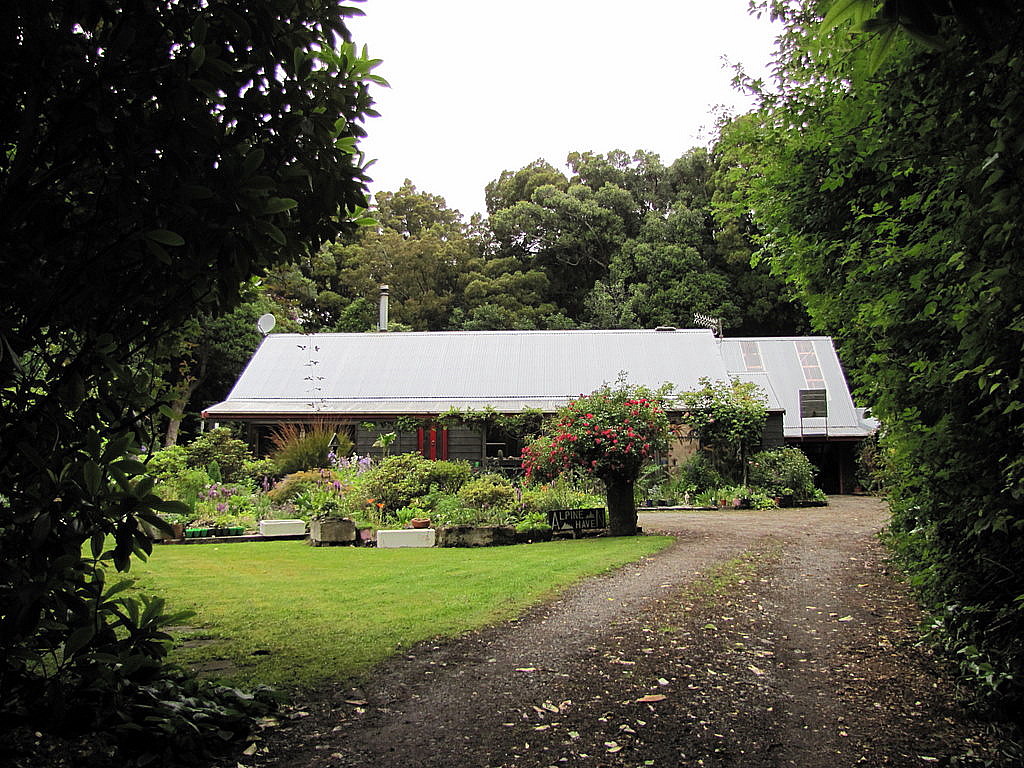
Our residence is situated in one of these forest ,(bush), remnants which backs onto a larger public native reserve and although we are only a couple of ks from the coast our bush has most of the large forest trees mentioned above.
The first pic is of our house surrounded by bush on all sides to give you an idea of scale.
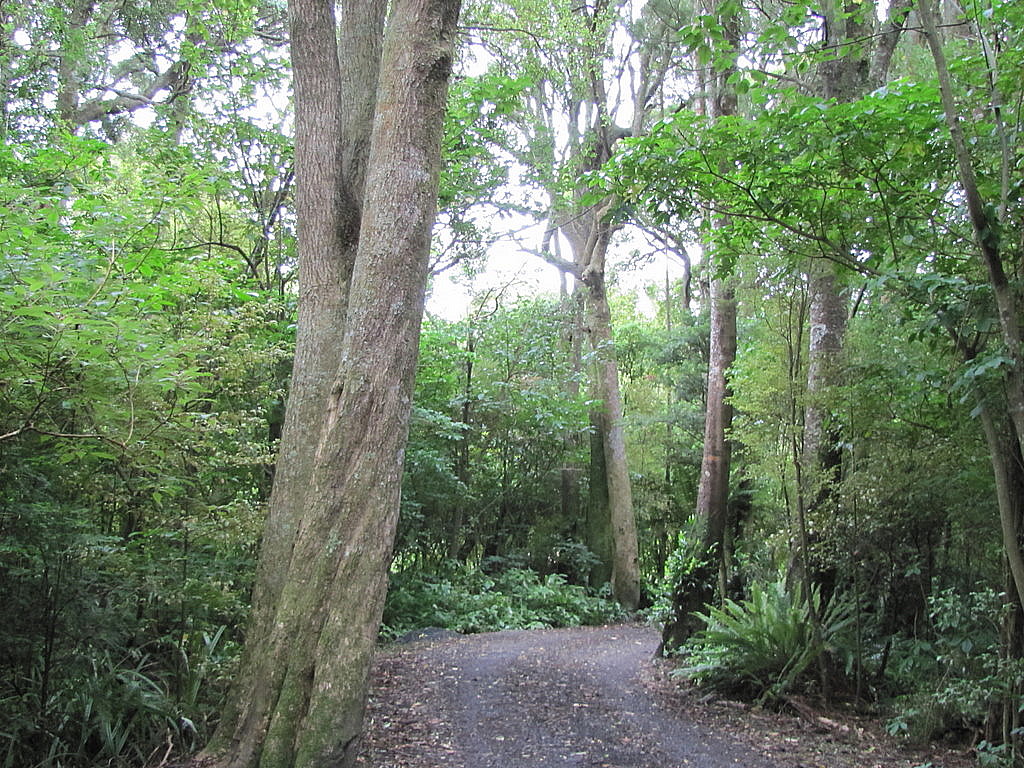
The following pics are of the various genera of dominant trees ,various ferns –Asplenium and Blechnum sps ---–the long strap like leaves of the bush flax ,Astelia ---the stringy bark of a tree Fuchsia and finally the impressive Dicksonia,(tree ferns),all within a few metres of our back door.
Cheers Dave.
Comments
cohan (not verified)
Re: New Zealand Alpine Flora
Sat, 02/25/2012 - 11:24pmVery nice! nothing dares grow epiphytically here apart from very low moss and lichens..
Toole (not verified)
Re: New Zealand Alpine Flora
Sat, 02/25/2012 - 11:27pmThanks Cohan
Here's a few more :)
Toole (not verified)
Re: New Zealand Alpine Flora
Sat, 02/25/2012 - 11:47pmThis afternoon i travelled just a short distance ,(about 5 ks from home), to the western edge of the New River Estuary .
Here there are extensive stands of Totara growing on ancient sandhills, where in a couple of places you can gain a view out over the tree tops.
Cheers Dave.
Trond Hoy
Re: New Zealand Alpine Flora
Sun, 02/26/2012 - 1:25amTruly exotic, Dave!
Although we have some kinds of temperate "rainforests" here they are totally different (mostly consisting of spruce). The nearest I've been to anything similar is mountain forests in Africa and South America.
Lori S. (not verified)
Re: New Zealand Alpine Flora
Sun, 02/26/2012 - 8:55amWow, I'm so envious... to be able to walk around the preserve whenever you want! Wonderful!
cohan (not verified)
Re: New Zealand Alpine Flora
Sun, 02/26/2012 - 10:53amVery interesting plants and forests, Dave! And so civilised with smooth trails and stairs and everything! :o
Tim Ingram (not verified)
Re: New Zealand Alpine Flora
Mon, 02/27/2012 - 9:15amTremendous natural gardens, and especially the ferns. I am very sad that I have lost my plant of Pseudowintera colorata after having it in the garden for many years. It grew very slowly in our dry conditions but you see superb plants in the west and Ireland.
Richard T. Rodich
Re: New Zealand Alpine Flora
Mon, 02/27/2012 - 10:02amThose are the coolest mushroom I have EVER seen! And the conifer ain't too shabby either. :o Living in a place so drastically different, it's all quite surreal.
It's hard for me as a northerner to accept that what you show isn't a contrived design. This a wild preserve, yet there doesn't seem to be weed in sight on the trails. I would have thought in situation as such that it would be a battled to keep trails open, let alone manicured. Obviously, I know diddly about the ecology of area...
Toole (not verified)
Re: New Zealand Alpine Flora
Mon, 02/27/2012 - 11:10pmThanks for the comments all....
I should have named more of the individual pics (the Pseudowintera is shown in reply 100 --IMGs 1365 and 1289).
I have no doubt you know your ecology Rick :)---I'm selective in what photos i show that's all--there are numerous introduced weeds in the area especially where there has been some disturbance to the tree canopy which allows for example , blackberry ,sycamore, berberis and others to gain a foothold....
Ps some healthy looking seed forming on Lilium mackliniae. ;)
Cheers dave.
Richard T. Rodich
Re: New Zealand Alpine Flora
Tue, 02/28/2012 - 9:38am;D ;D ;D
Toole (not verified)
Re: New Zealand Alpine Flora
Mon, 04/23/2012 - 2:59amSpent yesterday out in the field in the company of a couple of Americans --Sean Hogan ,co-founder of Cistus Nursery near Portland ,Oregon and his partner Nathan.
Sean is a key note speaker this coming weekend at the International Plant Propagators Society conference being held just up the road in Cromwell ,Central Otago.
He has /is giving talks to a number of garden groups throughout the South Island and is being shown the sights by fellow forumist Jandels, (aka Steve).
Boy.... i thought we Kiwis were plant 'nuts' Wink but we are not in the same league .... Grin Grin
Just a few pics of the visit to an area of ultrabasic rock in Northern Southland.
Being so late in the season very little was in bloom.
Scenery.
The gang.
Sean grabbing a close up, with Jandels in the background.
Helichrysum intermedium on the edge.
Raoulia hookerii.
Sean and Aciphylla aurea.
Gentianella bellidifolia.
Negotiating through red tussock.
Cheers Dave.
Richard T. Rodich
Re: New Zealand Alpine Flora
Mon, 04/23/2012 - 6:30amThe perfect mix of photos. What are the spruces in the second pic, and the pines in the third photo?
The gentianella flowers are exquisite!
Not too much "bellidifolia" though... ;D
Trond Hoy
Re: New Zealand Alpine Flora
Mon, 04/23/2012 - 12:11pmDid you find anything interesting among the tussocks?
I like the Helichrysum and Aciphylla!
Toole (not verified)
Re: New Zealand Alpine Flora
Mon, 04/23/2012 - 11:51pmRick
The trees in question are from the USA ---Pseudotsuga menziesii ,(douglas fir), and Pinus radiata ,(Monterey Pine), both planted in NZ as plantation timber.
Hoy
A roll call back at the vehicle and all of Steves toes were present and accounted for :D ,so nothing interesting found in the tussocks......... ;) ;)
Cheers Dave.
cohan (not verified)
Re: New Zealand Alpine Flora
Thu, 05/03/2012 - 5:33pmGreat stuff as always- of course the Helichrysum and Aciphylla are favourites- something about plants on rock, and the A looks esp nice with space to hang at the front!
So jandals are what Jandals was wearing? Flip-flops we'd call them- I was thinking that a very interesting footwear choice for a hike :o
Steve Newall (not verified)
Re: New Zealand Alpine Flora
Sat, 05/12/2012 - 11:05pmHowdy . Bit late replying because I went walkabout for awhile . I was wearing jandals (flip-flops) because we didn't venture far from the car . The lack of opuntia seedlings also makes it slightly more practical here in NZ . A few pictures to follow
On Mt.Hutt above the Canterbury Plains (near Christchurch)
Dracophyllum uniflorum
Haastia recurva
Wind shaped manuka above Akaroa
Nikau palms (Rhopalostylis sapida) south of Westport
An urban Weka
A rural Kea adjusting my windshield wiper
Yeah yeah .... whatever
Seed on Raoulia subsericea
Lori S. (not verified)
Re: New Zealand Alpine Flora
Sun, 05/13/2012 - 7:45amBeautiful photos! Looks a bit chilly for jandals, no? ;)
I can understand a hungry bear (and wild animals must always be hungry - it's a rough life for them!) dismantling a camper to get at food, but what is the attraction of car windshield wipers, tires(?), etc. to keas anyway? ???
cohan (not verified)
Re: New Zealand Alpine Flora
Sun, 05/13/2012 - 9:58amI fixed my bad spelling above...lol The thought of bare feet and opuntias is indeed a bad combination...lol- unknowingly got a spine under my thumbnail yesterday, but luckily got it out later without too much trouble..
Lovely views! I forgot momentarily that you were heading into winter- interesting to see the chilly heights with green fields in view behind...
Those keas are fascinating, but must be a bit frustrating ;D
Steve Newall (not verified)
Re: New Zealand Alpine Flora
Sun, 05/13/2012 - 2:56pmI watched keas in action for nearly a decade when I lived and worked in Fiordland . They are very intelligent and just a little curious . Sometimes I think they pull things apart because they are bored and it's a fun thing to do . On occasions I could swear they were laughing at us humans . The pictures are of a kea near Mt.Cook (on a S.P.A.T. mission with Toolie and Doug) which had been ripping up a cushion plant (Phyllachne colensoi) and then telling us how clever it was .
And yes, it is cooling down here and with snow forecast in the hills this week , it's time to head your way . Thanks for the Utah pictures Lori . They make my feet warm up just thinking about it and looking forward to seeing flowering plants again soon
Trond Hoy
Re: New Zealand Alpine Flora
Sun, 05/13/2012 - 11:10pmBeautiful pictures Jandals!
I have no keas here but a pair of magpies doing some research in my beds assisted by blackbirds of course. They haven't showed interest in my car yet but the earthworms have. I do find earthworms on my windshield and roof ???
Steve Newall (not verified)
Re: New Zealand Alpine Flora
Mon, 05/14/2012 - 3:34pmOK . I give up Trond . How do you get earthworms on the windshield ? Do you have a roof garden on the garage or maybe you do handbrake turns in the vege patch???
Trond Hoy
Re: New Zealand Alpine Flora
Tue, 05/15/2012 - 12:09pmGod knows. My car is parked outside my neighbours boat shed. But when it's raining here I find worms creeping everywhere - even at the walls and windows of the greenhouse. Maybe they are looking for mates?
Toole (not verified)
Re: New Zealand Alpine Flora
Sun, 06/03/2012 - 2:35amSpent last weekend up near the top of the South Island attending the Nelson Alpine Garden Society's annual Winter Study Weekend.
I managed to grab a lift up with Pete ,(owner of Hokonui alpines--- [email protected]), and forumist Jandals,(aka Steve).
Being a 12 hour trip we broke the journey by staying a night, just out of Christchurch, at another forumists residence ,Senecio 2 ,(aka Stuart).
Stuart grows a wide collection of wonderful healthy looking plants in numerous small ,raised covered frames --my pics unfortunately don't show his system where the lower part of the pots are suspended in a grid pattern--(I'm sure Stuart will be able to answer any questions folks may have..........).
Firstly a few scenic pics from the Lewis Pass nature walk on the main divide followed by Stuarts set up.
Cheers Dave
Toole (not verified)
Re: New Zealand Alpine Flora
Sun, 06/03/2012 - 2:39amCheers Dave.
Tim Ingram (not verified)
Re: New Zealand Alpine Flora
Sun, 06/03/2012 - 3:49amThat has to be the weirdest nursery and most impressive plants I've seen for a long time! These NZ Alpines are really in a class of their own - I wish I could grow some of them better in our dry garden. I'm getting better with Leucogynes leontopodium (this is the first time I've seen flowers) and I took Steve's advice from his talk at Edinburgh and have planted Raoulia australis in pure sharp grit; great success and remarkably tolerant of summer drought. Fantastic to see these pictures as ever.
Toole (not verified)
Re: New Zealand Alpine Flora
Sun, 06/03/2012 - 4:40amHello Tim
Stuart doesn't have a nursery --it's his own private collection ....... :o
I'm probably biased ;D ;D but i never tire of NZ natives that's why they were in all of my pics of Stuarts plants ;)
Congrats on the flowering Leucogenes leontopodium--interestingly my plant flowers regularly in a sand crevice bed at the back door where it receives no sun at this time of the year for 3 months then as the sun gets higher about 4 hours during the middle of spring into summer.
Cheers Dave.
Cliff Booker
Re: New Zealand Alpine Flora
Sun, 06/03/2012 - 12:12pmHi Dave,
Wonderful post as normal ... can't get enough of your incredible flora and Stuart seems to grow them so beautifully. Does he succeed with Ranunculus as well?
Replying from our hotel in Dalyan, Turkey where the weather is gorgeous. We are on a beach holiday with the grandchildren but still managing to see a few plants here and there.
Steve looks as well as ever, though he didn't have a glass in his hand????
Kind regards to you all.
Trond Hoy
Re: New Zealand Alpine Flora
Mon, 06/04/2012 - 12:38pmDave, a beautiful landscape, and your friend Stuart has an impressive collection :o
Steve Newall (not verified)
Re: New Zealand Alpine Flora
Mon, 06/04/2012 - 12:48pmPleased you are having success with Raoulia australis Tim . Using the same principle here for growing Myosotis australis .
Stuart's frames are designed to withstand snow and prevent knee/back damage . The most cunning thing is that the covers can be lifted from either side . Lots of nice plants inside .
Message to Mr.Booker - Just because you are on a beach in Turkey with a glass glued to your hand doesn't mean the rest of us have to . Actually I put my glass away for the picture because the sandflies were drinking too much of the contents and then flying away to crash into each other or damage themselves on nearby trees . They can't handle a good malt
That is why it is such a good sandfly repellent . Either you are too drunk to notice them or they are too drunk and they fall off
Trond Hoy
Re: New Zealand Alpine Flora
Mon, 06/04/2012 - 1:06pmSteve, here's my equivalent of jandals ;D bought in South Africa 9 years ago. The soles are made of old tyres!
Picture taken now (10PM in my yard).
Steve Newall (not verified)
Re: New Zealand Alpine Flora
Mon, 06/04/2012 - 1:22pmWay to go Trond . Wish mine would last 9 years . I guess if I took them off every now and then it might help
Trond Hoy
Re: New Zealand Alpine Flora
Mon, 06/04/2012 - 1:38pmSurely you have to take them off in the shower :rolleyes:
Toole (not verified)
Re: New Zealand Alpine Flora
Tue, 06/05/2012 - 12:59amThanks Cliff
Stuart has so many pots that we didn't scratch the surface in terms of viewing them all however i wouldn't be surprized if he grows a few buttercups --failing any pics from me i suggest you might need to come out here sometime and view them in the wild ;)
The SPCA have been contacted and are investigating !!!! ;D ;D
Hoy --I'll check with Mandy as i have a suspicion he wears them to bed....... :o :o
Cheers Dave.
cohan (not verified)
Re: New Zealand Alpine Flora
Sat, 07/21/2012 - 7:03pmInteresting collection and set-up- saving knees and backs is a good idea-- I wonder are they more storm (wind) proof than they appear, or is he lucky to be in an area without many strong winds? The plants look wonderful. No bias in loving NZ plants, the native flora is quite wonderful, many I'd love to grow if I thought they had a hope of being hardy here!
Toole (not verified)
Re: New Zealand Alpine Flora
Tue, 11/13/2012 - 11:45pmA few images from last weekends trip to Mt Cook on the main divide.
Traveling up with fellow forumist Steve our first stop was near Trotters Gorge to view Celmisia hookeri,a spectacular lowland sps that grows on lime stone bluffs seemingly liking cool positions.
Gingerly working our way through dense gorse and pines we managed to find a number of plants .
Flowering plants of the common tree daisy Olearia arborescens were thereabouts as well and in pockets of native bush the blooms of Clematis paniculata were seen ,wondering at height through a number of shrubs.
Heading inland Steve showed me a spot where another Clematis sps was flowering --Clematis afoliata a leafless sps.
Then it was onto our accommodation at Ferintosh ,Lake Pukaki to meet up with the others .
Toole (not verified)
Re: New Zealand Alpine Flora
Wed, 11/14/2012 - 12:03amSaturday it was overcast at Ferintosh but became wet as we made our way further into the mountains.
A couple of shots of Aciphylla aurea ,(and Gaultheria crassa),in the Hooker Valley before we retreated.
It was drier in the nearby Tasman Valley after lunch and almost immediately as we pulled up in the vehicle Pimelea prostrata was sighted.The braided river bed is home also to 4 different Raoulia sps and Myosotis uniflora.
Toole (not verified)
Re: New Zealand Alpine Flora
Wed, 11/14/2012 - 12:31amTraveling further up the Valley we decided to climb to the lookout over the Tasman Glacier Lake .
View looking downstream.
Steve with his videocam --our two American visitors --Kirk and Thomas.
Finally on the way home Steve and i stopped at a Reserve where Pimelea pulvinaris resides and as per normal ,(at least for me),our timing was just a little way off as all the flowers on the sunny side of the cushion were well past their best.
Raoulia
apicinigrawas more accommodating however. Edit--Now seperated out as R.beauverdiiDoug Logan another member of our group has posted some wonderful pics of other plants seen during the weekend .
Details are below.
http://www.srgc.net/forum/index.php?topic=9753.msg260022#new
Cheers Dave.
cohan (not verified)
Re: New Zealand Alpine Flora
Wed, 11/14/2012 - 2:50pmA fantastic set of plants, as usual! The Celmisia hookeri has awesome foliage! Olearia arborescens is interesting too- how tree-like does it get?
Toole (not verified)
Re: New Zealand Alpine Flora
Thu, 11/15/2012 - 10:16amThanks Cohan
The Olearia can reach 3 to 4 metres in height.Tough as old boots . ;D
Yip Celmisia hookeri would do well in my shady lowland garden i think ---might have to look out for some seed later on in my travels.
I understand the Raoulia i posted above as R.apicinigra has now been seperated out as R.beauverdii so i'll make an edit above .
Just about to wake the Americans who stayed here overnight--hopefully the weather will hold so we can head down to the coastal bogs before they head across into Fiordland this arvo..
Cheers dave.
cohan (not verified)
Re: New Zealand Alpine Flora
Thu, 11/15/2012 - 10:24amThe tall Olearias must be very cool!
I forgot to ask- what is painting the slopes yellow in the first photo of this set?
Toole (not verified)
Re: New Zealand Alpine Flora
Thu, 11/15/2012 - 10:38amGorse ,(Ulex europaeus ), a spine bearing, nitrogen fixing bush.--an introduced ,terrible weed here . :(
Cheers Dave.
cohan (not verified)
Re: New Zealand Alpine Flora
Thu, 11/15/2012 - 11:06am:(
Richard T. Rodich
Re: New Zealand Alpine Flora
Thu, 11/15/2012 - 4:59pmWow, that gorse really is terribly invasive. It seems to have really taken over. Do people even try to curb its appetite at all?
Love the landscape shots even more. They really give a feel for the area.
Clematis afoliata, is sure an odd one, especially since I noticed a "tendril" at the lower left of the closer, second photo. A clematis with tedrils? Well, a web searched revealed that the species has "Lvs reduced to petioles and petiolules", so that's explainable. Also interesting is that the species has unisexual flowers, but apparently(?) it is not dioecious. I could only see male flowers in the pic...
Would anyone like to shed some clarification here? Are there other clematis species like this?
Trond Hoy
Re: New Zealand Alpine Flora
Sat, 11/17/2012 - 12:45amVery interesting Dave, as always though! If you ever manage saving enough Celmisia hookeri seed, please ....... ;)
The Olearia is also an interesting gardenworthy plant. It's a pity all the nice plants are so hard to come by here in Norway!
Was the gorse introduced as a useful agricultural plant or is it just a garden escape?
Rick, according to Christopher Grey-Wilson (Clematis the genus) Clematis afoliata is unique although seedlings do have small ordinary laves the first years. It seems that all species in section Novae-Zeelandiae are dioecious. There are a couple other similar but a little leafier species in the same section NZ: C. marata, quadribracteolata; and the very leafy C. forsteri. The beautiful C. paniculata is in the same section.
Toole (not verified)
Re: New Zealand Alpine Flora
Sat, 11/17/2012 - 12:50pmHello Rick/Hoy
Yes there is control taken.
Each Regional council is responsible for administering a Regional Pest Management Strategy under the Biosecurity Act and enforcing the rules pertaining to this . I'm not sure of the rules surrounding gorse ,either boundary clearance or total control.
It is seen as having some value --pollen for bees , stabilising eroding ground, fixing nitrogen in the soil and providing a nursery bed for regenerating native forests,(the shade of which eventually kills the gorse--still a real hassle though when i go pig hunting with my brother --the gorse while dead ,takes a long time to collapse to the ground so it's matter of bashing through wearing protective clothing and a good pair of gloves).
Guess this is a reminder of what can happen when a foreigner is introduced ,(originally as a hedging plant),into a favourable climate where there are a lack of biological predators.
Cheers Dave.
Steve Newall (not verified)
Re: New Zealand Alpine Flora
Thu, 11/29/2012 - 12:31amWent back to the Mt.Cook area last weekend to look at some upcoming work and managed to sneak off for the morning and revisit the areas from our previous trip 2 weeks earlier . I was particularly interested in finding flowers on Celmisia bellidioides ( which had been in bud ) and also having another look for Dave's hybrid ( Ranunculus tooliei )
I would appreciate any feedback on placing names on the pictures . I hope it doesn't clutter anything . Firstly , some Anisotomes from "Anisotome Valley "
The one and only flower that was open on the C.bellidioides , so I guess early December probably a better time for pictures
The new bridge across the Hooker River is nearly finished
The view from inside Stocking Creek shelter
Lots of Mt.Cook lilies were flowering . Actually thousands were but tens of thousands were not which is probably why we cannot find Dave's hybrid again . It's resting and waiting for its turn again
Mt.Sefton
Even the Pittosporums are divaricating shrubs here
(Moderator: added plant names for forum searches; Anisotome haastii, Anisotome pilifera, Gingidia montana, Celmisia bellidioides, Ranunculus lyallii, Gaultheria crassa, Pittosporum anomalum)
Howey (not verified)
Re: New Zealand Alpine Flora
Thu, 11/29/2012 - 4:42amDave - interesting to read of the problems you are having with gorse in New Zealand. It has also been introduced to Vancouver Island, BC and is a terrible pest there too - in fact I hear groups of local volunteers periodically take forays out to try to get rid of it - hmm. Guess, as you point out, there is a good side to it - attracts bees and helps prevent soil erosion. Think we used to call it Broom and I thought it originated in the British Isles (Scotland)? Fran
Frances Howey
London, Ontario, Canada
Zone 5b
Howey (not verified)
Re: New Zealand Alpine Flora
Thu, 11/29/2012 - 4:49amJandals - Didn't know a plant, which is not normally divericate, could become so. At the Dunedin Botanic Garden, there is a Divericate border which highlights naturally divericate plants. If a Pittasporum can become divericate, would that be caused by a "spartan" diet or something special either present or lacking in the soil. Just wondering. Fran
Frances Howey
London, Ontario, Canada
Zone 5b
Tim Ingram (not verified)
Re: New Zealand Alpine Flora
Thu, 11/29/2012 - 8:48amSteve - I don't think I can imagine a more beautiful plant than that Ranunculus! And the view from the mountain cabin...
I've just been reading about Capt. Cook's voyages to the southern seas and get some idea of what it must have been like to first see some of those landscapes and plants. Different when you live there I suppose...
Toole (not verified)
Re: New Zealand Alpine Flora
Fri, 11/30/2012 - 11:09pmGreat pics Steve.
Hello Fran
Broom ,(Cytisus scoparius), unfortunately has been introduced here as well and is classed as a pest also.
Both were probably introduced from the UK by the early settlers.
I'm not a supporter of either at all.
Cheers Dave.
Pages