I have had plenty of earwig damage on other lilies, but never a nibble by anything on L. majoense. I couldn't say about the lily beetles; they aren't here in Minnesota yet. But my guess is that this species might be somewhat resistant, as the leaves are very thick and waxy. Perhaps someone else has had some experience?
Another interesting thing: Lilium 'White Henryi' is never bothered by earwigs, but the just opening buds seem to irresistible nighttime/morning "livetraps" for them. I can shake the buds in a jar and catch them easily.
Rick, I was interested to hear of your success with the lily scales - what temperature do you have in your linen closet?
That would be 70F (21C). Hybrid lilies produce scale bulblets pretty easily and aren't nearly as moisture sensitive, but species can be more tricky, depending on the type.
By the way, Lilium majoense is much more cold hardy than literature reports. I have had plants growing here in zone 4 for four years, and blooming for two years.
Rick, I am impressed of your L majoense lilies! It is a species I have wanted to try for years. How do they tolerate wet winters, do you know? And what about slug resistance?
Rick, I am impressed of your L majoense lilies! It is a species I have wanted to try for years. How do they tolerate wet winters, do you know? And what about slug resistance?
Our ground freezes solid 1 to 4 feet down, depending on our snow cover and temperature. Winter wet isn't such a problem as much as you, Trond, although, compared to a montane climate it is. My plants do grow in clay based, rich soil, but I can't say if L. majoense is any more or less tolerant to wet winters, compared to other lily species. I also have Ll. distichum, martagon, fargesii, formosanum, f. var. pricei, concolorvarieties, taliense, lankongense, duchartrei, tsingtauense, szovitsianum, and various asiatic and trumpet hybrids all growing in the same garden. I'm not claiming they all do wonderfully well, but they do all bloom. It is too dry in the summer to support moisture loving lilies like Ll. canadense, pardalinum or parryi.
Regarding slugs, the leaf texture would seem to point to resistance, but I don't know. Slugs love cacti too, if it weren't for the thorns.
by the way, I was excited to see seed offered in the NARGS seed ex from a dwarf form of L. pardalinum. I did get some, but most lily species are self infertile so I am not holding my breath. Dwarf genes crossed with normal genes would likely result in a normal phenotype. On the other hand, apomixis is not unheard of in Lilium species, so I might get lucky.
This is Campanula makaschvilii...or at least that is what the seeds say! It bloomed for the first time last summer. It looks very similar to C. alliarifolia, but more compact.
What? No images of the day? I have been absent for some time (more travel--this time to Oregon) but I am back in time for an ungodly cold snap. Ugggh. Wish I was back in Oregon!
My image is of so-called Iris bucharica 'Alba' (which I believe is actually Iris wilmottiana 'Alba') whose icy white flowers are appropriate to our frigid cold this week (36 hours below zero Farenheit: rising to nine above today and making things feel positively TROPICAL!): the low this weekend is expected to be ABOVE freezing (and it was 70F last Saturday). Which explains why we and our plants are schizophrenic. There were snowdrops blooming everywhere last week, and hazelnuts ready to burst bloom. As opposed to Portland, Oregon where it was early spring with lots of Sarcoccoca blooming everywhere, and Hamamelis and the first blooms on Mume and pears...and of course Camellias in full glory.
I did a short blog on Tropicalismo vs. reality (namely alpines) for the Gardens:
Gentiana terglouensis - what a stunning plant, in a stunning setting! Thanks for the inspiring photos, Cliff. Wow, so much inspiration from all over on this forum... an amazing clump of beautiful little irises from Panayoti, gorgeous lilies from Rick, yet another fine campanula that I will need to try from Todd... guess I'd better start working on my secret plan to annex the neighbor's yard.
Some images to remind those of us who are still in the depths of winter that spring will eventually arrive... A tarn below Panorama Ridge, Banff N.P.:
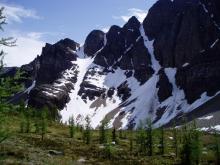
Scenery from same area:
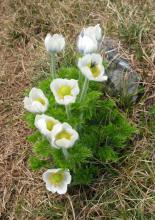
One of the snow-melt plants of the area, Anemone occidentalis:
Lovely shots Lori especially Anemone occidentalis .
I have a couple of very small seedlings of Pulsatilla occidentalis x AGS of BC ,sown Feb 2010.They germinated quite quickly and reappeared again this season.Fingers crossed they reach maturity and flower because it has that 'wow' factor... 8)
Dave, it's amazing to hear of our alpine, snow-melt bloomer, Pulsatilla occidentalis, growing at essentially sea level in zone 8! It will be really interesting to know how it does through time.
Some blooms for today: Androsace primuloides... or something like it. (Please correct me if my ID is wrong.)
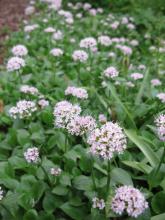
Valeriana montana is surprising tolerant of very non-alpine conditions. I have it as one of my experiments, growing in crazy pavement haphazardly set in very heavy clay that dries rock hard in the baking sun. Experiment reults: Ok as ground cover, but not very floriferous.
I grow (V. montana) too... nice as a not-too-rampant groundcover at the front of perennial beds. It only blooms in early summer for me... no where near so floriferous as Cliff's photo of V. supina either. It's fragrant but I have never noticed the fragrance wafting around. How about yours, Rick?
Cliff, is your V. supina photo taken in the wild or in cultivation?
It seems some of you are back in business after a rather dull month ( I mean with little activity in the green sector). All your nice shots of flowers make me longing for the spring! Although the snow has disappeared weeks ago the weather is rainy and barely above freezing temps. The snowdrops has started to show and the witch hazel flower but not much else.
However, I visited London, Norwich and a small place called Holt in Norfolk last week. Lots of spring flowers to see: snowdrops, winter aconites, mahonias, prunus, crocuses etc. Mindrefreshing sights :D Sorry, no pics!
I grow (V. montana) too... It's fragrant but I have never noticed the fragrance wafting around. How about yours, Rick?
Honestly, I don't think I ever stuck my nose in it... certainly no wofting about. ------------------------------
How about a different kind of "image of the day"...
Germinated Lilium monadelphum var. szovitsianum seed, from last year's NARGS seed ex, in the first stage. In its first season, it produces a tiny bulb, from which a leaf will emerge the following season.
Welcome back to the fold Mark. A cheery image for today ... Pulsatilla alpina ssp apiifolia under the Eiger.
Thanks Cliff, I was suffering forum withdrawal symptoms! That's a splendid plant, and it looks surprisingly tall and robust, perhaps inspired by living on the doorstep to the Eiger.
Interesting photos from a wide range of topics! Here is my contribution, it is a witch hazel growing at the main entrance where I work (Hamamelis x intermedia 'Pallida'). Some spring plants have started the season now.
Beautiful, Cliff. Congrats on the seedlings Rick. The hypogeal Lilium are always cool like that. I love the tiny bulbs that germinating seedlings produce, before they ever put up a leaf as well.
Grows about 10 inches here and the seed heads are only a few inches higher. More hardy in my zone 4 climate than any variegated sedge I've tried. One might think that with all the little "bulbs" it produces at the soil surface it would be invasive, but not so. This is a well behaved, clump grass.
Trond, looks like winter is losing its grip for you with witch hazel blooms. We have had 5 feet of snow in the last 3 weeks with several more storms heading our way. Looks like a very late spring for us. I have literally been shovelling everyday..I am getting sick of this!
At the risk of mortally offending Todd, I am happy to report this weekend has been very balmy--60F: the mountains of snow at every parking lot are still daunting, but on level ground the snow is melting like butter on a hot skillet: freshets are everywhere, and the ground is absorbing some much needed moisture. The brash steppe sun was toasty all day, and snowdrops and hellebores that were opening just before the last few weeks of arctic cold, are emerging again and continuing their pageant despite -20F! Knock on wood..but we seem to have precious little evidence for the cold snap: the agaves, nolinas, dasylirions and other marginal succuolents around town don't seem to have singed, and the various Atlas Cedars and evergreen magnolias look just fine...I think a very long, dry summer and fall must have put everything into a state of complete dormancy. Of course, a week or two of this and everything will explode just in time for ANOTHER cold snap (such is Colorado!)...Most years the Adonis amurensis is out by now (it often starts in January): I haven't looked, but I suspect one must be blooming somewhere in my garden or Denver Botanic Gardens: here is a picture from last spring about this time. I have never seen the Winterthur March Bank, but I am told there are hundreds there...but even a single plant is heavenly! Happy Valentine's day to all of you! (A day early that is...)
Lovely Erigeron, Lori: what a great involucre! And the lake in the background...
Over 70 yesterday: the freshets are drying out and the snow is only in shady spots now, and the vast Himalaya drifts in parkinglots are shrinking into black and muddy Appalachians.
Snowdrops are out everywhere suddenly, the first crocus are open and Adonis and Hellebores are open too! I declare springtime! (tentatively....)
I got blisters yesterday afternoon cutting things back in the garden. I will not mention that it was shirtsleeve weather and that I had to wear a hat (it was so sunny)...I shan't tell you that things are poking up everywhere. Of course all this in time for another half dozen snowy spells we are sure to have into April or even May! There are advantages to long snow cover...
I hope no-one minds a pic of the day from the south?
This is Goodenia affinis 'Little Luna', an Austalian native that is flowering for me at the moment.
And if no-one minds a couple more pics for the day...... here's a native Aussie bulb, Calostemma purpurea, this one a pink flowered form rather than the usual red and yellow ones.
Also a pic of an individual flower of Galtonia candicans 'Moonbeam', which is flowering at present as well.
In my desperate attempt to have spring as early as the rest of you, I brought a few of our potted alpines into the cool greenhouse at work. Three of the primula bloomed within 2 weeks. Here are some 'studio' pics of Primula marginata , Primula veris and Primula 'Freedom'
Great images Todd! And dazzling us with innovative usage of inline image posting. If it is any consolation, we still have a 2-1/2' (75 cm) ice-hard layer of snow on the ground, frustrating when it reached nearly 60 F today.
Paul, I'm fascinated with Calostemma, first encountering this unusual genus on the pages of the Pacific Bulb Society. So I googled Calostemma to come up with a couple links for this message, and see that you are all over the web with Calostemma images :D Here's the PBS Calostemma page (you're on that one too!): http://www.pacificbulbsociety.org/pbswiki/index.php/Calostemma
They vaguely remind me of Tulbaghia, with the united corona, and sort of Allium-esque too... I think I'm in love ;D I suspect however they would not be hardy here.
The bulbs sink to 30 to 45cm below ground, so that may offer some help in your area? Where they come from naturally is certainly not zone 5, that is for sure. Yes, I've posted pics of them all over the place...... always good to "advertise" an Aussie native bulb that people are unfamiliar with. ;D
All your nice flowering plants whether it be from studios or deep south make me sick of longing for spring :-[ Here we have neither snow nor rain but dry cold weather (well cold....not compared to the North of Norway which has -40 to -50C/-40 to -58F these days; Here it is -2C/28F). The soil has frozen solid once more and the lakes are ice-covered. The world is grey :(
Todd, You have perfectly illustrated why so many Brits grow plants under glass (but without heat of any kind). Our continually wet, dark and cool winters don't provide snow cover, the rain begins in October and continues until March and the sun rarely shines during the same period. Our pots outside either crack with frost or flood, they get blown around by winds or enveloped in moss, mud and weeds and, more importantly perhaps, the rain can prevent inspection and distills that exuberant joy of gardening. Under a pane of glass or in an unheated greenhouse we can shelter our plants (and ourselves) from the deluge and, hopefully, flower our plants up to two weeks earlier, so that we can compete (we should be so lucky) at the shows with our more privileged (higher temperatures, less rain, more sun) fellow gardeners in the south (of England, not Australia)!!! ;D


Comments
Richard T. Rodich
Re: Image of the day
Wed, 01/19/2011 - 7:52pmI have had plenty of earwig damage on other lilies, but never a nibble by anything on L. majoense. I couldn't say about the lily beetles; they aren't here in Minnesota yet. But my guess is that this species might be somewhat resistant, as the leaves are very thick and waxy. Perhaps someone else has had some experience?
Another interesting thing: Lilium 'White Henryi' is never bothered by earwigs, but the just opening buds seem to irresistible nighttime/morning "livetraps" for them. I can shake the buds in a jar and catch them easily.
Trond Hoy
Re: Image of the day
Wed, 01/19/2011 - 11:47pmRick, I am impressed of your L majoense lilies! It is a species I have wanted to try for years. How do they tolerate wet winters, do you know? And what about slug resistance?
Todd Boland
Re: Image of the day
Thu, 01/20/2011 - 8:59amRick, that lily is stunning! I wish I had more patience to grow lilies from seed but then, lilies don't really do well for me on the whole :-[
Richard T. Rodich
Re: Image of the day
Thu, 01/20/2011 - 12:56pmOur ground freezes solid 1 to 4 feet down, depending on our snow cover and temperature. Winter wet isn't such a problem as much as you, Trond, although, compared to a montane climate it is. My plants do grow in clay based, rich soil, but I can't say if L. majoense is any more or less tolerant to wet winters, compared to other lily species. I also have Ll. distichum, martagon, fargesii, formosanum, f. var. pricei, concolor varieties, taliense, lankongense, duchartrei, tsingtauense, szovitsianum, and various asiatic and trumpet hybrids all growing in the same garden. I'm not claiming they all do wonderfully well, but they do all bloom. It is too dry in the summer to support moisture loving lilies like Ll. canadense, pardalinum or parryi.
Regarding slugs, the leaf texture would seem to point to resistance, but I don't know. Slugs love cacti too, if it weren't for the thorns.
by the way, I was excited to see seed offered in the NARGS seed ex from a dwarf form of L. pardalinum. I did get some, but most lily species are self infertile so I am not holding my breath. Dwarf genes crossed with normal genes would likely result in a normal phenotype. On the other hand, apomixis is not unheard of in Lilium species, so I might get lucky.
Trond Hoy
Re: Image of the day
Fri, 01/21/2011 - 5:02amMany thanks, Rick. You have given me courage to try, at least :D
Cliff Booker
Re: Image of the day
Mon, 01/24/2011 - 2:23amOne of the darkest gentians we have found in the Dolomites.
Gentiana terglouensis
Amy Olmsted
Re: Image of the day
Mon, 01/24/2011 - 6:45amWell....all I can say is WOW!! What a fantastic blue! Thanks for that pic on this coldest day of the year....26 Below 0 farenheit last night!
Todd Boland
Re: Image of the day
Mon, 01/24/2011 - 5:02pmAnother stunning image Cliff!
This is Campanula makaschvilii...or at least that is what the seeds say! It bloomed for the first time last summer. It looks very similar to C. alliarifolia, but more compact.
Lori S. (not verified)
Re: Image of the day
Sat, 01/29/2011 - 11:21am1) Healy Pass and the Monarch Ramparts, Banff N.P.:
2) Castilleja rhexifolia (I think?)
Trond Hoy
Re: Image of the day
Sun, 01/30/2011 - 12:26amThat's what I call blue, Cliff!
Todd, I have a plant also labeled C. makaschvilii or something like that but it is much coarser than yours. Yours the better one!
Lori, the Banff mountains and flowers are always impressive :o
Panayoti Kelaidis
Re: Image of the day
Wed, 02/02/2011 - 9:37amWhat? No images of the day? I have been absent for some time (more travel--this time to Oregon) but I am back in time for an ungodly cold snap. Ugggh. Wish I was back in Oregon!
My image is of so-called Iris bucharica 'Alba' (which I believe is actually Iris wilmottiana 'Alba') whose icy white flowers are appropriate to our frigid cold this week (36 hours below zero Farenheit: rising to nine above today and making things feel positively TROPICAL!): the low this weekend is expected to be ABOVE freezing (and it was 70F last Saturday). Which explains why we and our plants are schizophrenic. There were snowdrops blooming everywhere last week, and hazelnuts ready to burst bloom. As opposed to Portland, Oregon where it was early spring with lots of Sarcoccoca blooming everywhere, and Hamamelis and the first blooms on Mume and pears...and of course Camellias in full glory.
I did a short blog on Tropicalismo vs. reality (namely alpines) for the Gardens:
http://www.botanicgardensblog.com/2011/02/02/brrrrrrrrrr-its-cold-out-th...
Lori S. (not verified)
Re: Image of the day
Fri, 02/04/2011 - 6:06pmGentiana terglouensis - what a stunning plant, in a stunning setting! Thanks for the inspiring photos, Cliff. Wow, so much inspiration from all over on this forum... an amazing clump of beautiful little irises from Panayoti, gorgeous lilies from Rick, yet another fine campanula that I will need to try from Todd... guess I'd better start working on my secret plan to annex the neighbor's yard.
Some images to remind those of us who are still in the depths of winter that spring will eventually arrive...
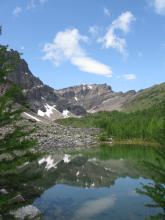
A tarn below Panorama Ridge, Banff N.P.:
Scenery from same area:
One of the snow-melt plants of the area, Anemone occidentalis:
Toole (not verified)
Re: Image of the day
Fri, 02/04/2011 - 7:59pmLovely shots Lori especially Anemone occidentalis .
I have a couple of very small seedlings of Pulsatilla occidentalis x AGS of BC ,sown Feb 2010.They germinated quite quickly and reappeared again this season.Fingers crossed they reach maturity and flower because it has that 'wow' factor... 8)
Cheers Dave.
McGregorUS (not verified)
Re: Image of the day
Sat, 02/05/2011 - 1:23amLori
Love the anemone and the images of Banff NP just make me remember how stunning it is. Thanks.
Lori S. (not verified)
Re: Image of the day
Sun, 02/06/2011 - 12:36pmDave, it's amazing to hear of our alpine, snow-melt bloomer, Pulsatilla occidentalis, growing at essentially sea level in zone 8! It will be really interesting to know how it does through time.
Some blooms for today: Androsace primuloides... or something like it. (Please correct me if my ID is wrong.)
Cliff Booker
Re: Image of the day
Sun, 02/06/2011 - 2:45pmLovely images folks.
Two for today ... Valeriana supina
Richard T. Rodich
Re: Image of the day
Sun, 02/06/2011 - 6:09pmValeriana montana is surprising tolerant of very non-alpine conditions. I have it as one of my experiments, growing in crazy pavement haphazardly set in very heavy clay that dries rock hard in the baking sun. Experiment reults:
Ok as ground cover, but not very floriferous.
Valeriana montana
Lori S. (not verified)
Re: Image of the day
Sun, 02/06/2011 - 10:37pmI grow (V. montana) too... nice as a not-too-rampant groundcover at the front of perennial beds. It only blooms in early summer for me... no where near so floriferous as Cliff's photo of V. supina either. It's fragrant but I have never noticed the fragrance wafting around. How about yours, Rick?
Cliff, is your V. supina photo taken in the wild or in cultivation?
Cliff Booker
Re: Image of the day
Mon, 02/07/2011 - 2:31amHi Lori,
The photos were taken in the Dolomites ... I couldn't grow anything as floriferous as that!! :D
Trond Hoy
Re: Image of the day
Mon, 02/07/2011 - 11:18amIt seems some of you are back in business after a rather dull month ( I mean with little activity in the green sector).
All your nice shots of flowers make me longing for the spring! Although the snow has disappeared weeks ago the weather is rainy and barely above freezing temps. The snowdrops has started to show and the witch hazel flower but not much else.
However, I visited London, Norwich and a small place called Holt in Norfolk last week. Lots of spring flowers to see: snowdrops, winter aconites, mahonias, prunus, crocuses etc. Mindrefreshing sights :D
Sorry, no pics!
Richard T. Rodich
Re: Image of the day
Mon, 02/07/2011 - 9:23pmHonestly, I don't think I ever stuck my nose in it... certainly no wofting about.
------------------------------
How about a different kind of "image of the day"...
Germinated Lilium monadelphum var. szovitsianum seed, from last year's NARGS seed ex, in the first stage. In its first season, it produces a tiny bulb, from which a leaf will emerge the following season.
Mark McDonough
Re: Image of the day
Tue, 02/08/2011 - 6:56amOh, how cute are those seedlings, I'm amazed that almost instantly the sprouting seedlings create tiny bulbs.
Cliff Booker
Re: Image of the day
Tue, 02/08/2011 - 6:59amWelcome back to the fold Mark.
A cheery image for today ... Pulsatilla alpina ssp apiifolia under the Eiger.
Mark McDonough
Re: Image of the day
Tue, 02/08/2011 - 7:11amThanks Cliff, I was suffering forum withdrawal symptoms! That's a splendid plant, and it looks surprisingly tall and robust, perhaps inspired by living on the doorstep to the Eiger.
Trond Hoy
Re: Image of the day
Tue, 02/08/2011 - 9:20amHello Mark, did you fix the problems?
Interesting photos from a wide range of topics!
Here is my contribution, it is a witch hazel growing at the main entrance where I work (Hamamelis x intermedia 'Pallida').
Some spring plants have started the season now.
Paul T (not verified)
Re: Image of the day
Tue, 02/08/2011 - 2:58pmBeautiful, Cliff. Congrats on the seedlings Rick. The hypogeal Lilium are always cool like that. I love the tiny bulbs that germinating seedlings produce, before they ever put up a leaf as well.
Trond Hoy
Re: Image of the day
Wed, 02/09/2011 - 3:56amNot today and not a plant either but as beautiful as any flower :D a Cucullia lactucae gnawing on a sow thistle (Sonchus arvensis).
Richard T. Rodich
Re: Image of the day
Sat, 02/12/2011 - 5:49pmArrhenatherum elatius ssp. bulbosum 'Variegatum'
Grows about 10 inches here and the seed heads are only a few inches higher. More hardy in my zone 4 climate than any variegated sedge I've tried. One might think that with all the little "bulbs" it produces at the soil surface it would be invasive, but not so. This is a well behaved, clump grass.
Todd Boland
Re: Image of the day
Sun, 02/13/2011 - 4:35pmTrond, looks like winter is losing its grip for you with witch hazel blooms. We have had 5 feet of snow in the last 3 weeks with several more storms heading our way. Looks like a very late spring for us. I have literally been shovelling everyday..I am getting sick of this!
Panayoti Kelaidis
Re: Image of the day
Sun, 02/13/2011 - 7:00pmAt the risk of mortally offending Todd, I am happy to report this weekend has been very balmy--60F: the mountains of snow at every parking lot are still daunting, but on level ground the snow is melting like butter on a hot skillet: freshets are everywhere, and the ground is absorbing some much needed moisture. The brash steppe sun was toasty all day, and snowdrops and hellebores that were opening just before the last few weeks of arctic cold, are emerging again and continuing their pageant despite -20F! Knock on wood..but we seem to have precious little evidence for the cold snap: the agaves, nolinas, dasylirions and other marginal succuolents around town don't seem to have singed, and the various Atlas Cedars and evergreen magnolias look just fine...I think a very long, dry summer and fall must have put everything into a state of complete dormancy. Of course, a week or two of this and everything will explode just in time for ANOTHER cold snap (such is Colorado!)...Most years the Adonis amurensis is out by now (it often starts in January): I haven't looked, but I suspect one must be blooming somewhere in my garden or Denver Botanic Gardens: here is a picture from last spring about this time. I have never seen the Winterthur March Bank, but I am told there are hundreds there...but even a single plant is heavenly! Happy Valentine's day to all of you! (A day early that is...)
Todd Boland
Re: Image of the day
Mon, 02/14/2011 - 1:45pmI hate you Panayoti! ;D
Anne Spiegel
Re: Image of the day
Mon, 02/14/2011 - 7:00pmMe too, Panayoti.
Trond Hoy
Re: Image of the day
Tue, 02/15/2011 - 1:44amWell, I will thank you Panayoti ;) I can't grow Adonis like this anyway!
What a difference the strong sunshine does even if it is biting cold ;D
Although we have some sun these days the air is Arctic cold and the sun doesn't give any warmth at all :-[ :(
deesen (not verified)
Re: Image of the day
Tue, 02/15/2011 - 8:39amI have rain to spare if anyone would like some? ;D
Trond Hoy
Re: Image of the day
Tue, 02/15/2011 - 2:18pmYes please! Better rain than dry cold.
Lori S. (not verified)
Re: Image of the day
Tue, 02/15/2011 - 10:13pmErigeron humilis... and an interesting dwarf grass... in Kananaskis Country, Alberta.
Panayoti Kelaidis
Re: Image of the day
Wed, 02/16/2011 - 8:12amLovely Erigeron, Lori: what a great involucre! And the lake in the background...
Over 70 yesterday: the freshets are drying out and the snow is only in shady spots now, and the vast Himalaya drifts in parkinglots are shrinking into black and muddy Appalachians.
Snowdrops are out everywhere suddenly, the first crocus are open and Adonis and Hellebores are open too! I declare springtime! (tentatively....)
Todd Boland
Re: Image of the day
Wed, 02/16/2011 - 5:35pmHere is my back yard...there is a 4.5 foot fence NOT visible on the left side of the yard. Spring is NOT here!
Paul T (not verified)
Re: Image of the day
Wed, 02/16/2011 - 7:34pmGood grief, Todd!! :o :o
Panayoti Kelaidis
Re: Image of the day
Thu, 02/17/2011 - 8:13amTodd, you do make me feel guilty! (sort of)...
I got blisters yesterday afternoon cutting things back in the garden. I will not mention that it was shirtsleeve weather and that I had to wear a hat (it was so sunny)...I shan't tell you that things are poking up everywhere. Of course all this in time for another half dozen snowy spells we are sure to have into April or even May! There are advantages to long snow cover...
Paul T (not verified)
Re: Image of the day
Thu, 02/17/2011 - 2:31pmI hope no-one minds a pic of the day from the south?
This is Goodenia affinis 'Little Luna', an Austalian native that is flowering for me at the moment.
And if no-one minds a couple more pics for the day...... here's a native Aussie bulb, Calostemma purpurea, this one a pink flowered form rather than the usual red and yellow ones.
Also a pic of an individual flower of Galtonia candicans 'Moonbeam', which is flowering at present as well.
Enjoy. 8)
Todd Boland
Re: Image of the day
Thu, 02/17/2011 - 3:51pmStunning images Paul...although with every current flower pic being posted I get more depressed :-[
Todd Boland
Re: Image of the day
Thu, 02/17/2011 - 4:03pmIn my desperate attempt to have spring as early as the rest of you, I brought a few of our potted alpines into the cool greenhouse at work. Three of the primula bloomed within 2 weeks. Here are some 'studio' pics of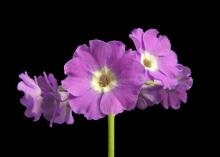 , Primula veris
 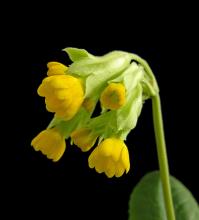 and Primula 'Freedom'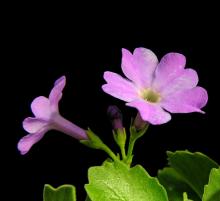
Primula marginata
Paul T (not verified)
Re: Image of the day
Thu, 02/17/2011 - 4:13pmTodd,
Just bear in mind that we're late summer here, so it isn't exactly difficult to find things in flower. ;D
Mark McDonough
Re: Image of the day
Thu, 02/17/2011 - 4:14pmGreat images Todd! And dazzling us with innovative usage of inline image posting. If it is any consolation, we still have a 2-1/2' (75 cm) ice-hard layer of snow on the ground, frustrating when it reached nearly 60 F today.
Paul, I'm fascinated with Calostemma, first encountering this unusual genus on the pages of the Pacific Bulb Society. So I googled Calostemma to come up with a couple links for this message, and see that you are all over the web with Calostemma images :D Here's the PBS Calostemma page (you're on that one too!):
http://www.pacificbulbsociety.org/pbswiki/index.php/Calostemma
They vaguely remind me of Tulbaghia, with the united corona, and sort of Allium-esque too... I think I'm in love ;D I suspect however they would not be hardy here.
Paul T (not verified)
Re: Image of the day
Thu, 02/17/2011 - 4:23pmMark,
The bulbs sink to 30 to 45cm below ground, so that may offer some help in your area? Where they come from naturally is certainly not zone 5, that is for sure. Yes, I've posted pics of them all over the place...... always good to "advertise" an Aussie native bulb that people are unfamiliar with. ;D
Lori S. (not verified)
Re: Image of the day
Thu, 02/17/2011 - 11:12pmHere's a cold compress for the fevered brows of all those imagine that spring is nigh...
Winter... might as well embrace it!! ('Cause we know it's gonna be around for a whole lot longer! ;D ;D ;D)
Cliff Booker
Re: Image of the day
Fri, 02/18/2011 - 12:26amBeautiful images Lori ... an antidote to our continuous cool rain! :D
Trond Hoy
Re: Image of the day
Fri, 02/18/2011 - 12:37amAll your nice flowering plants whether it be from studios or deep south make me sick of longing for spring :-[
Here we have neither snow nor rain but dry cold weather (well cold....not compared to the North of Norway which has -40 to -50C/-40 to -58F these days; Here it is -2C/28F).
The soil has frozen solid once more and the lakes are ice-covered.
The world is grey :(
Please continue showing colors!
Cliff Booker
Re: Image of the day
Fri, 02/18/2011 - 12:50amTodd,
You have perfectly illustrated why so many Brits grow plants under glass (but without heat of any kind).
Our continually wet, dark and cool winters don't provide snow cover, the rain begins in October and continues until March and the sun rarely shines during the same period. Our pots outside either crack with frost or flood, they get blown around by winds or enveloped in moss, mud and weeds and, more importantly perhaps, the rain can prevent inspection and distills that exuberant joy of gardening.
Under a pane of glass or in an unheated greenhouse we can shelter our plants (and ourselves) from the deluge and, hopefully, flower our plants up to two weeks earlier, so that we can compete (we should be so lucky) at the shows with our more privileged (higher temperatures, less rain, more sun) fellow gardeners in the south (of England, not Australia)!!! ;D
Lovely studio shots, Todd.
Pages