Silene uralensis ssp. attentuata in limestone scree, eastern slope Rockies - with it, in a little microcosm of the local alpine selection, are tiny plants of Minuartia austromontana, Smelowskia calycina, Androsace chamaejasme, Saussurea nuda var. densa, and Potentilla sp.. I need to learn to identify potentillas... any idea which one this may be?
Lori, do you grow the Silene uralensis in the garden? I have seen this or something very similar, in the Mosquito Range of Colorado, never very plentiful and always high up. It's one of my favorite plants. I think it was called Silene apetala when I saw it?
It was -14 C this morning, but tomorrow it may go up to 40F at some point. Snow cover is good, but the deer are everywhere, whacking off anything showing above the snow.
Gorgeous scenes, Cliff! Which primulas would those be?
Anne, I have not yet grown Silene uralensis in the garden but I did collect a little bit of seed, so I will be giving it a try this winter. One of my favourites too! Yes, it was formerly Lychnis apetala according to my local references.
Silene uralensis ssp. attentuata in limestone scree, eastern slope Rockies - with it, in a little microcosm of the local alpine selection, are tiny plants of Minuartia austromontana, Smelowskia calycina, Androsace chamaejasme, Saussurea nuda var. densa, and Potentilla sp.. I need to learn to identify potentillas... any idea which one this may be?
You are sure this isn't your new rock bed ;D?
Cliff, superb pictures as always! But now I have bought me a new camera ;)!
Vella spinosa, an interesting spiny shrub from the Sierra Nevada of Spain. It was planted in regular soil and unfortunately, I lost it after the first of the recent string of unusually snowy winters (3 in a row now!) I suspect the soil, usually quite dry with our normally patchy, inconsistent snow cover, probably became too saturated for it in the spring melt. (Who says snow cover is necessarily good?? :()
Lori It is Penstemon speciosus a densly flowered form, I see at elevations of from 6000'-7500' on the eastern slopes of the northern Sierra Nevada Range.
I have to live for many more years to get sufficient time to try all plants I want to! Both Vella spinosa and Penstemon speciosus are worth waiting for.
Lovely Penstemon Lori and your latest pic is such a contrast Cliff. :)
Not as colourful --a couple from yesterdays trip into Fiordland.
Aciphylla crosby-smithii with a view.
A moody pic of the hybrid between Ranunculus lyallii and R.buchananii just as the clouds were gathering ,forcing a hasty retreat from the 'tops' before the rain arrived. :'(
Image for today ... Valeriana supina growing on the same Dolomite scree where we find Ranunculus seguieri, Linaria alpina, Thlaspi rotundifolium and Potentilla nitida among many others.
I don't do the descent anymore - not when a gondola can take you down in minutes and save your knees. Far prefer the ascent. It's steep, but the plants invite you to stop to photograph and take a rest.
I don't have a greenhouse, but do have a single basement window (out of two such windows) where I have the nuptial-privilege of overwintering plants... mostly devoted to a small collection of Nothoscordum species from Thad Howard. One blooming now is Nothoscordum felipponei, a dwarf plant with very narrow channeled leaves and surprisingly large mildly fragrant yellow starry blooms. It is rather close to N. dialystemon, which I also grow, and still waiting for buds to appear. In growth, I find these plants love plenty of moisture (not a good point with me, as I'm terrible with "houseplants", habitually forgetting to water them... I'm much better with outdoor plants). But given lots of watering when in growth, they flower over a very long period and are delight.
I have shared the delightful smaller-flowered N. montevidense with our local New England Chapter NARGS chapter, where it has become a mainstay of rock garden meetings, plant shows, and plant sales. The small group of yellow-flowered Nothoscordums are all desirable little collector's bulbs, easy of culture, and most rewarding with some that will flower prolifically both in spring and fall/winter... not to be put off by a couple of white-flowered weedy species that give Nothoscordum an undeserved bad name.
Mark, I also grow a few plants in my cool basement window...mostly Cyclamen. The coum are starting to flower now. I'll probably see them blooming outside in Vancouver on Sunday!
Cliff, do you spend a lot of time in the Dolomites on your knees looking for the right angles to take the picture! Anyway, you manage to do it! And not only the picture but in plural too.
Mark, I would put a nice plant like that on the table in my sittingroom at least for a while when it flowered!
Todd, a long way for a sunday stroll to look for cyclamen!
Usually on my stomach, Trond ... and either in thistles or running water!!! ;D ;D ;D
Thanks for the kind comments folks.
Two more of a similar type ... Papaver rhaeticum 1 and 2
Hoy wrote:
Cliff, do you spend a lot of time in the Dolomite on your knees looking for the right angles to take the picture! Anyway, you manage to do it! And not only the picture but in plural too
Do you use a special overall with reinforced and waterproof front? You should!
Yours and others pictures from the Dolomites have made me longing for visiting those areas! Unfortunately I have no time this year (we are going to visit South America). What time of the year would you recommend to be the best?
Hi Trond, Anytime after the third week of May should give you stunning plants and reasonable weather. I, personally, would try to arrive for the last week of June or the first week of July for the optimum number of species. I envy you your travels to South America ... are you going to Chile? No overalls for me ... only tee-shirts and shorts. :D
Cliff, Chile is on my wish list too but this time the goal is the jungles and beaches of Venezuela. And if weather permits a tour to Tepuy Roraima with its endemic carnivorous plants. I hope I get some nice pictures.....
not to be put off by a couple of white-flowered weedy species that give Nothoscordum an undeserved bad name.
Mark, your photos of the yellow Nothoscordums are an eye-opener. Years ago I had a weedy white example run rampant through a bulb frame. Hearing that there are some that behave I'm going to keep an eye out for bulbs or seed of the yellow flowered ones.
Mark, your photos of the yellow Nothoscordums are an eye-opener. Years ago I had a weedy white example run rampant through a bulb frame. Hearing that there are some that behave I'm going to keep an eye out for bulbs or seed of the yellow flowered ones.
Jenny, sounds like you had the ubiquitous weed N. inodorum or N. bivalve. There are a number of choice dwarf yellow Nothoscordum species from South America, all are delightful and easy to grow, but not reliably hardy in colder climates (such as my Zone 5 garden) and must be protected indoors for the winter (easily done). The best in my opinion is Nothoscordum montevidense from Argentina, Southern Brazil, and Uruguay. It has thread-like leaves and small cheery yellow "cups" on short stems, blooming both in the spring and in the autumn. Here are some good photo links:
Barely heard of Nothoscordum before (not a stretch in my case), and that little montevidense is so cute!
I suspect some of us are already planting or preparing to plant our NARGS seeds. I am preparing my first digital presentation for our Chapter. It will be good to have my newbie mistakes presented to a friendly audience...
--------------- As I was puting stuff away in the linen closet, I was reminded that I had some Lilium scales incubating there. I am very happy to report that a couple not very good looking Lilium majoense scales have produced bulblets, and leaves already to boot!
For anyone who does, scaling, I think I have found a pretty foolproof medum: 4/5 perlite (rinsed to remove the fluorine) and 1/5 raw sphagnum. The trick is the correct amount of moisture - not so much as to allow rot, yet enough to prevent dehydration. If the sphagnum turns light colored, indicating drying out, then add more moisture.
Thanks for the great links, Mark. I didn't realise that Ipheion had been submerged into Nothoscordum. I have pots of Ipheion dialystemon, or rather N. dialystemon, growing in a frost-free glasshouse and they flower freely in winter. I'll definitely be looking out for N. montevidense.
Thanks for the great links, Mark. I didn't realise that Ipheion had been submerged into Nothoscordum. I have pots of Ipheion dialystemon, or rather N. dialystemon, growing in a frost-free glasshouse and they flower freely in winter. I'll definitely be looking out for N. montevidense.
I knew there was something that I forgot to mention in my Nothoscordum post, the fact that taxonomically the species interchange between Ipheion and Nothoscordum. I don't know the current standing or separation between the two genera, but I believe the yellow ones are still Nothoscordum, although one can find them listed both ways.
At some point in time, some of these "Nothoscordum-Ipheion" plants have also resided in Milla, Tristagma, Beauverdia, and Brodiaea (the latter, not as we currently know the North American genus Brodiaea, but in early taxonomy the genus name, along with Allium, were sometimes misapplied to such S. American plants). The status of N. felipponei (syn. I. sellowianum) is particularly confusing (see the previously given Pacific Bulb Society link), but I have simply maintained the names as given to me by Thad Howard, someone who knew a great deal about the genus.
Rick, I was interested to hear of your success with the lily scales - what temperature do you have in your linen closet?
That would be 70F (21C). Hybrid lilies produce scale bulblets pretty easily and aren't nearly as moisture sensitive, but species can be more tricky, depending on the type.
By the way, Lilium majoense is much more cold hardy than literature reports. I have had plants growing here in zone 4 for four years, and blooming for two years.
By the way, Lilium majoense is much more cold hardy than literature reports. I have had plants growing here in zone 4 for four years, and blooming for two years.
Rick, I don't know this lily, do you have a photo you could post? Where is it native to? I too am interested in how you propagate from Lilium scales, I've never tried such a technique.
Thanks Rick, it looks to be a magnificent Lily to be sure. I'm glad to get to know this beauty. Is it one that lily beetles tend to ignore... I've ripped out a few of the fancy Lilium hybrids as they're a magnet for lily beetle; and I resort to diligent daily handpicking of beetles on my Fritillaria species to stave off their attacks.
Okay, I got three different pics this time (and deleted the old post).
Lilium majoense is related to L. nepalense and L. primulinum. It's from western China. For a wild Chinese species, it is has been quite tolerant to heat and dryness for me. See about propagating by scales here: http://www.lilies.org/propagation.html

Comments
Cliff Booker
Re: Image of the day
Thu, 12/30/2010 - 10:26amSuper image, Lori ...
A few from Wengen, Switzerland taken over five years ago ... now just sitting on my hard drive degenerating slowly! :D
Anne Spiegel
Re: Image of the day
Thu, 12/30/2010 - 3:48pmLori, do you grow the Silene uralensis in the garden? I have seen this or something very similar, in the Mosquito Range of Colorado, never very plentiful and always high up. It's one of my favorite plants. I think it was called Silene apetala when I saw it?
Anne Spiegel
Re: Image of the day
Thu, 12/30/2010 - 3:51pmIt was -14 C this morning, but tomorrow it may go up to 40F at some point. Snow cover is good, but the deer are everywhere, whacking off anything showing above the snow.
Lori S. (not verified)
Re: Image of the day
Thu, 12/30/2010 - 4:17pmGorgeous scenes, Cliff! Which primulas would those be?
Anne, I have not yet grown Silene uralensis in the garden but I did collect a little bit of seed, so I will be giving it a try this winter. One of my favourites too! Yes, it was formerly Lychnis apetala according to my local references.
Cliff Booker
Re: Image of the day
Thu, 12/30/2010 - 5:53pmThanks Lori ... I would suggest Primula hirsuta ... significant colonies on the shale escarpments.
Trond Hoy
Re: Image of the day
Thu, 12/30/2010 - 10:54pmYou are sure this isn't your new rock bed ;D?
Cliff, superb pictures as always! But now I have bought me a new camera ;)!
Trond Hoy
Re: Image of the day
Thu, 12/30/2010 - 11:10pmDon't think all flowers grow well in the rockery, but these did taste well! They are made of vegetables. (From a meeting in the local Garden Society)
Cliff Booker
Re: Image of the day
Fri, 12/31/2010 - 2:47amHAPPY NEW YEAR from Sue and I here in Whitworth, Lancashire. England ...
Trond Hoy
Re: Image of the day
Fri, 12/31/2010 - 7:19amYou should understand this!
Lori S. (not verified)
Re: Image of the day
Fri, 12/31/2010 - 11:13amI'm no linguist, Trond, but I think I get it! ;D
Happy New Year to all from me too!
John P. Weiser
Re: Image of the day
Sat, 01/01/2011 - 7:18amGreat cards everyone!! Thank you for your best wishes.
Richard T. Rodich
Re: Image of the day
Sat, 01/01/2011 - 10:13am[shadow=blue,left]And to you all also...[/shadow]
Lori S. (not verified)
Re: Image of the day
Sun, 01/02/2011 - 12:12pmNow for something rather different again...
Vella spinosa, an interesting spiny shrub from the Sierra Nevada of Spain. It was planted in regular soil and unfortunately, I lost it after the first of the recent string of unusually snowy winters (3 in a row now!) I suspect the soil, usually quite dry with our normally patchy, inconsistent snow cover, probably became too saturated for it in the spring melt. (Who says snow cover is necessarily good?? :()
Lori S. (not verified)
Re: Image of the day
Sun, 01/02/2011 - 12:23pmJohn, which penstemon are you showing in the gorgeous card you posted? I need to grow it!!
John P. Weiser
Re: Image of the day
Sun, 01/02/2011 - 12:58pmLori
It is Penstemon speciosus a densly flowered form, I see at elevations of from 6000'-7500' on the eastern slopes of the northern Sierra Nevada Range.
Here are a couple of closeups.
Lori S. (not verified)
Re: Image of the day
Sun, 01/02/2011 - 3:59pmTerrific plant! I love that shading from blue through to violet that seems to be seen often on "blue"-flowered penstemons.
Richard T. Rodich
Re: Image of the day
Sun, 01/02/2011 - 7:47pmThat is a fantastic plant, John. And Lori, I never tire seeing that wonderful Vella.
Trond Hoy
Re: Image of the day
Mon, 01/03/2011 - 5:06amI have to live for many more years to get sufficient time to try all plants I want to!
Both Vella spinosa and Penstemon speciosus are worth waiting for.
Lori S. (not verified)
Re: Image of the day
Mon, 01/03/2011 - 1:46pm... which I unfortunately neglected to collect seeds from. I'll have to search the various lists. Has anyone come across a source for Vella spinosa?
Cliff Booker
Re: Image of the day
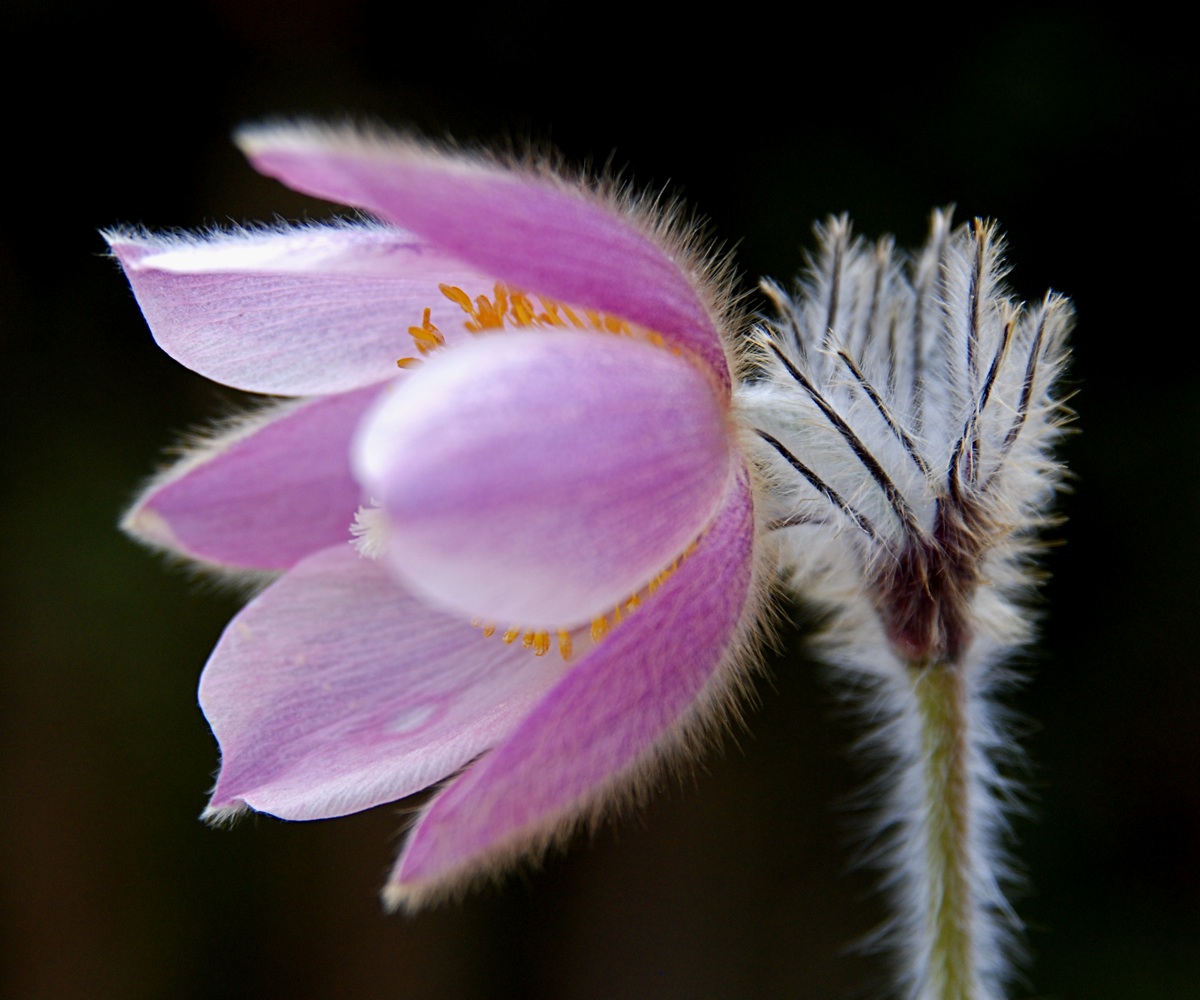
Wed, 01/05/2011 - 1:15amPulsatilla vernalis under the Eiger.
Please click on the image to expand.
Toole (not verified)
Re: Image of the day
Wed, 01/05/2011 - 10:31pmLovely Penstemon Lori and your latest pic is such a contrast Cliff. :)
Not as colourful --a couple from yesterdays trip into Fiordland.
Aciphylla crosby-smithii with a view.
A moody pic of the hybrid between Ranunculus lyallii and R.buchananii just as the clouds were gathering ,forcing a hasty retreat from the 'tops' before the rain arrived. :'(
Cheers dave
Todd Boland
Re: Image of the day
Fri, 01/07/2011 - 4:23pmSpectacular photography Dave!
Todd Boland
Re: Image of the day
Sat, 01/08/2011 - 5:12amNot really an alpine, but here is a picture of Watsonia lepida I took at the base of the Drakensberg Mountains.
Cliff Booker
Re: Image of the day
Sat, 01/08/2011 - 5:26amBeautiful colour, Todd.
Cliff Booker
Re: Image of the day
Sat, 01/08/2011 - 3:05pmImage for today ... Valeriana supina growing on the same Dolomite scree where we find Ranunculus seguieri, Linaria alpina, Thlaspi rotundifolium and Potentilla nitida among many others.
Anne Spiegel
Re: Image of the day
Sat, 01/08/2011 - 5:18pmWonderful photo, Cliff. And I know exactly where you took it. Such a marvelous trail with such great plants.
Cliff Booker
Re: Image of the day
Sun, 01/09/2011 - 11:23amMany thanks Anne ... that descent is one of our favourite hikes as well.
Dryas octopetala this time.
Anne Spiegel
Re: Image of the day
Sun, 01/09/2011 - 12:50pmI don't do the descent anymore - not when a gondola can take you down in minutes and save your knees. Far prefer the ascent. It's steep, but the plants invite you to stop to photograph and take a rest.
Todd Boland
Re: Image of the day
Mon, 01/10/2011 - 4:25pmLooks so inviting...I could use a alpine pick-me-up these days!
Mark McDonough
Re: Image of the day
Mon, 01/10/2011 - 9:05pmI don't have a greenhouse, but do have a single basement window (out of two such windows) where I have the nuptial-privilege of overwintering plants... mostly devoted to a small collection of Nothoscordum species from Thad Howard. One blooming now is Nothoscordum felipponei, a dwarf plant with very narrow channeled leaves and surprisingly large mildly fragrant yellow starry blooms. It is rather close to N. dialystemon, which I also grow, and still waiting for buds to appear. In growth, I find these plants love plenty of moisture (not a good point with me, as I'm terrible with "houseplants", habitually forgetting to water them... I'm much better with outdoor plants). But given lots of watering when in growth, they flower over a very long period and are delight.
I have shared the delightful smaller-flowered N. montevidense with our local New England Chapter NARGS chapter, where it has become a mainstay of rock garden meetings, plant shows, and plant sales. The small group of yellow-flowered Nothoscordums are all desirable little collector's bulbs, easy of culture, and most rewarding with some that will flower prolifically both in spring and fall/winter... not to be put off by a couple of white-flowered weedy species that give Nothoscordum an undeserved bad name.
Cliff Booker
Re: Image of the day
Tue, 01/11/2011 - 1:16amNuptial privileges at your time of life, Mark? ;)
Cliff Booker
Re: Image of the day
Fri, 01/14/2011 - 10:43amA quiet period on the forum, so three images for today ...
Eritrichium nanum scene
Anemone baldensis scene
Dolomite scene
Todd Boland
Re: Image of the day
Fri, 01/14/2011 - 5:25pmStunning images Cliff!
Mark, I also grow a few plants in my cool basement window...mostly Cyclamen. The coum are starting to flower now. I'll probably see them blooming outside in Vancouver on Sunday!
Richard T. Rodich
Re: Image of the day
Fri, 01/14/2011 - 8:46pmThose pics are absolutely surreal, Cliff !!!
Trond Hoy
Re: Image of the day
Sat, 01/15/2011 - 12:01amCliff, do you spend a lot of time in the Dolomites on your knees looking for the right angles to take the picture! Anyway, you manage to do it! And not only the picture but in plural too.
Mark, I would put a nice plant like that on the table in my sittingroom at least for a while when it flowered!
Todd, a long way for a sunday stroll to look for cyclamen!
Cliff Booker
Re: Image of the day
Sat, 01/15/2011 - 1:07amUsually on my stomach, Trond ... and either in thistles or running water!!! ;D ;D ;D
Thanks for the kind comments folks.
Two more of a similar type ... Papaver rhaeticum 1 and 2
Trond Hoy
Re: Image of the day
Sat, 01/15/2011 - 2:29amYou haven't been on your stomach here, Cliff!
Do you use a special overall with reinforced and waterproof front? You should!
Yours and others pictures from the Dolomites have made me longing for visiting those areas! Unfortunately I have no time this year (we are going to visit South America).
What time of the year would you recommend to be the best?
Cliff Booker
Re: Image of the day
Sat, 01/15/2011 - 4:37amHi Trond,
Anytime after the third week of May should give you stunning plants and reasonable weather. I, personally, would try to arrive for the last week of June or the first week of July for the optimum number of species. I envy you your travels to South America ... are you going to Chile?
No overalls for me ... only tee-shirts and shorts. :D
Trond Hoy
Re: Image of the day
Sat, 01/15/2011 - 7:54amCliff, Chile is on my wish list too but this time the goal is the jungles and beaches of Venezuela. And if weather permits a tour to Tepuy Roraima with its endemic carnivorous plants. I hope I get some nice pictures.....
Jennifer Wainwr...
Re: Image of the day
Sun, 01/16/2011 - 10:43pmMark, your photos of the yellow Nothoscordums are an eye-opener. Years ago I had a weedy white example run rampant through a bulb frame. Hearing that there are some that behave I'm going to keep an eye out for bulbs or seed of the yellow flowered ones.
Mark McDonough
Re: Image of the day
Mon, 01/17/2011 - 7:00amJenny, sounds like you had the ubiquitous weed N. inodorum or N. bivalve. There are a number of choice dwarf yellow Nothoscordum species from South America, all are delightful and easy to grow, but not reliably hardy in colder climates (such as my Zone 5 garden) and must be protected indoors for the winter (easily done). The best in my opinion is Nothoscordum montevidense from Argentina, Southern Brazil, and Uruguay. It has thread-like leaves and small cheery yellow "cups" on short stems, blooming both in the spring and in the autumn. Here are some good photo links:
N. montevidense at Edgewood Gardens
http://www.edgewoodgardens.net/Plants_Album/The%20Plants%20-%20%20Comple...
Yellow Nothoscordums at Edgewood Gardens
http://www.edgewoodgardens.net/Plants_Album/The%20Plants%20-%20%20Comple...
Pacific Bulb Society page on Nothoscordum
http://www.pacificbulbsociety.org/pbswiki/index.php/Nothoscordum
Mark McDonough
Re: Image of the day
Mon, 01/17/2011 - 7:05amGlorious photos Cliff! The Eritrichium photo is stunning, love the intense blue with the orange lichens among mountain backdrop.
Richard T. Rodich
Re: Image of the day
Mon, 01/17/2011 - 8:57amBarely heard of Nothoscordum before (not a stretch in my case), and that little montevidense is so cute!
I suspect some of us are already planting or preparing to plant our NARGS seeds. I am preparing my first digital presentation for our Chapter. It will be good to have my newbie mistakes presented to a friendly audience...
---------------
As I was puting stuff away in the linen closet, I was reminded that I had some Lilium scales incubating there. I am very happy to report that a couple not very good looking Lilium majoense scales have produced bulblets, and leaves already to boot!
For anyone who does, scaling, I think I have found a pretty foolproof medum: 4/5 perlite (rinsed to remove the fluorine) and 1/5 raw sphagnum. The trick is the correct amount of moisture - not so much as to allow rot, yet enough to prevent dehydration. If the sphagnum turns light colored, indicating drying out, then add more moisture.
Jennifer Wainwr...
Re: Image of the day
Mon, 01/17/2011 - 8:59amThanks for the great links, Mark. I didn't realise that Ipheion had been submerged into Nothoscordum. I have pots of Ipheion dialystemon, or rather N. dialystemon, growing in a frost-free glasshouse and they flower freely in winter. I'll definitely be looking out for N. montevidense.
Mark McDonough
Re: Image of the day
Mon, 01/17/2011 - 9:49amI knew there was something that I forgot to mention in my Nothoscordum post, the fact that taxonomically the species interchange between Ipheion and Nothoscordum. I don't know the current standing or separation between the two genera, but I believe the yellow ones are still Nothoscordum, although one can find them listed both ways.
At some point in time, some of these "Nothoscordum-Ipheion" plants have also resided in Milla, Tristagma, Beauverdia, and Brodiaea (the latter, not as we currently know the North American genus Brodiaea, but in early taxonomy the genus name, along with Allium, were sometimes misapplied to such S. American plants). The status of N. felipponei (syn. I. sellowianum) is particularly confusing (see the previously given Pacific Bulb Society link), but I have simply maintained the names as given to me by Thad Howard, someone who knew a great deal about the genus.
Cliff Booker
Re: Image of the day
Tue, 01/18/2011 - 11:57amSuper area and beautiful images Trond ... many thanks for posting.
(see new split topic: http://nargs.org/smf/index.php?topic=539.0)
Two more from me today ... at Porto Vescova above Arabba in the Dolomites ...
Richard T. Rodich
Re: Image of the day
Tue, 01/18/2011 - 5:47pmThat would be 70F (21C). Hybrid lilies produce scale bulblets pretty easily and aren't nearly as moisture sensitive, but species can be more tricky, depending on the type.
By the way, Lilium majoense is much more cold hardy than literature reports. I have had plants growing here in zone 4 for four years, and blooming for two years.
Mark McDonough
Re: Image of the day
Tue, 01/18/2011 - 8:13pmRick, I don't know this lily, do you have a photo you could post? Where is it native to? I too am interested in how you propagate from Lilium scales, I've never tried such a technique.
Mark McDonough
Re: Image of the day
Wed, 01/19/2011 - 7:21pmThanks Rick, it looks to be a magnificent Lily to be sure. I'm glad to get to know this beauty. Is it one that lily beetles tend to ignore... I've ripped out a few of the fancy Lilium hybrids as they're a magnet for lily beetle; and I resort to diligent daily handpicking of beetles on my Fritillaria species to stave off their attacks.
Richard T. Rodich
Re: Image of the day
Wed, 01/19/2011 - 7:27pmOkay, I got three different pics this time (and deleted the old post).
Lilium majoense is related to L. nepalense and L. primulinum. It's from western China. For a wild Chinese species, it is has been quite tolerant to heat and dryness for me. See about propagating by scales here:
http://www.lilies.org/propagation.html
Images for the day:
Lilium majoense
Pages