
I find the seed raising discussions on this Forum of Gene, Rick and others absolutely fascinating.
I have no experience in the use of fluorescent lights ,baggies, etc as living in a somewhat 'soft' climate i just sow seed and place it outside as soon as i receive it,regardless of the time of the year.
If i consider the pots are getting too wet i place a poly sheet over the pots .It's not a fail safe method - Sure :) in an individual pot i lose a few to rot but not all however ,as a number do come up.
Following are current pics with the date of sowing --unfortunately i haven't kept records of when germination occured ,(might need to look at doing so from now on).
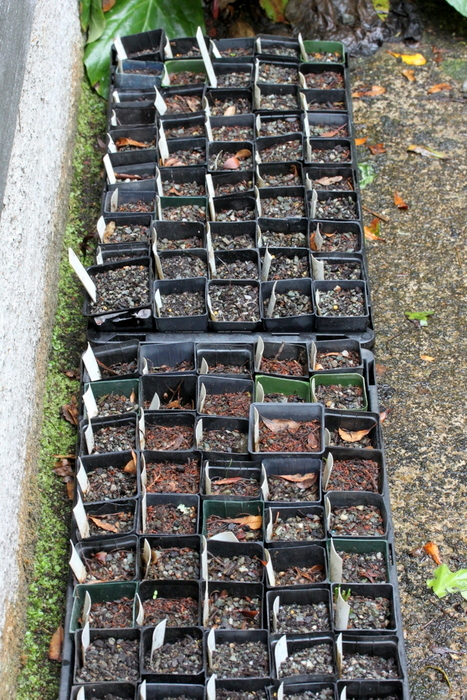
Some of the seed trays .
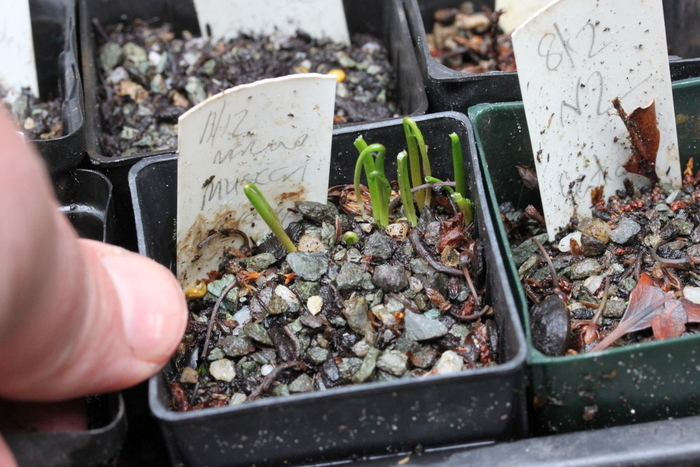
Muscari macrocarpum -- x Tasmania sown in late Nov 2012-- My thumb shows the size of the small pots that I generally use.
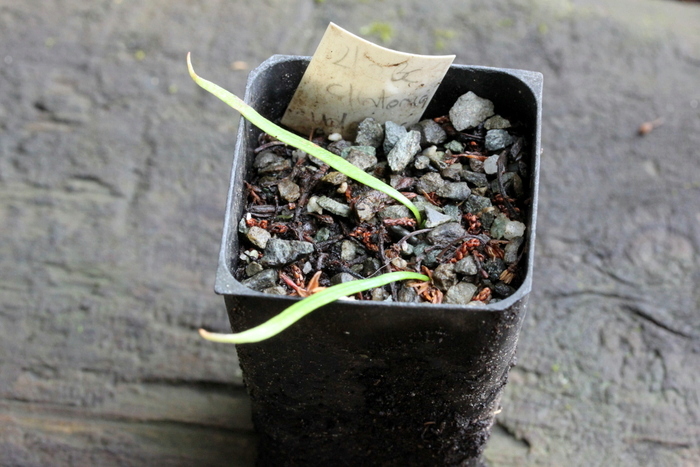
Clintonia udensis-- x AGC of BC sown early Feb 2010.
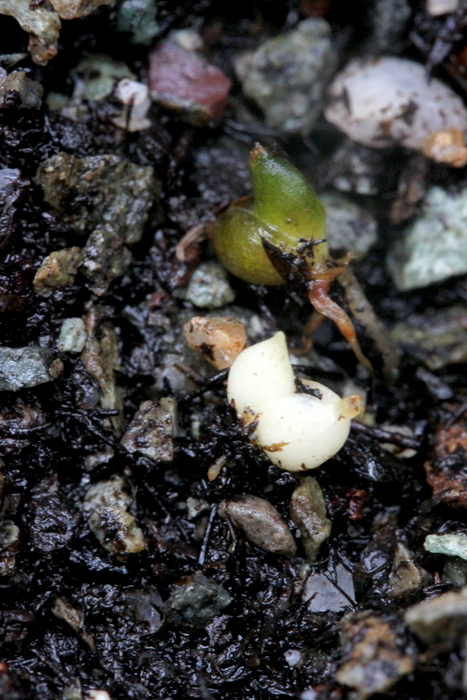
Lilium wigginsii --x Gene sown mid spring ,beginning of Nov 2011 .
Pulsatilla turczaninovii --x Rick sown early winter ,middle of June 2012.
Cheers Dave.

Comments
Lori S. (not verified)
Re: Seed starting chronicles 2013
Sat, 01/19/2013 - 5:57pmI've split this off into Seed starting chronicles 2013, Dave... even though some of your late germinators were planted well before that!
Just hoping to encourage other seed-starters to post here if they wish to (and don't want to start separate threads)... :)
Toole (not verified)
Re: Seed starting chronicles 2013
Sat, 01/19/2013 - 6:02pmOops !.--Lol. ;D ;D
Harold Peachey
Re: Seed starting chronicles 2013
Sun, 01/20/2013 - 4:58amI am very curious about the new led grow light technology-seems to be a mixed bag of information regarding their reliability. Does anyone have experience to share with these devices?
Jan Jeddeloh
Re: Seed starting chronicles 2013
Wed, 01/23/2013 - 6:01pmRe LED lights. I don't know much about them but I know who probably does. Marijuana growers. I've stumbled upon some of their forums by accident and it's apparent those folks really know how to grow plants. I would think LEDs would be attractive to pot farmers because they don't suck the juice like metal halide or sodium vapor lights. My guess is that if you hunt up a marijuana forum you may learn something you can apply to alpines and other legal plants.
Jan
Richard T. Rodich
Re: Seed starting chronicles 2013
Wed, 01/23/2013 - 8:40pmGood thought, Jan.
Ether ourselves or someone we know, I think we all have stories of avid alpine seed growers being "raided" by police because of their "excessive" use of electricity for lighting.
Regarding actual marijuana growers, I see them a couple times of year at the store where I work. They always ask for a fertilizer with an exact nutrient formulation that no one makes (or would ever make), like 12.5-11-14. Yes, they'll do anything to maximize growth. :D
ClifflineGardens (not verified)
Re: Seed starting chronicles 2013
Thu, 01/24/2013 - 6:03amI really hope I never get raided, but I've grown under LED for a year, and recently switched to 120 watt fluorescent. Use mylar on the walls of your grow room to increase grow area. LED is garbage, sorry. I tried so hard to convince myself that it would work, looking at the decreased energy bills. A common problem is the lights start blinking on and off after a while. Since it's hard to buy just the bulbs, most units are one piece. You get leggy growth with Fluorescent, but turn the plants often when they lean, and maybe put a small fan in your room and the stems should thicken up. Plus, our plants are not illegal like marijuana, and they're going outside in the Spring anyhow.
You can buy really expensive LED setups that work well, but expect to spend way more than they $170 for a good fluorescent setup. 120 Watts is the lowest.
I want to add, that I love marijuana grow shops, I bought Greensand, glacial flour, grow lights, mylar, coco peat, and guano at a shop in Chicago. You think you can get that at Lowes or Home Depot? Where else could I buy those things in December in Chicago?!? To me, it's what a garden supply place should be. They also sell GA-3 and IBA in any formulation you desire, powders, gels, whatever. Plus, everyone there seemed really mellow...
Gene Mirro (not verified)
Re: Seed starting chronicles 2013
Thu, 01/24/2013 - 9:54pmMy seedlings under fluorescents are nice and stocky. I think it's because I grow at around 60F. I find that seedlings get stretched and weak if I grow them at 70F. Also, you have to make sure that you surround the growing area with reflective surfaces, like strips of white insulating foam. Otherwise the plants will lean in towards the strongest light.
My plants grow so well under cheap cool white fluorescents that I see no reason to use anything else.
If you want to attract law enforcement, run halide lights indoors, especially at night. That eerie purple glow coming through your curtains will get their attention.
CScott (not verified)
Re: Seed starting chronicles 2013
Sat, 01/26/2013 - 8:21amYou are right -----not every plant likes high light and heat.
I am having good success with meconopsis this year.
I started them in a south window in December when the winter sun is not strong.
I have kept the thermostat so that the area where they are is at 60º F .
They are progressing slowly, transplanted into trays of peaty soil, and kept at 60º F
I have tried them under lights,but while they germinate faster, the young plants do not like the heat under the lights.
Most poppies are cool season plants. Now when I do petunias----it is heat and bright lights all the way.
Having my own fresh meconopsis seed also helped a lot! Only a couple of commercial sources send viable meconopsis seed.
Lori S. (not verified)
Re: Seed starting chronicles 2013
Mon, 01/28/2013 - 10:12pmGot some germination now...
Oxtropis splendens started germinating in 5 days at room temp after scarification; seeds collected last summer from my old plants which are starting to decline a bit.
Erigeron aurantiacus started germinating in 7 days at room temp; also collected from a plant in the border - it will look a lot more interesting in the rock garden.
Trifolium nanum started germinating in 2 days at room temp after scarification.
Trifolium andersonii v. andersonii started germinating in 2 days at room temp after scarification.
Gentiana erectisepala - a few germinated in 15 days at room temperature after soaking seed overnight in a few drops of GA-3 solution; seed from Pavelka order received in early 2011 ; collected at 4700m, Heizi Shan, Sichuan ,China; "similar to G.algida but broader lvs, big white to pale yellow flws with blue stripes outside, alpine meadows".
deesen (not verified)
Re: Seed starting chronicles 2013
Tue, 01/29/2013 - 3:42amI've got seed of a few Dodecatheon species from the exchanges this year and would welcome advice as when is the best time to sow please?
Lori S. (not verified)
Re: Seed starting chronicles 2013
Tue, 01/29/2013 - 7:29amFrom a quick glance at Dr. Deno's studies (see the link here in Propagation), it looks like Dodecatheon responds to cold stratification, so I'd guess that potting up the seeds now and chucking them outside should do the trick.
I always assumed it was the metal halide setups... the ones that suck electricity big time... that the utilities might notice (in terms of unusual energy consumption) and hence report to the cops. When we had one, DH did take the precaution of showing the neighbors what we were growing (tropical water lilies and other tropicals)... a bit paranoid that. :rolleyes: (Judging from what one reads in the news about grow-ops, illegal growers are likely to be stealing power anyway... )
Leggy growth is from not enough light, rather than from the source of the light... add another bank of fluorescents for stronger plants. I haven't found fans to be necessary.
Gene Mirro (not verified)
Re: Seed starting chronicles 2013
Tue, 01/29/2013 - 9:21amHere's a pot of Dodecatheon clevelandii v. insulare seedlings:
[attachthumb = 1]
Sown 12/23/12, germinated two weeks later at 60F (15C), and grown under lights at 60F. D. pulchellum may also be a warm germinator, but the ones I've grown have needed cold. Most other Dodecatheon species are cold germinators. Dodecatheon will often not produce true leaves in the first growing season. But they are making big roots. I will be transplanting this group into a 6-inch deep pot in the next day or two, without separating the plants. Keep them growing as long as possible. Don't let the soil get too warm. Plunge the pot if necessary to keep the roots cool. Do not starve the plants. When the leaves start turning yellow in midsummer, stop watering and let the soil get somewhat dry, but not completely dry. When the plants are dormant, store the pot in a cool, dry place. Provide a few months of chilling over the next Winter, but protect from temperatures below 25F. As the plants begin growth the next Spring, plant the whole clump into prepared garden soil. When they go dormant in the Summer, dig and separate and transplant the roots.
A mature plant of D. clevelandii v. insulare:
[attachthumb = 2]
There is nothing modest or understated about this bloom. It's the Marilyn Monroe of shooting stars.
Also see http://nargs.org/smf/index.php?topic=1056.0
deesen (not verified)
Re: Seed starting chronicles 2013
Tue, 01/29/2013 - 11:04amMany thanks Lori and Gene. Our cold spell (such as it was!) has gone, been around 12C daytime for the last couple of days with rain on and off (mostly on!) it seems like forever.
Richard T. Rodich
Re: Seed starting chronicles 2013
Tue, 01/29/2013 - 4:18pmGene, did you plant the seeds rather deeply?
Gene Mirro (not verified)
Re: Seed starting chronicles 2013
Tue, 01/29/2013 - 6:18pmNo, I covered the seeds with just a dusting of potting mix. I germinated them under a propagation dome, under lights at 60F. Always the same old story, right?
They are native to southern California, but they are hardy down to 15F here. If you don't abuse them, Dodecatheons will hang around for 10 - 20 years.
Lori S. (not verified)
Re: Seed starting chronicles 2013
Tue, 01/29/2013 - 8:05pmTownsendia condensata germinated in 3 days at room temp.
Trifolium dasyphyllum germinated 3 days at room temp after scarifying.
cohan (not verified)
Re: Seed starting chronicles 2013
Wed, 01/30/2013 - 7:47pmDavid, as we discussed somewhere else, Kristl says D pulchellum is a warm germinator, but as Gene notes, maybe not from all populations (which then suggests those populations may not really be one species! Others vary..
D pulchellum is not really summer dormant here- nothing native that I can think of offhand is- summer just isn't long enough to bother, plus midsummer is when the rain comes! After that, fall isn't far away, so the most anything could have time for is an early fall dormancy! Seriously, though, I think the Dodecatheon do die back in late summer sometime (I can't remember for sure now if any had leaves still when I was collecting seed)- but early frosts are only a few weeks away by then...
Lori S. (not verified)
Re: Seed starting chronicles 2013
Wed, 01/30/2013 - 10:05pmI grow Dodecatheon meadia and it goes dormant in summer... though since it's not native to the west, the observation may not add much to your speculation, Cohan.
More germination notes...
Oxyria digyna germinated in 8 days at room temperature; a bit of locally wild-collected seed.
Salvia nutans germinated in 4 days at room temp.
Nepeta longibracteata also germinated in 4 days at room temp.
http://www.butbn.cas.cz/ladakh/fotky/flora/screes/Nepeta_longibracteata1...
I'm not holding out much hope for Townsendia condensata 'Cottonballs' from the SRGC seedex... no sign of germination (though the other pot of T. condensata germinated in 3 days). The material in the seed packet looked like a few bits of chaff... oh, well.
ClifflineGardens (not verified)
Re: Seed starting chronicles 2013
Thu, 01/31/2013 - 7:42amI absolutely agree that legginess is from low light, but movement stimulates stem thickening, I will also apically prune leggy plants to encourage basal growth. What it really comes down to, is that I'm trying to squeeze too many plants under a grow light. I figure 12 hours a day of 120 watts probably won't be cheap. What photoperiods do you guys prop under?
Gene Mirro (not verified)
Re: Seed starting chronicles 2013
Thu, 01/31/2013 - 7:56amI run my lights for 12 to 14 hours a day, but it's not based on any scientific reason.
If you figure out your kilowatt-hours of electrical usage per month, you will be able to figure out the cost. For example, if you are running 120 watts total lamp power:
120 watts * 0.001 kw/watt = 0.12 kw.
12 hours/day * 30 days/month = 360 hours/month.
So your kilowatt-hours are 0.12 kw * 360 hours/month = 43.2 kw-hours/month.
Now find out what your electric rate is, say 10 cents per kw-hr.
So your cost is 43.2 kw-hours/month * $0.10/kw-hour = $4.32/month.
If your light setup is in a heated area of the house, almost all of that energy will help to heat the house. So your additional energy cost to run the lights is almost nothing.
Gene Mirro (not verified)
Re: Seed starting chronicles 2013
Thu, 01/31/2013 - 8:43amDodecatheon dormancy: we have dry summers here, and all Dodecatheons go dormant if you don't irrigate. I grow clevelandii v. insulare, hendersonii, jeffreyi, meadia, and pulchellum. In the high mountains, jeffreyi barely has time to set seed, so it doesn't have a summer dormancy.
cohan (not verified)
Re: Seed starting chronicles 2013
Thu, 01/31/2013 - 9:56amIs anyone here using the high output T5 flurorescents? I've read about them lots and have cactus and succulent friends using them with great results- far more light output than regular fluoros -even c+s requiring intense light do well, plants do not have to be a couple of inches from the lights as with regular fluoros, and relatively energy efficient. More expensive to buy though! but one friend bought hers as simple hardware without the fancy reflectors you will see in aquarium or hydroponics shops, set up her own reflective apparatus and paid much much less..
Richard T. Rodich
Re: Seed starting chronicles 2013
Thu, 01/31/2013 - 11:53amI hadn't even heard of high output T5s until a few weeks ago. I use regular T5 28w.
Lori, thanks for being thorough and consistent with your germination info. You know I am recording it ;D.
And thanks for the link of Nepeta longibracteata. What a cool plant!
Gene Mirro (not verified)
Re: Seed starting chronicles 2013
Thu, 01/31/2013 - 12:39pmI use the old-fashioned T12 cool white lamps because I have a lot of lamps and fixtures that are still in good shape. This is what tomatoes and peppers look like under T12s:
[attachthumb = 1]
T5s are more efficient, but T12s do a perfectly good job. The side reflectors really help with plants that need a lot of light, especially big plants like this.
cohan (not verified)
Re: Seed starting chronicles 2013
Fri, 02/01/2013 - 11:01amA lot of people have grown cacti and succulents under T12s or the slightly more efficient T8s (which is what I have now) permanently for many years, but high output T5s are a lot better for light intensity. It depends a lot on what you are growing and for how long, how many uints you want to install etc. Contrary to what one may think, not all C+S for example actually need the most extreme light exposure, since they may grow sheltered by bushes, rocks etc in nature, but there are those plants that really do need maximum exposure (some caudiciforms for example) that just aren't easily grown under the old shoplights.
Of course we're really just talking about seedlings here, and if they etiolate a bit, it can usually be rectified when they go outside.. I am more interested in better light for some of my permanent indoor plants- especially winter growing South African bulbs!
Lori S. (not verified)
Re: Seed starting chronicles 2013
Sat, 02/02/2013 - 8:31amMy fluorescent lights are T12's that are on for 14 hours per day on a timer. The lights themselves appear to be the same as what Gene is using... 4 foot long, 2-bulb reflectors. In my case, each bulb is 40 watts, just regular cool whites and warm whites. Right now, only 2 of these are on (overtop 2 trays of pots), but with time as more pots germinate, the rest will come into use (640 watts total).
Astragalus purshii - germ in 6 days at room temp after scarifying
Rhodiola rhodantha - germ in 6 days at room temp
Salvia cryptantha - germ in 20 days at room temp
Gene Mirro (not verified)
Re: Seed starting chronicles 2013
Sat, 02/02/2013 - 1:27pmI'm trying a couple of batches of Dodecatheon pulchellum seed in warm conditions. I'll let you know what happens. See also http://nargs.org/smf/index.php?topic=1056.0
ClifflineGardens (not verified)
Re: Seed starting chronicles 2013
Mon, 02/04/2013 - 8:07amI decided to try growing some western native US species, I'm growing them in 50/50 sand gravel with a little coco peat to hold at least a little moisture. In a window planter, in my closet under a grow light;
Silene armeria
Arabis alpina
Erysimum capitatum
Campanula rotundifolia
Linum perenne
Aquilegia caerula
Eragrostis spectabilis
I'm stoked to see what comes up, these are all seeds that were labeled to not need any seed treatments prior to prop. Mostly from Everwilde, so I'm not sure if they treat them with anything before sale. I've had great luck with their seed prop advice in the past, but I feel their advice only applies to their seed. Their seed prop requirements are almost always different from other sources I read for the same species.
Claire Cockcroft
Re: Seed starting chronicles 2013
Mon, 02/04/2013 - 10:06amAn urge to clean out my refrigerator prompted me to sow just about every seed I'd saved up from years past and all the new ones. As a result, I have about 350 seed pots holding an odd assortment of seeds. Everything went out in the weather with no special treatment.
We've been stuck at 40 degrees most days and nights for almost a month now, so I was surprised to see things starting up already. Sowed in December, 2012, and germinating in January: Arabis aculeolata, Balsamorhiza rosea, Calandrinia umbellata, Codonopsis pilosula, Delphinium andersonii, Dodecatheon clevelandii ssp. insulare, Primula munroi, Primula waltonii, Saussurea sp., and Symphyandra armena. The dodecatheon was a Ron Ratko collection in 2003, the arabis in 2005, and the balsamorhiza in 2006.
Also germinating but from a January 20012 sowing are Cyclamen graecum anatolicum, Eranthis pinnatifida, and Lilium humboldtii var. ocellatum.
Heaven help me when it's time to pot things on or plant them out. Many will go to our local NARGS chapter's plant sales (thank goodness). Seed growing is an addiction for me!
cohan (not verified)
Re: Seed starting chronicles 2013
Mon, 02/04/2013 - 10:49amThat's lots of pots, Claire! I need to do something similar to get caught up..
Everwild is new to me, looks like fun to go through :)
Richard T. Rodich
Re: Seed starting chronicles 2013
Mon, 02/04/2013 - 11:04amClaire, Good for you!
For various reasons, most of us experience an overall germination rate of around 50% with our endeavors of species previously tried and untried. That is, around half of the species planted have no germination at all (for the first season, at least). Now doesn't that make you feel better, that you will only have to deal with 175 pots? :o :o :o
I found it interesting in the eranthis thread on the SRGC forum, that some Eranthis sp. have two seed leaves, and some just one. http://www.srgc.net/forum/index.php?topic=9951.msg265963#msg265963
Eranthis (Shibateranthis) pinnatifida should only have one.
Most of those you mention are listed as warm germinators. Obviously, it has not been 40F all winter for you, but it's a testament to nature's diversity and adaptability.
-------------------------------------
When I bought some bags of Fafard 52 mix (which is basically ground bark), I also got some Metro 360 (coir) to play with. This ground coir is finer than what I envisioned, and it holds a lot more water than I expected, too. GreenRoofer, I will be interested to see (in the future) if you formulate any preference, good or bad, with the coco peat. I see it as the same as the Metro 360 I have.
ClifflineGardens (not verified)
Re: Seed starting chronicles 2013
Mon, 02/04/2013 - 12:40pmWell, with the Coco peat, my frame of reference is peat moss, which I love and hate. The coco peat isn't hydrophobic when wet, which I REALLY like. I've read the pH is more neutral so that's good. My soil mix for alpines so far has been -
80% equal parts sand, pea gravel, perlite, fuller's earth (oil sorb)
20% half and half coffee grinds and peat moss
The coffee grinds seemed sustainable to me, but after a month they stop draining. The peat moss might be making the mix acidic, so I added a little liquid iron to my watering. I've only got two planters with my 'desert soil' mix, which is half and half sand/gravel and a few handfuls of coco peat. I've never worked with anything this lean. I'm very excited! The only thing is, it's way too heavy, at least 80 lbs. I wish I had added a bunch of perlite. I don't like the way perlite floats up to the top, it draws my eye and looks cheap to me. But my back appreciates it.
Lori S. (not verified)
Re: Seed starting chronicles 2013
Mon, 02/04/2013 - 2:51pmRightly or wrongly (maybe someone can tell me which; in any case, I'll pull out the books and refresh my memory)... I've never taken Deno's results completely literally. I've always assumed that "warm germinators" were just those that don't need fluctuating temperatures to break down germination inhibitors, not that they actually need warm temperatures to germinate... ?
Similarly, I've always assumed that the details of Deno's practices (e.g. 3 month temperature periods) were made constant for the purposes of experimental integrity (i.e. for consistent comparison with the control sets). For example, it may be that some species actually need that long a chilling period, but that many don't and will germinate when once brought out to warm temperature after a shorter period... ??
Wow, sounds like a great start for a lot of cool things, Claire!
Trond Hoy
Re: Seed starting chronicles 2013
Tue, 02/05/2013 - 10:22amI don't bother neither with different germination regimes nor soil mixtures. I usually make a mixture of some ordinary garden soil, sand, grit, perlite and peat. I place almost all the pots outside and let them experience the natural weather and usually have very good germination. If they start germinating during the winter months they are brought inside. The problem starts later when the seedlings can be damaged by slugs and other critters as I have to place them outside again due to lack of space inside.
Here are 4 pots (of about 20) with seedlings brought inside. Two with Helleborus, one with Trillium and one with Erythronium. They've been outside since last winter till germination started in January.
cohan (not verified)
Re: Seed starting chronicles 2013
Tue, 02/05/2013 - 10:32amLori- your comments put me in mind of Alplains germinations guidelines where each species that needs cold stratification is given a specific number of weeks- 4, 8, 12 etc..
Lori S. (not verified)
Re: Seed starting chronicles 2013
Tue, 02/05/2013 - 11:26amSo you are actually cold stratifying the seeds but you are letting nature do it for you... the perfect solution. :)
I would do this too (used to do a lot of it) but it is not until late in spring that the seeds sprout outdoors here under natural conditions. By stratifying indoors, I can get a few months of indoor growing, and have reasonably-sized seedlings to plant outdoors in the same season... at least that's how I rationalize it. Being able to stratify seeds outdoors and yet get germination early (i.e. during what is still the depths of winter here) is definitely an advantage of living in those zone 7-8-ish maritime climate areas!
deesen (not verified)
Re: Seed starting chronicles 2013
Tue, 02/05/2013 - 11:58amSame regime, same problem, different mix.
Richard T. Rodich
Re: Seed starting chronicles 2013
Thu, 02/07/2013 - 11:05amYou're absolute right here. And Dr. Deno does explain in detail.
I'd really like to explore this subject, so I started a new thread:
Warm germinators and Cool germinators
Claire Cockcroft
Re: Seed starting chronicles 2013
Wed, 02/13/2013 - 5:22pmGermination update:
Sown in January, 2012 and up this week:
Fritillaria rhodocanakis ssp. argolica
Iris sp. (AGS -- Juno type, white)
Paeonia veitchii
Sown this winter and up this week:
Arabis blepharophylla Balsamorhiza incana
Calochortus weedii var. vestus Centaurium venustum (Zeltnera venusta)
Cortusa matthioli 'Alba' Incarvillea compacta
Meconopsis "napaulensis" (garden hybrid) Nepeta laevigata
Phyteuma scheuchzeri Primula orbicularis
Primula polyneura Primula waltonii
Rhodiola heterodonta Silene californica
Stenotus stenophyllus
Lots of Meconopsis baileyi and its hybrids
cohan (not verified)
Re: Seed starting chronicles 2013
Sat, 02/16/2013 - 3:51pmI have a number of things to sow, some of which I'm finding recommendations for several weeks of warm before cold treatment- not things I'd think of as warm/cold/warm germinators, such as spring ripened woodland seeds but things mentioned for example in the Ontario Rock Garden germination database as fall ripe seed, wanting a few weeks warm before cold-- eg:
Androscae carnea ssp halleri- ORG site says 6 weeks warm then 6 weeks cold
the Kootenay guide says 2-4 weeks warm, 4-6 weeks cold
Kristl says requires cold treatment, but I didn't get the seed from her, so I don't know whether that's her full recommendations...
Any thoughts? Does it need the warm before cold? I just got the seed and if I keep it at warm for too long I could be running short on outdoor stratification time..
A couple more Bupleurum stellatum- ORG says warm or cycling
Kootenay says 2-4wks warm, 4-6 cold
Campanula cenisia- ORG says warm
Kootenay says 2-4 wrm, 4-6 cold
Saponaria lutea- ORG says 6 weeks warm, 6 cold
Kootenay says 2-4wrm 4-6 cold
Does anyone generally give things a few weeks warm before cold? I give a few days usually to absorb moisture, then outside for stratifying.. At this point, we will surely have many weeks yet with freezing temps much of the time, I could probably give things a couple of weeks warm indoors before out, but in case of an early spring, I don't think I would take a chance on long enough stratifying if I kept them in for 6 weeks...
Gene Mirro (not verified)
Re: Seed starting chronicles 2013
Sat, 02/16/2013 - 7:02pmI give cold germinators at least two weeks at 60F or above. I figure they need some warm time to imbibe (absorb) moisture. The surface tension of cold water is very high. But I've never done comparison studies to determine what the optimum warm time is. According to Deno, if you give cold germinators too much warm time (like 3 months) they die.
On the other hand, I know that some seeds will absorb moisture just fine at fridge temp (40F). I had a batch of Russell lupines germinate in 5 days in the fridge without any warm period. Some poppies will germinate very cold.
Since just about everything responds well to the two weeks of warmth, I have standardized on that for cold germinators. Note that I am not talking about seeds with complex requirements, like lilies with delayed hypogeal germination.
cohan (not verified)
Re: Seed starting chronicles 2013
Sun, 02/17/2013 - 3:58pmI have put things requiring cold strat directly outside other years in late winter/early spring (only a day or few of warm at most), with good results on some, but not all.. though those that did not germinate, I generally assumed the cold period was too short if it was late in the year, but who knows...
I put out a bunch a week or so back also, seed from Kristl, and her instructions for cold strat do not mention a warm period (other than, as Gene mentioned, warm/cold/wrm germinators etc, different issue). They'll have plenty of up and down at this time of year- I put them in a spot that is sunny part of the day, and we have had days up to 10C, other days forecast to be well below freezing, with nights considerably colder still..
Richard T. Rodich
Re: Seed starting chronicles 2013
Wed, 02/20/2013 - 1:16pmA few pics from last spring that I neglected to add to our growing archive:
Dietes bicolor
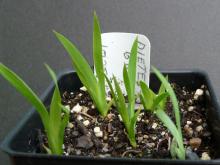
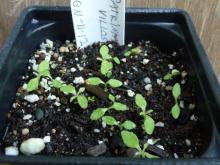
Patrinia villosa
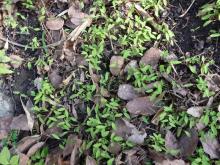
Corydalis ochroleuca - volunteer seedlings in the garden, where an old plant finally died
Mark McDonough
Re: Seed starting chronicles 2013
Wed, 02/20/2013 - 3:02pmHad to look up Dietes as I wasn't familiar with it; oh yes, I know it under the alternate name Moraea.
Rick, are you overwintering the Dietes plants indoors, I see that it is rated for zones 8-11, thus a tender plant. Very attractive from photos I've seen.
I don't think one has to try too hard with Corydalis ochroleuca, seems like this one, along with C. lutea, looks towards world domination. ;) Both might be good candidates for green roof plants, as they'll grow most anywhere. I have C. ochroleuca seeding into my stone/gravel "drip strip" around the house, a 2' wide strip around my house corresponding to the roof overhang. The area gets blazing hot in full sun, the light color walls and foundation reflecting light and heat, the plants never get watered unless blowing rain comes from the right direction. Normally I yank out ochroleuca plants whenever I see them, while the foliage is attractive, the plant spreads too much by seed, and I don't care much for the long wands of pale flowers. But I usually neglect those growing in the barren drip strip (because I'm lazy), and they sail through heat and drought without any problem.
Richard T. Rodich
Re: Seed starting chronicles 2013
Wed, 02/20/2013 - 5:43pmOverwintering Dietes indoors was my plan, but they got missed when I was separating out the winter tender species in the fall. So they "endured" 20F before I realized my blunder. They were quite vigorous until their death knell.
Corydalis ochroleuca is not as invasive as C. lutea here, but yes, it can be a bit too much. Seedlings are super easy to pull at the stage in the photo, but once they get their second true leaves, it can be more tedious.
ClifflineGardens (not verified)
Re: Seed starting chronicles 2013
Thu, 02/21/2013 - 6:28amI never considered C. lutea as a green roof plant, maybe. I have enough of it, growing in DEEP shade. Gets maybe a half hour of direct light in the summer. In my climate, it is remarkably hardy.
Richard T. Rodich
Re: Seed starting chronicles 2013
Thu, 02/21/2013 - 9:27amCorydalis lutea survives in that window box on the railing through the winter?
ClifflineGardens (not verified)
Re: Seed starting chronicles 2013
Thu, 02/21/2013 - 12:06pmYep, it has survived for two years now.
Rimmer (not verified)
Re: Seed starting chronicles 2013
Fri, 02/22/2013 - 10:56amI am looking for advice on starting west Asian dry land alliums from seed.
I suspect they are spring bloomers followed by a dry summer, so would that mean they should be sown in early fall?
specifically i am looking for germination advice in the following:
Allium alexeianum
Allium ericetorum
Allium gomphrenoides
Allium scabriscapum
Allium wendelboanum
Thank you
Rimmer
SE MI Zone 5
5" snow cover today
Mark McDonough
Re: Seed starting chronicles 2013
Sat, 02/23/2013 - 7:47pmHello Rimmer, the only species in your list that requires cold treatment, best sown in fall and allowed to overwinter outdoors, is Allium alexeianum. Most of the "big ball" Asian melannocrommyum types have hard round seed that only germinate in spring following seed set the previous summer.
The other four species will also germinate after winter cold treatment, but its not necessary, they can be sown anytime, including spring, and germinate within 2-3 weeks, germination stimulated by exposure to soaking rain (if pots are left outside) or after being keep continually moist is pots are in a controlled environment. They are generally "easy germinators". I don't have first-hand experience with gomphrenoides, but being a member of "section Allium" from Greece, alliums in this section are typically quick germinators. The European to Russian Allium ericetorum, and Turkish scabriscapum & wendelboanum, are also easy germinators. They could be sown now, placed outside, and can be expected to germinate as cool & moist spring weather arrives.
With such species as A. alexeianum, if I were going to sow the seed, would sow directly in a prepared spot in the garden, in midsummer, to see germination spring 2014.
As for Allium scabriscapum, it is maddening that this beauty is not in general cultivation, it's a real beauty. I have a few 2-year seedlings and hope one day to have blooming size plants. Some good images here:
http://www.vanherbaryum.yyu.edu.tr/flora/famgenustur/li/al/sca/index.htm
Pages