Hundreds of Cimicifuga simplex are in bloom, perfuming much of the yard and garden. My favorite are those that has dramatic dark pruplish foliage (particularly early in the season), black purple stems, and ruby-purple sepals on the small florets, striking as the flowers first open. Such plants are referred to as "atropurpurea group". Eventually the fluffy flower spires become all white.
These seed about rather too easily, the seedlings with foliage from all green (which I discard) to dark blackish-purple. Of hundreds of self-sown plants, all have pure white flowers (although the "atropurpurea" types with striking ruby sepals). Today I noticed one plant flowering that has decidely pink flowers, really lovely. Here are two views showing this light pink-flowered beauty.
Trond, even a tall Senecio blooming yellow in the fall would be welcome in the shade garden, although I'm wondering about your plant, perhaps what you have is Senecio cannabifolius var. integrifolius with undivided leaves.
It could be that one, Mark. It is no problem sending seed of both forms if you are interested although I think they'll be earlier in your climate than in mine. You better have to deadhead the plants too or you'll soon have more than you want - if they don't behave differently over there ;)
McDonough wrote:
Hundreds of Cimicifuga simplex are in bloom, perfuming much of the yard and garden. My favorite are those that has dramatic dark pruplish foliage (particularly early in the season), black purple stems, and ruby-purple sepals on the small florets, striking as the flowers first open. Such plants are referred to as "atropurpurea group". Eventually the fluffy flower spires become all white.
I can't boast of hundreds but two plants and they are in flower now! I like the scent but some friends don't ;D
It is no problem sending seed of both forms if you are interested although I think they'll be earlier in your climate than in mine. You better have to deadhead the plants too or you'll soon have more than you want - if they don't behave differently over there ;)
I can't boast of hundreds but two plants and they are in flower now! I like the scent but some friends don't ;D
I'm a bit wary of taking on any more "big woodland plants". I had added some woodland goldenrods (Solidago) and several Aster species, but they quickly started taking over, and I have ripped most of them out now. I'm finally getting self-sown seedlings on BIG plants like Kirengeshoma palmata, but will have to transplant these to places where then can grow large. I'm not writing the Senecio off entirely, I thank you for the kind offer, and I like the look of that Senecio, but I wonder.
On Cimicifuga simplex, they seed around with wild abandon. Each spring I allow the local garden club ladies come in and dig a few dozen big plants to sell at they annual spring plant sale. I relocate many seedlings to woodsy enbankments and rough woodland areas where I don't actually garden, and they survive and with reasonable moisture during the summer, are splendid in late summer/early autumn with great trusses of white flowers. I've been known to snip off the 7-8' stalks in late autumn when the dry seed follicles split to shed seed, and take these great seed wands and do a ritualistic thrashing dance in the woodland, to promote and assist their self-sowing.
I've been known to snip off the 7-8' stalks in late autumn when the dry seed follicles split to shed seed, and take these great seed wands and do a ritualistic thrashing dance in the woodland, to promote and assist their self-sowing.
We visited a wonderful small specialist nursery on Wednesday - Beeches Nursery near Saffron Waldon, just north of London. They grow an especially fine range of woodland plants - I picked up a nice Trillium simile with two noses, Scopoliacarniolica 'Brevifolia', which I know by name but have never grown, and this blue form of Helionopsis orientalis from Korea. There were also some lusty plants of Ypsilandra tibetica. Nice trip on what has been one of the coldest days this spring, with blistering winds. Another plant in one of the tunnels was Eriogonum allenii 'Little Rascal'. Does anyone know this plant? Very good foliage.
Looks like some nice choices, Tim! I've only seen Helionopsis and Ypsilandra on these fora, but like them a lot.. I have seed outside currently of Scopolia from Gardens North, don't think its 'Brevifolia' but I found it quite interesting looking..
Ah! The blue Heloniopsis orientalis looks awesome! I have some forms of Heloniopsis and Ypsilandra but I am very afraid they are damaged in this cold dry weather we have. I would love to visit that nursery!
I have always had a liking for Heloniopsis and Ypsilandra, and grow and flower them both, but most of my friends can't see the attraction. They do seem to have an inherent scruffyness mostly because of slugs and snails for me. Do they grow better elsewhere? Must try and get the blue form of Heloniopsis. Kirengeshoma grows well in the RHS garden at Rosemoor, at the top of the gulley to the Lady Anne garden. Not exactly head height but several feet wide from memory.
I too would like to get hold of Ypsilandra and Heloniopsis, particularly the blue form of the latter, even with the "inherent scruffyness" of the foliage; I agree the foliage does have a certain unkempt look. Has anyone grown these little known treasures in New England?
I too would like to get hold of Ypsilandra and Heloniopsis, particularly the blue form of the latter, even with the "inherent scruffyness" of the foliage; I agree the foliage does have a certain unkempt look. Has anyone grown these little known treasures in New England?
I did pick up a Ypsilandra last spring at the Bloedel Reserve Spring Plant Sale on Bainbridge Island, WA. It has been planted under a Hepticodium facing west in good composty soil. We'll see how tough that little bugger is in a few weeks! ???
I did pick up a Ypsilandra last spring at the Bloedel Reserve Spring Plant Sale on Bainbridge Island, WA. It has been planted under a Hepticodium facing west in good composty soil. We'll see how tough that little bugger is in a few weeks! ???
Amy, keep us posted of its progress; if it'll grow for you, it should be doable for me. And I have a Heptacodium tree that need underplanting too :)
Probably the best place for the Helionopsis and Ypsilandra would be in a good shady trough in peaty/sandy soil. In pots they are vulnerable to vine weevil grubs. I think planted under Heptacodium they could get too dry and wouldn't have that loose woodsy soil that things like trilliums and such do so well in.
Probably the best place for the Helionopsis and Ypsilandra would be in a good shady trough in peaty/sandy soil. In pots they are vulnerable to vine weevil grubs. I think planted under Heptacodium they could get too dry and wouldn't have that loose woodsy soil that things like trilliums and such do so well in.
Duly noted! I'll put on my spring list of things to move 2 Ypsilandra from the Heptacodium to the streamside garden. Thanks for the info Dr. Tim!
Mark; Far Reaches Farm has Ypsilandra ($10), and Helionopsis (lavender-pink form; $18).
Thanks Don, what a super fine nursery listing at Far Reaches Farm, innumerable temptations. Ypsilandra and Heloniopsis are zone rated Z7 and Z6 respectively, both requiring moist soil. Since I'm Z5 and have a dryish garden, I may wait to hear about Amy's results before purchasing. Perhaps I should be like your namesake and tempt zone denial ;) and take a chance on them, but as I already have several plant orders expected this spring, I think I'll wait, at least for this year. Good tip, many excellent plant selections there, certainly one to bookmark under one's favorites.
At last - the Lysichitons have appeared! It is spring!! The yellow americanus do self seed a lot but I am happy! Among the coming huge plants some bigleaved Chinese Chrysosplenium macrophyllum has flowered for weeks. In the background you can see the winterburned native blueberry shrubs. No berries this summer!
Thanks! Has your spring weather finally developed more normally? We had a warm March, cold April, and first part of May very warm, now we are closer to normal, maybe some rain coming after a long dry period... If the pattern holds, June will be cold...lol
Well, I can't say things are normal yet. We went to spend our long holiday (it's Norway's national day today) at the mountain cabin and when we left home yesterday not a single birch tree had leafed out. It has never happened before in the 30 years I have lived here. Usually the birches are green 1th May. However, the forecast says 24C the next couple of days so I expect the trees are green when we are back home! Here at our cabin it is still patches of snow which is normal though but it has rained much and lots of roads and homes are damaged due to flooding. Warm rain + a lot of snow in the higher places make a lot of water!
Who knows the forms of Chrysogonum virginianum (there are 3), I assume by the shortness of this one, it is either var. australe or var. brevistolon. If "var australe", Flora of North America says the stolons are 12-60 cm long! Yikes, 60 cm, or 2', I might have to move this to a wild part of the garden. It's only two years in my garden, so far spreading mildly. But I wonder, and watch.
It certainly looks charming but then I'm a sucker for daisy-like flowers (which I suppose will help explain why I planted some sort of Arnica 15 years ago... which I've been weeding out fitfully ever since. Damned thing never blooms but it sure gets around.)
Who knows the forms of Chrysogonum virginianum (there are 3),
What a coincidence as just yesterday I picked up 3 Chrysogonum virginianum ("Allen Bush"). I was looking for a shorter flowering shade plant and Chrysogonum virginianum seemed interesting from its description.
For those of you that have it, for how long does it flower in the spring? Does it ever repeat bloom...maybe late in the cooler wetter fall?
Aaron, with three Chrysogonum virginicum subspecies, maybe there's a form that will be more amenable to your garden, or a strong selection like 'Allen Bush'.
Copperbeach, I had not heard of the 'Allen Bush' selection before, so looked it up. It's interesting that all sites report this plant flowers in spring but also reflowers in autumn. Here's what three different nurseries say about C. virginicum 'Allen Bush':
Lazy S's Farm Nursery http://www.lazyssfarm.com/Plants/Perennials/C_files/Ce-Ci.htm East Coast Native from PA south. Nice ground cover in rich, well-drained soil but tolerates less than ideal conditions. The cultivar 'Allen Bush' typifies the species but with a profusion of dark yellow, star-shaped blooms in late spring/early summer and some later in the Fall. Takes sun in cooler zones, more shade in warmer zones. Light evergreen, triangular shaped leaves. Great groundcover.
By the way, I ordered Epimediums and a couple other plants from Lazy S'S Farm Nursery this year (along with orders for Epimedium from 3 other mail order nurseries); the plants from Lazy S were top notch, beautful large vigorous plants perfectly packed, highly recommended. Three out of four nurseries shipped excellent plants, Lazy S gets the highest grade. :)
Updated photo of my Chrysogonum virginicum, more flowers coming. I'm closely watching to see how far away new stolons appear, to gauge its spread, may have to move it out of its current location close to other plants. By the way, when I was 8 or 9 years old, this was one of the first plants I grew in a wildflower garden, I started early ;D
Mark, I am a bit hesitant to ask - but does it set seed?
Honestly, I don't know if it sets seed, but I suppose it must, I haven't paid attention to that point in the two years I've had it back in my gardens after decades absence.
A quietly attractive plant for a woodland setting is Tellima grandiflora (Fringecups) from Western North America. Mine came to me misidentified as Boykinia rotundifolia (that species is from California). The flowers start out green but age pink. To 18" tall.
In the Pacific NW, you need to be careful with Tellima. If you let it go to seed, you will be sorry. And they are extremely difficult to kill with herbicide.
In the Pacific NW, you need to be careful with Tellima. If you let it go to seed, you will be sorry. And they are extremely difficult to kill with herbicide.
The same in NW England it is a complete nuisance but nice
In the Pacific NW, you need to be careful with Tellima. If you let it go to seed, you will be sorry. And they are extremely difficult to kill with herbicide.
Although it self seeds here in coastal Norway too it is not a problem (yet) and not difficult to remove like some other weeds.
Hmmm, thanks for the head's up warnings everyone, had a similar warning on Facebook. Well, it was supposed to be a Boykinia. Hasn't shown any tendencies of spreading just yet (3 years here), but I'll watch it carefully, and if I spy lots of seedlings, will be sure to eradicate; it's a pleasant enough plant but I don't need yet another thug to invade my garden.
I grew Tellima grandiflora from seed one year. They all died the second winter. ??? Nice pink fall foliage, but flowers weren't even as nice as yours, Mark.
When I moved here I found a small clump of lavender coloured Anemone nemorosa, possible 'Robinsoniana'. Now it has spread with seed to a lot of new sites and I have several forms - it has possibly crossed with the wild windflower. They are much later than the common white ones. Here is at least two clones (not easy to see in the picture though) and the colour is darker in real. Another plant growing at the property was Polygonatum multiflorum. It has spread by runners to a huge patch in the woodland - making a nice understory among the rhododendrons. Unfortunately the Diphylleia sinesis doesn't spread!
Although these Maianthemums don't have the most colourful flowers they have handsome leaves and the berries are nice in the fall. Sorry, don't remember the names although I have planted them myself (you can spot my foot in the last picture).
Very nice, Trond! I wish my Anemone nemorosawould flourish like that. I also wish Diphylleia liked the dry conditions here... oh well. Very striking foliage on the Maianthemum.
A west-coaster that is hardy here, vanilla-leaf, Achlys triphylla... somewhat spreading, though:
Aaron, thanks for adding your notes on Tellima grandiflora, maybe it will be well behaved enough here in the East. Although I have taken into consideration warnings by others, and will remove the plant if it shows any worrisome spreading tendencies.
Lori, really like the appearance of Anemone trifoliata, can you tell me about it's rate of spread (I'm cautious with Anemone). I never think about Achlys triphylla, it is attractive, I should look to introduce that to some wilder parts of my woodland.
Trond, good to see Diphylleia sinensis, I grow the other two species cymosa and have two-year seedlings of D. grayi. My garden tends to be too dry for these plants, but I manage to keep D. cymosa going for a long number of years now, and I hope D. grayi too.
Here's the cutest little thing, dare I say, a Pinellia. This is Pinellia cordata 'Yamazakii', a tiny well-behaved form. It emerges so late (just a few days ago) I always think I've lost it; for me it stays as a small clump, with cute hooded blooms and skywards spadices. The best part, the flowers give off a strong aroma like sweet juicy-fruit bubblegum! I'm not kidding!
Lori, really like the appearance of Anemone trifoliata, can you tell me about it's rate of spread (I'm cautious with Anemone). I never think about Achlys triphylla, it is attractive, I should look to introduce that to some wilder parts of my woodland.
I really like Anemone trifoliata too! It seems to be a slow spreader here... at least in the time I've had it. I think I planted it in 2009. Trond, I think you have Anemone trifoliata too? How is the rate of spread for you? Also, I can't remember if it goes dormant after blooming or not... must pay closer attention this year.
Pinellia cordata 'Yamazakii' is incredibly cute! I wonder how hardy it is?
Pinellia cordata 'Yamazakii' is incredibly cute! I wonder how hardy it is?
This plant has been perfectly hardy here for the 5 years of so that I've had it (USDA Zone 5), but that's not enough information for your colder climate. It doesn't set seed (not that I've seen yet), so I'm not sure about its propagation options. Today I asked my daughter to smell the flowers; she thought it smelled very "fruity". Must work on getting this increased, too cute to lose.
Lori, really like the appearance of Anemone trifoliata, can you tell me about it's rate of spread (I'm cautious with Anemone). I never think about Achlys triphylla, it is attractive, I should look to introduce that to some wilder parts of my woodland.
I really like Anemone trifoliata too! It seems to be a slow spreader here... at least in the time I've had it. I think I planted it in 2009. Trond, I think you have Anemone trifoliata too? How is the rate of spread for you? Also, I can't remember if it goes dormant after blooming or not... must pay closer attention this year.
Pinellia cordata 'Yamazakii' is incredibly cute! I wonder how hardy it is?
Anemone trifoliata behaves itself very well in my garden. It is slow to increase making a rather dense rhizome. I have not seen seedlings either but I have only one clone. Anemone trifoliata does go dormant during the summer like the other similar wood anemones.
I have not tried Pinellia yet but certainly have to!
Here's a view into the area under the 'Royalty' crabapple and also shaded by a large sweetberry honeysuckle (Lonicera caerulea) and by roses... Geranium himalayense starting to bloom (sorry if this makes you shudder, Cohan ;D); a rapidly-spreading Arnica of some sort - at least this one blooms so I'm not complaining!; Anemone trifoliata in the distance:
An interesting plant I obtained as Streptopus obtusatus flowering for the first time. I think it is wrongly named and a friend has suggested it is Disporum cantoniense which seems a better identification.
Boy, even this 'minor' thread ( a personal fave) I'm way behind on- I've been spending all my time digging- a bunch of new veg beds, and still lots planned for ornamental beds... L:ove the Chrysogonum! I'll have to watch for seeds of that available somewhere..
I also really like the Anemone trifoliata. I have A. nemorosa from roots planted in fall 2011, only a couple of flowers last year, a bit more this year, seems like it might make some nice clumps in a few years. A ranunculoides planted at the same time seems just a touch faster. They are near one another, so I'll be curious to see if I get any of the nice hybrid... I also finally have some success with A nemorosa seeds after a number of failures, so I hope to get some other shades :)
Tony, love that Streptopus or Disporum you show. I purchased and planted a number of Disporum this summer, but I'm sure none as lovely as that plant.
As to Chrysogonum virginicum, I came to the decision to extract it from where it was planted, after it invaded other small plants, and replant them in a spot where it will be allowed to spread. The species has several subspecies, with varying degree of spread, see my previous two posts on this, links below. Cohan, not sure if it made any seed, I wasn't watching, of course for me, no need at it spreads quickly, but I'll try and watch next year.
I was surprised just how robust the roots were, and with seemingly modest growth above, the roots were tenacious and made for difficult uprooting. I was also surprised at how thick the stolons are. The rate of spread is about 6" per (in all directions) per season. Here's a photo showing an uprooted piece.
I am working on a new shady area that quite large, the result of "limbing up" a row of fir and spruce trees that borders my side property line. It was a tremendous effort to "get inside" the trees with incredibly dense branching to the ground, and also much effort to spade some soil pockets removing stones and roots. There's the chosen relocation, at the base of Uvularia grandiflora, before and after planting.
Looks like a nice new area. I haven't done any limbing, but plenty of digging amongst roots!
Re: Disporum, I can't remember if I've told this tale before here, but I thought I'd collected berries of Disporum trachycarpum in the woods on the farm, a few years back. The berries have a distinctive look, so I was pretty confident in my id, and happy since this was the first time I'd come across this species. Well, it was also the last- despite revisiting the site repeatedly over several years, I have never found any further trace of the plant in leaf, flower or fruit. I'd pretty much convinced myself that I was just confused about Maianthemum stellatum which also grows there. Seemed an unlikely confusion, since I am so familiar with the Maianthemum, and again, those Disporum berries are distinctive, and not remotely like Maianthemum berries.
If there was Disporum there, I suppose something could have eaten it, or it could have been covered by a fallen tree, of which there have been a number- but I really would have thought it could easily send shoots a foot or so over to get around any logs...
Anyway, I did get germination after a year or two, and I'd been watching the seedlings- not conclusive, since I'd never seen Maianthemum seedlings. I had a batch of something come up in a nearby pot, which was supposed to have Elaeagnus seed in it, and those are pretty clearly M stellatum (how does that happen? I can see getting a few seeds of natives in seed pots outdoors, but an entire pot of evenly distributed seedlings??? no elaeagnus...same thing happened in a pot with Lindera seed- a full crop of Cornus canadensis- no Lindera :( ).. So now i am thinking maybe those really are Disporum seedlings... I planted them out in a new bed a while back, so we'll see.. doubt they'll flower yet next year.. Planted out the Maianthemum seedlings too..

Comments
Mark McDonough
Re: Miscellaneous Woodlanders
Sun, 09/23/2012 - 11:07amHundreds of Cimicifuga simplex are in bloom, perfuming much of the yard and garden. My favorite are those that has dramatic dark pruplish foliage (particularly early in the season), black purple stems, and ruby-purple sepals on the small florets, striking as the flowers first open. Such plants are referred to as "atropurpurea group". Eventually the fluffy flower spires become all white.
Left: Cimicifuga simplex "atropurpurea" in bud early flower.
Right: Cimicifuga simplex "atropurpurea" in full flower.
These seed about rather too easily, the seedlings with foliage from all green (which I discard) to dark blackish-purple. Of hundreds of self-sown plants, all have pure white flowers (although the "atropurpurea" types with striking ruby sepals). Today I noticed one plant flowering that has decidely pink flowers, really lovely. Here are two views showing this light pink-flowered beauty.
Trond Hoy
Re: Miscellaneous Woodlanders
Sun, 09/23/2012 - 1:40pmIt could be that one, Mark.
It is no problem sending seed of both forms if you are interested although I think they'll be earlier in your climate than in mine. You better have to deadhead the plants too or you'll soon have more than you want - if they don't behave differently over there ;)
I can't boast of hundreds but two plants and they are in flower now! I like the scent but some friends don't ;D
Mark McDonough
Re: Miscellaneous Woodlanders
Sun, 09/23/2012 - 5:53pmI'm a bit wary of taking on any more "big woodland plants". I had added some woodland goldenrods (Solidago) and several Aster species, but they quickly started taking over, and I have ripped most of them out now. I'm finally getting self-sown seedlings on BIG plants like Kirengeshoma palmata, but will have to transplant these to places where then can grow large. I'm not writing the Senecio off entirely, I thank you for the kind offer, and I like the look of that Senecio, but I wonder.
On Cimicifuga simplex, they seed around with wild abandon. Each spring I allow the local garden club ladies come in and dig a few dozen big plants to sell at they annual spring plant sale. I relocate many seedlings to woodsy enbankments and rough woodland areas where I don't actually garden, and they survive and with reasonable moisture during the summer, are splendid in late summer/early autumn with great trusses of white flowers. I've been known to snip off the 7-8' stalks in late autumn when the dry seed follicles split to shed seed, and take these great seed wands and do a ritualistic thrashing dance in the woodland, to promote and assist their self-sowing.
Trond Hoy
Re: Miscellaneous Woodlanders
Mon, 09/24/2012 - 12:19pmI can imagine that ;D Who is the drummer?
Tim Ingram (not verified)
Re: Miscellaneous Woodlanders
Thu, 03/14/2013 - 1:03pmWe visited a wonderful small specialist nursery on Wednesday - Beeches Nursery near Saffron Waldon, just north of London. They grow an especially fine range of woodland plants - I picked up a nice Trillium simile with two noses, Scopolia carniolica 'Brevifolia', which I know by name but have never grown, and this blue form of Helionopsis orientalis from Korea. There were also some lusty plants of Ypsilandra tibetica. Nice trip on what has been one of the coldest days this spring, with blistering winds. Another plant in one of the tunnels was Eriogonum allenii 'Little Rascal'. Does anyone know this plant? Very good foliage.
cohan (not verified)
Re: Miscellaneous Woodlanders
Thu, 03/14/2013 - 11:38pmLooks like some nice choices, Tim! I've only seen Helionopsis and Ypsilandra on these fora, but like them a lot.. I have seed outside currently of Scopolia from Gardens North, don't think its 'Brevifolia' but I found it quite interesting looking..
Trond Hoy
Re: Miscellaneous Woodlanders
Sat, 03/16/2013 - 12:12amAh! The blue Heloniopsis orientalis looks awesome! I have some forms of Heloniopsis and Ypsilandra but I am very afraid they are damaged in this cold dry weather we have.
I would love to visit that nursery!
Brian Whyer
Re: Miscellaneous Woodlanders
Sat, 03/16/2013 - 4:46pmI have always had a liking for Heloniopsis and Ypsilandra, and grow and flower them both, but most of my friends can't see the attraction. They do seem to have an inherent scruffyness mostly because of slugs and snails for me. Do they grow better elsewhere? Must try and get the blue form of Heloniopsis.
Kirengeshoma grows well in the RHS garden at Rosemoor, at the top of the gulley to the Lady Anne garden. Not exactly head height but several feet wide from memory.
Mark McDonough
Re: Miscellaneous Woodlanders
Sun, 03/17/2013 - 5:49amI too would like to get hold of Ypsilandra and Heloniopsis, particularly the blue form of the latter, even with the "inherent scruffyness" of the foliage; I agree the foliage does have a certain unkempt look. Has anyone grown these little known treasures in New England?
Amy Olmsted
Re: Miscellaneous Woodlanders
Sun, 03/17/2013 - 11:10amI did pick up a Ypsilandra last spring at the Bloedel Reserve Spring Plant Sale on Bainbridge Island, WA. It has been planted under a Hepticodium facing west in good composty soil. We'll see how tough that little bugger is in a few weeks! ???
Mark McDonough
Re: Miscellaneous Woodlanders
Sun, 03/17/2013 - 11:23amAmy, keep us posted of its progress; if it'll grow for you, it should be doable for me. And I have a Heptacodium tree that need underplanting too :)
Trond Hoy
Re: Miscellaneous Woodlanders
Mon, 03/18/2013 - 6:10amI'll tell you how my plants have survived the arctic winter we have had - if we ever get a proper spring!
Amy Olmsted
Re: Miscellaneous Woodlanders
Mon, 03/18/2013 - 9:21amI know!!! We are expecting a dump of snow tomorrow!! 12-18" is forecast! :o When oh when will I get to see some snowdrops at least?!? :-[
Trond Hoy
Re: Miscellaneous Woodlanders
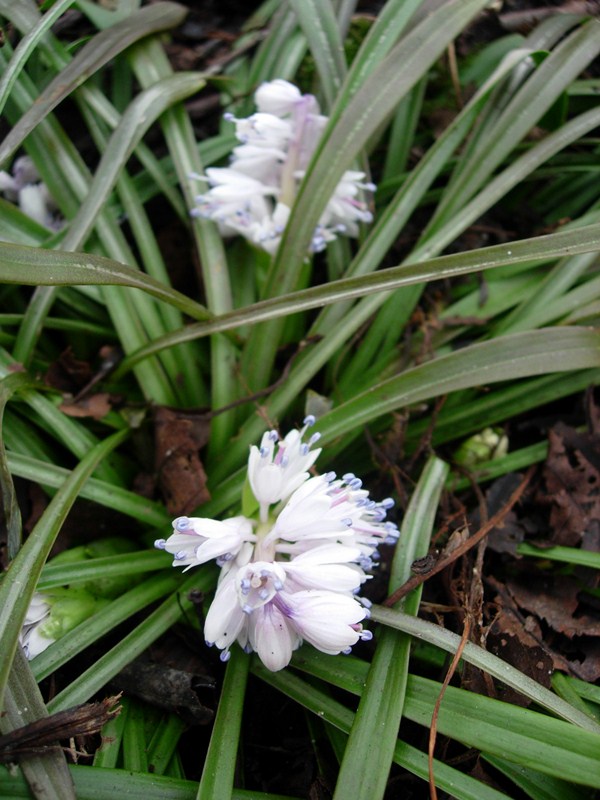
Mon, 03/18/2013 - 9:59amThe snowdrops and snowflakes are showing but barely and many weeks late.
Galanthus 'Wendy's Gold' and Leucojum vernum
Tim Ingram (not verified)
Re: Miscellaneous Woodlanders
Tue, 03/19/2013 - 6:46amProbably the best place for the Helionopsis and Ypsilandra would be in a good shady trough in peaty/sandy soil. In pots they are vulnerable to vine weevil grubs. I think planted under Heptacodium they could get too dry and wouldn't have that loose woodsy soil that things like trilliums and such do so well in.
Amy Olmsted
Re: Miscellaneous Woodlanders
Tue, 03/19/2013 - 8:20amDuly noted! I'll put on my spring list of things to move 2 Ypsilandra from the Heptacodium to the streamside garden.
Thanks for the info Dr. Tim!
Zonedenial (not verified)
Re: Miscellaneous Woodlanders
Tue, 03/19/2013 - 1:24pmMark; Far Reaches Farm has Ypsilandra ($10), and Helionopsis (lavender-pink form; $18).
Mark McDonough
Re: Miscellaneous Woodlanders
Tue, 03/19/2013 - 5:10pmThanks Don, what a super fine nursery listing at Far Reaches Farm, innumerable temptations. Ypsilandra and Heloniopsis are zone rated Z7 and Z6 respectively, both requiring moist soil. Since I'm Z5 and have a dryish garden, I may wait to hear about Amy's results before purchasing. Perhaps I should be like your namesake and tempt zone denial ;) and take a chance on them, but as I already have several plant orders expected this spring, I think I'll wait, at least for this year. Good tip, many excellent plant selections there, certainly one to bookmark under one's favorites.
Zonedenial (not verified)
Re: Miscellaneous Woodlanders
Tue, 03/19/2013 - 5:50pmI have Ypsilandra ordered this spring for my 5b garden... or as I sometimes call it, "The Graveyard". ;D
Trond Hoy
Re: Miscellaneous Woodlanders
Sun, 05/05/2013 - 2:26pmAt last - the Lysichitons have appeared! It is spring!! The yellow americanus do self seed a lot but I am happy! Among the coming huge plants some bigleaved Chinese Chrysosplenium macrophyllum has flowered for weeks.
In the background you can see the winterburned native blueberry shrubs. No berries this summer!
cohan (not verified)
Re: Miscellaneous Woodlanders
Wed, 05/08/2013 - 4:05pmLooking good, Trond! These are both still on my list to try someday :)
Trond Hoy
Re: Miscellaneous Woodlanders
Tue, 05/14/2013 - 11:07amI'll keep it in mind and try to harvest seeds at the right time!
cohan (not verified)
Re: Miscellaneous Woodlanders
Thu, 05/16/2013 - 2:22pmThanks!
Has your spring weather finally developed more normally? We had a warm March, cold April, and first part of May very warm, now we are closer to normal, maybe some rain coming after a long dry period... If the pattern holds, June will be cold...lol
Trond Hoy
Re: Miscellaneous Woodlanders
Fri, 05/17/2013 - 12:50amWell, I can't say things are normal yet. We went to spend our long holiday (it's Norway's national day today) at the mountain cabin and when we left home yesterday not a single birch tree had leafed out. It has never happened before in the 30 years I have lived here. Usually the birches are green 1th May. However, the forecast says 24C the next couple of days so I expect the trees are green when we are back home!
Here at our cabin it is still patches of snow which is normal though but it has rained much and lots of roads and homes are damaged due to flooding. Warm rain + a lot of snow in the higher places make a lot of water!
Mark McDonough
Re: Miscellaneous Woodlanders
Sun, 05/19/2013 - 8:02pmWho knows the forms of Chrysogonum virginianum (there are 3), I assume by the shortness of this one, it is either var. australe or var. brevistolon. If "var australe", Flora of North America says the stolons are 12-60 cm long! Yikes, 60 cm, or 2', I might have to move this to a wild part of the garden. It's only two years in my garden, so far spreading mildly. But I wonder, and watch.
Lori S. (not verified)
Re: Miscellaneous Woodlanders
Sun, 05/19/2013 - 8:17pmIt certainly looks charming but then I'm a sucker for daisy-like flowers (which I suppose will help explain why I planted some sort of Arnica 15 years ago... which I've been weeding out fitfully ever since. Damned thing never blooms but it sure gets around.)
Trond Hoy
Re: Miscellaneous Woodlanders
Sun, 05/19/2013 - 11:19pmI like that Chrysogonum whatever sort it is! Wouldn't mind it spread in my woodland!
copperbeech (not verified)
Re: Miscellaneous Woodlanders
Sat, 05/25/2013 - 2:28amWhat a coincidence as just yesterday I picked up 3 Chrysogonum virginianum ("Allen Bush"). I was looking for a shorter flowering shade plant and Chrysogonum virginianum seemed interesting from its description.
For those of you that have it, for how long does it flower in the spring? Does it ever repeat bloom...maybe late in the cooler wetter fall?
Mark McDonough
Re: Miscellaneous Woodlanders
Sat, 05/25/2013 - 6:33amAaron, with three Chrysogonum virginicum subspecies, maybe there's a form that will be more amenable to your garden, or a strong selection like 'Allen Bush'.
Copperbeach, I had not heard of the 'Allen Bush' selection before, so looked it up. It's interesting that all sites report this plant flowers in spring but also reflowers in autumn. Here's what three different nurseries say about C. virginicum 'Allen Bush':
North Creek Nursery
http://www.northcreeknurseries.com/index.cfm/fuseaction/plants.plantDeta...
Chrysogonum 'Allen Bush' is typical of the species in most ways with a profusion of dark yellow, star-shaped flowers in spring and a few again in the fall.
New Moon Nursery
http://www.newmoonnursery.com/index.cfm/fuseaction/plants.plantDetail/pl...
‘Allen Bush’ is more compact and floriferous than the straight species. A good ground cover with yellow star-shaped flowers. Needs well-drained, moist soil in full to part shade.
Lazy S's Farm Nursery
http://www.lazyssfarm.com/Plants/Perennials/C_files/Ce-Ci.htm
East Coast Native from PA south. Nice ground cover in rich, well-drained soil but tolerates less than ideal conditions. The cultivar 'Allen Bush' typifies the species but with a profusion of dark yellow, star-shaped blooms in late spring/early summer and some later in the Fall. Takes sun in cooler zones, more shade in warmer zones. Light evergreen, triangular shaped leaves. Great groundcover.
By the way, I ordered Epimediums and a couple other plants from Lazy S'S Farm Nursery this year (along with orders for Epimedium from 3 other mail order nurseries); the plants from Lazy S were top notch, beautful large vigorous plants perfectly packed, highly recommended. Three out of four nurseries shipped excellent plants, Lazy S gets the highest grade. :)
Updated photo of my Chrysogonum virginicum, more flowers coming. I'm closely watching to see how far away new stolons appear, to gauge its spread, may have to move it out of its current location close to other plants. By the way, when I was 8 or 9 years old, this was one of the first plants I grew in a wildflower garden, I started early ;D
Trond Hoy
Re: Miscellaneous Woodlanders
Sat, 05/25/2013 - 1:38pmMark, I am a bit hesitant to ask - but does it set seed?
Mark McDonough
Re: Miscellaneous Woodlanders
Sat, 05/25/2013 - 5:43pmHonestly, I don't know if it sets seed, but I suppose it must, I haven't paid attention to that point in the two years I've had it back in my gardens after decades absence.
Trond Hoy
Re: Miscellaneous Woodlanders
Mon, 05/27/2013 - 1:34amOK, thanks. Being stoloniferous maybe it doesn't bother using energy on seed.
Mark McDonough
Re: Miscellaneous Woodlanders
Wed, 05/29/2013 - 6:09pmA quietly attractive plant for a woodland setting is Tellima grandiflora (Fringecups) from Western North America. Mine came to me misidentified as Boykinia rotundifolia (that species is from California). The flowers start out green but age pink. To 18" tall.
Gene Mirro (not verified)
Re: Miscellaneous Woodlanders
Wed, 05/29/2013 - 7:40pmIn the Pacific NW, you need to be careful with Tellima. If you let it go to seed, you will be sorry. And they are extremely difficult to kill with herbicide.
Tony Willis (not verified)
Re: Miscellaneous Woodlanders
Thu, 05/30/2013 - 1:05amThe same in NW England it is a complete nuisance but nice
Trond Hoy
Re: Miscellaneous Woodlanders
Thu, 05/30/2013 - 1:56amAlthough it self seeds here in coastal Norway too it is not a problem (yet) and not difficult to remove like some other weeds.
Mark McDonough
Re: Miscellaneous Woodlanders
Thu, 05/30/2013 - 6:27amHmmm, thanks for the head's up warnings everyone, had a similar warning on Facebook. Well, it was supposed to be a Boykinia. Hasn't shown any tendencies of spreading just yet (3 years here), but I'll watch it carefully, and if I spy lots of seedlings, will be sure to eradicate; it's a pleasant enough plant but I don't need yet another thug to invade my garden.
Richard T. Rodich
Re: Miscellaneous Woodlanders
Thu, 05/30/2013 - 5:15pmI grew Tellima grandiflora from seed one year. They all died the second winter. ???
Nice pink fall foliage, but flowers weren't even as nice as yours, Mark.
I wasn't too heart broken by the loss.
Trond Hoy
Re: Miscellaneous Woodlanders
Fri, 05/31/2013 - 11:34pmWhen I moved here I found a small clump of lavender coloured Anemone nemorosa, possible 'Robinsoniana'. Now it has spread with seed to a lot of new sites and I have several forms - it has possibly crossed with the wild windflower. They are much later than the common white ones.
Here is at least two clones (not easy to see in the picture though) and the colour is darker in real.
Another plant growing at the property was Polygonatum multiflorum. It has spread by runners to a huge patch in the woodland - making a nice understory among the rhododendrons. Unfortunately the Diphylleia sinesis doesn't spread!
Although these Maianthemums don't have the most colourful flowers they have handsome leaves and the berries are nice in the fall. Sorry, don't remember the names although I have planted them myself (you can spot my foot in the last picture).
Lori S. (not verified)
Re: Miscellaneous Woodlanders
Sat, 06/01/2013 - 6:58pmVery nice, Trond! I wish my Anemone nemorosa would flourish like that. I also wish Diphylleia liked the dry conditions here... oh well.
Very striking foliage on the Maianthemum.
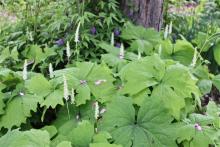
A west-coaster that is hardy here, vanilla-leaf, Achlys triphylla... somewhat spreading, though:
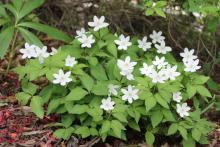
Anemone trifoliata and Viola canadensis:
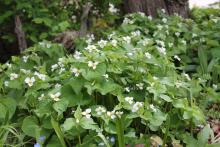
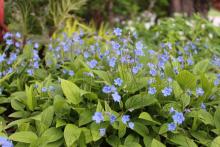
Omphalodes verna:
Mark McDonough
Re: Miscellaneous Woodlanders
Sat, 06/01/2013 - 8:22pmAaron, thanks for adding your notes on Tellima grandiflora, maybe it will be well behaved enough here in the East. Although I have taken into consideration warnings by others, and will remove the plant if it shows any worrisome spreading tendencies.
Lori, really like the appearance of Anemone trifoliata, can you tell me about it's rate of spread (I'm cautious with Anemone). I never think about Achlys triphylla, it is attractive, I should look to introduce that to some wilder parts of my woodland.
Trond, good to see Diphylleia sinensis, I grow the other two species cymosa and have two-year seedlings of D. grayi. My garden tends to be too dry for these plants, but I manage to keep D. cymosa going for a long number of years now, and I hope D. grayi too.
Here's the cutest little thing, dare I say, a Pinellia. This is Pinellia cordata 'Yamazakii', a tiny well-behaved form. It emerges so late (just a few days ago) I always think I've lost it; for me it stays as a small clump, with cute hooded blooms and skywards spadices. The best part, the flowers give off a strong aroma like sweet juicy-fruit bubblegum! I'm not kidding!
Lori S. (not verified)
Re: Miscellaneous Woodlanders
Sun, 06/02/2013 - 7:57amI really like Anemone trifoliata too! It seems to be a slow spreader here... at least in the time I've had it. I think I planted it in 2009.
Trond, I think you have Anemone trifoliata too? How is the rate of spread for you?
Also, I can't remember if it goes dormant after blooming or not... must pay closer attention this year.
Pinellia cordata 'Yamazakii' is incredibly cute! I wonder how hardy it is?
Mark McDonough
Re: Miscellaneous Woodlanders
Sun, 06/02/2013 - 5:21pmThis plant has been perfectly hardy here for the 5 years of so that I've had it (USDA Zone 5), but that's not enough information for your colder climate. It doesn't set seed (not that I've seen yet), so I'm not sure about its propagation options. Today I asked my daughter to smell the flowers; she thought it smelled very "fruity". Must work on getting this increased, too cute to lose.
Trond Hoy
Re: Miscellaneous Woodlanders
Wed, 06/05/2013 - 9:10amAnemone trifoliata behaves itself very well in my garden. It is slow to increase making a rather dense rhizome. I have not seen seedlings either but I have only one clone. Anemone trifoliata does go dormant during the summer like the other similar wood anemones.
I have not tried Pinellia yet but certainly have to!
Lori S. (not verified)
Re: Miscellaneous Woodlanders
Sat, 06/08/2013 - 7:37pmHere's a view into the area under the 'Royalty' crabapple and also shaded by a large sweetberry honeysuckle (Lonicera caerulea) and by roses...
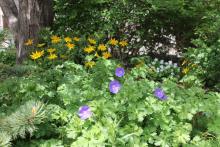
Geranium himalayense starting to bloom (sorry if this makes you shudder, Cohan ;D); a rapidly-spreading Arnica of some sort - at least this one blooms so I'm not complaining!; Anemone trifoliata in the distance:
Tony Willis (not verified)
Re: Miscellaneous Woodlanders
Mon, 06/10/2013 - 1:30pmAn interesting plant I obtained as Streptopus obtusatus flowering for the first time. I think it is wrongly named and a friend has suggested it is Disporum cantoniense which seems a better identification.
Richard T. Rodich
Re: Miscellaneous Woodlanders
Mon, 06/10/2013 - 5:33pmThe speckling/mottling in the flowers is a nice touch.
Would the square shoulders help in identification?
cohan (not verified)
Re: Miscellaneous Woodlanders
Wed, 06/12/2013 - 5:01pmBoy, even this 'minor' thread ( a personal fave) I'm way behind on- I've been spending all my time digging- a bunch of new veg beds, and still lots planned for ornamental beds...
L:ove the Chrysogonum! I'll have to watch for seeds of that available somewhere..
I also really like the Anemone trifoliata. I have A. nemorosa from roots planted in fall 2011, only a couple of flowers last year, a bit more this year, seems like it might make some nice clumps in a few years. A ranunculoides planted at the same time seems just a touch faster. They are near one another, so I'll be curious to see if I get any of the nice hybrid...
I also finally have some success with A nemorosa seeds after a number of failures, so I hope to get some other shades :)
Achlys is very nice, too...
Mark McDonough
Tony, love that Streptopus or
Sun, 09/15/2013 - 6:33amTony, love that Streptopus or Disporum you show. I purchased and planted a number of Disporum this summer, but I'm sure none as lovely as that plant.
As to Chrysogonum virginicum, I came to the decision to extract it from where it was planted, after it invaded other small plants, and replant them in a spot where it will be allowed to spread. The species has several subspecies, with varying degree of spread, see my previous two posts on this, links below. Cohan, not sure if it made any seed, I wasn't watching, of course for me, no need at it spreads quickly, but I'll try and watch next year.
https://www.nargs.org/comment/11840#comment-11840
https://www.nargs.org/comment/11845#comment-11845
I was surprised just how robust the roots were, and with seemingly modest growth above, the roots were tenacious and made for difficult uprooting. I was also surprised at how thick the stolons are. The rate of spread is about 6" per (in all directions) per season. Here's a photo showing an uprooted piece.
I am working on a new shady area that quite large, the result of "limbing up" a row of fir and spruce trees that borders my side property line. It was a tremendous effort to "get inside" the trees with incredibly dense branching to the ground, and also much effort to spade some soil pockets removing stones and roots. There's the chosen relocation, at the base of Uvularia grandiflora, before and after planting.
cohan (not verified)
Looks like a nice new area. I
Sun, 09/15/2013 - 3:06pmLooks like a nice new area. I haven't done any limbing, but plenty of digging amongst roots!
Re: Disporum, I can't remember if I've told this tale before here, but I thought I'd collected berries of Disporum trachycarpum in the woods on the farm, a few years back. The berries have a distinctive look, so I was pretty confident in my id, and happy since this was the first time I'd come across this species. Well, it was also the last- despite revisiting the site repeatedly over several years, I have never found any further trace of the plant in leaf, flower or fruit. I'd pretty much convinced myself that I was just confused about Maianthemum stellatum which also grows there. Seemed an unlikely confusion, since I am so familiar with the Maianthemum, and again, those Disporum berries are distinctive, and not remotely like Maianthemum berries.
If there was Disporum there, I suppose something could have eaten it, or it could have been covered by a fallen tree, of which there have been a number- but I really would have thought it could easily send shoots a foot or so over to get around any logs...
Anyway, I did get germination after a year or two, and I'd been watching the seedlings- not conclusive, since I'd never seen Maianthemum seedlings. I had a batch of something come up in a nearby pot, which was supposed to have Elaeagnus seed in it, and those are pretty clearly M stellatum (how does that happen? I can see getting a few seeds of natives in seed pots outdoors, but an entire pot of evenly distributed seedlings??? no elaeagnus...same thing happened in a pot with Lindera seed- a full crop of Cornus canadensis- no Lindera :( ).. So now i am thinking maybe those really are Disporum seedlings... I planted them out in a new bed a while back, so we'll see.. doubt they'll flower yet next year.. Planted out the Maianthemum seedlings too..
Pages