I grew a clump of it here for a few years, until it eventually disappeared (have unlabelled photos somewhere on my hard drive). I'm trying to start more from seed this year. It's probably worth a try for you... but then, I think pretty well everything is worth a try. ;D
Hylomecon vernalis (syn H japonica) is one of my woodland favorites. Although the flowers don't last long they are very welcome. The plant tolerates deep shade and fits perfect in my woodland. Seems that the former 2-3 species are lumped into one.
I love this one too! It can spread around a bit by seed when it's happy and it's easy to divide. Yes a great plant for deeper shade and it's under huge pines so it like or tolerates dry soils. My kind of plant! ;)
Looks very nice. The Hylomecon foliage doesn't look like it would be very durable though, is that true? How does it look by late summer? Or is it ephemeral?
I grew a clump of it here for a few years, until it eventually disappeared (have unlabelled photos somewhere on my hard drive). I'm trying to start more from seed this year. It's probably worth a try for you... but then, I think pretty well everything is worth a try. ;D
Good to know! Did you get seed from one of the exes, or find it commercially?
I guess it must be rather adaptable, considering the comments on this site, combined with comments earlier in this thread: Hylomecon vernalis Maxim. Hylomecon vernalis Credit: Tatyana Shulkina Plant with long rhizome, stems 20-30 cm during flowering. Basal leaves shortly petiolate, pinnate, stem leaves shortly petiolate, sessile, 10-15 cm x 10-15 cm. Flowering stem shorter than leaves. Flowers solitary, yellow, very large. V - early spring to early autumn, April-September in St. Petersburg. Fl - May-June for 2-3 weeks. Fr - early summer, June-July in St Petersburg. P - by seed and by division. Prefers a sunny place, does well in a semi-shaded position. Recommended for small group planting. Well suited to the rock garden. Cultivated in St. Petersburg Botanical Garden since 1870. Z 4 (3). New. Far East (southern regions), northwesern China, northern Korea and Japan. In coniferous forests. from: http://www.efloras.org/florataxon.aspx?flora_id=120&taxon_id=220006651
Looks very nice. The Hylomecon foliage doesn't look like it would be very durable though, is that true? How does it look by late summer? Or is it ephemeral?
Here it stays green almost all summer depending on how dry it is. It spreads very slowly outwards but that is not a problem! I have never seen seeds or found seedlings here. Maybe I have only one clone (plants bought on sale in fall). However I bought some new ones last year, hope they are another clone ;)
Hmmm, Hylomecon vernalis looks like a good one for my woodland gardens, will have to keep an eye out for this "forrest poppy".
Another aspect of plants that doesn't get much coverage photographically, is early spring plant emergence, except perhaps with a few genera known for their whimsical spring growth, such as Syneilesis, the Shredded Umbrella Plant. http://nargs.org/smf/index.php?topic=252.0
Several years ago I bought a plant of the white-flowered form of Asarum caudatum, but it turned out to be the regular maroon color, but a nice ginger all the same. Its early emergence is awesome to watch; from a network of above-surface blackish rhizomes, the swelling leaf buds appear as silvery blobs of crumpled tissue. At the stage where either true leaves start to emerge, or the brooding flowers are revealed, the growth points remind me of fortune cookies. In the photo below, first row, on the right, ignore the little orangish-color seedlings, it's just those pesky Jeffersonia dubia seedlings that pop up all over the place ;)
I would suggest keying that in FNA. It looks like lemmonii or maybe even canadense. Caudatum should remain somewhat evergreen or tardily deciduous at least. Also the lobes of it should be far longer. I don't grow caudatum now, but I still have it in my parents yard.
Canadense can vary from short to mid-range, and long calyx-lobe forms. These "forms" all had names and may get them again. I have seen all three in one population with no intermediates, differences in pubescence, and plant size.
Aaron Knoxville, TN
Aaron thanks for the suggestions, I will need to give it a closer look when in flower this spring, but after looking at the photos of lemmonii, canadense, and the FNA descriptions, I'm inclined to think it is A. canadense. I see that caudatum has those extra long tail-like calyx lobes; and they look much shorter in the picture I show, similar to canadense, wasn't sure if the appendages become longer in more fully developed flowers. It seems A. lemmonii looks a bit different.
I dug through more images, and I post some general garden scenes where the fully expanded foliage of the Asarum can be seen, and here again, I think you're right with the A. canadense suggestion.
General garden view on the left, the red arrow points to the foliage of the subject Asarum. Close-up of the foliage on the right.
On the left, garden scene with Epimedium, Trilliums, Primula kisoana, Syneilesis, and other woodlanders. On the right, close-up of Trillium grandiflorum
On the left, is Epimedium grandiflorum var. coelestre 'Alpine Beauty', Trillium grandiflorum 'Roseum" behind, foliage of Jeffersonia dubia in upper right, and foliage of the subject Asarum in the lower right. On the right, Primula kisoana, an Asarum self-sown seedling plant in the center (with shiny foliage), and a small division of Deinanthe bifida in the upper right.
Those deep teeth are just remarkable. Hmm, reMARKable? I suppose you've heard that one before.. And where is the "bifida" in the leaves? Would that make it D. cearulea?
Those deep teeth are just remarkable. Hmm, reMARKable? I suppose you've heard that one before.. And where is the "bifida" in the leaves? Would that make it D. cearulea?
Now I'm more confused than ever, reminds me of the two species of Mukdenia exploration, or the two species of Kirengeshoma, which when researched, seems an overlapping muddle. I've grown my white-flowered D. bifida from seed (most likely NARGS), and it does indeed have white flowers, so never questioned the identity. I wish it were the more desirable blue-flowered D. caerulea. But looking at images of both, I see wildly variable leaves on both species, how many are misidentified, I don't know, and to what degree is the variability reported. Deinanthe caerulea is listed in FOC as having leaves with the apex entire or deeply 2-lobed with lobes 5-6 cm.
It should also be noted, that only some leaves, perhaps the most mature leaves in D. bifida, are in fact bifid, this can be seen in the Plant Delights Nursery photo that shows both types of leaves on D. bifida. The plant in my photo is a small division from my much larger plant, so might only be showing immature leaves. http://www.plantdelights.com/Deinanthe-bifida-Perennial-Two-lobed-False-...
Nice woodland garden views, Mark. I have only tiny seedlings of Trillium, so far, and no Asarum yet.. hope to have more of both eventually! I pay a lot of attention to emerging foliage in spring/early summer-- especially the earliest things, when we have been without greenery for so many months! I took a lot of photos last year, especially, I'll try to post some here, at a later time..
I have been thinking lately that I probably have too many Rhododendrons in my garden! They are all winter green and it isn't much growing underneath their dense foliage. Where there are open patches however a kind of grass soon infest the available space. I am looking forward to having "those pesky Jeffersonia dubia seedlings that pop up all over the place", Mark!
The foliage in your last picture looks like A. canadense to me. The others do not. A. canadense leaves are quite heart-shaped, with a definite point. Also, the points on the flowers you show seem to be a little long for A. canadense, and the rhizomes do not look characteristic. I can't put my finger on it, but I have the feeling that A. canadense rhizomes are a lot smaller and shorter. Could your plants be a cross?
Possibly, but not sure. I purchased the plant as Asarum caudatum 'Album', but it was mislabeled. It's a misnomer that needs an identity. Perhaps as you suggest, it is a hybrid? I'm not very experienced with Asarum, but welcome the suggestions.
The primulas are coming now! This one, a P denticulata lookalike (I think it is from one of Chadwell's allocations) has a lot of farina on the early buds. The flowers open early down between the leaves but the scape elongates soon.
The primulas are coming now! This one, a P denticulata lookalike (I think it is from one of Chadwell's allocations) has a lot of farina on the early buds. The flowers open early down between the leaves but the scape elongates soon.
Super cool Trond! Mine are still a few weeks away from bloom, but with temps going up into the 50'sf all week perhaps I'll see flowers much sooner! :D
The primulas are coming now! This one, a P denticulata lookalike (I think it is from one of Chadwell's allocations) has a lot of farina on the early buds. The flowers open early down between the leaves but the scape elongates soon.
Super cool Trond! Mine are still a few weeks away from bloom, but with temps going up into the 50'sf all week perhaps I'll see flowers much sooner! :D
Thanks Amy ;) Here the temp stays in the lower 40's F so everything develop rather slowly except the slugs. I've already sent quite a few to their eternal greenery.
Epigaea repens (mayflower) is already budded, it'll be interesting to see if the flowers will open in March if we continue to get unseasonably warm weather, or hold off until April (which is still early for a mayflower). Photos taken today, March 17, 2012.
This is a colony growing on a wooded roadcut just a couple minute walk from my house. Observing the colony, there are obvious patches of variable forms, in the first photo you can see a lighter green leaved type on the left, and a darker green leaved form on the right. The photo on the right gives a view of the steep roadcut covered in mayflower.
On the left is a strong healthy looking form with large rounded dark green leaves. On the right is a particularly small leaved form, of a lighter green color, and with congested more leafy growth. The flowers are mostly very pale pink in this colony.
Are there any named selections of mayflower? I see photos of some strong pink color forms, but I don't know of any named selections. Has anyone grown this plant from cuttings, if so, any suggestions?
Epigaea repens (mayflower) is already budded, it'll be interesting to see if the flowers will open in March if we continue to get unseasonably warm weather, or hold off until April (which is still early for a mayflower). Photos taken today, March 17, 2012.
This is a colony growing on a wooded roadcut just a couple minute walk from my house. Observing the colony, there are obvious patches of variable forms, in the first photo you can see a lighter green leaved type on the left, and a darker green leaved form on the right. The photo on the right gives a view of the steep roadcut covered in mayflower.
On the left is a strong healthy looking form with large rounded dark green leaves. On the right is a particularly small leaved form, of a lighter green color, and with congested more leafy growth. The flowers are mostly very pale pink in this colony.
Are there any named selections of mayflower? I see photos of some strong pink color forms, but I don't know of any named selections. Has anyone grown this plant from cuttings, if so, any suggestions?
Very nice to see, Mark. And almost impossible to find over here. I've sown it three times now and killed them two times when transplanting. Now I have a third batch of three year old seedlings. I planted them out this spring without disturbing their roots... I just dug a hole in the shape of the seedbox and put it in like that....
Mark, Dean Evans of the Berkshire chapter has successfully propagated this species from cuttings. One plant he gave me years ago still survives in my old Averill Park garden.
I've wanted to grow mayflowerfrom the first time I saw a picture of it! As Wim says it is next to impossible to buy here and I have never had any luck with seed :( Maybe I should try cuttings if anybody have some to spare . . . .
It must depend on getting the cuttings at the right time.
Michael Dirr says in his propagation book that August into September (I assume in Georgia) is the best time to take cuttings of Trailing Arbutus. ("Mayflowers" denote Thalictrum thalictroides were I live.) Untreated in sand/peat mix gave 94% rooting in 5 weeks. Cuttings include part of last season's growth. October cutting rooted at 50%.
That primula would make a great time lapse film! I've had thoughts of doing this on beds in the garden but so far haven't built up the resolve - it needs a bit of planning. Fern fronds expanding, Jeffersonia coming in and going out of flower (or Sanguinaria); in both cases it is only a few days. With Giant Fennels you can virtually watch the flower spike growing! I'm convincing myself that this would make a good project.
That primula would make a great time lapse film! I've had thoughts of doing this on beds in the garden but so far haven't built up the resolve - it needs a bit of planning. Fern fronds expanding, Jeffersonia coming in and going out of flower (or Sanguinaria); in both cases it is only a few days. With Giant Fennels you can virtually watch the flower spike growing! I'm convincing myself that this would make a good project.
I have always wanted to do a time lapse photography of Arisaema heterophyllum (the form I grow is a giant, reaches 6' (2 m) to the spathe tip), typically it doesn't emerge until late May or early June, then in the span of 3 weeks it reaches 6 feet!
Thinking about time-lapse photography, in notheastern USA we've had a full week of record breaking mid-summer like warmth, each day to 79-80 F, people going around dressed in shorts and tee shirts. As if by magic, everything starting popping open; Magnolia soulangiana trees (widely planted here) are in full bloom, as are M. stellata and salicifolia, Forsythia, Cornus mas, Rhododendron mucronulatum, daffodils, and everything else pushing rapid growth. Suddenly Jeffersonia dubia is in bloom, the plants looking foreshortened and not flowering normally. Predicted to go down to 19 F (-7 C) tomorrow night, below freezing the following night(s) too; I anticipate the level of freeze damage that will occur with so much soft and advanced spring plant growth.
Mayflower or Trainling Arbutus, Epigaea repens is in bloom, now in New England we must call these Marchflower ;) Here are a couple photos taken near dusk on my way home from work a couple days ago. It's a near white form, I did take a photo of a single deeper pink form, but it came out blurry.
Mark, white or pink, March or Mayflower; it is a gem!
McDonough wrote:
Thinking about time-lapse photography, in notheastern USA we've had a full week of record breaking mid-summer like warmth, each day to 79-80 F, people going around dressed in shorts and tee shirts. As if by magic, everything starting popping open; Magnolia soulangiana trees (widely planted here) are in full bloom, as are M. stellata and salicifolia, Forsythia, Cornus mas, Rhododendron mucronulatum, daffodils, and everything else pushing rapid growth. Suddenly Jeffersonia dubia is in bloom, the plants looking foreshortened and not flowering normally. Predicted to go down to 19 F (-7 C) tomorrow night, below freezing the following night(s) too; I anticipate the level of freeze damage that will occur with so much soft and advanced spring plant growth.
Although we have had nice sunny weather we haven't reached that warm temperatures! Neither do we get freezing nights either :) In the eastern part of Norway they have had all time high temperatures in March and my sister in Oslo tells she'll have flowering daffodils in the garden before Easter for the first time ever!
Mark, are you sure it is an Arisaema and not a bamboo you grow?
Nice stuff, Wim! I'm jealous of your different T thalictroides cultivars. Have tried to establish some here with little success :(
Thanks, Trond. Really weird that the T. thalictroides (Anemonella) doesn't grow at your place....maybe to cold in winter?? Would you like to try again?
Nice stuff, Wim! I'm jealous of your different T thalictroides cultivars. Have tried to establish some here with little success :(
Thanks, Trond. Really weird that the T. thalictroides (Anemonella) doesn't grow at your place....maybe to cold in winter?? Would you like to try again?
Oh yes! I don't think it is the climate actually but slugs and snails. I kill several small gastropods every day - but they are out in the night and they seem to prefere soft garden plants to grass and weeds :( :( Although it is mild it isn't very warm so the plants develop slowly and are prone to attack every night for a long time till they get so big and tough that the slugs loose interest.
The wild Thalictrum thalictroides here survive most of the summer in dry woodland soil as just tuberous roots and no foliage. In the garden with better conditions, they tend to stay green far longer and flower for at least an extra month.
Last season I tried to collect seed for you, Trond. I kept looking at them (the seeds), thinking they are almost ready but not quite, and the next time I went to collect, they would be gone. I had never tried harvesting this seed before, so that was a learning experience, and now I now to take them at the more green stage.
Last season I tried to collect seed for you, Trond. I kept looking at them (the seeds), thinking they are almost ready but not quite, and the next time I went to collect, they would be gone. I had never tried harvesting this seed before, so that was a learning experience, and now I now to take them at the more green stage.
Rick, I remember that you tried and appreciate your efforts! Hope you get some nice walks in the woods ;)
There are some very nice Antonella! I like those Whim!
As a no ob i want to send a little pictures to you.
I have send them in the Imodium threat before, but as i can hear, here is the right place.
First i want to show an Aconite 'Red Wine' (ready for climbing up to the sky :-) )
Next picture presents a Brynner 'Jack Frost' which brings a little light into my shadow areas
Maybe this plant takes attention to you prof is- Colorfully electrodes ( nice leaves ,pretty bloom and a nice built) I enjoy having this plant!!!
And for an end today , here comes Docents cu cullaria in bloom
Have a nice eastern (even if you don't want to have a greedy rabbit in your garden :-) )
Hello Ernie! Neither of my Red Wines reaches the sky! One gets munched by slugs and the other gets down my throat ;) Nice selection of plants! Have a nice Easter :)
I mentioned elsewhere how it seems this season is giving deeper colors, despite the warm weather. I have never seen the Cardamine laciniata with such deep lavender buds. These are in the wild, near my house:
Open woods are not common in Minnesota. Usually there is a lot of native underbrush. The cardamine seems to thrive in these areas that get too dry to support summer growth.
Dicentra cucullaria, in the wild not far from my house. I have "decided" this is another species that can sit "dormant" for multiple years without showing above ground. I know this area quite well, and this spring I am seeing at least four times as many plants as I have ever seen there before. Plants are larger than ever before, too, with flower scapes up to 6 inches(!)
Possible reasons: --- the ridiculously warmer than normal winter --- the exceptionally dry late summer through winter --- perfectly timed rainfall last spring during the Dutchman's Breeches' growth cycle
It's weird that our dry spring has not seemed to affect the plants...
I mentioned elsewhere how it seems this season is giving deeper colors, despite the warm weather. I have never seen the Cardamine laciniata with such deep lavender buds. These are in the wild, near my house: Open woods are not common in Minnesota. Usually there is a lot of native underbrush. The cardamine seems to thrive in these areas that get too dry to support summer growth.
Cool plant! I'm interested in the woodland Cardamines I've seen on the lists, nothing like that here! Of course the Dicentra is exquisite, high on my endless list ;D
Ernie, you obviously like Polygonatum; I'm tempted to grow more of them, I only grow 3-4 types, but it is a most interesting genus. I do have P. humile, although have not heard of a 'Nanum' form, is it really smaller than regular P. humile. Must add P. falcatum to my garden too, Plant Delight's Nursery has some wonderful selections.
Rick, the Cardamine laciniata is most pleasing, seems like there are a number of very worthwhile Cardamine/Dentaria species to try in the woodland garden. Have you tried growing this in your garden.
Following up on my imposter Asarum caudatum alba posting (plant was actually A. canadense), I had bought the plant a second time and planted it out a couple years ago, the label got lost, then couldn't remember where I had planted it. :rolleyes: Well, today I found it, here's two photos of Asarum caudatum forma alba; an overall shot of the handsome foliage, and lots of creamy-greenish blooms (instead of maroon). Don't you just love those sorts of garden surprises!
The rediscovery of something thought lost or forgotten is definitely uplifting. It happens "often" in my potted menagerie. Most recently for me, Lilium rhodopaeum, that I had started from seed and couldn't find last fall when I had wanted to give it special care for the winter. I found it this spring as it started its second year of leaf growth. 8)
When I first found Cardamine laciniata, perhaps ten years ago, I did pot up a few, thinking perhaps I would plant it in the garden. But change my mind mostly because it flowers very sparsely. The pots were donated to the Chapter's plant sale. More recently, though, I am changing my mind, only because its life above ground seems to be so fleeting, that even its interesting greenery would be welcome at a time when there is plenty of room in the garden. However, it may decide, like Thalictrum thalictroides does, to extend its stay at the surface in garden conditions. I guess I will only know if I try it.
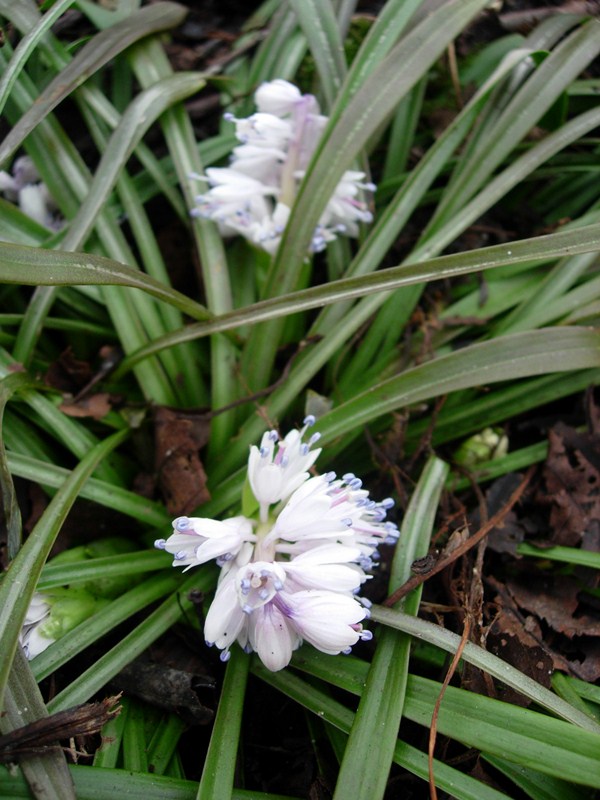
to give an idea of the paucity of bloom: in the largest carpet in the pic below (in the wild), there were 16 blooming spikes.

Comments
cohan (not verified)
Re: Miscellaneous Woodlanders
Sat, 02/11/2012 - 11:34amNice one- I don't think I've heard of these..
Lori S. (not verified)
Re: Miscellaneous Woodlanders
Sat, 02/11/2012 - 12:44pmI grew a clump of it here for a few years, until it eventually disappeared (have unlabelled photos somewhere on my hard drive). I'm trying to start more from seed this year. It's probably worth a try for you... but then, I think pretty well everything is worth a try. ;D
Amy Olmsted
Re: Miscellaneous Woodlanders
Sat, 02/11/2012 - 1:02pmI love this one too! It can spread around a bit by seed when it's happy and it's easy to divide. Yes a great plant for deeper shade and it's under huge pines so it like or tolerates dry soils. My kind of plant! ;)
Richard T. Rodich
Re: Miscellaneous Woodlanders
Sat, 02/11/2012 - 8:57pmLooks very nice. The Hylomecon foliage doesn't look like it would be very durable though, is that true? How does it look by late summer? Or is it ephemeral?
cohan (not verified)
Re: Miscellaneous Woodlanders
Sat, 02/11/2012 - 9:53pmGood to know! Did you get seed from one of the exes, or find it commercially?
Lori S. (not verified)
Re: Miscellaneous Woodlanders
Sat, 02/11/2012 - 10:04pmI bought it locally, though, unfortunately, I've never seen it again since.
cohan (not verified)
Re: Miscellaneous Woodlanders
Sat, 02/11/2012 - 10:11pmI guess it must be rather adaptable, considering the comments on this site, combined with comments earlier in this thread:
Hylomecon vernalis Maxim.
Hylomecon vernalis
Credit: Tatyana Shulkina
Plant with long rhizome, stems 20-30 cm during flowering. Basal leaves shortly petiolate, pinnate, stem leaves shortly petiolate, sessile, 10-15 cm x 10-15 cm. Flowering stem shorter than leaves. Flowers solitary, yellow, very large. V - early spring to early autumn, April-September in St. Petersburg. Fl - May-June for 2-3 weeks. Fr - early summer, June-July in St Petersburg. P - by seed and by division. Prefers a sunny place, does well in a semi-shaded position. Recommended for small group planting. Well suited to the rock garden. Cultivated in St. Petersburg Botanical Garden since 1870. Z 4 (3). New.
Far East (southern regions), northwesern China, northern Korea and Japan. In coniferous forests.
from:
http://www.efloras.org/florataxon.aspx?flora_id=120&taxon_id=220006651
Trond Hoy
Re: Miscellaneous Woodlanders
Sun, 02/12/2012 - 12:18amHere it stays green almost all summer depending on how dry it is. It spreads very slowly outwards but that is not a problem!
I have never seen seeds or found seedlings here. Maybe I have only one clone (plants bought on sale in fall). However I bought some new ones last year, hope they are another clone ;)
Lori S. (not verified)
Re: Miscellaneous Woodlanders
Sun, 02/12/2012 - 11:35amIf I recall correctly, they stay green through the summer here as well.
Mark McDonough
Re: Miscellaneous Woodlanders
Mon, 02/20/2012 - 7:41amHmmm, Hylomecon vernalis looks like a good one for my woodland gardens, will have to keep an eye out for this "forrest poppy".
Another aspect of plants that doesn't get much coverage photographically, is early spring plant emergence, except perhaps with a few genera known for their whimsical spring growth, such as Syneilesis, the Shredded Umbrella Plant.
http://nargs.org/smf/index.php?topic=252.0
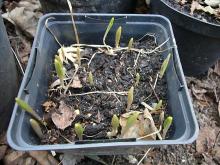
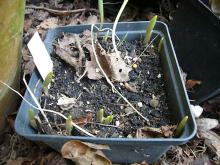
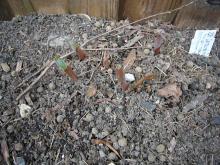
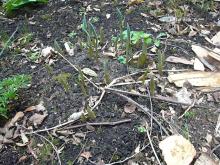
Several years ago I bought a plant of the white-flowered form of Asarum caudatum, but it turned out to be the regular maroon color, but a nice ginger all the same. Its early emergence is awesome to watch; from a network of above-surface blackish rhizomes, the swelling leaf buds appear as silvery blobs of crumpled tissue. At the stage where either true leaves start to emerge, or the brooding flowers are revealed, the growth points remind me of fortune cookies. In the photo below, first row, on the right, ignore the little orangish-color seedlings, it's just those pesky Jeffersonia dubia seedlings that pop up all over the place ;)
Mark McDonough
Re: Miscellaneous Woodlanders
Mon, 02/20/2012 - 6:25pmAaron thanks for the suggestions, I will need to give it a closer look when in flower this spring, but after looking at the photos of lemmonii, canadense, and the FNA descriptions, I'm inclined to think it is A. canadense. I see that caudatum has those extra long tail-like calyx lobes; and they look much shorter in the picture I show, similar to canadense, wasn't sure if the appendages become longer in more fully developed flowers. It seems A. lemmonii looks a bit different.
I dug through more images, and I post some general garden scenes where the fully expanded foliage of the Asarum can be seen, and here again, I think you're right with the A. canadense suggestion.
General garden view on the left, the red arrow points to the foliage of the subject Asarum. Close-up of the foliage on the right.
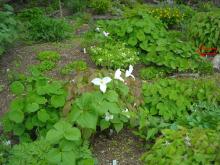
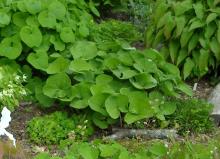
On the left, garden scene with Epimedium, Trilliums, Primula kisoana, Syneilesis, and other woodlanders.
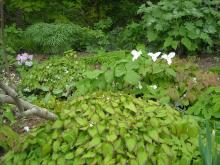
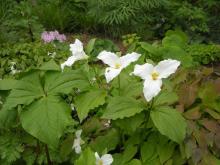
On the right, close-up of Trillium grandiflorum
On the left, is Epimedium grandiflorum var. coelestre 'Alpine Beauty', Trillium grandiflorum 'Roseum" behind, foliage of Jeffersonia dubia in upper right, and foliage of the subject Asarum in the lower right.
On the right, Primula kisoana, an Asarum self-sown seedling plant in the center (with shiny foliage), and a small division of Deinanthe bifida in the upper right.
Richard T. Rodich
Re: Miscellaneous Woodlanders
Mon, 02/20/2012 - 7:47pmMark, that Deinanthe is super cool! :o
Those deep teeth are just remarkable. Hmm, reMARKable? I suppose you've heard that one before..
And where is the "bifida" in the leaves? Would that make it D. cearulea?
Mark McDonough
Re: Miscellaneous Woodlanders
Mon, 02/20/2012 - 8:13pmNow I'm more confused than ever, reminds me of the two species of Mukdenia exploration, or the two species of Kirengeshoma, which when researched, seems an overlapping muddle. I've grown my white-flowered D. bifida from seed (most likely NARGS), and it does indeed have white flowers, so never questioned the identity. I wish it were the more desirable blue-flowered D. caerulea. But looking at images of both, I see wildly variable leaves on both species, how many are misidentified, I don't know, and to what degree is the variability reported. Deinanthe caerulea is listed in FOC as having leaves with the apex entire or deeply 2-lobed with lobes 5-6 cm.
It should also be noted, that only some leaves, perhaps the most mature leaves in D. bifida, are in fact bifid, this can be seen in the Plant Delights Nursery photo that shows both types of leaves on D. bifida. The plant in my photo is a small division from my much larger plant, so might only be showing immature leaves.
http://www.plantdelights.com/Deinanthe-bifida-Perennial-Two-lobed-False-...
cohan (not verified)
Re: Miscellaneous Woodlanders
Mon, 02/20/2012 - 10:48pmNice woodland garden views, Mark. I have only tiny seedlings of Trillium, so far, and no Asarum yet.. hope to have more of both eventually!
I pay a lot of attention to emerging foliage in spring/early summer-- especially the earliest things, when we have been without greenery for so many months! I took a lot of photos last year, especially, I'll try to post some here, at a later time..
Trond Hoy
Re: Miscellaneous Woodlanders
Wed, 02/22/2012 - 12:26amI have been thinking lately that I probably have too many Rhododendrons in my garden! They are all winter green and it isn't much growing underneath their dense foliage. Where there are open patches however a kind of grass soon infest the available space.
I am looking forward to having "those pesky Jeffersonia dubia seedlings that pop up all over the place", Mark!
Mark McDonough
Re: Miscellaneous Woodlanders
Wed, 02/22/2012 - 8:38pmPossibly, but not sure. I purchased the plant as Asarum caudatum 'Album', but it was mislabeled. It's a misnomer that needs an identity. Perhaps as you suggest, it is a hybrid? I'm not very experienced with Asarum, but welcome the suggestions.
Trond Hoy
Re: Miscellaneous Woodlanders
Tue, 03/13/2012 - 12:41pmThe primulas are coming now!
This one, a P denticulata lookalike (I think it is from one of Chadwell's allocations) has a lot of farina on the early buds. The flowers open early down between the leaves but the scape elongates soon.
Amy Olmsted
Re: Miscellaneous Woodlanders
Wed, 03/14/2012 - 5:55amSuper cool Trond! Mine are still a few weeks away from bloom, but with temps going up into the 50'sf all week perhaps I'll see flowers much sooner! :D
Trond Hoy
Re: Miscellaneous Woodlanders
Thu, 03/15/2012 - 1:29pmThanks Amy ;)
Here the temp stays in the lower 40's F so everything develop rather slowly except the slugs. I've already sent quite a few to their eternal greenery.
Mark McDonough
Re: Miscellaneous Woodlanders
Sat, 03/17/2012 - 3:06pmEpigaea repens (mayflower) is already budded, it'll be interesting to see if the flowers will open in March if we continue to get unseasonably warm weather, or hold off until April (which is still early for a mayflower). Photos taken today, March 17, 2012.
This is a colony growing on a wooded roadcut just a couple minute walk from my house. Observing the colony, there are obvious patches of variable forms, in the first photo you can see a lighter green leaved type on the left, and a darker green leaved form on the right. The photo on the right gives a view of the steep roadcut covered in mayflower.
On the left is a strong healthy looking form with large rounded dark green leaves. On the right is a particularly small leaved form, of a lighter green color, and with congested more leafy growth. The flowers are mostly very pale pink in this colony.
Are there any named selections of mayflower? I see photos of some strong pink color forms, but I don't know of any named selections. Has anyone grown this plant from cuttings, if so, any suggestions?
cohan (not verified)
Re: Miscellaneous Woodlanders
Sat, 03/17/2012 - 7:49pmCool to see, Mark, this is one I'd like to establish- I have some unsown seeds.. :-[
WimB (not verified)
Re: Miscellaneous Woodlanders
Sun, 03/18/2012 - 12:24amVery nice to see, Mark. And almost impossible to find over here. I've sown it three times now and killed them two times when transplanting. Now I have a third batch of three year old seedlings. I planted them out this spring without disturbing their roots... I just dug a hole in the shape of the seedbox and put it in like that....
Harold Peachey
Re: Miscellaneous Woodlanders
Sun, 03/18/2012 - 4:35amMark, Dean Evans of the Berkshire chapter has successfully propagated this species from cuttings. One plant he gave me years ago still survives in my old Averill Park garden.
Trond Hoy
Re: Miscellaneous Woodlanders
Sun, 03/18/2012 - 9:51amI've wanted to grow mayflowerfrom the first time I saw a picture of it! As Wim says it is next to impossible to buy here and I have never had any luck with seed :(
Maybe I should try cuttings if anybody have some to spare . . . .
Richard T. Rodich
Re: Miscellaneous Woodlanders
Fri, 03/23/2012 - 7:04pmMichael Dirr says in his propagation book that August into September (I assume in Georgia) is the best time to take cuttings of Trailing Arbutus. ("Mayflowers" denote Thalictrum thalictroides were I live.) Untreated in sand/peat mix gave 94% rooting in 5 weeks. Cuttings include part of last season's growth. October cutting rooted at 50%.
Trond Hoy
Re: Miscellaneous Woodlanders
Sun, 03/25/2012 - 1:45amI prefere cuttings to tiny seeds :-\ ;)
Tim Ingram (not verified)
Re: Miscellaneous Woodlanders
Sun, 03/25/2012 - 2:47amThat primula would make a great time lapse film! I've had thoughts of doing this on beds in the garden but so far haven't built up the resolve - it needs a bit of planning. Fern fronds expanding, Jeffersonia coming in and going out of flower (or Sanguinaria); in both cases it is only a few days. With Giant Fennels you can virtually watch the flower spike growing! I'm convincing myself that this would make a good project.
Mark McDonough
Re: Miscellaneous Woodlanders
Sun, 03/25/2012 - 7:30amI have always wanted to do a time lapse photography of Arisaema heterophyllum (the form I grow is a giant, reaches 6' (2 m) to the spathe tip), typically it doesn't emerge until late May or early June, then in the span of 3 weeks it reaches 6 feet!
Thinking about time-lapse photography, in notheastern USA we've had a full week of record breaking mid-summer like warmth, each day to 79-80 F, people going around dressed in shorts and tee shirts. As if by magic, everything starting popping open; Magnolia soulangiana trees (widely planted here) are in full bloom, as are M. stellata and salicifolia, Forsythia, Cornus mas, Rhododendron mucronulatum, daffodils, and everything else pushing rapid growth. Suddenly Jeffersonia dubia is in bloom, the plants looking foreshortened and not flowering normally. Predicted to go down to 19 F (-7 C) tomorrow night, below freezing the following night(s) too; I anticipate the level of freeze damage that will occur with so much soft and advanced spring plant growth.
Mayflower or Trainling Arbutus, Epigaea repens is in bloom, now in New England we must call these Marchflower ;) Here are a couple photos taken near dusk on my way home from work a couple days ago. It's a near white form, I did take a photo of a single deeper pink form, but it came out blurry.
Trond Hoy
Re: Miscellaneous Woodlanders
Sun, 03/25/2012 - 10:52amMark, white or pink, March or Mayflower; it is a gem!
Although we have had nice sunny weather we haven't reached that warm temperatures! Neither do we get freezing nights either :)
In the eastern part of Norway they have had all time high temperatures in March and my sister in Oslo tells she'll have flowering daffodils in the garden before Easter for the first time ever!
Mark, are you sure it is an Arisaema and not a bamboo you grow?
WimB (not verified)
Re: Miscellaneous Woodlanders
Mon, 03/26/2012 - 7:13amSome plants which are flowering here now in the shade-garden.
Hepatica transsilvanica 'Eisvögel'
Hepatica nobilis (white)
Hepatica nobilis (blue)
Adonis ramosa
Thalictrum thalictroides 'Amelia'
Thalictrum thalictroides 'Big' and Primula 'Cowichan Red'
Forgot a few :rolleyes: :rolleyes:
Hepatica x media 'Blue Jewel'
and Thalictrum thalictroides 'Pink Flash'
Trond Hoy
Re: Miscellaneous Woodlanders
Mon, 03/26/2012 - 1:18pmNice stuff, Wim!
I'm jealous of your different T thalictroides cultivars. Have tried to establish some here with little success :(
cohan (not verified)
Re: Miscellaneous Woodlanders
Mon, 03/26/2012 - 10:56pmWim- many nice things in flower there, as always!
WimB (not verified)
Re: Miscellaneous Woodlanders
Tue, 03/27/2012 - 8:00amThanks, Trond. Really weird that the T. thalictroides (Anemonella) doesn't grow at your place....maybe to cold in winter?? Would you like to try again?
Thanks Cohan!
Trond Hoy
Re: Miscellaneous Woodlanders
Tue, 03/27/2012 - 11:35amOh yes!
I don't think it is the climate actually but slugs and snails. I kill several small gastropods every day - but they are out in the night and they seem to prefere soft garden plants to grass and weeds :( :( Although it is mild it isn't very warm so the plants develop slowly and are prone to attack every night for a long time till they get so big and tough that the slugs loose interest.
Lori S. (not verified)
Re: Miscellaneous Woodlanders
Tue, 03/27/2012 - 6:43pmIt seems to be hardy here, so not surviving in zone 8 can't be due to any lack of hardiness! Maybe it drowned, Trond. ;D
Trond Hoy
Re: Miscellaneous Woodlanders
Wed, 03/28/2012 - 10:19amI don't know what's the worse - whether it drowned or was munched by slugs :-\
Richard T. Rodich
Re: Miscellaneous Woodlanders
Wed, 03/28/2012 - 5:44pmThe wild Thalictrum thalictroides here survive most of the summer in dry woodland soil as just tuberous roots and no foliage. In the garden with better conditions, they tend to stay green far longer and flower for at least an extra month.
Trond Hoy
Re: Miscellaneous Woodlanders
Thu, 03/29/2012 - 1:12pmRick, that is exactly how I would like it in my woodland! - together with wood anemones, trilliums etc :)
Richard T. Rodich
Re: Miscellaneous Woodlanders
Thu, 03/29/2012 - 5:54pmLast season I tried to collect seed for you, Trond. I kept looking at them (the seeds), thinking they are almost ready but not quite, and the next time I went to collect, they would be gone. I had never tried harvesting this seed before, so that was a learning experience, and now I now to take them at the more green stage.
Trond Hoy
Re: Miscellaneous Woodlanders
Fri, 03/30/2012 - 12:58amRick, I remember that you tried and appreciate your efforts! Hope you get some nice walks in the woods ;)
ErnieC123 (not verified)
Re: Miscellaneous Woodlanders
Thu, 04/05/2012 - 1:18pmThere are some very nice Anemonella! I like those Wim!
As a noob i want to send a little pictures to you.
I have send them in the Epimedium threat before, but as i can hear, here is the right place.
First i want to show an Aconitum hemsleyanum 'Red Wine' (ready for climbing up to the sky :-) )
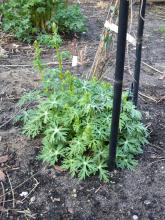
Next picture presents a Brunnera 'Jack Frost' which brings a little light into my shadow areas
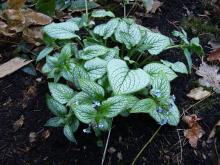
Maybe this plant takes attention to you profis- Caulophyllum thalictroides ( nice leaves ,pretty bloom and a nice built)
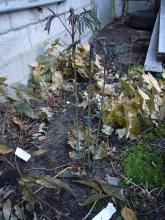
I enjoy having this plant!!!
And for an end today , here comes Dicentra cucullaria in bloom
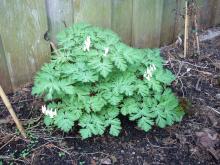
Have a nice eastern (even if you don´t want to have a greedy rabbit in your garden :-) )
Trond Hoy
Re: Miscellaneous Woodlanders
Thu, 04/05/2012 - 10:22pmHello Ernie! Neither of my Red Wines reaches the sky! One gets munched by slugs and the other gets down my throat ;)
Nice selection of plants!
Have a nice Easter :)
ErnieC123 (not verified)
Re: Miscellaneous Woodlanders
Fri, 04/06/2012 - 1:40pmSo here some more plants i like
This is a Cimicifuga ramosa 'Atropurpurea'
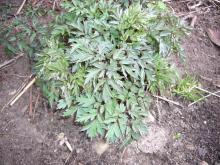
Paris quadrifolia
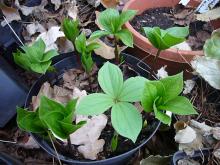
Polygonatum falcatum
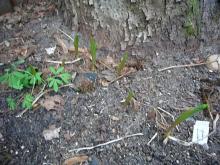
Polygonatum humilis 'Nanum'
Polygonatum humilis
Polygonatum odoratum
Polygonatum x 'Weihenstephan'
I hope you like some of it ...
Richard T. Rodich
Re: Miscellaneous Woodlanders
Fri, 04/06/2012 - 6:01pmIsn't it nice how even little bits of growth can bring such joy...
Richard T. Rodich
Re: Miscellaneous Woodlanders
Fri, 04/06/2012 - 8:03pmI mentioned elsewhere how it seems this season is giving deeper colors, despite the warm weather. I have never seen the Cardamine laciniata with such deep lavender buds. These are in the wild, near my house:
Open woods are not common in Minnesota. Usually there is a lot of native underbrush. The cardamine seems to thrive in these areas that get too dry to support summer growth.
Trond Hoy
Re: Miscellaneous Woodlanders
Fri, 04/06/2012 - 11:56pmRick, I love that! ;)
Richard T. Rodich
Re: Miscellaneous Woodlanders
Sat, 04/07/2012 - 7:43pmDicentra cucullaria, in the wild not far from my house. I have "decided" this is another species that can sit "dormant" for multiple years without showing above ground. I know this area quite well, and this spring I am seeing at least four times as many plants as I have ever seen there before. Plants are larger than ever before, too, with flower scapes up to 6 inches(!)
Possible reasons:
--- the ridiculously warmer than normal winter
--- the exceptionally dry late summer through winter
--- perfectly timed rainfall last spring during the Dutchman's Breeches' growth cycle
It's weird that our dry spring has not seemed to affect the plants...
A pinkish form:
cohan (not verified)
Re: Miscellaneous Woodlanders
Sat, 04/07/2012 - 8:52pmCool plant! I'm interested in the woodland Cardamines I've seen on the lists, nothing like that here!
Of course the Dicentra is exquisite, high on my endless list ;D
Mark McDonough
Re: Miscellaneous Woodlanders
Sat, 04/21/2012 - 7:37pmCatching up to these topics :)
Ernie, you obviously like Polygonatum; I'm tempted to grow more of them, I only grow 3-4 types, but it is a most interesting genus. I do have P. humile, although have not heard of a 'Nanum' form, is it really smaller than regular P. humile. Must add P. falcatum to my garden too, Plant Delight's Nursery has some wonderful selections.
Rick, the Cardamine laciniata is most pleasing, seems like there are a number of very worthwhile Cardamine/Dentaria species to try in the woodland garden. Have you tried growing this in your garden.
Following up on my imposter Asarum caudatum alba posting (plant was actually A. canadense), I had bought the plant a second time and planted it out a couple years ago, the label got lost, then couldn't remember where I had planted it. :rolleyes: Well, today I found it, here's two photos of Asarum caudatum forma alba; an overall shot of the handsome foliage, and lots of creamy-greenish blooms (instead of maroon). Don't you just love those sorts of garden surprises!
Richard T. Rodich
Re: Miscellaneous Woodlanders
Sat, 04/21/2012 - 9:14pmThe rediscovery of something thought lost or forgotten is definitely uplifting. It happens "often" in my potted menagerie. Most recently for me, Lilium rhodopaeum, that I had started from seed and couldn't find last fall when I had wanted to give it special care for the winter. I found it this spring as it started its second year of leaf growth. 8)
When I first found Cardamine laciniata, perhaps ten years ago, I did pot up a few, thinking perhaps I would plant it in the garden. But change my mind mostly because it flowers very sparsely. The pots were donated to the Chapter's plant sale. More recently, though, I am changing my mind, only because its life above ground seems to be so fleeting, that even its interesting greenery would be welcome at a time when there is plenty of room in the garden. However, it may decide, like Thalictrum thalictroides does, to extend its stay at the surface in garden conditions. I guess I will only know if I try it.
to give an idea of the paucity of bloom: in the largest carpet in the pic below (in the wild), there were 16 blooming spikes.
Pages