More pictures from Entiat Ridge: a couple of penstemons (P. fruticosus, P. pruinosus), Calochortus lyallii, Castillejas mixed with Penstemon fruticosus and ceanothus.
Wonderful pictures, Claire. I'd love to see Lewisia tweedyi in the wild. There seems to be a lot of variation. I can't keep up with the name changes either.
I recall growing this one, Tim, and growing it in the sand bed where it did well. The one I grew was unfortunately much paler in flower, and as a result, rather insignificant. Glad to see one with better color.
I grew Teucrium aroanium decades ago in my Seattle area garden, it was charming plant, even is rather pale flowered, almost a grey-lavender with deeper veining. Googling around, I see some photos labeled as this species, with deep color flowers, but with much more linear green leaves, so probably some misidentified images out there. Here's a few images from Denver Botanic Garden, click the small "images" link. http://navigate.botanicgardens.org/weboi/oecgi2.exe/INET_ECM_DispPl?NAME...
Thanks fpr the link, Mark. That looks like what I grew. Good foliage but the flowers were such a delicate and pale color, it didn't make a "statement" in bloom.
This is not in the wild, but a wild corner of my garden! I grow 4 different types of Enkianthus, this is the showiest, Enkianthus campanulatus var palibinii. Always a reliable bloomer.
This is not in the wild, but a wild corner of my garden! I grow 4 different types of Enkianthus, this is the showiest, Enkianthus campanulatus var palibinii. Always a reliable bloomer.
[/quote]
Very pretty. Are the flowers stinky; whenever I've encountered Enkianthus in a botanic garden and given the flowers a whiff, I think "oh my, them's some stinky flowers".
;-)
Mark, I have not noticed any bad smell! On the contrary I can discern a weak honey fragrance and the bumblebees are very fond of them.
Although this shrub doesn't stink either (not to my nose anyway) it has the bad habit of spreading vigorously by runners: Neillia thibetica. It is a nice filler in a shrubbery though and freely flowering in June.
Another shub in flower now is Rosa roxburghii f normalis - weeks later than most years.
I've seen Neillia thibetica growing well at an arboterum (or sorts), the famous Mt. Auburn Cemetery near Boston, Massachusetts, so apparently it's hardy here.
Heading to the mountains on a daytrip last week, these are near home... about 7:30am, misty morning looking at the hills just north of us, then a hazy view on the main highway looking west to the mountains..
Erigeron caespitosum (I think- I id'd this before I had the Flora, haven't gone back to really key it out) with seed capsules of Linum lewisii in the montane zone, near Abraham Lake, Alberta, Sept 4
Trond- not all of the roads are so straight, and of course in the mountains it is not so easy, but we do have some places where the roads are on a nice easy grid.
Lori- I could easily be wrong, but this photo is not that representative, just a pretty shot not a botanical one, I'll post some others. Whatever it is, it is very common in these dry montane (if I'm using the term right) areas in the Kootenay Plains, and based on shape and greyish glaucous foliage and small stature (maybe 30cm tall at most, generally low and sprawling, at least in dry spots) it seems like a good fit for Erigeron caespitosus. I haven't recently gone through all the Erigeron possibilities, but I was going through the Asters yesterday looking for something else, and I did not see any small glaucous white Asters (of course, could have missed it).These flowers were all pretty much white, but I've seen them in the past with a hint of lavender- might be about temperature as well. In the photo this sort of resembles our white marsh asters (maybe borealis or similar) but the plants are not at all alike.
Here are a couple more views- first with an Artemisia, maybe frigida; Second with Heterotheca villosa etc, and third a closer view; no really good shots of foliage, but you can kind of see it...
RE: size of high altitude vs 'lowland' plants; here is a photo of mine in July 2010, (planted in the early 80's, in my original rock garden, and one of the few things that survived more than 20 years of inattention, before I rebuilt the whole rock garden around it and moved the plant over to the edge of the garden. I actually don't remmber exactly where I got the original plant in my teen years, but somewhere in the foothills or mountains, in Alberta or B.C...lol More to the point, it has the same size more or less as the plants that grow wild around here, I'm guessing near 2 feet tall, but I'll take a closer look next time I'm out.. It does bloom earlier than the wild plants- I had photos of a wild one in bud just a few days before these shots were taken.
eFlora of North America mentions a size range of 2-8dm - I guess those around here are in the middle of that range, up to maybe 60cm...
I actually measured yesterday, and in fact this year's dried stalks on that plant were nearly 70cm tall. I agree, Lori, one of my favourite natives, and looking almost like miniature yuccas in flower. The glaucous foliage is a really nice feature too.
the 'goblet' form seems nice for the Colchicum- a lot of them just seem too floppy and wishy washy to me- but that might just be in photos, I haven't seen them in person..
They can flop in rainy weather, but we've had a long string of the most perfect sunny autumn days.
Flowering nicely now is Vernonia lettermannii. I had to protect this plant, it is rabbit caviar and the last two years it was munched repeatedly, so it is protected by a wire cage this year. The flowering stems are just a smidgen over 2' and with very fine dark green foliage, what a fine plant.
From Arkansas and Oklahoma, but very hardy. It is available in the USA, Plant Delights Nursery carries this gem.
It looks like sand, but then how could it have such stronge "topography"?
[/quote]
If I may offer an opinion, the erosional pattern (forming vertical rills) is characteristic of silt, which in that area, would most likely have been deposited by glacial processes.
Fermi, nice spring flowers- are you getting any moisture to go with the spring bluster?
Rick- as Lori pointed out, that soil is very fine material, and usually very dry, though I suppose it should hold moisture fairly well when it does get wet. Since these dry sections don't get much snow cover, the wettest time is probably early to mid-summer, like here, and I haven't been there much at that time..
Somewhere I had got the idea that some of these soils were loess, deposited by wind (easy to believe when you are there- always windy and nearly always dry), but I can't remember where I got that idea, so I did just a tiny bit of searching.. Found this reference on soils of that region, for anyone really keen on the subject..lol
This slightly paraphrased info is from there- land unit 1a, includind the Kootenay Plains;surface material is a relatively thick (16-40inches) deposit of fine sand and silt of alluvial or aeolian origin. (i.e. from flooding and/or wind; I'd have to read more carefully to see if they distinguish between flooding from glacial melting and other river flooding, but they must be closely related in this area, which they mention having been glaciated twice. This site is more or less valley bottom, and while it is hard to imagine the existing river reaching this high, no doubt much larger watercourses with less deeply eroded channels passed through here in post/glacial times).
Elsewhere in the document, they do mention that soils in the area in general are 'developed at least partially from a 4-6 inch silty aeolian mantle'. They also mention the 'high volcanic ash content in the almost continuous layer of loess...' Hadn't thought of that component... wonder how far that ash had to travel?
For those still interested, and not already knowing this, here is a brief definition of loess:
http://en.wikipedia.org/wiki/Loess
and here is a discussin of aeolian processes:
http://en.wikipedia.org/wiki/Aeolian_processes
Thanks for the question, Rick- made me dig a bit more!
Thanks for the info, Cohan. It's just hard for me to imagine that "crevices" in fine soil could remain with such steep inclines. I would have though that earth would be quite unstable and vulnerable to erosions of all sorts.
Even after heavy rains the last couple days, these two alliums look terrific, combined two images into one. Allium thunbergii - robust white form on the left, stellatum (from Carroll Co, Arkansas) on the right. Photos taken a couple days ago before rains, but with new sunshine today, they look pretty much the same, although there might be a different bee visiting ;-)

Comments
Claire Cockcroft
Re: Image of the day - 2013
Fri, 06/07/2013 - 9:36amWe also found Lewisia rediviva in its white form at the top of Entiat Ridge.
Claire Cockcroft
Re: Image of the day - 2013
Fri, 06/07/2013 - 9:39amMore pictures from Entiat Ridge: a couple of penstemons (P. fruticosus, P. pruinosus), Calochortus lyallii, Castillejas mixed with Penstemon fruticosus and ceanothus.
Longma (not verified)
Re: Image of the day - 2013
Fri, 06/07/2013 - 11:48amAll are amazing plants Claire. :o Very special
Any chance of a closer pic of the Ceanothus sp. please? One of our favorites ;D
Richard T. Rodich
Re: Image of the day - 2013
Fri, 06/07/2013 - 1:22pmWe learn so much from photos in the wild, Claire. Thank you so much!
So many good subjects! Love them all!
Anne Spiegel
Re: Image of the day - 2013
Fri, 06/07/2013 - 8:47pmWonderful pictures, Claire. I'd love to see Lewisia tweedyi in the wild. There seems to be a lot of variation. I can't keep up with the name changes either.
Claire Cockcroft
Re: Image of the day - 2013
Fri, 06/07/2013 - 10:29pmCeanothus velutinus
Longma (not verified)
Re: Image of the day - 2013
Sat, 06/08/2013 - 2:24amThanks Claire, :)
Cliff Booker
Re: Image of the day - 2013
Sat, 06/08/2013 - 4:50amMany of us have no intention of keeping up with these infernal name changes ... wonderful images, Claire - many thanks for posting.
Claire Cockcroft
Re: Image of the day - 2013
Sat, 06/08/2013 - 10:10amJust one more plant -- a fairly rare endemic, Valeriana columbiana.
Trond Hoy
Re: Image of the day - 2013
Sat, 06/08/2013 - 11:45amVery nice Claire! I love them all! I wouldn't mind replacing the weed Valeriana sambucifolia I have in my garden with V columbiana!
Tim Ingram (not verified)
Re: Image of the day - 2013
Sun, 06/09/2013 - 11:13amThis has to be the most beautiful of teucriums in flower - T. aroanum.
Richard T. Rodich
Re: Image of the day - 2013
Sun, 06/09/2013 - 1:11pmAgreed, Tim. Pretty spectacular close up.
What size are we talking about here - leaves and flowers?
Tim Ingram (not verified)
Re: Image of the day - 2013
Mon, 06/10/2013 - 1:51amOnly a couple of inches high Rick, but the plant spreads over about two feet in deep sand.
Anne Spiegel
Re: Image of the day - 2013
Mon, 06/10/2013 - 6:52amI recall growing this one, Tim, and growing it in the sand bed where it did well. The one I grew was unfortunately much paler in flower, and as a result, rather insignificant. Glad to see one with better color.
deesen (not verified)
Re: Image of the day - 2013
Mon, 06/10/2013 - 11:41amJust been doing a bit of research to try to source a plant and find that the sub-species name is actually aroanium.
For anyone in the UK Rob Potterton stocks it.
Mark McDonough
Re: Image of the day - 2013
Mon, 06/10/2013 - 1:01pmI grew Teucrium aroanium decades ago in my Seattle area garden, it was charming plant, even is rather pale flowered, almost a grey-lavender with deeper veining. Googling around, I see some photos labeled as this species, with deep color flowers, but with much more linear green leaves, so probably some misidentified images out there. Here's a few images from Denver Botanic Garden, click the small "images" link.
http://navigate.botanicgardens.org/weboi/oecgi2.exe/INET_ECM_DispPl?NAME...
Anne Spiegel
Re: Image of the day - 2013
Tue, 06/11/2013 - 3:46amThanks fpr the link, Mark. That looks like what I grew. Good foliage but the flowers were such a delicate and pale color, it didn't make a "statement" in bloom.
Trond Hoy
This is not in the wild, but
Wed, 06/19/2013 - 1:58pmThis is not in the wild, but a wild corner of my garden! I grow 4 different types of Enkianthus, this is the showiest, Enkianthus campanulatus var palibinii. Always a reliable bloomer.
Mark McDonough
Hoy wrote:
Wed, 06/19/2013 - 6:51pm[quote=Hoy]
This is not in the wild, but a wild corner of my garden! I grow 4 different types of Enkianthus, this is the showiest, Enkianthus campanulatus var palibinii. Always a reliable bloomer.
[/quote]
Very pretty. Are the flowers stinky; whenever I've encountered Enkianthus in a botanic garden and given the flowers a whiff, I think "oh my, them's some stinky flowers".
;-)
Trond Hoy
Mark, I have not noticed any
Sun, 06/23/2013 - 5:03amMark, I have not noticed any bad smell! On the contrary I can discern a weak honey fragrance and the bumblebees are very fond of them.
Although this shrub doesn't stink either (not to my nose anyway) it has the bad habit of spreading vigorously by runners: Neillia thibetica. It is a nice filler in a shrubbery though and freely flowering in June.
Another shub in flower now is Rosa roxburghii f normalis - weeks later than most years.
Mark McDonough
I've seen Neillia thibetica
Sun, 06/23/2013 - 6:55amI've seen Neillia thibetica growing well at an arboterum (or sorts), the famous Mt. Auburn Cemetery near Boston, Massachusetts, so apparently it's hardy here.
Toole (not verified)
Cyclamen coum close up .
Sun, 07/07/2013 - 1:57amCyclamen coum close up .
Cheers Dave.
Trond Hoy
Toole wrote:
Tue, 07/09/2013 - 1:29pm[quote=Toole]
Cyclamen coum close up .
Cheers Dave.
[/quote]
Nice! My cyclamens suffered badly last winter. Although most survived the flowering was sparse.
Trond Hoy
Where you find Salix
Thu, 07/11/2013 - 2:36pmWhere you find Salix myrsinites you often find other exciting plants too!
Lori S. (not verified)
A photo from another place
Thu, 08/08/2013 - 3:53pmA photo from another place with lots of exciting plants, Erigeron aureus:
Trond Hoy
Unfortunately we have no all
Sat, 08/10/2013 - 11:35amUnfortunately we have no all yellow fleabanes here only some with yellow disc florets.
Lori S. (not verified)
Rhodiola integrifolia:
Sat, 09/07/2013 - 7:49pmRhodiola integrifolia:
Trond Hoy
Nice, Lori!
Mon, 09/09/2013 - 2:50pmNice, Lori!
cohan (not verified)
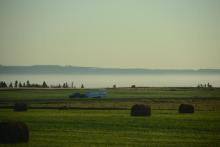
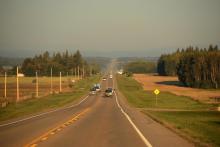
Heading to the mountains on a
Wed, 09/11/2013 - 11:25amHeading to the mountains on a daytrip last week, these are near home... about 7:30am, misty morning looking at the hills just north of us, then a hazy view on the main highway looking west to the mountains..
.
cohan (not verified)
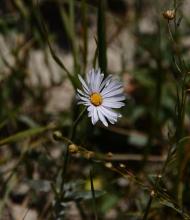
Erigeron caespitosum (I think
Fri, 09/13/2013 - 10:46amErigeron caespitosum (I think- I id'd this before I had the Flora, haven't gone back to really key it out) with seed capsules of Linum lewisii in the montane zone, near Abraham Lake, Alberta, Sept 4
.
Trond Hoy
Looks like a gardenworthy
Sat, 09/14/2013 - 12:56pmLooks like a gardenworthy plant whatever the name is!
Seems easy to make roads in Alberta!
Lori S. (not verified)
Given the very late bloom and
Sat, 09/14/2013 - 1:47pmGiven the very late bloom and the general look of it, I wonder if it might not be an Aster?
Lori S. (not verified)
Just an interesting scene
Sat, 09/14/2013 - 2:30pmJust an interesting scene with colourful rocks:
cohan (not verified)
Trond- not all of the roads
Sat, 09/14/2013 - 2:31pmTrond- not all of the roads are so straight, and of course in the mountains it is not so easy, but we do have some places where the roads are on a nice easy grid.
Lori- I could easily be wrong, but this photo is not that representative, just a pretty shot not a botanical one, I'll post some others. Whatever it is, it is very common in these dry montane (if I'm using the term right) areas in the Kootenay Plains, and based on shape and greyish glaucous foliage and small stature (maybe 30cm tall at most, generally low and sprawling, at least in dry spots) it seems like a good fit for Erigeron caespitosus. I haven't recently gone through all the Erigeron possibilities, but I was going through the Asters yesterday looking for something else, and I did not see any small glaucous white Asters (of course, could have missed it).These flowers were all pretty much white, but I've seen them in the past with a hint of lavender- might be about temperature as well. In the photo this sort of resembles our white marsh asters (maybe borealis or similar) but the plants are not at all alike.
Here are a couple more views- first with an Artemisia, maybe frigida; Second with Heterotheca villosa etc, and third a closer view; no really good shots of foliage, but you can kind of see it...
cohan (not verified)
Lori and I were discussing
Sun, 09/22/2013 - 4:04pmLori and I were discussing Zigadenus elegans in another thread:
https://www.nargs.org/forum/mt-hector-banff-np-august-16-2013?page=1#comment-24182
RE: size of high altitude vs 'lowland' plants; here is a photo of mine in July 2010, (planted in the early 80's, in my original rock garden, and one of the few things that survived more than 20 years of inattention, before I rebuilt the whole rock garden around it and moved the plant over to the edge of the garden. I actually don't remmber exactly where I got the original plant in my teen years, but somewhere in the foothills or mountains, in Alberta or B.C...lol More to the point, it has the same size more or less as the plants that grow wild around here, I'm guessing near 2 feet tall, but I'll take a closer look next time I'm out.. It does bloom earlier than the wild plants- I had photos of a wild one in bud just a few days before these shots were taken.
eFlora of North America mentions a size range of 2-8dm - I guess those around here are in the middle of that range, up to maybe 60cm...
Lori S. (not verified)
Beautiful! Alpine form or
Sun, 09/22/2013 - 4:25pmBeautiful! Alpine form or not, I think they are spectacular!
Richard T. Rodich
I would estimate the wild
Sun, 09/22/2013 - 6:24pmI would estimate the wild Zigadenus elegans in western Minnesota prairies to be about 60cm, also. Elevation approximately 1100ft (307m).
cohan (not verified)
I actually measured yesterday
Mon, 09/23/2013 - 11:24amI actually measured yesterday, and in fact this year's dried stalks on that plant were nearly 70cm tall. I agree, Lori, one of my favourite natives, and looking almost like miniature yuccas in flower. The glaucous foliage is a really nice feature too.
Mark McDonough
Colchicum 'Pink Goblet'
Sat, 09/28/2013 - 8:24amColchicum 'Pink Goblet' opened today, after 6 years, still just a single bulb, a single flower, lovely nonetheless.
By the way Cohan, love those Zigadenus of yours
Richard T. Rodich
It seems very strong and
Sat, 09/28/2013 - 9:19amIt seems very strong and stout for a Colchicum, Mark.
I expect it holds up better in rainy weather?
cohan (not verified)
Thanks, Mark,
Sun, 09/29/2013 - 11:36amThanks, Mark,
the 'goblet' form seems nice for the Colchicum- a lot of them just seem too floppy and wishy washy to me- but that might just be in photos, I haven't seen them in person..
Mark McDonough
They can flop in rainy
Sun, 09/29/2013 - 11:52amThey can flop in rainy weather, but we've had a long string of the most perfect sunny autumn days.
Flowering nicely now is Vernonia lettermannii. I had to protect this plant, it is rabbit caviar and the last two years it was munched repeatedly, so it is protected by a wire cage this year. The flowering stems are just a smidgen over 2' and with very fine dark green foliage, what a fine plant.
From Arkansas and Oklahoma, but very hardy. It is available in the USA, Plant Delights Nursery carries this gem.
cohan (not verified)
Looks like a good one!-nice
Tue, 10/01/2013 - 10:37amLooks like a good one!-nice colour and foliage. I haven't tried anything in this genus yet..
cohan (not verified)
A couple of views of Physaria
Tue, 10/01/2013 - 11:23amA couple of views of Physaria didymocarpa with Artemisia- probably A frigida. In the Kootenay Plains in Western Alberta, September 04 this year.
Richard T. Rodich
Cohan, what is the substrate
Tue, 10/01/2013 - 4:25pmCohan, what is the substrate they are growing in?
It looks like sand, but then how could it have such stronge "topography"?
Fermi de Sousa
It's a cold, bleak and windy
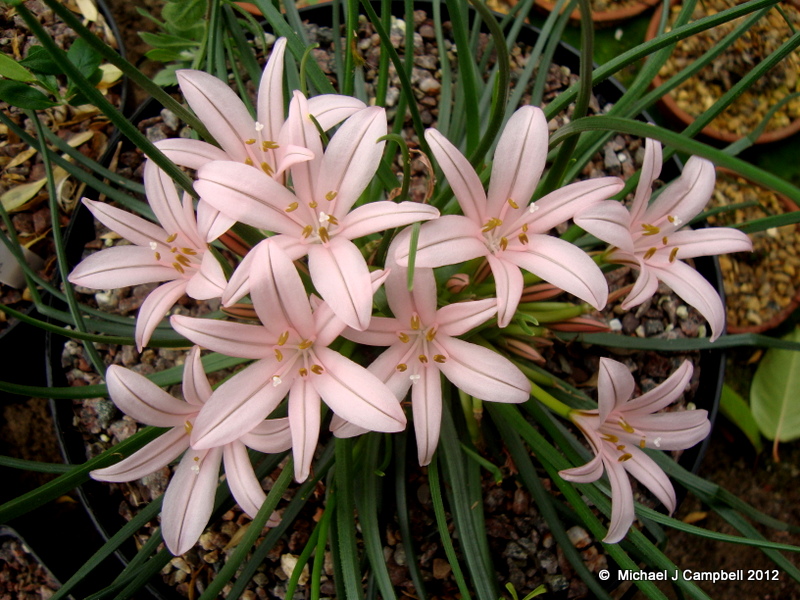
Wed, 10/02/2013 - 12:45amIt's a cold, bleak and windy spring day here but i managed to capture these images before leaving for work this morning.
Grown from seed from NARGS Seedex 2006 as Leucocoryne vittata, but probably a hybrid as the striping isn't as vivid as it should be,
cheers
fermi
Lori S. (not verified)
RickR wrote:
Fri, 10/04/2013 - 10:23am[quote=RickR]
Cohan, what is the substrate they are growing in?
It looks like sand, but then how could it have such stronge "topography"?
[/quote]
If I may offer an opinion, the erosional pattern (forming vertical rills) is characteristic of silt, which in that area, would most likely have been deposited by glacial processes.
cohan (not verified)
Sorry, I missed the replies
Mon, 10/07/2013 - 11:37pmSorry, I missed the replies here..
Fermi, nice spring flowers- are you getting any moisture to go with the spring bluster?
Rick- as Lori pointed out, that soil is very fine material, and usually very dry, though I suppose it should hold moisture fairly well when it does get wet. Since these dry sections don't get much snow cover, the wettest time is probably early to mid-summer, like here, and I haven't been there much at that time..
Somewhere I had got the idea that some of these soils were loess, deposited by wind (easy to believe when you are there- always windy and nearly always dry), but I can't remember where I got that idea, so I did just a tiny bit of searching.. Found this reference on soils of that region, for anyone really keen on the subject..lol
http://sis.agr.gc.ca/cansis/publications/surveys/ab/ab31a/ab31a_report.pdf
This slightly paraphrased info is from there- land unit 1a, includind the Kootenay Plains;surface material is a relatively thick (16-40inches) deposit of fine sand and silt of alluvial or aeolian origin. (i.e. from flooding and/or wind; I'd have to read more carefully to see if they distinguish between flooding from glacial melting and other river flooding, but they must be closely related in this area, which they mention having been glaciated twice. This site is more or less valley bottom, and while it is hard to imagine the existing river reaching this high, no doubt much larger watercourses with less deeply eroded channels passed through here in post/glacial times).
Elsewhere in the document, they do mention that soils in the area in general are 'developed at least partially from a 4-6 inch silty aeolian mantle'. They also mention the 'high volcanic ash content in the almost continuous layer of loess...' Hadn't thought of that component... wonder how far that ash had to travel?
For those still interested, and not already knowing this, here is a brief definition of loess:
http://en.wikipedia.org/wiki/Loess
and here is a discussin of aeolian processes:
http://en.wikipedia.org/wiki/Aeolian_processes
Thanks for the question, Rick- made me dig a bit more!
Richard T. Rodich
Thanks for the info, Cohan.
Tue, 10/08/2013 - 6:43amThanks for the info, Cohan. It's just hard for me to imagine that "crevices" in fine soil could remain with such steep inclines. I would have though that earth would be quite unstable and vulnerable to erosions of all sorts.
Mark McDonough
Even after heavy rains the
Tue, 10/08/2013 - 8:29amEven after heavy rains the last couple days, these two alliums look terrific, combined two images into one. Allium thunbergii - robust white form on the left, stellatum (from Carroll Co, Arkansas) on the right. Photos taken a couple days ago before rains, but with new sunshine today, they look pretty much the same, although there might be a different bee visiting ;-)
Pages