
NARGS member Tim Ingram mentioned his interest in Lomatium, a North American genus of umbellifers.
See: http://nargs.org/smf/index.php?topic=662.0;topicseen
The plant family Apiaceae is huge, with 347 plant genera, with many species of interest for rock gardens, so let me start up this topic with links to another North American genus, Cymopterus.
I share an enthusiasm for rock-garden-sized Apiaceae, and have long admired both Lomatium and Cymopteris when I've seen them both in photos and during my Western American travels years ago... some are truly superb. Here are some selected links to photos of Western American species of Cymopterus.
fruiting heads on Cymopterus cinerarius
http://calphotos.berkeley.edu/cgi/img_query?enlarge=0000+0000+0908+0697
flowering Cymopterus cinerarius, fantastic foliage
http://calphotos.berkeley.edu/cgi/img_query?enlarge=0000+0000+0908+0696
Cymopterus gilmanii
http://calphotos.berkeley.edu/cgi/img_query?enlarge=0000+0000+1210+1537
Cymopteris globosus
http://calphotos.berkeley.edu/cgi/img_query?enlarge=0000+0000+0306+0913
Cymopterus multinervatus
http://calphotos.berkeley.edu/cgi/img_query?enlarge=0000+0000+1004+0875
Some Apiaceae that I've seen photos of, in places such as Kazakhstan, and in New Zealand and Australia, show these are fantastic foliage plants, with strangely beautiful flowers.
Comments
Trond Hoy
Re: amazing Apiaceae (the umbellifers)
Mon, 05/02/2011 - 1:11pmReally remarkable plants, Mark! I didn't know such treasures existed. Now you have given me a problem - shall I ignore them or look out for seed?! And I have several years to retirement. . . .
cohan (not verified)
Re: amazing Apiaceae (the umbellifers)
Wed, 05/11/2011 - 12:00pmI was very pleased to see seedlings of Cymopterus --I think its planosus, but would have to check--they were sown in spring last year, early enough for some cold strat, but maybe not enough-- I got one seedling, which I think didn't survive, so I thought that seed was done for, and didn't even put the pot with others that were overwintering outside.. well, there are at least several coming up now :)
John P. Weiser
Re: amazing Apiaceae (the umbellifers)
Wed, 05/11/2011 - 1:52pmI have encountered Cymopterus globosus in it's native haunts. The flowers have rather thick petals very densly packed. The immature fruiting bodies feel like dense, bumpy rubber balls.
Trond Hoy
Re: amazing Apiaceae (the umbellifers)
Wed, 05/11/2011 - 2:13pmJohn, what do you call such a plant? Showy? Beautiful? Spectacular? Anyway it is a remarkable plant :)
Tim Ingram (not verified)
Re: amazing Apiaceae (the umbellifers)
Wed, 05/11/2011 - 2:29pmMy interest in these plants is being rapidly reignited. Thanks for the images and websites. I have also grown Shoshonea in the past, but didn't look after it well enough. There are some wonderful Mediterranean species adapted to similar but not so winter cold conditions - Athamanta turbith is probably my favourite. Another, Thapsia maxima, has large broad pleated leaves and a football size head of yellow flowers only to about a metre high. It is an extraordinary and fascinating family once you get into it!
cohan (not verified)
Re: amazing Apiaceae (the umbellifers)
Wed, 05/11/2011 - 4:09pmseriously cool, and at a glance, un-Apiaceae looking!
Tim, agreed, very cool family :)
There is another I've been looking at, I think a Lomatium, which is a metre or so tall, plus Anthriscus and others, and I have Heracleum growing naturally here--so they do have lots of appeal/potential besides the regular rock garden :)
John P. Weiser
Re: amazing Apiaceae (the umbellifers)
Wed, 05/11/2011 - 4:15pmStrangely, remarkably, cool??? Comes to mind.
Lori S. (not verified)
Re: amazing Apiaceae (the umbellifers)
Wed, 05/11/2011 - 4:19pmFascinating plants being shown!
I can verify that Athamanta turbith ssp. haynaldii is reliably hardy in this zone 3 area, even without snow cover. I believe Rick grows it in zone 4(?) too.
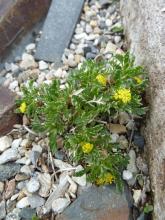
Shoshonea pulvinata wintered over last year here in a trough... no real record yet, but so far, so good!
John P. Weiser
Re: amazing Apiaceae (the umbellifers)
Wed, 05/11/2011 - 5:08pmI currently only grow only two Lomatiums but there are many around. I like the short matted types with gray leaves.
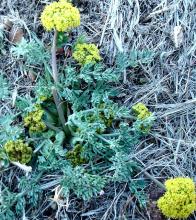
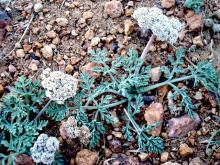
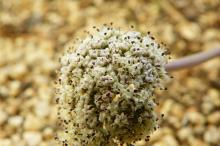
Lomatium austiniae (syn. L. plummerae)
Lomatium nevadense var nevadense. The flowers always look like they have been peppered. It's the dark purple staymens that give this effect.
cohan (not verified)
Re: amazing Apiaceae (the umbellifers)
Wed, 05/11/2011 - 6:45pmBoth cool!
Tim Ingram (not verified)
Re: amazing Apiaceae (the umbellifers)
Sun, 05/15/2011 - 9:27amA few umbels flowering in our garden at the moment. Athamanta turbith grows on a raised bed along with Lomatium columbianum, and still stands as my favourite of the family in the garden. I think of it as like a symphony of green and white; simple but very beautiful. Later the small seeds are silvery-grey and attractive in themselves. I was introduced to it at the Chelsea Physic Garden in London, where I often went to sell plants.
The second, Laserpitium siler, came on the recommendation of a Landscape Architect friend from Belgium, who used it in his planting schemes. It is a tough plant, used to the severe cold of northern and central Europe, slow to establish but very perennial, and with rather distinctive open heads of flowers and greyish foliage.
Thirdly, probably one of the best plant introductions of recent years, Anthriscus sylvestris 'Ravenswing', the black-leaved cow parsley (or Queen Anne's Lace). This self-sows under the apple trees with others such as Aquilegias and Brunnera, and they make a fine picture at the moment, even in one of the driest springs we have had for years.
cohan (not verified)
Re: amazing Apiaceae (the umbellifers)
Sun, 05/15/2011 - 11:29amAll nice, the last combination especially :)
I have some Raven's Wing seedlings, looking forward to seeing them grow up :) You don't find the Brunnera too vigorous in its selfsowing? a gardener in Manitoba was recently telling a tale of woe regarding all-green leafed seedlings of an expired B 'Jack Frost'....
Lori S. (not verified)
Re: amazing Apiaceae (the umbellifers)
Sun, 05/15/2011 - 11:55amAmazing scenes, Tim! You have a fabulous garden! :o
Mmmm, Lomatium - another genus to try! Thanks for opening our eyes to that one, John!
Cohan, Brunnera macrophylla self sows in moderation here... enough to start giving some seedlings away after a few years. It's hard to imagine that anyone would find its relatively modest habit excessive though (if I'm interpreting your comment correctly), in comparison to the truly rampant seeding of so many other species!
cohan (not verified)
Re: amazing Apiaceae (the umbellifers)
Sun, 05/15/2011 - 2:35pmGood to know, Lori, I haven't grown them, but sort of admired some of the variegated types, at least;
-- the person in Manitoba was giving a warning (coldzone yahoo group, mostly western Canadian members) that this plant must be deadheaded if you were going to grow it at all, or planted by itself far from anything else! I think part of the problem was that the variegated parent died, leaving only green seedlings, and they were coming up in the middle of some more valued plants...lol
Lori S. (not verified)
Re: amazing Apiaceae (the umbellifers)
Sun, 05/15/2011 - 3:16pmWell, that seems like a very extreme view, based on what I've seen, and on never having heard a similar complaint. ???
cohan (not verified)
Re: amazing Apiaceae (the umbellifers)
Sun, 05/15/2011 - 3:36pmThat's good, Lori, since I was kind of thinking about it--if I run across a cheap plant somewhere..lol
Lori S. (not verified)
Re: amazing Apiaceae (the umbellifers)
Sun, 05/15/2011 - 8:02pmOff topic but...
Cohan, if you ever have a reason to visit Calgary, you should let me know in advance... Having a mature perennial garden (that is in a constant state of flux due to needing more alpine beds!), I have many plants that I'd be happy to share! I tend not to divide many things, but I have lots of seedlings, offsets, etc., often blooming-size plants, that I pot up to give away.
cohan (not verified)
Re: amazing Apiaceae (the umbellifers)
Sun, 05/15/2011 - 11:20pmThanks, Lori, I'll let you know if we are going that way and my driver is amenable to a stop...lol
Tim Ingram (not verified)
Re: amazing Apiaceae (the umbellifers)
Mon, 05/16/2011 - 12:51amRe. Brunnera. With me this self-sows hugely and seems to grow as well in full sun as shade. Because I have so many seedlings I have decided to use it as ground cover under our rows of fruit trees - but we have a big garden of around 1 and 1/2 acres.
I neglected to say that Anthriscus sylvestris 'Ravenswing' was discovered and introduced by Prof. John Richards of Primula fame. If a nurseryman had found it they could have made a fortune!
Lori S. (not verified)
Re: amazing Apiaceae (the umbellifers)
Mon, 05/16/2011 - 8:05pmWell, live and learn! :)
Here's Shoshonea pulvinata in a trough, wintered over from last year - a tiny thing at present. I've only seen it in photos... I expect the flower stems will elongate, unless this is some particularly dwarfish form?? I got it from Beaver Creek, at last year's CRAGS spring plant sale.
cohan (not verified)
Re: amazing Apiaceae (the umbellifers)
Mon, 05/16/2011 - 9:50pmCute!
Trond Hoy
Re: amazing Apiaceae (the umbellifers)
Mon, 05/16/2011 - 11:54pmI would hardly guessed that this is a Apiaceae!
Here Brunnera makes runners and selfsow but not much.
Stephen Barstow
Re: amazing Apiaceae (the umbellifers)
Tue, 05/17/2011 - 6:10amA selection of my umbellifers:
1. Lomatium nudicaule: of the 10 or so I’ve tried, 5 have survived and this is the easiest and the only one to have flowered and seeded itself.
2). L. californicum (survived one winter and then died in the subsequent more severe winter)
3-6. I’m not sure which 2 species these are, but they’ve proven reliably hardy here having survived 4 or 5 winters. Just contrast the leaves of these with nudicaule … The possibilities are L. dissectum, utriculatum and triternatum (there are two pictures of each). Any suggestions?
7. Lovage, Levisticum officinale is one of the grandest umbellifers and looks particularly smart when blanched in springtime (it then doesn’t taste unlike celery and much milder than unblanched)
8. Laser trilobum (I also grow Laserpitium siler and latifolium, all 3 reliably hardy here, down to about -23C)
9. Angelica keiskei – surprised me to see that the sap is yellow!
10. Angelica sylvestris “Vicar’s Mead” is also a nice foliage plant (like the Anthriscus) – here with Trillium camtschacensis and Hylomecon japonicum
Lori S. (not verified)
Re: amazing Apiaceae (the umbellifers)
Tue, 05/17/2011 - 8:30pmVery nice, Stephen. Ahh, I was thinking about what to plant in a big area where we removed a huge old lilac last fall... Angelica would be suitably statuesque! Lots of great ideas in your photos... lovage is worth growing for its appearance alone (aside from using the leaves for flavouring) - I should get myself another one.
Here are a couple more fairly interesting umbellifers:
Peucedanum ostruthium 'Daphnis' - I don't have many variegated plants but I am fond of this one (though, strangely, I have few good photos of it):
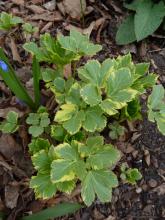
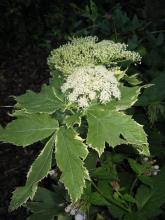
Pleurospermum szechenyii:
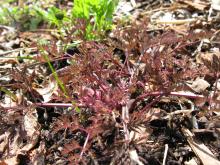
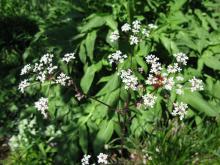
http://www.efloras.org/florataxon.aspx?flora_id=2&taxon_id=200015840
cohan (not verified)
Re: amazing Apiaceae (the umbellifers)
Wed, 05/18/2011 - 12:16amLori, does the Pleurospermum remain that colour, or is that just spring foliage?
Some of these remind of several local umbellifers I am fond of, I'll have to dig up pictures--such as the very charming, subtle Sweet Cicely (blunt-fruited; Osmorhiza depauperata) which is common in the woods here.. I sent seed to Stephen, hopefully he gets some babies :)
Lori S. (not verified)
Re: amazing Apiaceae (the umbellifers)
Wed, 05/18/2011 - 5:11amIt's actually dark purple throughout the season.
Stephen Barstow
Re: amazing Apiaceae (the umbellifers)
Wed, 05/18/2011 - 8:49amLori: I've overwintered Peucedanum ostruthium 'Daphnis' (nice pictures) for the first time this year! Nice Pleurospermum too!
Cohan: I wonder what happened to the Osmorhiza you sent me (it was in the fall wasn't it?). I haven't noticed them germinating (my pots are in a bit of disarray as a cat got into my cold frame with winter stratified seeds and labels were everywhere... I have otherwise Osmorhiza longistylis (picture) and O. claytonii:
cohan (not verified)
Re: amazing Apiaceae (the umbellifers)
Wed, 05/18/2011 - 12:03pmLori--then wow!
Stephen, it may have been mid-winter when I sent the seed, though I'm not sure, I might have a pm record of it.. if it does not appear eventually, let me know, I can get more seed this year...
Tim Ingram (not verified)
Re: amazing Apiaceae (the umbellifers)
Sat, 05/21/2011 - 4:08amGreat to see those various umbels. Stephen you have had better success with Lomatiums than me - I have grown nudicaule and californicum and a few others but had them on a gritty raised bed that may have been too dry and well drained, they never really got going well. I used to sell a few Laser trilobum on the nursery which shows there are gardeners who have a fascination with these plants - you could hardly call it showy. Lori's photo of Shoshonea is nice; this is definitely a plant I will try again - it is reminiscent of Olymposciadum caespitosum, which still grows on my raised bed and on the shady side of this, in deep grit, I have at last succeeded in getting Bolax gummifera to grow (this is a wonderful cushion plant often seen at the Shows and which I must have tried three or four times to date - its relative Azorella trifurcata is much easier and has made a lovely vivid green mat).
Tim Ingram (not verified)
Re: amazing Apiaceae (the umbellifers)
Sun, 06/05/2011 - 4:37amThe latest umbel to flower - Orlaya grandiflora - an annual species that more than lives up to its name. I am not sure how many gardeners grow it but it flowers just at the right time for the Chelsea Show and is often used on displays there. This and Ammi majus are both superb dry meadow plants mixed with poppies and the like.
Mark McDonough
Re: amazing Apiaceae (the umbellifers)
Sun, 06/05/2011 - 5:34amThere are so many of these umbellifers that I don't know and never heard of, but I'm paying attention ;) The Orlaya is pretty, the genus name sounding like it should be a town in Florida or a brand of potato chips :D
Stephen Barstow
Re: amazing Apiaceae (the umbellifers)
Sun, 06/05/2011 - 8:27amI didn't know what it was or what it's family might be when I saw it in seed in the Uppsala (Sweden) botanics a couple of years ago. Good to see it in flower!
Richard T. Rodich
Re: amazing Apiaceae (the umbellifers)
Sun, 06/05/2011 - 8:54amThat certainly seems like strange seed pods for the family.
I have tried to grow Orlaya from seed from another acquaintance in another garden forum. She gave me so many seeds that I planted them in a pot and directly in soil outside. Nothing ever showed, even in future years.
Any special insights/experiences on this one?
Tim Ingram (not verified)
Re: amazing Apiaceae (the umbellifers)
Sun, 06/05/2011 - 11:58amWith me Orlaya self seeds well, except when the rabbits discover it! Generally umbel seed should be sown pretty fresh and will germinate after a period of winter cold. Orlaya is a Mediterranean annual and should germinate with autumn rains if sown early enough, making strong overwintering plants. It sounds like you were just unlucky.
Umbel seeds are marvellously varied and quite a few have hooked spines like Orlaya, especially in dry habitats.
Trond Hoy
Re: amazing Apiaceae (the umbellifers)
Sun, 06/05/2011 - 1:33pmI have grown Orlaya at my summerhouse for many years but I have to sow it regularly.
Richard T. Rodich
Re: amazing Apiaceae (the umbellifers)
Sun, 06/05/2011 - 7:17pmThanks, Tim. Perhaps I will try again sometime.
Lori S. (not verified)
Re: amazing Apiaceae (the umbellifers)
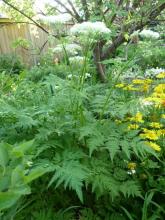
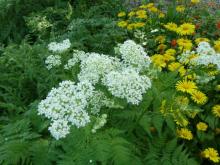
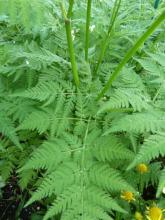
Sun, 06/19/2011 - 12:12amIt is not such an unusual one as some of those shown here, but Myrrhis odorata is looking nice right now...
Tony Willis (not verified)
Re: amazing Apiaceae (the umbellifers)
Sun, 06/19/2011 - 3:47amNo chance of it self seeding in the wet north west or surviving the winter. Here it is a tender annual which needs to be sown in a warm propagator in spring and grown on in individual pots for planting out now which is what I have just done.Small country vastly varied climate.It is a lovely plant
Lori S. (not verified)
Re: amazing Apiaceae (the umbellifers)
Sun, 06/19/2011 - 11:25amHere's an update on Peucedanum ostruthium 'Daphnis'... I've gained a bit more appreciation for it since this thread started, and it really is an attractive thing:

Trond Hoy
Re: amazing Apiaceae (the umbellifers)
Mon, 06/20/2011 - 2:00pmIt is a very nice plant and the seeds taste like "King of Denemark" ( a kind of sweeties) but it is one of the worst weeds here - I have it many places >:( ;)
Stephen Barstow
Re: amazing Apiaceae (the umbellifers)
Mon, 06/20/2011 - 2:34pmI've just planted seedlings of "Bald Cicely", my name for a variety of Myrrhis odorata which is completely hairless - also an excellent spring vegetable...
This is what Gerard had to say on the matter in 1597 (Kew Gardens):
Panayoti Kelaidis
Re: amazing Apiaceae (the umbellifers)
Sun, 11/27/2011 - 8:12pmDelighted to see Tim's Orlaya: one of my favorites. It has been self sowing a bit more every year and starting to make quite a show for me. Unlike many spring annuals, it hangs in there through the summer and reblooms when we get the odd shower in summer. I recall seeing something like these here and there all over Greece in April and May. It is a must have in my opinion. I keep stumblng on whole genera that seem to be twins to Orlaya from all over Eurasia. The only one I have a picture of is from Central Asia, I photographed it last September...here goes:
1) Overall shot of Orlaya grandiflora in my dry garden
2) Closeup of the same
3) Semenovia sp photographed near the Observatory near treeline above Almaty in Kazakhstan Tian Shan...growing with what looks like Veronica spicata, but is not, I believe.
Love them umbels!
Tim Ingram (not verified)
Re: amazing Apiaceae (the umbellifers)
Mon, 11/28/2011 - 12:35pmWhen I first became interested in these plants I was persuaded by the Hardy Plant Society to write one of their booklets on the family. Umbellifers have always been of interest to knowledgeable gardeners in the UK (such as Graham Stuart Thomas and Alan Bloom, both of whom wrote about them). Recently though they have been grown a lot more widely, especially in more naturalistic gardens, and they must always have an appeal even to non-gardeners because they are so recognisable. Even so it is only the very few that are grown in gardens. Looking back through this thread, and with the host of amazing North American umbels which are hardly grown anywhere, I am keen to learn a lot more about them and hopefully put this together in a more comprehensive book on the family (a bit of a tall order since it is such a large family!). There are quite a few nurserypeople I know with a fascination in the family - for example Marina Christopher who used to work with John Coke at Green Farm Plants, and who values them especially for the very wide range of pollinators they attract, and Graham Gough at Marchants Nursery and John-Pierre Jolivot in France.
I would be very grateful for any information from members of the NARGS who grow umbels (there is quite bit already on this thread already which is really helpful and stimulating) or even more who have experience of seeing them in the wild. I aim to try more of the North American species from seed since these are virtually unknown in cultivation. There are also quite a few alpine species in particular that have been introduced from South America.
I think the diversity of the family would surprise many even botanically minded gardeners and the long historical uses of umbels in medicine and as foods have given them such enduring interest. It may be quite a long project but there has been very little written on the family from a gardening perspective. Many thanks in advance.
John P. Weiser
Re: amazing Apiaceae (the umbellifers)
Mon, 11/28/2011 - 2:18pmTim
Here is one you will not see every day, Cymopterus globosus. I have only come across this little desert Spring Parsely one time, on a low, very cobbled hill in eastern Nevada. The flower heads feel like a moist, dense rubber ball when you squeeze them. I can't find a lot of information about it but it is a uniqui little guy. I hope some day to find it in seed.
http://aplantaday.blogspot.com/2011/04/globe-springparsley-cymopterus-gl...
http://plants.usda.gov/java/profile?symbol=CYGL2
Mark McDonough
Re: amazing Apiaceae (the umbellifers)
Mon, 11/28/2011 - 5:35pmCymopteris globosus is an amazing plant. I thought it rang a bell, and sure enough, I posted a CalPhotos link to this species and several other fantastic Cymopteris here:
http://nargs.org/smf/index.php?topic=662.msg8397#msg8397
Glad to be reminded of such unique plants as the NARGS Seedex opening approaches.
Tim Ingram (not verified)
Re: amazing Apiaceae (the umbellifers)
Tue, 11/29/2011 - 1:25amSome of the Cymopterus really are extraordinary! It is interesting how little they are known in comparison even with many of alpine umbels of South America and New Zealand. Mind you they must be really difficult to grow in the garden in many cases; I have always thought them very like bulbs with their early flowering habit and summer aestivation. I have tried a few of these from seed and had good germination (in some cases in the fridge!), but haven't yet managed to grow them on successfully. They must be good candidates for a sand or crevice bed. (There is a glorious example on the Alplains list - Cymopterus planosus - who would not want to grow a plant like that!!).
Panayoti Kelaidis
Re: amazing Apiaceae (the umbellifers)
Sat, 12/03/2011 - 9:19amTwo pix: the first is good old Lomatium dissectum: big, variable, easy in the garden. Here photographed on the West Elk Mts. in mid July in aspenwoods at about 8000-9000'.
The second is more problematical: Oreoxis humilis only grows on Pikes peak. I believe it is proposed for endangered species status. It is very cute and probably quite growable. Too this a few days after the last picture.
I spent the day with my girlfriend at the Stanford Mall (quite the shopping center): I cannot remember the name of the manufacturer, but there was an exquisite set of China at Bloomingdale's featuring all manner of Umbelliferae. Very appropriate to this string...
Mark McDonough
Re: amazing Apiaceae (the umbellifers)
Sat, 12/03/2011 - 10:11amWow, Oreoxis humilis is a beauty! Found a link from 2009 concerning endangered species status, with disappointing news. PK, hopefully you'll be collecting seed on it sometime (before it does get listed) and grow them at DBG.
USDA list 4 secies of Oreoxis
http://plants.usda.gov/java/profile?symbol=OREOX
Oreoxis humilis
In the following USDA Forest Service documents, the range is given as only Colorado.
http://www.fs.fed.us/r2/projects/scp/assessments/oreoxishumilis.pdf
http://www.fs.fed.us/wildflowers/rareplants/profiles/critically_imperile...
...and listed as only Colorado in this U.S. Fish and Wildlife Service document entitled "Endangered Species Act Protections for 165 Petitioned Species Not Warranted":
http://www.fws.gov/mountain-prairie/pressrel/09-04.html
...curiously the UDSA Plant Profile includes New Mexico in its range, probably a mistake:
http://plants.usda.gov/java/profile?symbol=ORHU
Oreoxis alpina (and O. bakeri):
http://www.swcoloradowildflowers.com/Yellow%20Enlarged%20Photo%20Pages/o...
...O. alpina on the NARGS Wiki:
http://www.nargs.org/nargswiki/tiki-browse_image.php?imageId=2960
Oreoxis bakeri
http://www.flickr.com/photos/12803916@N00/3936911951/
Oreoxis trotteri:
http://www.scribd.com/doc/35623196/Oreoxis-trotteri-Utah-Rare-Plants
John P. Weiser
Re: amazing Apiaceae (the umbellifers)
Sat, 12/03/2011 - 11:31amI like the look of them. Do they go dormant in the summer months?
Here we have Lomatium nevadense var nevadense a more wild spread miniature species. Easy from seed and summer dormant.
http://plants.usda.gov/java/profile?symbol=LONEN
Lori S. (not verified)
Re: amazing Apiaceae (the umbellifers)
Sat, 12/03/2011 - 11:39amIt's good to hear that they are easy from seed. Does that mean they don't need conditioning (stratification) or would you recommend it?
I've tried Lomatium columbianum a couple of times now with no germination at room temp, or stratified in the cold room, or over the winter outdoors - very frustrating! I wonder if the seeds have limited longevity? Then again, I seem to have problems germinating Apiaceae in general... what's the trick?
Pages