
I always suggest that is important to retry growing the same species from multiple sources. Too often our knowledge of any plant species is from a single mass-produced source, certainly true with bulbs, depriving our knowledge of the true breadth of variability of a plant species. Even something as common as nodding onion, Allium cernuum, can be had in amazingly diverse and beautiful forms (and nondescript ugly forms) from such efforts.
So it is true with Allium caeruleum, widely cultivated and surely mass-produced from a single clone for many decades. The problem is, the plant widely available in fall bulb bins at local nursery centers is an inferior form; flowers are indeed a good dark blue, but there's a tendency to produce an odd bulbil or two or three in the inflorescence, the flower heads often with amusingly weird aberrant florets.... multi-petaled ones, fused florets, or situations where a stamen morphs into a pedicel and sprouts one or more flowers from within a flower . Invariably the widely cultivated type is short-lived, only flowering well the first year after planting, dying out quickly in subsequent years. They're cheap enough to buy, but I was tired of these bad habits and replanting bulbs every couple of years.
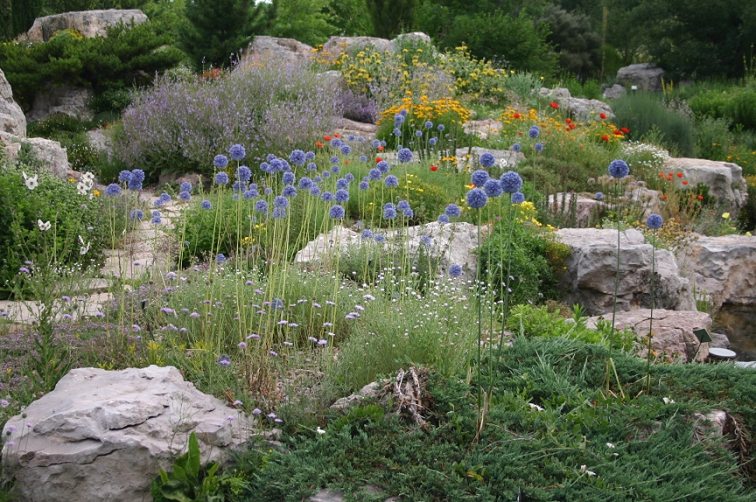
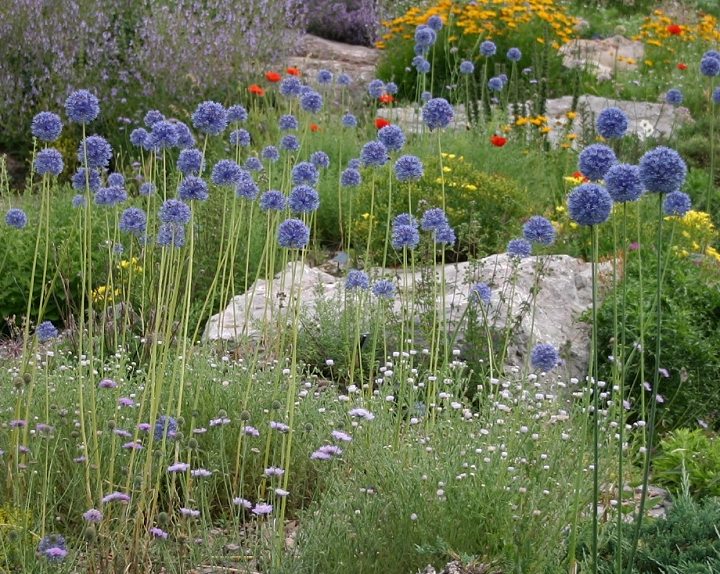
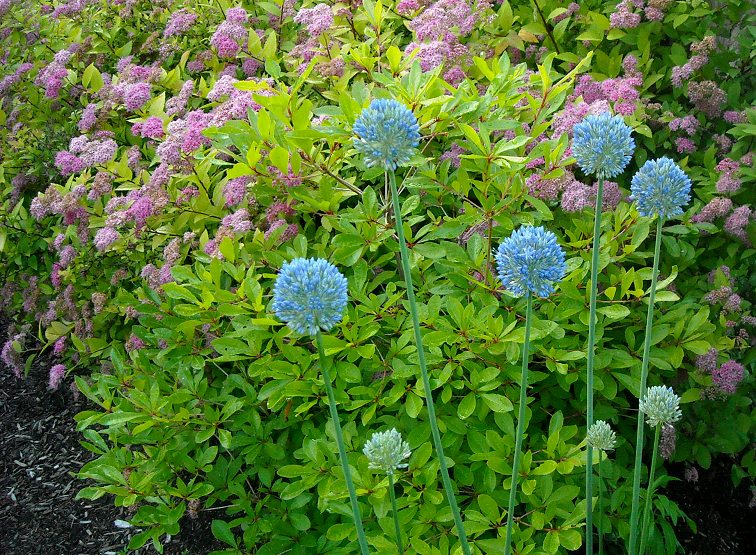
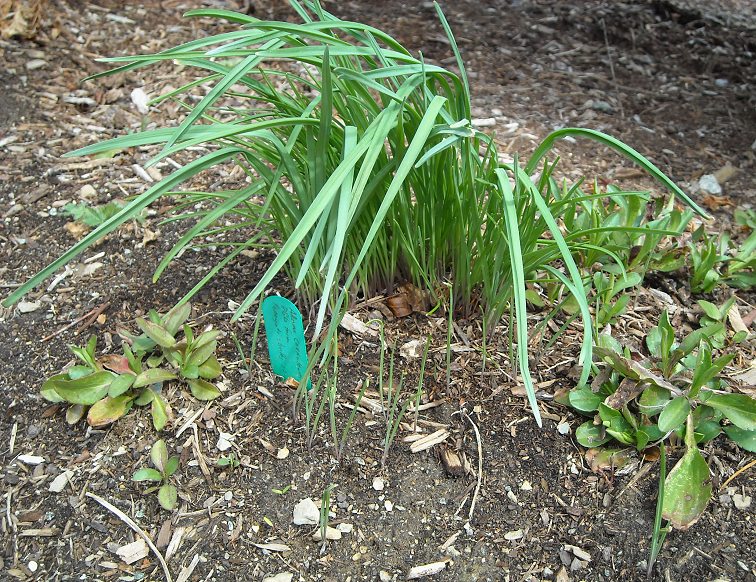
Then one day, Panayoti Kelaidis sent me a photo of this blue allium growing at Denver Botanic Garden (DBG), and I couldn't believe my eyes... a gorgeous form with brilliant azure blue flowers in heads larger than normal, and taller too. Afterwards, he sent me a good crop of bulbs (thanks Panayoti!). Determined to get a good form established, I planted bulbs out in 7-8 spots around the garden, hoping to find just the right spot to the plant's liking. And sure enough, the bulbs only really prospered in one location, the successful one now forming basal offsets and bulblets to try again in other locations. Here are some photos of what I have dubbed the 'DBG Form'.
1. Allium caeruleum in a mixed planting at Denver Botanic Garden, beautiful!
2. close-up of the same planting
3. In my garden, a close-up of a single flower head in 2008, 3" (7.5 cm) in diameter.
4. In my garden, several azure flower heads in 2009, at early anthesis with intense color of young buds.
5. In late summer, bulblets can be found at the stem bases bulging friom the basal leaf sheaths, harvest and replant.
6. Spring growth 2010 shows much dividing and increasing, some of the bulblets replanted near mother plant are sprouting.
(Aster pilosus growing nearby, see: http://nargs.org/smf/index.php?topic=159.0 )


Comments
Trond Hoy
Re: Allium 2010
Thu, 04/01/2010 - 1:12amThis is the best caeruleum I have ever seen! I try to establish alliums at my summer cabin, especially those flowering in late June - early August. There it is more summer warmth and sun than at home and a bit drier too! (If you get too many bulblets ... let me know!)
Mark McDonough
Re: Allium 2010
Sat, 05/15/2010 - 4:01amAfter A. paradoxum var. normale, the first of the Alliums to bloom here each year, the second is Allium zebdanense. The first photo shows how this species makes a fine clump of narrow arching foliage in a woodland setting. The second photo shows it growing in full sun at early anthesis. In sun it will flower earlier and go over more quickly, often with the foliage turning yellow after a couple days in early retreat to dormancy, whereas those grown in shade or part shade will flower later, last longer, and maintain the attractive narrow arching green foliage much longer. Nearly sterile in the form I grow, it'll occassionally makes a bit of seed and a few welcome seedlings show up.
Photos 3-4 were taken in the garden of my friend Marsha Russell, where a marvelous moss and lichen covered outcrop serves as backdrop to a fine stand of thus showy allium growing in a mostly shaded location.
Mark McDonough
Re: Allium 2010
Sat, 05/15/2010 - 4:13amFirst of the Acanthoprasum allium are blooming here, and judging from my 10 year photo records, I'm in need of doing some propagation and replanting to reinvigorate declining plants. Large clumps of A. karataviense 'Ivory Queen' have all but disappeared, although they are cheap enough to buy a fresh supply in the fall.
1-2 Allium karataviense 'Red Globe' - the cultivar name given before var. henrikii was published, but evidently they are the same. The first two photos show this really attractive form in the garden now, the leaf and flower size smaller than in previous years. For what it is worth, I am maintaining the name 'Red Globe', as photos I've seen of var. henrikii, show it to be quite variable is size, density of the inflorescence, and flower color; always red toned but some are much deeper colored than others, so I'm of the opinion that this plant is best named A. karataviense var. henrikii 'Red Globe' to distinguish it from less worthy forms of var. henrikii.
3 Allium karataviense 'Red Globe' in 2008
4 Allium karataviense 'Red Globe' in 2000, with foliage of other karataviense color forms in background.
5-6 Allium species aff. ellisii, at early and mid anthesis.
Trond Hoy
Re: Allium 2010
Sun, 05/16/2010 - 5:15amMark, do you feed your Alliums? My Alliums like karataviense tend to grow smaller and smaller and ultimately stop flowering. Only wild ones and some smaller species proliferate.
Here's one of the few wild onions of Norway, A. scorodoprasum. Not the showiest but stout and majestic when the tallest plants reach 1m or more in a few weeks.
externmed (not verified)
Re: Allium 2010
Thu, 06/10/2010 - 7:38pmAllium thunbergii certainly presents no permanence problems here; but the color is just a bit off to my taste,
? slightly muddy mauve purplish, rose pink. I don't recall my source and am not sure if it was supposed to be Ozawa, but I think not. Is Ozawa a clearer color? Or is there variation in color? Have the white too, which is white.
On the other hand, Allium oreophilum 'Agalik Giant', had stunning flowers, though the inflorescence careened off to one side. Plant did not show the next spring. Planted 2 more last fall, no show in the spring.
Charles Swanson NE Massachusetts USA z6a +/-
Mark McDonough
Re: Allium 2010
Thu, 06/10/2010 - 8:31pmAn overdue response. No, I don't feed Allium plants, in fact, I don't feed any garden plants. I have seen Allium karataviense in botanic gardens looking monstrously large and over-blown, the enlarged leaves and abnormally large flabby inflorescences no doubt due to planting in rich soil and heavy feeding. I have noted upon return to these same gardens in subsequent years, the same gross displays were not there, probably dying out from over feeding. I believe in growing bulbous plants, such as A. karataviense, hard and lean.
A. scorodoprasum is as you say, a stately plant, one of the larger species lending scale and vertical substance to a garden... I like such plants, even if not the showiest in flower.
Mark McDonough
Re: Allium 2010
Thu, 06/10/2010 - 8:57pmHiya Charles, I find such things as color preferences, and even plants in general, often come down to personal likes/dislikes. I don't find the color of Allium thunbergii to be a bit off in any way, I rather like the color very much. I have grown numerous A. thunbergii forms, and 'Ozawa', and the color is pretty much the same rosy-purple color. It should be noted that the white form is really a clean white, without a trace of other colors, and is very good indeed.
Now, regarding A. oreophilum 'Agalik Giant', I feel somewhat the same way you do about A. thunbergii, with the color being a bit off in my opinion... but let me explain. First of all, I got mine as A. oreophilum 'Torch' years ago. Janis Ruksans assures me this is the same as 'Agalik Giant', and that I got mine under a then provisional name early on... although I still call mine 'Torch'... I like that name. The flowers are bigger, showier, and in more dense heads than regular A. oreophilum, the cultivar a fine plant to be sure. However, the flowers, like many Alliums, have a "bloom" or dusty coating on the flowers, which under certain light conditions can have the effect of making the flower color appear dull. On certain days, and in certain light, the flowers strike me as extra fine, and at other times, less so and a bit off. But regardless, this is a fine variety that far surpasses A. oreophilum for garden worthiness.
Sorry to hear your plants of 'Agalik Giant' did not come back for you, twice! Makes me wonder if indeed the 'Torch' selection is identical to 'Agalik Giant' after all, as 'Torch' has been with me about 8 years (too late at night to go run out in the rain and check my label to verify the stats :D). I have in years past, scratched in seed around the parent plant, to increase the small colony. I include a few photos taken recently. Send me a personal message and I can save you some seed.
It should also be noted, that in years of sufficient moisture, the thick blue-grey leaves will remain intact at flowering, but under drier conditions, such as our many recent weeks or warm to hot weather without much moisture, the foliage definitely started into early senescence and yellowing by the time the flowers appeared, a common oniony occurrence.
externmed (not verified)
Re: Allium 2010
Fri, 06/11/2010 - 7:50pmThanks Mark for the information. My photo was taken under heavy morning dew so less than optimal for comparison.
"In the past someone suggested to Antoine Hoog that the typical Agalik was unsightly (with its twisted stem) and suggested that he picked a straight-stemmed form of what was otherwise a very good plant.
Torch is the result, a super plant selected by Antoine." (rareplants.co.uk)
(Mark McD: Here's the link to the RarePlant.co.uk site with Allium oreophilum 'Torch':
http://www.rareplants.co.uk/product.asp?P_ID=3288&strPageHistory=related)
Random additional allium news bits: the plant I bought as insubricum from Evermay last year, came back larger (with 5 growths) this spring, but still small. (Not on list this year) A second I bought at the same time was DOA. Someone was selling a "bigger growing" A. cyaneum this spring and seems to be 8" at a glance. Haven't really had time to investigate.
Charles Swanson NE Massachusetts USA
externmed (not verified)
Re: Allium 2010
Fri, 06/11/2010 - 7:53pmAgalik (with decidedly crooked stem--leaned over onto the ground)
Mark McDonough
Re: Allium 2010
Fri, 07/02/2010 - 6:53pmPreviously I posted information from Dr. Eric Block, Professor of Chemistry, University at Albany, SUNY, and his recent book "Garlic and Other Alliums - The Lore and The Science" published by the Royal Society of Chemistry.
http://www.srgc.org.uk/smf/index.php?topic=4757.msg145659#msg145659
I recently heard from Dr. Block and received updated information about the book and various speaking engagements and radio/tv interviews, so I'm posting that information here.
The hardcover version of the book has sold out. However a paperback (softback) version is now available ($39.95 in the U.S., 25 GBP in the UK).
hardcover - http://www.rsc.org/shop/books/2009/9780854041909.asp
paperback - http://www.rsc.org/shop/books/2010/9781849731805.asp
Dr. Block gave a free lecture on Allium science at the New York Botanical Gardens on Friday, July 2, at 11 AM. This venue has already happened, but for a 23-minute audio podcast of NPR's Science Friday, click this link:
http://podcastdownload.npr.org/anon.npr-podcasts/podcast/510221/12827625...
For those in England, Dr. Block will be giving an illustrated public lecture at the Chemistry Centre of the Royal Society of Chemistry in London on July 15 at 18:30. While the talk is free, advance registration is required since space is limited. At this event, Dr. Block will also be signing copies of his book. For more information or to register, click here:
http://www.rsc.org/AboutUs/ChemistryCentre/Events/saladbowl.asp?CFID=446...
Also, for those in Scotland, Dr. Block has been assisting BBC-TV on a feature they are producing on onions for a program called 'Jimmy's Food Factory 2', BBC Scotland. He does not know when it will air, but believes it should be of interest to Scottish Allium-lovers.
Other news of interest to those in the UK and the EU
A new environmentally-benign garlic-based pesticide has just this week been fully approved by the UK regulators for horticultural use, such as with root crops like carrots and parsnips, as well as on turf grass in golf courses and soccer fields, etc. EU approval has also recently been received.
The product is now commercially available from a small UK company (full disclosure: Dr. Block is a scientific consultant for them) called ECOspray. The ECOspray website is currently being updated with the new information and it may be a week or more before it is up to date. Here is the link: http://www.ecospray.com/index.php
More information on Dr. Eric Block
e-mail: [email protected]
http://www.albany.edu/chemistry/eblock.shtml
Richard T. Rodich
Re: Allium 2010
Sat, 07/03/2010 - 6:29pmI listened to yesterday's Science Friday edition of NPR that included Dr. Block's interview. I thought the book would be a good Christmas present for me (from someone else). $40 for the paperback. We have a $20 max rule in our family, so maybe it will be a joint effort...
Trond Hoy
Re: Allium 2010
Mon, 07/12/2010 - 1:08pmNot all flower.
Panayoti Kelaidis
Re: Allium 2010
Fri, 07/23/2010 - 9:36amIn honor of our resident Alliophile expert, the first pix I've downloaded from the last few weeks of intensive travel all over Colorado and Oregon will be some Allium! You probably have seen this miniature form of Allium geyeri from Pikes Peak and Mt. Evans (the only place I have seen it). It is sometimes classified as its own species: Allium pikeanum. I think I got some good pix that you should enjoy. These were taken about two weeks ago on Mt. Goliath (a shoulder of Mt. Evans where Denver Botanic Gardens has its Alpine unit) Typical A. geyeri gets a foot or more high and its umbels can be two inches across. This is barely a third that size in all dimensions, and perhaps even shorter. Need to remember to go back and get some seed!
Trond Hoy
Re: Allium 2010
Sat, 07/24/2010 - 4:00amNice onions!
What's the blue plant together with the alliums in the last picture?
Mark McDonough
Re: Allium 2010
Sat, 07/24/2010 - 6:30amPanayoti, when was it that I was out to Colorado for an annual NARGS (ARGS then) meeting in Boulder CO, I think it was in the mid 1980s? At this event, one of the field trips was a bus ride up to the top of Pike's Peak, a hair raising experience to be sure. But I remember it well, excited to see dwarf (prostrate) fans of narrow foliage, that I later learned was Allium geyeri in a dwarf alpine form (syn. A. pikeanum). It was not in flower at the time, so it's great to see your photos of flowering plants from Mt. Evans.
I did grow this in Seattle, and later in Massachusetts after moving back to New England; while it stayed smaller, growing only 6-7" tall, it was upright growing at lower elevations, and did not show any of the prostrate habit as seen up on Pike's Peak. This form was recalcitrant and never increased, eventually dying out, whereas other forms collected in moist partly-shaded sites in my western mountain travels are easy growers, making pleasant billows of light pink urceolate flowers in late spring. In moist sites, A. geyeri can easily reach 18" (45 cm) or more.
Back to the Pike's Peak buses. We were told that the small fleet of Pike's Peak buses dedicated to shuttling people up and down the 14,115' (4,302 m) peak, were specially designed with the wheel bases pulled in towards the center of the bus's length, thereby making it easier to turn and navigate the many switchback turns (180 degree hairpin turns). However, what this means, is that the front portion of the bus would actually project out and over shear vertical drops at each hairpin turn, the mostly 60s and over crowd of ARGS members screaming in terror with each and every turn, like some sort of hellish amusement park ride. The adept bus drivers, so used to the trips up and down, would also travel at what seemed like death-defying speed given the precarious terrain and dizzying heights... I think they rather enjoyed getting riders to scream. :o :o :o
Mark McDonough
Re: Allium 2010
Sat, 07/24/2010 - 6:34amThe blue plant looks like Phacelia sericea.
Panayoti Kelaidis
Re: Allium 2010
Sun, 07/25/2010 - 8:38pmThe blue plant is Phacelia sericea. The yellow is Geum rossii.
A few more pix of Mt. Goliath are posted at: http://www.botanicgardensblog.com/2010/07/25/quick-before-its-winter/
Trond Hoy
Re: Allium 2010
Mon, 07/26/2010 - 6:22amThanks both, I thought of a Phacelia species.
Panayoti Kelaidis
Re: Allium 2010
Mon, 07/26/2010 - 8:29amDear Mark!
You bring back great memories! I remember that bus ride. I also recall that Linc and Timmy Foster were on that bus and were not thrilled with the thrills (Timmy later told me she felt as if she was on a trick plane ride)...the crowning moment came when we heard Dr. William A. Weber bellowing (at the top of his lungs) "Penis! Penis! Penis!" As it turned out, he was correcting some poor soul who made the mistake of pronouncing the prevalent low altitude pine as "Pie-nuss ponderosa".
You realize that was 28 years ago! Gawd, we're going to be tiresome geezers.
Bill, incidentally, is in his nineties, and still arresting.
Robert Nold
Re: Allium 2010
Tue, 07/27/2010 - 3:07pm(Nothing to do with alliums....)
Too bad I wasn't there, it might have been fun. The correct pronunciation of Pinus, for English speakers, is, of course, Pie-nuss. Botanical names are not Latin and attempts to pronounce them as such are just silly. And, in many cases, impossible.
Mark McDonough
Re: Allium 2010
Thu, 07/29/2010 - 6:48amAllium listera is one of a small handful of Chinese species with hosta-like leaves, quite remarkably so in this species. I grow three clones, all collected by Darrell Probst in China, two of which flowered this year side-by-side. I've grown these a number of years, and it proves to be a most unique, attractive, and hardy Allium for the semi-shady bed. I upload 10 photos showing the progression from early leaf emergence to flowering. Normally flowering takes place in latest July to mid August, but this year we are 2-3 weeks earlier than normal.
Early leaf emergence shows off the different clones well, my original plant is the one with ruddy reddish foliage in spring, looking rather odd with fleshy shiny leaves, but robust and more leaves than the second clone... the leaves eventually turning green but larger than the other... the second clone was green and looking altogether normal, smaller and narrower in shape. The second clone started flowering about 2 weeks earlier than my original more robust form, but there is some cross-over in bloom time.
This year, it has been so desperately hot and dry, that the leaves started drying off as the flowers appeared, something nor experienced before, normally the leaves are in good green hosta form as the flowers open. The smaller form did not set any seed, it was near 99 F (37 C) when the flowers were blooming, too soon to tell if the later more robust form will set viable seed this year.
Lori S. (not verified)
Re: Allium 2010
Sun, 08/01/2010 - 10:05pmWhat interesting foliage on A. listera.
Mark, here, in bloom now, is the allium that you commented on previously as likely being A. nutans. Does it still seem to be it? The stems are flattened, and ridged. The leaves are also flattened, about 1cm wide, and blunt at the tips. Thank you, in advance, for an ID.
Trond Hoy
Re: Allium 2010
Mon, 08/02/2010 - 12:41amMark, you never stop showing interesting onions! Allium listera is no exception. Both clones had very nice leaves but the robust form wins the gold medal. The flowers weren't bad either.
And your presumably A. nutans Lori, also is very fine. Here I like the dense flowerheads better!
Mark McDonough
Re: Allium 2010
Mon, 08/02/2010 - 10:21amLori, that is not only Allium nutans, but a very fine form of it, both for flowers and for the leaves. I grow one that looks similar, which is flowering now.
I have fallen way behind posting Allium photos, but here are a few recent ones.
1 Allium nutans - robust white form, looks similar to Lori's plant
2 Allium angulosum - good white form, here it is stretching for more light, must move it to a sunnier position.
3-4 Allium plummerae - this should be a standard Allium in everyone's garden who permit alliums, a first rate "garden perennial" that clumps up well, has distinctive pale gray-green glaucous leaves held straight up, topped with flat clusters of white flowers, the ovaries changing to brown or orangish colors. From high alpine meadows in Arizona and New Mexico, this one wants full sun, but good rich (and moist) soil, but will grow easily even in dryish loam. Almost never reseeds.
5 Allium mixed species growing together, Allium cernuum, A. stellatum and stellatum hybrids, and Allium nutans hybrids.
6 Same as #5, except a week earlier, showing some of the bud habit.
7-8 Allium stellatum hybrid seedlings (ex. Allium stellatum x senescens 'Rosey Affair') - mixed white and pink.
9-10 Allium ericetorum (chartreuse yellow) on the left, A. saxatile (medium pink form) on the right, growing in a friend's garden.
Lori S. (not verified)
Re: Allium 2010
Fri, 08/06/2010 - 11:29amBeautiful alliums, Mark, and thanks for the ID.
Here's Allium flavum var. tauricum out on the corner of the sidewalk... the standard yellow.
Mark McDonough
Re: Allium 2010
Fri, 08/06/2010 - 5:31pmLooks to be a really good form, a good bright yellow. At one point I used to select out and discard the yellow ones, in part, that's how I ended up with so many colors other than yellow, but now I have been purposely replanting yellow forms and A. flavum, just for the spots of bright color they add without taking up much space.
Lori S. (not verified)
Re: Allium 2010
Wed, 08/25/2010 - 8:54amAllium sikkimense has been in bloom for some time now:
Trond Hoy
Re: Allium 2010
Wed, 08/25/2010 - 9:01amThat's a pretty blue one!
Lori S. (not verified)
Re: Allium 2010
Wed, 08/25/2010 - 6:56pmYes, it sure is! The other blue one I have, A. cyaneum, didn't bloom very well this year. (Oh, I guess I also have A. cyaneum... forgot about that one.)
A couple of our native species, from a moist swale between the higher, rocky ridges on Forgetmenot Ridge (again) on Aug. 23:
1) Allium schoenoprasum var. sibiricum, chives
2) Allium cernuum
Mark McDonough
Re: Allium 2010
Wed, 08/25/2010 - 8:15pmWow, that's a SUPERB clump of Allium sikkimense! Well grown.
Richard T. Rodich
Re: Allium 2010
Thu, 08/26/2010 - 4:20pmCool stuff, Lori. It seems my Alium "sikkimense" from NARGS seed is not. The pedicels seem too long. Any guesses, Mark? Flowers never opened more than what you see.
(Edited to say that Mark's preliminary ID is Alium sikkimense.)
I finally caught some native Allium tricoccum in seed.
#2 - early spring foliage
#3 - shall we just say an artsy photo of a seedhead? Seeds are black, not blue.
Mark McDonough
Re: Allium 2010
Thu, 08/26/2010 - 6:57pmI'm guessing that you do have Allium sikkimense, it is quite variable, sometimes nodding heads, sometimes more upright as in your plant. The flowers typically don't open widely, but I have found that the flowers can be puny, underdeveloped, and don't open as well as they should in very hot and dry weather... some of my Chinese Alliums look miserable this year, and I think I have lost A. mairei in the drought.
I'm glad you mentioned that the seeds on your artsy photo of A. tricoccum are indeed black instead of blue; I was starting to get excited there for a minute or two!
Richard T. Rodich
Re: Allium 2010
Fri, 08/27/2010 - 7:47amThanks Mark. I'll see if they perform any differently next season...
We had our August "seedling" sale recently. I picked up Allium nutans and Allium platycaule, grown from seed. This sale is open to members and guests (not the public) and is priced more modestly for our members, rather than our real money maker in the spring that is open to the public. Still, a member brought several Redbud seedlings from the cold hardy strain for up in the north, and another brought some Iseli conifers left over from her tech college sale. Both bunches fetched good prices, and we made $600! A record for our August sale.
This sale is always at a member's home, and touring her gardens, I spied an allium with very blue chive-like, very narrow foliage. Stupid me, I didn't check to see if leaves were hollow. Inquiring as to its identity, she said "it has a poison in its name." Thinking of cyanide, I mentioned cyaneum, and she said "yes, I think so." Blooms were spent, but it may not have been very long since senescence, and the umbels were compact - similar to A. shoenoprasum (but perhaps larger, in total). Is this consistent with Allium cyaneum?
Mark McDonough
Re: Allium 2010
Sat, 09/11/2010 - 9:32pmDoesn't sound like Allium cyaneum to me, that species has thread thin green leaves, not blue hued leaves. However, many forms of chives, Allium schoenoprasum, do indeed have bluish hued leaves... most likely that's what it was. I have no idea what "it has a poison in its name" could refer to, although posibly it is a misnamed item labeled as A. cyaneum as you surmised.
Mark McDonough
Re: Allium 2010
Sat, 09/11/2010 - 9:36pmSome recent Alliums:
1. Allium stellatum
2-4 Allium callimischon ssp. callimischon, from Antoine Hoog, 2001, one of the Brevispatha alliums that produce buds in an extremely narrow spathe barely differentiated from the stem, the dry looking stem popping open with fresh flowers in late summer or fall.
5-6 Allium hybrid that appeared a couple meters away from the probable parent, also a hybrid A. senescens type, shown growing in 100% crushed stone gravel in a "drip strip" under the roof eave overhang. Short, nice full spherical flowers.
7-10 Allium 'Pink Pepper' - a dwarf type, like a miniature Allium senescens "glaucum" but with narrow swirling green leaves (not gray) and light pink hemispherical flowers on 4-6" (10-15 cm) stems in September, the flowers peppered with protruding stamens and yellow anthers.
Lori S. (not verified)
Re: Allium 2010
Sat, 09/11/2010 - 10:02pmWow, it's been astounding to see the vast variety of garden-worthy Allium species, and to realize - even more than I already did - the extremely long bloom period one can achieve with the genus!
Trond Hoy
Re: Allium 2010
Sun, 09/12/2010 - 1:24amI repeat what Lori just said!
Richard T. Rodich
Re: Allium 2010
Sun, 09/12/2010 - 6:20pmYes, I used to shy away from onions, not realizing their allure. When I first heard of you and your vast collection and knowledge, Mark, I thought: "Well, to each their own."
You're probably right about my mystery onion. It very well could be a chive. The flower heads, though dried when I saw them, do fit, too. The reference to poison: "cyan" from cyanide (doh!).
I recall something about Allium stellatum seed heads that is supposed to be very different from other Allium species and is an easy identification marker. Do you know what that might be?
Mark McDonough
Re: Allium 2010
Sun, 09/12/2010 - 7:55pmSome American Allium species have crested capsules, horn-like projections at the top of the capsules, pronounced in Allium cernuum and Allium stellatum, but particularly so in Allium stellatum. Shown are 3 views of a deep pink late flowering forms of A. stellatum, with the inflorescences starting to go over and some capsules are developing. In these deep pink forms, the fresh seed capsules are dark reddish colored initially, as are the pedicels. In paler color forms, there is still a dark hue to the capsules, but not nearly as dark. You can see in the last photo, how pronounced the crests are on the capsules. On a totally dried inflorescence where color has dissipated, I would not attempt telling cernuum and stellatum apart, would need to see other plant characteristics and fresh flowers.
Mark McDonough
Re: Allium 2010
Sun, 09/12/2010 - 9:28pmThis year was the hottest and driest in the last two decades, a brutal drought that provided for challenging conditions in the garden. For the most part, the numerous rhizomatous Allium hybrids I grow still managed to put on a good show as they are quite drought tolerant, although the flowers went over quicker and looked lighter in color than in cooler years, and with more leaves senescing than normal. I've put together some photos from previous years, in seasons more favorable to good growth and flowering.
1-2 Allium 'Sugar Melt' - one of my hybrids resulting from 'Pink Pepper', a dwarf autumn blooming plant, like a small green-leaved A. senescens glaucum, but with good pink flowers peppered with yellow anthers, the flowers on short stems. In 'Sugar Melt', the plants grow taller, but still on the low side, at 14-16", with clear pink flowers in August. I include a link to Plant Delights Nursery where this cultivar is available, although I must say, the image they used is rather poor; my photos give a better impression of what this one looks like.
http://www.plantdelights.com/Catalog/Plants/Genus/Allium
3-4 These photos represent a type of Allium nutans/senescens hybrids that I've been getting, what I call the pincushion types, with flowers so densely packed, and stamens well exserted, the flower balls quite literally look like pin cushions.
5 Allium garden view, with a pincushion type hybrid, Allium 'Stellar Dust' in the top center of the view. August blooming.
6 Close-up view of Allium 'Stellar Dust'
7-9 Allium 'Meteor Shower' - one of my newer selections, has a distinctive look, with low broad hemispheres of bloom, the individual florets spaced apart from each other, each floret with a lighter tip. August blooming.
10 Allium 'Asteroids', another recent selection, with 2' tall (or taller) stems, and largish balls of tightly packed lavender pink flowers, each floret like a small crater. August blooming.
Richard T. Rodich
Re: Allium 2010
Mon, 09/13/2010 - 11:12amThanks, Mark. I remember now, but I had thought those crested capsules were definitive for stellatum only, but I was wrong.
Really like your selections, especially Asteroid.
More Allium stellatum photos, the second one taken on a dark and gloomy day. I wondered if the crested capsules were crested enough, but when I looked on your web site, I satisfied myself. If I am wrong, of course let me know.
Todd Boland
Re: Allium 2010
Thu, 09/16/2010 - 4:33pmMark, how does one distinguish stellatum from senescens? I have what I thought were senescens in bloom at the moment but they look a lot like stellatum you are posting.
Mark McDonough
Re: Allium 2010
Thu, 09/16/2010 - 7:55pmWow! Todd, you pose a legitimate question, but your Allium photo has me puzzled. I could answer this questions readily if the photo you posted was an obvious A. senescens, but it is not! So, there are two questions... 1) how to tell stellatum from senescens (this is the easier question)... 2) what the heck is your allium?
First of all, let me say, with your flexing your photographic muscle with your new camera, it is paying off, your photos are quite excellent, and this one is no exception... love the completely black background and clarity of detail... superb photo.
1. Distinguishing Allium senescens from stellatum: senescens is a rhizomatous species, with basal bulbs attached to strong well-developed horizontal rhizomes close to the surface, much like an Iris... a spreading very leafy plant, whereas stellatum is usually a solitary bulb, these are sometimes attached to other bulbs by very short temporary vestigial rhizomes, but essentially this is a bulbous species with ovoid bulbs... an upright plant rather sparse of foliage. Allium senescens has hemispherical umbels, usually quite dense, the hemisphere oriented normal to the ground, with campanulate to narrowly-campanulate florets, to almost pinched cup-shaped florets, whereas A. stellatum has a more effuse head of florets, semi-nodding in bud but can become pseudo-erect in flower (typically hemispherical opening sideways, but can develop almost spherical heads), the tepals strongly dimorphic with inner tepals strongly erect (at some portion of anthesis) and the outer tepals spreading wide open... the inner tepals can splay outwards once more mature adding to the starry effect. Allium senescens foliage is completely different, a strong leafy plant, with linear but broad-ish strap shaped leaves, bright glossy green in ssp. montanum, and very gray in true type senescens and senescens var. glaucum, whereas the leaves of A. stellatum are few and depauperate, narrow matte-green basal leaves of hardly any impact. Many other differences too. Also, seed capsules on senescens are smooth, they are strongly horned in A. stellatum, per the photos shown by me and Rick.
2. Your plant is a total puzzle. Need to see more of the plant, the leaves, stems, the roots and bulbs if possible, and it's general disposition. Do you know where it is from, or under what name it came? The totally spherical flower head, and very open flowers (not campanulate) tells me we are definitely dealing with something other than Allium senescens, thus the conundrum answering your question.
So, the question is, what Allium are you growing. As much information and photos you can post here, of the various plant characteristics, will help ascertain an ID diagnosis. Also, if you know the provenance of the plant, that certainly cuts down a huge amount of possibilities.
Mark McDonough
Re: Allium 2010
Thu, 09/16/2010 - 7:57pmRick, nice stellatum selections, they look much like my taller light pink forms. There are also some very deep pink forms, and some rather dwarf forms... that's what I like about these, they're so variable.
Richard T. Rodich
Re: Allium 2010
Thu, 09/16/2010 - 10:23pmI love a mystery...
The really nice thing, technically speaking, about solid backgrounds is that it allows greater compression of the image file, while still keeping the detail of the subject. Similarly, a blurred background will allow more preservation of detail of the subject than a photo with an in focus background.
Todd Boland
Re: Allium 2010
Sat, 09/18/2010 - 12:04pmOK, it seems most of my senescens are the real thing...they have the rhizomatous habit you describe. Also, most have finished blooming (actually have shed their seeds) except Blue Eddie which is just starting (why is this one do darn late?). I will have to go back and look for my sources for the current blooming onion. I will also have a look at the bulb scenario. I will endeavor to get a whole plant shot if the wind ever dies down! I know this one did not come from NARGS (a convenient scapegoat for mislabeled seed).
Todd Boland
Re: Allium 2010
Mon, 09/20/2010 - 2:49pmWell I could not discover the source of my recent allium but here is the plant...it has the habit of a senescens.
Mark McDonough
Re: Allium 2010
Wed, 09/29/2010 - 8:33pmIn bloom today, a recently received replacement to an Allium I once grew but lost, Allium thunbergii DJH 272 (Dan Hinkley). It is 6-8" (15-20 cm) in bloom.
Mark McDonough
Re: Allium 2010
Fri, 10/08/2010 - 8:18pmAt least 1 month early this year, is an allium received as A. taquetii that I received from the US National Arboretum many years ago; the name taquetii is a synonym for A. thunbergii. Certainly the flowers are just like A. thunbergii, deep rose-purple with long exserted stamens, and flowering very late in the season. However, instead of having the usual fistulose (hollow) keeled leaves, here the leaves are absolutely flat and not hollow. Usually this one blooms extremely late, the end of October into December, but this year it is flowering much earlier, even before A. thunbergii 'Ozawa'!
Harold Peachey
Re: Allium 2010
Sun, 10/24/2010 - 7:49amAllium thunbergii white form blooming now
Pages