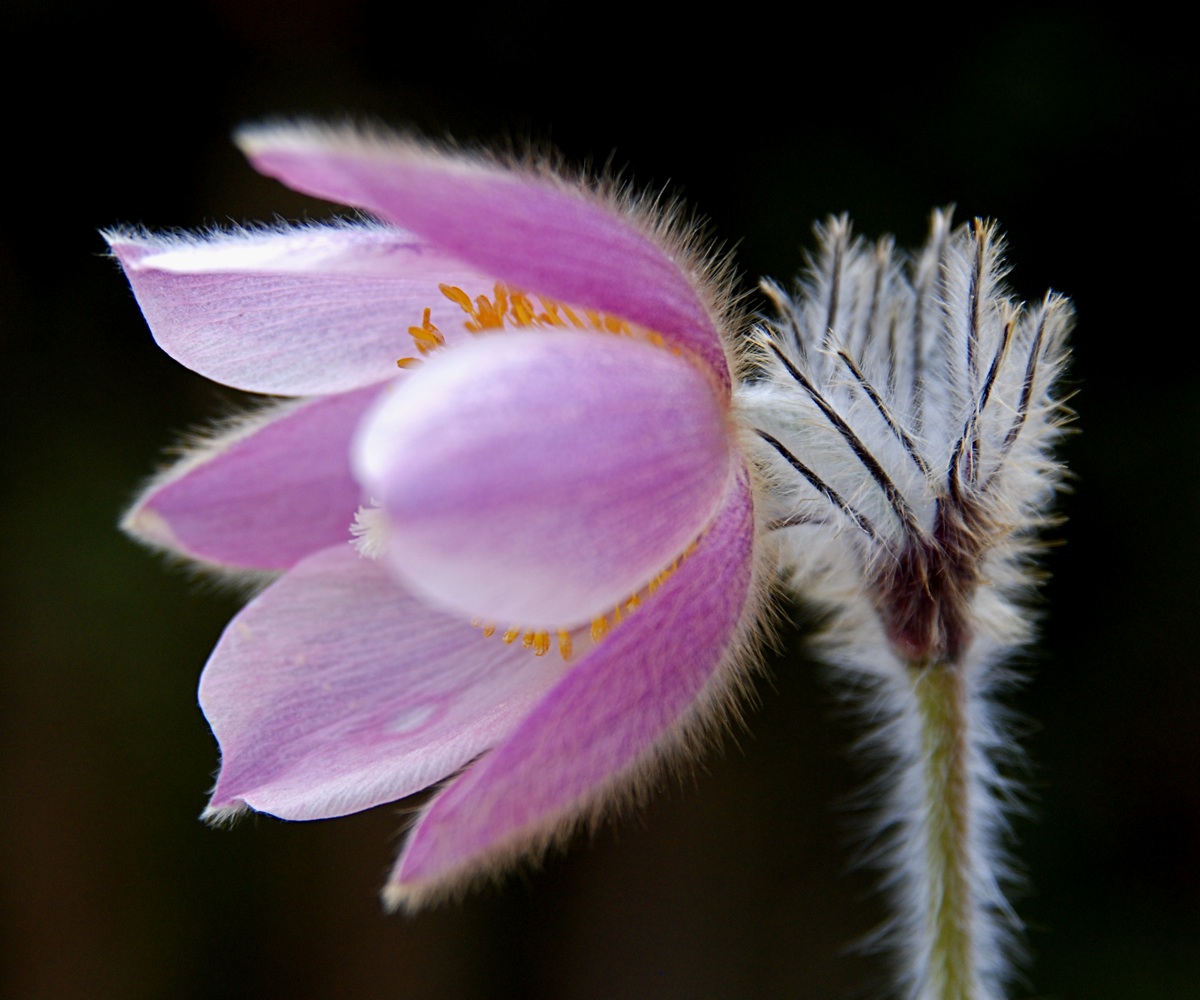
But perhaps I can get back by showing off Scopiola! Alas, I am not sure which one it is. I grew four or more species years ago at the Rock Alpine Garden, two of which persist. I shall have to go see if we still have S. carniolica, a lovely yellow one. There are so few hardy ornamentals in the Solanacee, and this one almost qualifies for the rock garden, although it is a tad tall. It has fabulous anther color. Easily accommodated in the woodland garden. I shall have to delve into my files for a name, alas, unless one of you can turn it up!
Panayoti, I always find it interesting how things work out! You see, there is this unusual plant flowering in my garden, no label to be found anywhere near it (darned crows), I have no recollection planting it (probably something I got from a NARGS chapter seedling sale and just "poked" into a spot in the garden... but with a label I'm sure!), wondering what it could be everytime I pass by it... and then you post its possible identitity; that's my mystery plant!
Googling Scopiola produces very little useful information, mostly just info and pics on the poisonous S. carniolica, and the names of a couple Asian ones. Now I'm "curioser and curioser" than ever to find out more about this genus.
Hi Panayoti and Mark, I think you have Physochlaina physaloides syn. Scopolia physaloides. Seems to be an attractive species! I have a red-brown flowered Scoplolia carniolica myself.
Beautiful, Jim! Looks like you've got the camera figured out just fine! It will be a long time yet before our earliest penstemon, P. nitidus, starts to bloom.
So the Scopiola/Physochlaina genera are shade loving? do you think physaloides might be zone 4 hardy?
It seems like it would definitely be worth a try... I recently found out that Physochlaina orientalis is at least zone 3-hardy (from a plant ID at Dave's Garden; it also grows at the Reader rock garden here), and ScopiolaSCOPOLIA carniolica wintered over for me (see previous posting in this thread).
EDIT: Thanks for the spelling correction, Kelaidis - I keep getting this one messed up for some reason; must memorize it!! :)
Thanks Trond for "keeping us awake and on our toes", no wonder googling the genus spelled incorrectly didn't come up with much ;D
For todays image, I'm showing one of my favorite Trillium species, the quitely attractive T. catesbaei, or Bashful Wakerobin, another Southeastern native that is perfectly hardy much further north. http://plants.usda.gov/java/profile?symbol=TRCA11
What I like about this species, is the undulate grayish-green foliage is narrow enough to allow easy viewing of the delicately recurved blooms in shades of white, pink, to deep rose, with large not-so-bashful bright yellow stamens. The flowers are nicely presented from bluish-grey sepals.
I have had several Trillium species during the years but they disappear after a while. I suspect my regular culprit the slug! But when I look at the pictures of T. catesbaei I have to try once more!
You often see pictures of different Dicentra cultivars, but this one, Dicentra macrantha, (new name Ichthyoselmis macrantha) is not often seen. Easily grown in woodland conditions.
You often see pictures of different Dicentra cultivars, but this one, Dicentra macrantha, (new name Ichthyoselmis macrantha) is not often seen. Easily grown in woodland conditions.
Yikes, the new name is a visual and phonentic challenge! It is a beautiful species, one that I hope to try sometime.
Iris cristata 'Dick Redfield' is a rare variant of crested iris, one with 6 falls instead of the usual 3 falls and 3 standards. Not only that, the crests are extraorinarily ornamental, golden colored for the entire length of the petals, conspicuously margined with white frills! The deep royal blue-purple flowers have been partially opened for a week, but cold weather slowed their full display, and finally a couple flowers reveal their frilly madness. In fact, one flower has 7 falls.
And a great picture...Mark you are incredible. As was the gentleman the iris was named for. So different from my modest stand of various I. cristata that tried to bloom before this last snow....on May 12 can you believe!
Too bad Lori these don't winter over for you, they are what I call "easy as dirt" here. I grow about 10 named varieties of I. cristata, they're all delightful... the last one in flower now if Shenandoah Sky. The rhizomes literally grow on top of the soil, exposed to the elements; they like to explore/colonize a layer of bark mulch or forrest litter... so I'm surprized to hear they are not hardy in a more northerly location.
Also bloomed here recently is the Chinese Iris henryi, only brought into cultivation here in the USA recently by Darrell Probst. I find this one easy to; it's a dwarf evergreen species with extremely narrow grasslike foliage that will trail down an enbankment like a fine sedge. The flowers are exquisite; palest blue with bright yellow brown-rimmed signal spots. It just finished, but as every stem has two flowers, I'm expecting the "reflush" today or tomorrow... it's magical.
Hi Mark you seem to have all kind of plants blooming simultaneously! Here things go much slower and it is still spring, the spring lasts for months! Your Irises are all wonderful! I have to try more of them but as I have told before, my enemies the slugs use Iris to dinner.
From the Iris of China by Jim Waddick & Zhao Yu-tang, the habitat of I. henryi is described as "grows among grass in forest or at forest edges. Type specimen from the bank of the Yangtze River, western Hubei, [China]."
I grow it near the top of a steep enbankment about 30" high, in our poor rocky clay subsoil, amended with some humus. The area gets about 2-3 hours of direct sun when the leaves emerge on deciduous trees, but prior to that occurrence, it would get about 1/2 day of sun or bright indirect light. The top of this enbankment (which I created in part, to form a screen between the road and a garden shed) is planted with arborvitae (Thuya), which may eventually be cut down after they've served their temporary screening purpose. The Thuya roots are aggressive and keep the soil very dry. I'm going to divide and move this Iris clump later in the summer (hopefully after it sets seed), to make a larger planting on a fairly steep sloped area.
I've written a lot about Bird's Foot Violet (Viola pedata) in the past, so I'm not going to say much about it here, other than the species is wildly variable in color and form, all are choice, and it is among the best species in the genus. Rabbits who infrequently nibble away in my garden seems to think so too, and periodically graze these down to stubs, so over the years I have lost dozens upon dozens of unique beautiful forms, with just a few plants remaining. The plant pictured has been flowering for a couple weeks.
We've had a set-back in Newfoundland...today it is snowing...about 2" on the ground at the moment...I'm sure the alpines will come through fine but they look pretty sad at the moment.
Mark, I've tried V. pedata severla times but they have yet to survive the winter...I thought they would be hardy enough for Newfoundland, but perhaps the super-wet winters do them in.
We've had a set-back in Newfoundland...today it is snowing...about 2" on the ground at the moment...I'm sure the alpines will come through fine but they look pretty sad at the moment.
Mark, I've tried V. pedata severla times but they have yet to survive the winter...I thought they would be hardy enough for Newfoundland, but perhaps the super-wet winters do them in.
When I lived in Seattle, 2-3 zones milder than my New England garden, I struggled with Viola pedata. The problem was that the leaves and broad clasping leaf bases will persist in a milder climate, become soggy and wet, and rot the thick central rhizome. Planting in full sun, in very well drained sandy soil, AND cutting off all foliage in the late autumn did the trick, and they would winter over. Also, the slugs are partial to this plant, so a perimeter barrier of slug poison was necessary. Depending on one's outlook, it might not be worth the effort.
Still snowing? Here at last the cold air has given way for more normal temperature. Today I had to take my shirt off when outside! The Magnolia x soulangiana is in full bloom now! (Well, not exactly a rock garden plant!)
someone please correct me if I am wrong, but I don't think there are any other frit species that can masquerade as F. camschatcensis. I think we can be certain it is what you think, Jim. Nice lewisias.
Regarding Viola pedata, in the dryer west of my region (eastern South Dakota), I have seen it grow in short grass prairies and next to rocks on the prairies. On the eastern, wetter side (Wisconsin) I see it grow in pure sand that supports scant vegetation. Mark, great problem solving with this one's winter drawback.
I kind of assumed Iris henryi would be similar to I. gracilipes, I.koreana and I. odaesanensis. Thanks, Mark. By the way, now after a couple failures, I finally have some odaesanensis seedlings!
Still snowing? Here at last the cold air has given way for more normal temperature. Today I had to take my shirt off when outside! The Magnolia x soulangiana is in full bloom now! (Well, not exactly a rock garden plant!)
Trond, that is indeed a welcome sign of spring, when the "cup and saucer" magnolias (that what people call them here) are in bloom. This species and its cultivars are commonly gown here, so I have concentrated on other Magnolia species and cultivars, although I do love a picturesque old specimen of M. soulangeana, a magnificent tree.
RickR wrote:
I kind of assumed Iris henryi would be similar to I. gracilipes, I.koreana and I. odaesanensis. Thanks, Mark. By the way, now after a couple failures, I finally have some odaesanensis seedlings!
Rick, good luck with your I. odaesanensis seedlings. My very large mat of this only produced three flowers this year, and my many seedlings from it, into their 3rd year, also no flowers. I think I'm going to experiment and move them to other locations to find what they like to promote flowering. On the other hand, the yellow Iris koreana which rarely flowered in its previous location, does indeed like it's newer location of the last two years, and flowered very well (photo uploaded).
The photo I wanted to show today is Clematis albicoma var. coactilis - a rare shale barren plant that is very slow to establish, the plant shown from seed collected in Eagle Rock, Virginia. Flowers are light yellow if the blooms are lifted up to peer inside. Not the most beautiful of Clematis, but I find these dry habitat, herbaceous perennial types of Clematis to be interesting. All parts of this plant are fuzzy.
Thought I'd jump in with a few shots of a xeric Astragalus restricted to alkalitic sinks and shelves laid down by thermally active seeps and springs. Commonly known as the "Silver Leaf Astragalus".It is found growing in lose, grainy, mineral rich, dry soils that contain higher than normal consentratios of calcium, and lime. The first two shots are of it in habitat on thermally derived shelves just south of Reno. Photo one shows Eriogonum ovalifolium var. williamsiae intertwined with Astragalus argophyllus var. argophyllus in native habitat . Photo two shows a closeup of a wild plant. The next three shots are of it growing in my garden.
WOW :o :o :o. John, that is about the most delicious Astragali I've ever seen, a sumptuous feast for the eyes. It is amazing too, that the plants in your garden views look as good as, if not better than, the plants in the wild. The foliage on the Eriogonum ovalifolium var. williamsiae seen in the first shot looks great too... have you tried to recreate the pairing in the garden? Do you need to apply extra lime and calcium in the garden cultivated plants, or does it adapt to other soil conditions?
Mark It is a nice plant for sure. The mats in the wild were up too eighteen inches across. It seems to adapt to normal soils so I have not added extra lime. As far as paring it with the Eriogonum ovalifolium var. williamsiae, I am afraid I can not. Eriogonum ovalifolium var. williamsiae is on the endangered species list. It is limited to one sight of around 200 acres, growing on the precipitated deposits of a hot springs. Young plants are low growing tight mats older plants mound up into very tight domes about eight to ten inches tall and twelve to eighteen inches across. You come across some that are dead except for a few branches sticking up in the center. Very strange looking. Here are some of my shots of it in the wild, and a link with information about it.
Although the Eriogonum is special I prefere the Astragalus! The brilliant flower color is marvellous! I found similar plants in Turkey last summer and we have some species of Astragalus in Norway too but not that color! Do you think this Astragalus takes winter wet? Had been interesting trying the species here at my cabin (soil consist of fragments of sea shell so shouldn't lack calcium!).
Hoy I do not know, but as long as you have very good drainage it would stand a chance. The environment around Reno is very dry in the summer our only measurable moisture accumulations are in the winter and spring. This astragalus and varieties can be found in locations in CA, ID, MT, NV, UT, WY. I assume many of these sights receave more winter moisture than we do. If it can live in Montana it should be hardy for you as it is rated as USDA hardiness zones 3 & 4.
Hoy I do not know, but as long as you have very good drainage it would stand a chance. The environment around Reno is very dry in the summer our only measurable moisture accumulations are in the winter and spring. This astragalus and varieties can be found in locations in CA, ID, MT, NV, UT, WY. I assume many of these sights receave more winter moisture than we do. If it can live in Montana it should be hardy for you as it is rated as USDA hardiness zones 3 & 4.
Thanks, Weiser! I will look for seed! Have to try this plant. By the way, where I intend to grow it, the winter minimum is seldom less than -15C and the coldest month, February, has a mean temperature of -3C.
One of the earlier Alliums blooming today, in a threesome view... Allium decipiens, with Linum perenne in the background, and to the left, the scarlet buds of Penstemon eatonii ready to open. I may have overdone it with Linum perenne; at one time I had a hard time getting it established, then it started seeding about freely and I would relocate seedlings here and there, really liking the vertical ephemeral fountains of blue saucers every morning, a beautiful foil to pink, rose, and purple blooms on early Allium species like chives (A. schoenoprasum) and nodding onion (A. cernuum), but now rethinking the situation as Linum perenne is seedling around with overly wild abandon... too much of a good thing. ;D
What's amisss! Mid May and no Plant of the Day! Egads! That's scary...I suppose everyone must be in their gardens sniffing and poking the soil and planting and just generally reveling in the glory of the height of spring. We have had the miracle spring of springs in Colorado: now I know how you all in cool mild climates do it: we get a bit of rain every other day, lots of overcast and temps in the 50's and 60's for months now. We have dodged dozens of bullets, so to speak (we have had hoar frost on and off for two months, but no killing frost) so there are apricots miraculously on the trees, and peaches (most years these are blasted) and the fruit trees have bloomed for months. I feel as though I should throw in the trowel: we shall never have another spring like this....aaaaah.
What to pick? My astragali don't quite match up to that magnificent A. argophyllum, and though I have flowers on my Iris odesanensis, my I. koreana did NOT bloom this year (getting too much shade? Better move it!)...and I have three or four self sown seedlings on my Lathyrus vernus, which in Denver is regarded as a choice plant and all my European friends weed it from their gardens. Aha! I know what to pick! I was recently visiting the marvellous garden of friends, Stanley and Judy Dempsey who live in Arvada. They had an Arabis I'd never seen before, Arabis breweri from the Pacific Northwest: it reminds me of Arabis pulchra which is universal in the Colorado Plateau across to the high Sierra (I saw it both places in recent weeks--gorgeous but way too tall for us! and usually white or pink). This luminous lavender arabis is more our size!
If you miss plants in this thread i will contribute too! Here is one of my "countless" rhododendrons flowering now. This one still have the label attached so I know the name! It is Rh. 'Quail', a hardy floriferous plant which does not grow too big.
What to pick? Aha! I know what to pick! I was recently visiting the marvellous garden of friends, Stanley and Judy Dempsey who live in Arvada. They had an Arabis I'd never seen before, Arabis breweri from the Pacific Northwest: it reminds me of Arabis pulchra which is universal in the Colorado Plateau across to the high Sierra (I saw it both places in recent weeks--gorgeous but way too tall for us! and usually white or pink). This luminous lavender arabis is more our size!
Great looking native Arabis... many of the North American native species are somewhat weedy, small flowered, with over-elongating stems and distracting seed pods, or all of the above, although there are a few nice ones too ;D. That one looks like a winner. So I jumped onto by botanical armchair, cranked it up, and started cruising, and it results in more intrigue, raising more questions than answers.
First I explored the USDA information, which I find more satisfactory over all (as compared to the quagmire of the new online semi-complete Flora of North America, and the dividing of familiar genera into loads of new or affiliated genera)... the USDA interlinking of web information delivers solid results. So, looking at USDA, I find there are three varieties of Arabis breweri, the species and its varieties restricted to Oregon and California. Judging from the CalPhotos links, my guess is that the plant in the Dempsey's garden is A. breweri var. austiniae.
Wondering why I could not find Arabis breweri in the online Flora of North America, the long and detailed preface on the Bassicaceae in Flora of North America states "The generic placement of 158 species in this account differs drastically from that in Rollins, though most of the changes involve the transfer of most of his species of Arabis to Boechera (59 spp.) and of Lesquerella to Physaria (54 spp.)" So, according to that, the name of this arabis is now Boechera breweri, with a different subspecies designation (ssp. shastaensis) and var. austiniae and var. pecuniaria apparently subsumed into the taxonomic shake-up someplace... but where? I find it interesting that USDA is taking it's own course, and FONA is doing its own thing, all very confusing... each time I look at FONA I get more confused and frustrated than ever. http://www.efloras.org/florataxon.aspx?flora_id=1&taxon_id=250094761
Thanks for your wonderful disquisition on Boechera/Arabis: I am aware of the name change...just resisting it. I suspect that there is some justification for it. But living in a state which has had the world's most radical generic splitter as state botanist (Bill Weber) I have become a compulsive lumper at the generic level out of sheer obstinacy. Taxonomists think they are scientists, but in fact they are semanticists: more linguists and workers in the highly subjective realm of cognitive logic. Their dirty little secret is that their science is based more on agreement, more on persuasion and consensus than on any airy fairy "scientific truth". Every generation has its panacea: I recall when paper chromatography was going to show REAL truth of plant relationships. Of course, there have always been the strict morphologists, and those who now think genetic analysis (the great God DNA) shall reveal all truths applied rigorously with Cladistic analysis. Of course, unless you combine this with real fieldwork on the ground, and factor in ecology and a half dozen other sciences, you're just grasping one leg of the elephant. DNA just just one more argument you use for persuasion, for building agreement and consensus! Bah humbug! Am I not a cynic?
Mark: you must write a book IMMEDIATELY on North American rock plants!
I got so carried away by my dissertation that I forgot to post me plant! I took this picture of Muscari moschata almost a month ago (or more) at Kendrick Lake Park...I have grown it for many years at Denver Botanic Gardens, although I my plants were overgrown during a transitional phase between rock garden curators. What the picture doesn't show is the sweet scent. This is so much larger than the common purple grape hyacinths, and seemingly more restrained that it is really sadly overlooked by most rock gardeners. I'm curious how it does for people in other parts of the world. It is pretty widely available now thanks to the Dutch trade, and one I need to get for my private garden next fall (make a note, Panayoti: put in an order quick before Forumists buy them all up!).

Comments
Mark McDonough
Re: Image of the day
Sun, 05/09/2010 - 5:57amPanayoti, I always find it interesting how things work out! You see, there is this unusual plant flowering in my garden, no label to be found anywhere near it (darned crows), I have no recollection planting it (probably something I got from a NARGS chapter seedling sale and just "poked" into a spot in the garden... but with a label I'm sure!), wondering what it could be everytime I pass by it... and then you post its possible identitity; that's my mystery plant!
Googling Scopiola produces very little useful information, mostly just info and pics on the poisonous S. carniolica, and the names of a couple Asian ones. Now I'm "curioser and curioser" than ever to find out more about this genus.
Todd Boland
Re: Image of the day
Sun, 05/09/2010 - 9:12amNever heard of that genus Panayoti but is makes an attractive plant.
Trond Hoy
Re: Image of the day
Sun, 05/09/2010 - 9:57amHi Panayoti and Mark, I think you have Physochlaina physaloides syn. Scopolia physaloides. Seems to be an attractive species! I have a red-brown flowered Scoplolia carniolica myself.
Hatchett (not verified)
Re: Image of the day
Sun, 05/09/2010 - 10:33amHere are my pictures form this morning, a couple of penstemons.
http://photos.imageevent.com/teita/jimsrockgarden2010/websize/roadway.jpg
http://photos.imageevent.com/teita/jimsrockgarden2010/websize/P.menz...jpg
I am starting to figure out this darn new camera.
Lori S. (not verified)
Re: Image of the day
Sun, 05/09/2010 - 10:47amBeautiful, Jim! Looks like you've got the camera figured out just fine! It will be a long time yet before our earliest penstemon, P. nitidus, starts to bloom.
Trond Hoy
Re: Image of the day
Sun, 05/09/2010 - 12:10pmThat's fine, Jim! I have always wanted to grow more penstemons. In the meantime can I admire yours.
Richard T. Rodich
Re: Image of the day
Sun, 05/09/2010 - 6:38pmSo the Scopiola/Physochlaina genera are shade loving?
do you think physaloides might be zone 4 hardy?
Nice penstemons, Jim. And nice settings too. Indeed you are getting the knack of photo taking.
Lori S. (not verified)
Re: Image of the day
Sun, 05/09/2010 - 7:09pmIt seems like it would definitely be worth a try... I recently found out that Physochlaina orientalis is at least zone 3-hardy (from a plant ID at Dave's Garden; it also grows at the Reader rock garden here), and
ScopiolaSCOPOLIA carniolica wintered over for me (see previous posting in this thread).EDIT: Thanks for the spelling correction, Kelaidis - I keep getting this one messed up for some reason; must memorize it!! :)
Trond Hoy
Re: Image of the day
Mon, 05/10/2010 - 12:08amSCOPOLIA, not SCOPIOLA! Or you won't find it.
Mark McDonough
Re: Image of the day
Mon, 05/10/2010 - 4:56amThanks Trond for "keeping us awake and on our toes", no wonder googling the genus spelled incorrectly didn't come up with much ;D
For todays image, I'm showing one of my favorite Trillium species, the quitely attractive T. catesbaei, or Bashful Wakerobin, another Southeastern native that is perfectly hardy much further north.
http://plants.usda.gov/java/profile?symbol=TRCA11
What I like about this species, is the undulate grayish-green foliage is narrow enough to allow easy viewing of the delicately recurved blooms in shades of white, pink, to deep rose, with large not-so-bashful bright yellow stamens. The flowers are nicely presented from bluish-grey sepals.
Trond Hoy
Re: Image of the day
Mon, 05/10/2010 - 1:33pmI have had several Trillium species during the years but they disappear after a while. I suspect my regular culprit the slug! But when I look at the pictures of T. catesbaei I have to try once more!
Trond Hoy
Re: Image of the day
Tue, 05/11/2010 - 10:45amYou often see pictures of different Dicentra cultivars, but this one, Dicentra macrantha, (new name Ichthyoselmis macrantha) is not often seen. Easily grown in woodland conditions.
Mark McDonough
Re: Image of the day
Wed, 05/12/2010 - 5:48amYikes, the new name is a visual and phonentic challenge! It is a beautiful species, one that I hope to try sometime.
Todd Boland
Re: Image of the day
Wed, 05/12/2010 - 5:52amWhere does one even start to pronounce this genus!
Mark McDonough
Re: Image of the day
Wed, 05/12/2010 - 5:59amIris cristata 'Dick Redfield' is a rare variant of crested iris, one with 6 falls instead of the usual 3 falls and 3 standards. Not only that, the crests are extraorinarily ornamental, golden colored for the entire length of the petals, conspicuously margined with white frills! The deep royal blue-purple flowers have been partially opened for a week, but cold weather slowed their full display, and finally a couple flowers reveal their frilly madness. In fact, one flower has 7 falls.
Panayoti Kelaidis
Re: Image of the day
Wed, 05/12/2010 - 6:21amWhat an amazing plant!
And a great picture...Mark you are incredible. As was the gentleman the iris was named for. So different from my modest stand of various I. cristata that tried to bloom before this last snow....on May 12 can you believe!
Richard T. Rodich
Re: Image of the day
Wed, 05/12/2010 - 8:26pmWow! That's quite uncharacteristic of any iris. The flowers are "frosted."
Lori S. (not verified)
Re: Image of the day
Wed, 05/12/2010 - 9:24pmMy flowers have been "frosted" ever morning for the last couple of weeks. ;) (+4 deg C tonight? We'll see.)
Beautiful iris! Have never managed to overwinter Iris cristata here.
Mark McDonough
Re: Image of the day
Thu, 05/13/2010 - 3:37amToo bad Lori these don't winter over for you, they are what I call "easy as dirt" here. I grow about 10 named varieties of I. cristata, they're all delightful... the last one in flower now if Shenandoah Sky. The rhizomes literally grow on top of the soil, exposed to the elements; they like to explore/colonize a layer of bark mulch or forrest litter... so I'm surprized to hear they are not hardy in a more northerly location.
Also bloomed here recently is the Chinese Iris henryi, only brought into cultivation here in the USA recently by Darrell Probst. I find this one easy to; it's a dwarf evergreen species with extremely narrow grasslike foliage that will trail down an enbankment like a fine sedge. The flowers are exquisite; palest blue with bright yellow brown-rimmed signal spots. It just finished, but as every stem has two flowers, I'm expecting the "reflush" today or tomorrow... it's magical.
Trond Hoy
Re: Image of the day
Thu, 05/13/2010 - 3:53amHi Mark
you seem to have all kind of plants blooming simultaneously! Here things go much slower and it is still spring, the spring lasts for months!
Your Irises are all wonderful! I have to try more of them but as I have told before, my enemies the slugs use Iris to dinner.
Richard T. Rodich
Re: Image of the day
Thu, 05/13/2010 - 4:11pmWhat kind of habitat does I. henryi like?
Hatchett (not verified)
Re: Image of the day
Thu, 05/13/2010 - 5:07pmHere are my images of the day for plants in the garden May 13 2010
Lewisia rediviva, local form
http://photos.imageevent.com/teita/jimsrockgarden2010/websize/Picture%20055.jpg
Fritillaria camschatcensis?
http://photos.imageevent.com/teita/jimsrockgarden2010/websize/Picture%20064.jpg
Lewisia columbiana Wallowa mountian form
http://photos.imageevent.com/teita/jimsrockgarden2010/websize/Picture%20061.jpg
Mark McDonough
Re: Image of the day
Fri, 05/14/2010 - 5:07amFrom the Iris of China by Jim Waddick & Zhao Yu-tang, the habitat of I. henryi is described as "grows among grass in forest or at forest edges. Type specimen from the bank of the Yangtze River, western Hubei, [China]."
I grow it near the top of a steep enbankment about 30" high, in our poor rocky clay subsoil, amended with some humus. The area gets about 2-3 hours of direct sun when the leaves emerge on deciduous trees, but prior to that occurrence, it would get about 1/2 day of sun or bright indirect light. The top of this enbankment (which I created in part, to form a screen between the road and a garden shed) is planted with arborvitae (Thuya), which may eventually be cut down after they've served their temporary screening purpose. The Thuya roots are aggressive and keep the soil very dry. I'm going to divide and move this Iris clump later in the summer (hopefully after it sets seed), to make a larger planting on a fairly steep sloped area.
Mark McDonough
Re: Image of the day
Fri, 05/14/2010 - 5:16amI've written a lot about Bird's Foot Violet (Viola pedata) in the past, so I'm not going to say much about it here, other than the species is wildly variable in color and form, all are choice, and it is among the best species in the genus. Rabbits who infrequently nibble away in my garden seems to think so too, and periodically graze these down to stubs, so over the years I have lost dozens upon dozens of unique beautiful forms, with just a few plants remaining. The plant pictured has been flowering for a couple weeks.
Todd Boland
Re: Image of the day
Fri, 05/14/2010 - 5:26amWe've had a set-back in Newfoundland...today it is snowing...about 2" on the ground at the moment...I'm sure the alpines will come through fine but they look pretty sad at the moment.
Mark, I've tried V. pedata severla times but they have yet to survive the winter...I thought they would be hardy enough for Newfoundland, but perhaps the super-wet winters do them in.
Mark McDonough
Re: Image of the day
Fri, 05/14/2010 - 5:38amWhen I lived in Seattle, 2-3 zones milder than my New England garden, I struggled with Viola pedata. The problem was that the leaves and broad clasping leaf bases will persist in a milder climate, become soggy and wet, and rot the thick central rhizome. Planting in full sun, in very well drained sandy soil, AND cutting off all foliage in the late autumn did the trick, and they would winter over. Also, the slugs are partial to this plant, so a perimeter barrier of slug poison was necessary. Depending on one's outlook, it might not be worth the effort.
Trond Hoy
Re: Image of the day
Fri, 05/14/2010 - 12:59pmStill snowing? Here at last the cold air has given way for more normal temperature. Today I had to take my shirt off when outside! The Magnolia x soulangiana is in full bloom now! (Well, not exactly a rock garden plant!)
Richard T. Rodich
Re: Image of the day
Fri, 05/14/2010 - 2:18pmsomeone please correct me if I am wrong, but I don't think there are any other frit species that can masquerade as F. camschatcensis. I think we can be certain it is what you think, Jim. Nice lewisias.
Regarding Viola pedata, in the dryer west of my region (eastern South Dakota), I have seen it grow in short grass prairies and next to rocks on the prairies. On the eastern, wetter side (Wisconsin) I see it grow in pure sand that supports scant vegetation. Mark, great problem solving with this one's winter drawback.
I kind of assumed Iris henryi would be similar to I. gracilipes, I.koreana and I. odaesanensis. Thanks, Mark. By the way, now after a couple failures, I finally have some odaesanensis seedlings!
Mark McDonough
Re: Image of the day
Sat, 05/15/2010 - 3:48amTrond, that is indeed a welcome sign of spring, when the "cup and saucer" magnolias (that what people call them here) are in bloom. This species and its cultivars are commonly gown here, so I have concentrated on other Magnolia species and cultivars, although I do love a picturesque old specimen of M. soulangeana, a magnificent tree.
Rick, good luck with your I. odaesanensis seedlings. My very large mat of this only produced three flowers this year, and my many seedlings from it, into their 3rd year, also no flowers. I think I'm going to experiment and move them to other locations to find what they like to promote flowering. On the other hand, the yellow Iris koreana which rarely flowered in its previous location, does indeed like it's newer location of the last two years, and flowered very well (photo uploaded).
The photo I wanted to show today is Clematis albicoma var. coactilis - a rare shale barren plant that is very slow to establish, the plant shown from seed collected in Eagle Rock, Virginia. Flowers are light yellow if the blooms are lifted up to peer inside. Not the most beautiful of Clematis, but I find these dry habitat, herbaceous perennial types of Clematis to be interesting. All parts of this plant are fuzzy.
Trond Hoy
Re: Image of the day
Sun, 05/16/2010 - 6:12amIris koreana is new to me the same is Clematis albicoma var. coactilis. I have a fancy for Clematises which do not climb!
John P. Weiser
Re: Image of the day
Sun, 05/16/2010 - 4:00pmThought I'd jump in with a few shots of a xeric Astragalus restricted to alkalitic sinks and shelves laid down by thermally active seeps and springs. Commonly known as the "Silver Leaf Astragalus".It is found growing in lose, grainy, mineral rich, dry soils that contain higher than normal consentratios of calcium, and lime. The first two shots are of it in habitat on thermally derived shelves just south of Reno. Photo one shows Eriogonum ovalifolium var. williamsiae intertwined with Astragalus argophyllus var. argophyllus in native habitat . Photo two shows a closeup of a wild plant. The next three shots are of it growing in my garden.
Mark McDonough
Re: Image of the day
Sun, 05/16/2010 - 5:36pmWOW :o :o :o. John, that is about the most delicious Astragali I've ever seen, a sumptuous feast for the eyes. It is amazing too, that the plants in your garden views look as good as, if not better than, the plants in the wild. The foliage on the Eriogonum ovalifolium var. williamsiae seen in the first shot looks great too... have you tried to recreate the pairing in the garden? Do you need to apply extra lime and calcium in the garden cultivated plants, or does it adapt to other soil conditions?
John P. Weiser
Re: Image of the day
Sun, 05/16/2010 - 7:15pmMark
It is a nice plant for sure. The mats in the wild were up too eighteen inches across. It seems to adapt to normal soils so I have not added extra lime.
As far as paring it with the Eriogonum ovalifolium var. williamsiae, I am afraid I can not. Eriogonum ovalifolium var. williamsiae is on the endangered species list. It is limited to one sight of around 200 acres, growing on the precipitated deposits of a hot springs. Young plants are low growing tight mats older plants mound up into very tight domes about eight to ten inches tall and twelve to eighteen inches across. You come across some that are dead except for a few branches sticking up in the center. Very strange looking. Here are some of my shots of it in the wild, and a link with information about it.
http://www.centerforplantconservation.org/collection/cpc_viewprofile.asp...
Trond Hoy
Re: Image of the day
Sun, 05/16/2010 - 11:50pmAlthough the Eriogonum is special I prefere the Astragalus! The brilliant flower color is marvellous! I found similar plants in Turkey last summer and we have some species of Astragalus in Norway too but not that color! Do you think this Astragalus takes winter wet? Had been interesting trying the species here at my cabin (soil consist of fragments of sea shell so shouldn't lack calcium!).
John P. Weiser
Re: Image of the day
Mon, 05/17/2010 - 6:22amHoy
I do not know, but as long as you have very good drainage it would stand a chance. The environment around Reno is very dry in the summer our only measurable moisture accumulations are in the winter and spring. This astragalus and varieties can be found in locations in CA, ID, MT, NV, UT, WY. I assume many of these sights receave more winter moisture than we do. If it can live in Montana it should be hardy for you as it is rated as USDA hardiness zones 3 & 4.
Trond Hoy
Re: Image of the day
Mon, 05/17/2010 - 1:24pmThanks, Weiser!
I will look for seed! Have to try this plant. By the way, where I intend to grow it, the winter minimum is seldom less than -15C and the coldest month, February, has a mean temperature of -3C.
Mark McDonough
Re: Image of the day
Tue, 05/18/2010 - 8:41amOne of the earlier Alliums blooming today, in a threesome view... Allium decipiens, with Linum perenne in the background, and to the left, the scarlet buds of Penstemon eatonii ready to open. I may have overdone it with Linum perenne; at one time I had a hard time getting it established, then it started seeding about freely and I would relocate seedlings here and there, really liking the vertical ephemeral fountains of blue saucers every morning, a beautiful foil to pink, rose, and purple blooms on early Allium species like chives (A. schoenoprasum) and nodding onion (A. cernuum), but now rethinking the situation as Linum perenne is seedling around with overly wild abandon... too much of a good thing. ;D
Trond Hoy
Re: Image of the day
Tue, 05/18/2010 - 1:31pmNo Alliums yet here but the Lathyrus vernus flower all over the place. Have different colors and they interbreed and self sow.
Panayoti Kelaidis
Re: Image of the day
Tue, 05/18/2010 - 10:39pmWhat's amisss! Mid May and no Plant of the Day! Egads! That's scary...I suppose everyone must be in their gardens sniffing and poking the soil and planting and just generally reveling in the glory of the height of spring. We have had the miracle spring of springs in Colorado: now I know how you all in cool mild climates do it: we get a bit of rain every other day, lots of overcast and temps in the 50's and 60's for months now. We have dodged dozens of bullets, so to speak (we have had hoar frost on and off for two months, but no killing frost) so there are apricots miraculously on the trees, and peaches (most years these are blasted) and the fruit trees have bloomed for months. I feel as though I should throw in the trowel: we shall never have another spring like this....aaaaah.
What to pick? My astragali don't quite match up to that magnificent A. argophyllum, and though I have flowers on my Iris odesanensis, my I. koreana did NOT bloom this year (getting too much shade? Better move it!)...and I have three or four self sown seedlings on my Lathyrus vernus, which in Denver is regarded as a choice plant and all my European friends weed it from their gardens. Aha! I know what to pick! I was recently visiting the marvellous garden of friends, Stanley and Judy Dempsey who live in Arvada. They had an Arabis I'd never seen before, Arabis breweri from the Pacific Northwest: it reminds me of Arabis pulchra which is universal in the Colorado Plateau across to the high Sierra (I saw it both places in recent weeks--gorgeous but way too tall for us! and usually white or pink). This luminous lavender arabis is more our size!
Trond Hoy
Re: Image of the day
Wed, 05/19/2010 - 3:39amIf you miss plants in this thread i will contribute too!
Here is one of my "countless" rhododendrons flowering now. This one still have the label attached so I know the name! It is Rh. 'Quail', a hardy floriferous plant which does not grow too big.
Panayoti Kelaidis
Re: Image of the day
Wed, 05/19/2010 - 2:08pmI too have a rhododendron blooming: mine are much easier to count. I have maybe five!
I would LOVE to grow more: my shady beds with acid soil are just too blasted SMALL!
Mark McDonough
Re: Image of the day
Wed, 05/19/2010 - 4:56pmGreat looking native Arabis... many of the North American native species are somewhat weedy, small flowered, with over-elongating stems and distracting seed pods, or all of the above, although there are a few nice ones too ;D. That one looks like a winner. So I jumped onto by botanical armchair, cranked it up, and started cruising, and it results in more intrigue, raising more questions than answers.
First I explored the USDA information, which I find more satisfactory over all (as compared to the quagmire of the new online semi-complete Flora of North America, and the dividing of familiar genera into loads of new or affiliated genera)... the USDA interlinking of web information delivers solid results. So, looking at USDA, I find there are three varieties of Arabis breweri, the species and its varieties restricted to Oregon and California. Judging from the CalPhotos links, my guess is that the plant in the Dempsey's garden is A. breweri var. austiniae.
USDA info
Arabis breweri var. breweri, USDA distribution map and varieties, California & Oregon
http://plants.usda.gov/java/profile?symbol=ARBR
CalPhotos
http://calphotos.berkeley.edu/cgi/img_query?query_src=photos_index&where...
...in this one, look at those extensively long siliques.
http://calphotos.berkeley.edu/cgi/img_query?enlarge=0000+0000+0403+0982
Arabis breweri var. austiniae (California)
(this form appears showier, with a couple images of plants in the wild looking more like what was posted)
http://calphotos.berkeley.edu/cgi/img_query?query_src=photos_index&where...
...California distribution by county:
http://plants.usda.gov/java/county?state_name=California&statefips=06&sy...
Arabis breweri var. pecuniaria (California, San Bernardino Rock Cress)
http://calphotos.berkeley.edu/cgi/img_query?query_src=ucjeps&where-genre...
...California distribution by county:
http://plants.usda.gov/java/county?state_name=California&statefips=06&sy...
Flora of North America (FONA)
Wondering why I could not find Arabis breweri in the online Flora of North America, the long and detailed preface on the Bassicaceae in Flora of North America states "The generic placement of 158 species in this account differs drastically from that in Rollins, though most of the changes involve the transfer of most of his species of Arabis to Boechera (59 spp.) and of Lesquerella to Physaria (54 spp.)" So, according to that, the name of this arabis is now Boechera breweri, with a different subspecies designation (ssp. shastaensis) and var. austiniae and var. pecuniaria apparently subsumed into the taxonomic shake-up someplace... but where? I find it interesting that USDA is taking it's own course, and FONA is doing its own thing, all very confusing... each time I look at FONA I get more confused and frustrated than ever.
http://www.efloras.org/florataxon.aspx?flora_id=1&taxon_id=250094761
Trond Hoy
Re: Image of the day
Wed, 05/19/2010 - 11:12pmI have the opposit problem: All my beds are shady and with acidic soil! It is a problem growing sun loving plants.
Panayoti Kelaidis
Re: Image of the day
Thu, 05/20/2010 - 3:35amThanks for your wonderful disquisition on Boechera/Arabis: I am aware of the name change...just resisting it. I suspect that there is some justification for it. But living in a state which has had the world's most radical generic splitter as state botanist (Bill Weber) I have become a compulsive lumper at the generic level out of sheer obstinacy. Taxonomists think they are scientists, but in fact they are semanticists: more linguists and workers in the highly subjective realm of cognitive logic. Their dirty little secret is that their science is based more on agreement, more on persuasion and consensus than on any airy fairy "scientific truth". Every generation has its panacea: I recall when paper chromatography was going to show REAL truth of plant relationships. Of course, there have always been the strict morphologists, and those who now think genetic analysis (the great God DNA) shall reveal all truths applied rigorously with Cladistic analysis. Of course, unless you combine this with real fieldwork on the ground, and factor in ecology and a half dozen other sciences, you're just grasping one leg of the elephant. DNA just just one more argument you use for persuasion, for building agreement and consensus! Bah humbug! Am I not a cynic?
Mark: you must write a book IMMEDIATELY on North American rock plants!
Panayoti Kelaidis
Re: Image of the day
Thu, 05/20/2010 - 3:42amI got so carried away by my dissertation that I forgot to post me plant! I took this picture of Muscari moschata almost a month ago (or more) at Kendrick Lake Park...I have grown it for many years at Denver Botanic Gardens, although I my plants were overgrown during a transitional phase between rock garden curators. What the picture doesn't show is the sweet scent. This is so much larger than the common purple grape hyacinths, and seemingly more restrained that it is really sadly overlooked by most rock gardeners. I'm curious how it does for people in other parts of the world. It is pretty widely available now thanks to the Dutch trade, and one I need to get for my private garden next fall (make a note, Panayoti: put in an order quick before Forumists buy them all up!).
John P. Weiser
Re: Image of the day
Thu, 05/20/2010 - 5:04amPK
I've never seen this Muscari before. When I googled it's name I came up short. Where is it native?
Mark McDonough
Re: Image of the day
Thu, 05/20/2010 - 5:10amCould this really be M. macrocarpum? It is variable, but always some yellow to orangish color, and heavily perfumed.
John P. Weiser
Re: Image of the day
Thu, 05/20/2010 - 6:57amMark
Thank you.
Trond Hoy
Re: Image of the day
Thu, 05/20/2010 - 7:21amMuscari moschatum is synonym with M. muscarimi from SW-Turkey. It is very similar to M. macrocarpum except that the flowers are greenish-white.
Panayoti Kelaidis
Re: Image of the day
Thu, 05/20/2010 - 12:08pmSheesh, You are right Mark. It is macrocarpum.
I get confusioned.
Back to the garden!
Pages