Here is a little cushion Phlox that grows at 8500' on dry windy summits. It grows as a dense, tight, prickley, domed mat. 1-1.5 inches(2.5-4cm) tall, and 8-12 inches(20-30cm) across. The flowers are all snow white in it's parent population. The flowers measure 3/8 inch across(1cm). I belive it to be Phlox covillei (syn Phlox condensata)
I like this kind of Phlox better than those usually grown here, the big paniculata hybrids!
Here is a little cushion Phlox that grows at 8500' on dry windy summits. It grows as a dense, tight, prickley, domed mat. 1-1.5 inches(2.5-4cm) tall, and 8-12 inches(20-30cm) across. The flowers are all snow white in it's parent population. The flowers measure 3/8 inch across(1cm). I belive it to be Phlox covillei (syn Phlox condensata)
John, that's a beauty, I love the western phloxes... every bit as good as Androsace. What the dangerously prickly bad-boy to the right of the phlox? Are you able to grow this in your Sparks/Reno NV garden?
Does anyone know the name of the pink counterpart to the white Phlox 'Tiny Bugles'? I grow both 'Tiny Bugles', which is tiny and adorable, but I have the pink version of 'Tiny Bugles' in two of my troughs in full flower right noww... would like to get a name on it. I'll post photos later on.
Stunning plant John! I wish the western phlox would grow here but I've tried them several times and no go. I am trying yet again with P. kelseyi this year but I am not holding my breath.
What is the dangerously prickly bad-boy to the right of the phlox? Are you able to grow this in your Sparks/Reno NV garden?
The prickly bad boy is a start of Grusonia emoryi (syn. G. stanlyi). It put on one pad last year and made it through it"s first winter without a scratch. Yes! I do grow both in my garden for now! ;D They are both new starts from last season.
Here is my Primula marginata...just got a new camera and macro lens...makes for very artistic shots with shallow depths of field.
You certainly got it sharp! I have problems with that using my "new" automatic digital camera. Was easier with my old Nikon. I have no rock garden Primulas blooming yet but lots of woodland Primulas.
There are just too many things blooming to pick out only one, so I'm including three of my hundred or so faves. We have had annoyingly nice weather (cool sunny days, cool nights) for weeks: the apricots and almonds, magnolias and forsythias have been blooming for weeks (they usually just bloom a day or two before turning crispy black)...aaaah!
The Fritillarias both came from Jane McGary, (still our NARGS editor and bulb expert extraordinaire)...I realize they are an acquired taste. One I have acquired apparently (I think I grow 30 species at last count--not all of them deign to bloom every year). The black one is F. caucasica and the giant speckled one is F. kotschyana from a Hewer collection.
The Junos have been blooming for weeks: this little morsel came to us as I. zinaidae. There are probably 1000 clumps of Iris bucharica blooming at Denver Botanic Gardens as I type this...
Spring: we wait all year for it, and when it's here I'm a nervous wreck trying to keep up...
Panayoti - I'm glad I'm not the only one who feels that spring is just too quick when it finally comes - everything is rushing along - magnolias are just about to break here - camelias are doing well and everything is going by just so fast. And I've just managed to finish a sandbed - pics to follow sometime - so I've had no time to post anything for a couple of weeks with family having got as far as London to fly back to Washington. Just missed flying out Thursday - cancelled flight then canceled again today and now booked for Tuesday - and the skies are as clear as they can be so this is a short moment inside to read what's being posted.
I love the Iris - very beautiful - I've got I. bucharica in flower for the last week - but that one is very nice and so compact - does it set seed?
PK Great shots of the Frits and Iris. I have never tried Junos. I guess, I didn't research them enough and have never seen them growing in anyones garden. I will just have to add it to my fall list of bulbs. Sounds like they would do well for me.
My garden is going crazy: since there haven't been any images of the day for much of the past week, I suspect the same is true for everyone else...we are all on tenterhooks in Denver because of the consistently mild weather. It's wonderful! But snows will come again and our last frost date (average) is still 3 weeks away. How luxurious it is to watch Magnolias and forsythias bloom unfrosted for weeks and weeks...aaaah!
The following picture says it all: It's that Dutch selection of Tulipa humilis with the interminable name and outrageous prices (which have been coming down). I've grown it here and there, but finally found a spot where they seem to like it....
Also nice pic of Tulipa humila alba (or as so well established in Hort: Tulipa humilis 'alba coerulea oculata'), it is a such an unusual color form as dwarf species tulipa goes, a beautiful flower. Yes, I paid a stupid amount for a couple bulbs about 7-8 years ago. It would come up and flower, but as I was a working man with long daily commute, I'd never see the dang thing open. How sad is this: I would actually go outside at night when I got home from work, and with flashlight in hand, gingerly peel open the flower to see the famous blue center :'( Pathetic!
One year, at long last, I finally did see a single bloom open in daylight. And that's the last I've seen of it since.
I have always wanted to grow more Irises and not just the common garden types. When I see your plant, Panayoti, the lust overwhelms me! I have grown several cultivars of Tulipa humilis but they are shortlived acquaintances.
Here's something entirely different: how about a cormous plant in the Barberry family? I believe this is a Leontice. It was originally brought to me as a gift by a well known Czech collector, probably originating in one of the stans. There are a half dozen species kicking around there, so I am not sure which one this is (any guesses I would be grateful for). I grew it for fifteen years or so at my Eudora garden where it did nothing. I moved it to Quince three years ago and it has finally (probably nearly 20 years later) decided to bloom. I'm tickled pink (or yellow). Now let's hope it's self fertile...
Last year, my fat luxuriant clumps of Juno Iris were eaten by deer, sheared off to the base of the clasping leaves. After growing these outside for nearly a decade, this is the first time deer ate them, deer only rarely come through, and of course they eat the most treasured items. Subsequently, rain water got into the severed leaf bases and rotted them. I feared all would be lost. Of the 8 species or varieties I had, there is no sign of 3, 3 others only show only a few small non-flowering plants coming up, and two others are flowering, albeit the quantity of bulbs cut way back.
So here is the brave 'Warlsind' flowering this year, a mere remnant of the big clumps of previous years. Has anyone noticed how perfumed the flowers are, one of the few junos with a good fragrance.
Kelaidis, well done waiting 20 years for flowers! I have sown some trees and hope I shall have flowers while I am still alive but herbs.... Mark, Juno irises are out of question for me but I not for you!
The Juno irises are unnecessarily shrouded in my mystique; many are dirt easy to grow. John Lonsdale, plantsman extraordinaire and horticultural myth buster, grows these outdoors without any problems. He gave me my start with some of the easy species like I. vicaria, graeberiana, magnifica, and a few hybrid selections... he told me, just grow them in sand. I created a sand bed bermed up about 12", without any hard edges to the bed, and planted the forked carrot-like rhizomes in the sand. Reliably each spring the "corn patch" sprang to life, and after a few years, put on an amazing show. Here are 4 photos taken early May 2007 and 2008. I think Iris vicaria must have had 100 stems, absolutely gorgeous, and 'Warlsind' had about 16 stems. In 2009, imagine this scene as a deer salad bar >:(
The last few years I had intended to divide the plants up, so crowded had they become, but never got around to it.
Here's one that neither deer nor slugs eat: Vinca minor. It is a little humble in flowering but not in growth! Still, it is one favorite starting rather early, being in flower a month already. Furthermore it stays green all winter which the bigger cousin, V. major not always does.
Mark, Juno are impossible in Newfoundland...several of our members have tried and no one has been able to keep them alive after a single year. Even bucharica only survives 2, maybe 3 years then nothing. Quite a heart-break.
Trond, Vinca is a vicious weed in my garden..I am constantly fighting against it.
Here is my photo of the day...Heloniopsis orientalis.
Mark, Juno are impossible in Newfoundland...several of our members have tried and no one has been able to keep them alive after a single year. Even bucharica only survives 2, maybe 3 years then nothing. Quite a heart-break.
Trond, Vinca is a vicious weed in my garden..I am constantly fighting against it.
Here is my photo of the day...Heloniopsis orientalis.
Todd, your new camera is showing off it's muscle with that second shot of Heloniopsis orientalis; beautiful in-focus detail of the stamens. I've only seen Heloniopsis orientalis in a paler form, your form is a good color. An intriguing plant.
Trond, Vinca is a vicious weed in my garden..I am constantly fighting against it.
Here is my photo of the day...Heloniopsis orientalis.
Yes, Vinca is a weed but I let it loose in shrubbery and woodland. I haven't been lucky with my H. orientalis plants, don't know why; and I have never succeeded in sowing it.
Today's pic; Trillium grandiflorum roseum has been in flower a couple days, but the sun came out today to show off the flowers. The gusting wind is relentless today, so these shots were "live motion" pics... just couple a bunch until I got a couple in focus
Attending my local New England Chapter NARGS meeting and plant auction a couple weeks ago, a 1-stemmed plant of this went for $50 :o
I am not sure I would have paid $50 for one plant but I would love to grow such plants in my garden! I have had ordinary T. grandiflora several times and a huge clump of T. cernuum and others too but they have all suddenly disappeared - and I don't know why. But I will try more, I know several Trilliums growing well other places.
Corylopsis, not exactly a typical rock garden genus, is still a gardenworthy group of plants. This "extremely" cold winter has delayed the blooming for a couple of weeks.
Corylopsis, not exactly a typical rock garden genus, is still a gardenworthy group of plants. This "extremely" cold winter has delayed the blooming for a couple of weeks.
Trond, it's a beautiful shrub, what species is it? The first photo really captures the charm of this early bloomer. I've been wanting to add Corylopsis to my garden for years. Every garden needs some choice trees and shrubs, as they create planting opportunities underneath them for the smaller plants. :D
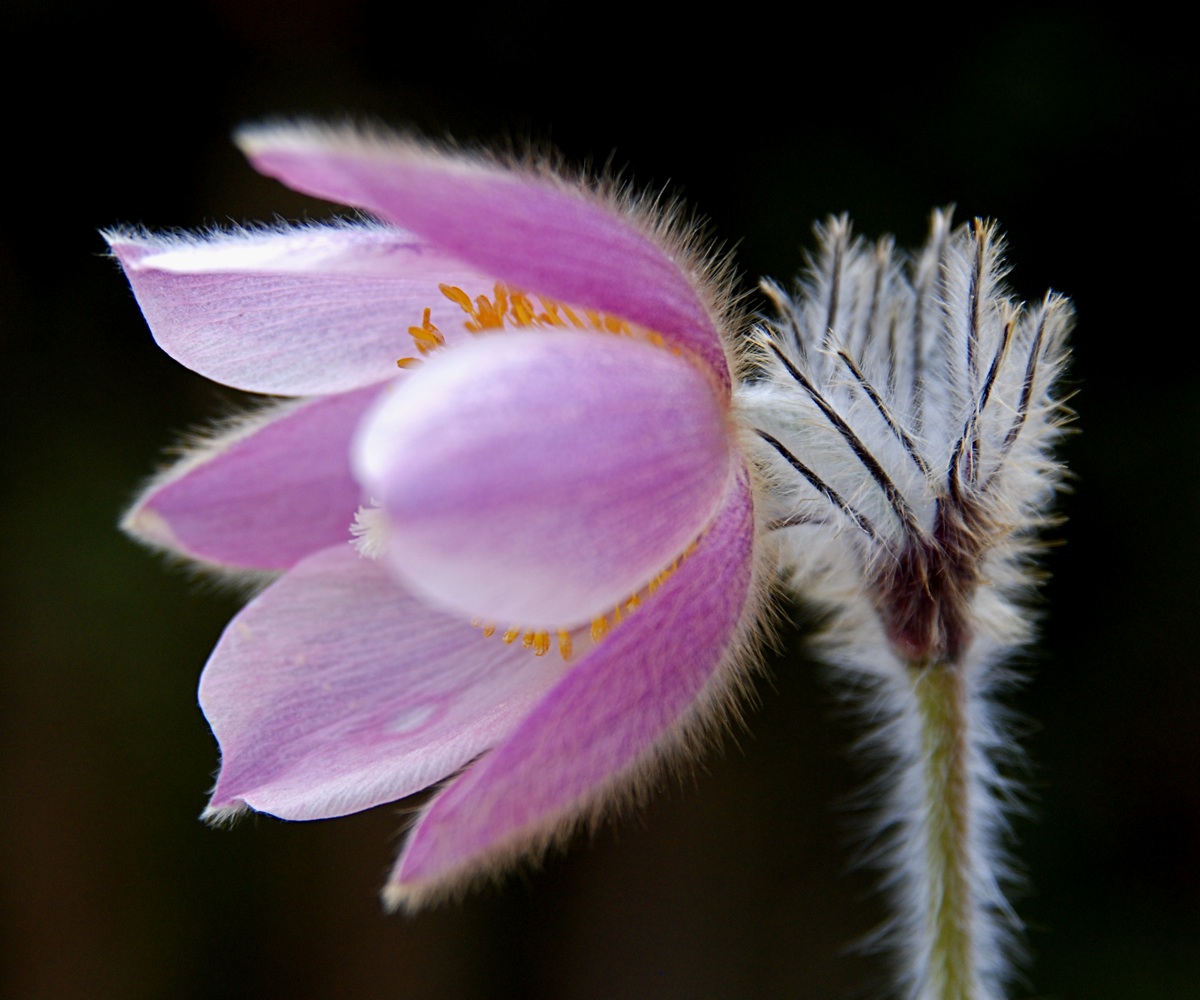
Having melted out from under 20 cm of wet snow today, here's Pulsatilla campanella, not looking too much the worse for wear.
Lori, that's an adorable little Pulsatilla! It's interesting hearing about "snow" now; I always think of my New England climate as late in terms of other more temperate regions (well, not this year with our record-breaking early spring), but we forget that gardeners in more northerly regions still await spring to arrive in earnest.
A short-lived floral treat from Paeonia japonica, the flowers only lasting a couple days at best. It is such a simple beauty, handsome in foliage too, and not as large as many Paeonia, suitable for a choice spot in the woodland garden.
I have some peonies but have not seen japonica before! My peonies are late this year - we have northerly wind from the Arctic although sun it is cold. Here is one of mine, not the dainty japonica but a coarser one, P. lutea ludlowii threatening to bar the way.
I have some peonies but have not seen japonica before! My peonies are late this year - we have northerly wind from the Arctic although sun it is cold. Here is one of mine, not the dainty japonica but a coarser one, P. lutea ludlowii threatening to bar the way.
Trond, lots of promise in those buds. Decades ago when I lived in the Pacific Northwest USA, the garden had a number of tree peonies, including the wonderful P. lutea and its varieties. I have not tried growing it here, although tree peonies are growable here.
When one researches on native American violets, it quickly becomes clear that taxonomy is a tangled mess, and it is sometimes difficult to be certain what one is looking at. There are a number of dissected-leaf Viola species in Eastern USA, and like all violets, they both highly variable interbreed with almost any other species. One of the few references on this topic are a pair of bulletins published by the Vermont Agricultural Experiment Station, one is Violets of North America by Ezra Brainerd, 1921, Bulletin 224, 172 pages (with beautiful line drawings and watercolor plates), and the most telling of the taxonomic mayhem, Some Natural Violet Hybrids of North America, Ezra Brainerd, 1924, Bulletin 239, 203 pages. Dorothy Klaber's book "Violets" published in 1976 is not a very good book in my opinion, with ugly drawings/watercolors, thus less useful than the Brainerd publications. I bought all of these from mailorder book dealers specializing in rare out-of-print natural history and botanical books.
Whatever :D This little native violet with neatly dissected foliage prefers sunny dry sites. It has seeded itself into a bark-mulched "holding area" that I use to temporarily hold potted plants and seedlings, but this violet has never become a pest in the last 2 decades... just popping up here and there, with large purplish blue flowers, always a welcome sight.
2. Grown from NARGS seed by a fellow Chapter member as Viola alpina. I think NOT!!! Any ideas on this one? In my trough it only gets 1.5 inches high (1 inch in the pic), but given good conditions, I'm nearly certain it would get 2-3 inches. A real cutie, whatever it is.
Back in the saddle after spending most of the past week in the environs of Moab, Utah. Which is really just one giant rock garden, after all. I will post a URL once I finally download all my images off the camera and then find a site to upload them onto....
For my pic of the day choice I'm uploading a plant I doubt many of you are growing: I brought this one back in 1998 (I think) from somewhere in the Karoo: it is a widespread taxon on the Roggeveld and Komsberg plateaux and elsewhere too. I first saw it in 1994 on top of Hantamsberg above Calvinia--a magical place indeed. it formed huge mats there sometimes a meter or more across with its silvery, gorgeous rosettes. The flowers are fabulous (albeit white): alas, they only last a week or so in April! There are several other high altitude Arctotis I have not managed to bring back yet--including a bright orange one and a wonderful one with peachy flower color: they are more long blooming and it would be fun to try and cross these with this little groundcover to get some other flower colors and also to see if we can protract the flowering. I think Sunscapes Nursery (www.sunscapes.com) is the only place that sells this.
I have tried to grow American violets more than once but they disappear one after one. I have never been to Utah but to South Africa. South Africa is a very special piece of land. I'll never forget the beautiful plants there! You can get lots of interesting seeds here: http://www.silverhillseeds.co.za/
2. Grown from NARGS seed by a fellow Chapter member as Viola alpina. I think NOT!!! Any ideas on this one? In my trough it only gets 1.5 inches high (1 inch in the pic), but given good conditions, I'm nearly certain it would get 2-3 inches. A real cutie, whatever it is.
Your V. pedatifida looks right, narrower leaf segments than palmata to be sure. The white one sure is nice, I wonder what species it could be.
Kelaidis wrote:
Oh yes, it's Arctotis adpressa...
Arctotis adpressa is a COOL looking plant, looks like it would be worth growing for the unusual foliage alone!
Dear Mark! You are giving me a MAJOR case of Epimedium envy...I am so Epi deprived with my mere six or seven taxa....whimper...
But perhaps I can get back by showing off Scopiola! Alas, I am not sure which one it is. I grew four or more species years ago at the Rock Alpine Garden, two of which persist. I shall have to go see if we still have S. carniolica, a lovely yellow one. There are so few hardy ornamentals in the Solanacee, and this one almost qualifies for the rock garden, although it is a tad tall. It has fabulous anther color. Easily accommodated in the woodland garden. I shall have to delve into my files for a name, alas, unless one of you can turn it up!

Comments
Trond Hoy
Re: Image of the day
Wed, 04/14/2010 - 11:50pmI like this kind of Phlox better than those usually grown here, the big paniculata hybrids!
Mark McDonough
Re: Image of the day
Thu, 04/15/2010 - 4:23amJohn, that's a beauty, I love the western phloxes... every bit as good as Androsace. What the dangerously prickly bad-boy to the right of the phlox? Are you able to grow this in your Sparks/Reno NV garden?
Does anyone know the name of the pink counterpart to the white Phlox 'Tiny Bugles'? I grow both 'Tiny Bugles', which is tiny and adorable, but I have the pink version of 'Tiny Bugles' in two of my troughs in full flower right noww... would like to get a name on it. I'll post photos later on.
Todd Boland
Re: Image of the day
Thu, 04/15/2010 - 4:31amStunning plant John! I wish the western phlox would grow here but I've tried them several times and no go. I am trying yet again with P. kelseyi this year but I am not holding my breath.
John P. Weiser
Re: Image of the day
Thu, 04/15/2010 - 2:15pmThe prickly bad boy is a start of Grusonia emoryi (syn. G. stanlyi). It put on one pad last year and made it through it"s first winter without a scratch.
Yes! I do grow both in my garden for now! ;D They are both new starts from last season.
Todd Boland
Re: Image of the day
Thu, 04/15/2010 - 3:45pmHere is my Primula marginata...just got a new camera and macro lens...makes for very artistic shots with shallow depths of field.
Trond Hoy
Re: Image of the day
Fri, 04/16/2010 - 1:42pmYou certainly got it sharp! I have problems with that using my "new" automatic digital camera. Was easier with my old Nikon.
I have no rock garden Primulas blooming yet but lots of woodland Primulas.
Panayoti Kelaidis
Re: Image of the day
Sat, 04/17/2010 - 6:56amThere are just too many things blooming to pick out only one, so I'm including three of my hundred or so faves. We have had annoyingly nice weather (cool sunny days, cool nights) for weeks: the apricots and almonds, magnolias and forsythias have been blooming for weeks (they usually just bloom a day or two before turning crispy black)...aaaah!
The Fritillarias both came from Jane McGary, (still our NARGS editor and bulb expert extraordinaire)...I realize they are an acquired taste. One I have acquired apparently (I think I grow 30 species at last count--not all of them deign to bloom every year). The black one is F. caucasica and the giant speckled one is F. kotschyana from a Hewer collection.
The Junos have been blooming for weeks: this little morsel came to us as I. zinaidae. There are probably 1000 clumps of Iris bucharica blooming at Denver Botanic Gardens as I type this...
Spring: we wait all year for it, and when it's here I'm a nervous wreck trying to keep up...
McGregorUS (not verified)
Re: Image of the day
Sat, 04/17/2010 - 8:01amPanayoti - I'm glad I'm not the only one who feels that spring is just too quick when it finally comes - everything is rushing along - magnolias are just about to break here - camelias are doing well and everything is going by just so fast. And I've just managed to finish a sandbed - pics to follow sometime - so I've had no time to post anything for a couple of weeks with family having got as far as London to fly back to Washington. Just missed flying out Thursday - cancelled flight then canceled again today and now booked for Tuesday - and the skies are as clear as they can be so this is a short moment inside to read what's being posted.
I love the Iris - very beautiful - I've got I. bucharica in flower for the last week - but that one is very nice and so compact - does it set seed?
Todd Boland
Re: Image of the day
Sat, 04/17/2010 - 3:57pmI agree Panayoti..that iris is wonderful!
John P. Weiser
Re: Image of the day
Sat, 04/17/2010 - 6:30pmPK
Great shots of the Frits and Iris.
I have never tried Junos. I guess, I didn't research them enough and have never seen them growing in anyones garden. I will just have to add it to my fall list of bulbs. Sounds like they would do well for me.
Panayoti Kelaidis
Re: Image of the day
Mon, 04/19/2010 - 10:33amMy garden is going crazy: since there haven't been any images of the day for much of the past week, I suspect the same is true for everyone else...we are all on tenterhooks in Denver because of the consistently mild weather. It's wonderful! But snows will come again and our last frost date (average) is still 3 weeks away. How luxurious it is to watch Magnolias and forsythias bloom unfrosted for weeks and weeks...aaaah!
The following picture says it all: It's that Dutch selection of Tulipa humilis with the interminable name and outrageous prices (which have been coming down). I've grown it here and there, but finally found a spot where they seem to like it....
John P. Weiser
Re: Image of the day
Tue, 04/20/2010 - 5:32amPK
Lovely.
They are beautiful!! I have never seem a tulip with a purple center before! :o
They must really catch your eye when you pass.
Mark McDonough
Re: Image of the day
Tue, 04/20/2010 - 7:33amPanayoti, nice Iris zenaidae :o :o :o
Also nice pic of Tulipa humila alba (or as so well established in Hort: Tulipa humilis 'alba coerulea oculata'), it is a such an unusual color form as dwarf species tulipa goes, a beautiful flower. Yes, I paid a stupid amount for a couple bulbs about 7-8 years ago. It would come up and flower, but as I was a working man with long daily commute, I'd never see the dang thing open. How sad is this: I would actually go outside at night when I got home from work, and with flashlight in hand, gingerly peel open the flower to see the famous blue center :'( Pathetic!
One year, at long last, I finally did see a single bloom open in daylight. And that's the last I've seen of it since.
Went looking for some more pics of this tulip, here's a stunner:
http://3.bp.blogspot.com/_GBrtC5njfhk/Su_MQjyLdZI/AAAAAAAAJ-w/aUL3BCpQE3...
Trond Hoy
Re: Image of the day
Tue, 04/20/2010 - 12:11pmI have always wanted to grow more Irises and not just the common garden types. When I see your plant, Panayoti, the lust overwhelms me! I have grown several cultivars of Tulipa humilis but they are shortlived acquaintances.
Panayoti Kelaidis
Re: Image of the day
Tue, 04/20/2010 - 2:23pmHere's something entirely different: how about a cormous plant in the Barberry family? I believe this is a Leontice. It was originally brought to me as a gift by a well known Czech collector, probably originating in one of the stans. There are a half dozen species kicking around there, so I am not sure which one this is (any guesses I would be grateful for). I grew it for fifteen years or so at my Eudora garden where it did nothing. I moved it to Quince three years ago and it has finally (probably nearly 20 years later) decided to bloom. I'm tickled pink (or yellow). Now let's hope it's self fertile...
Mark McDonough
Re: Image of the day
Wed, 04/21/2010 - 5:11amCongratulations Panayoti! And only 20 years to bloom :P
It looks similar to Leontice leontopetalum in this link:
http://www.srgc.org.uk/smf/index.php?topic=5044.0
I like the look of these strange plants, and the closely allied genus Gymnospermium:
http://www.srgc.org.uk/smf/index.php?topic=5235.0
John P. Weiser
Re: Image of the day
Wed, 04/21/2010 - 5:51amMark
Looks like you nailed that ID down. Good job!
Mark McDonough
Re: Image of the day
Wed, 04/21/2010 - 6:04amLast year, my fat luxuriant clumps of Juno Iris were eaten by deer, sheared off to the base of the clasping leaves. After growing these outside for nearly a decade, this is the first time deer ate them, deer only rarely come through, and of course they eat the most treasured items. Subsequently, rain water got into the severed leaf bases and rotted them. I feared all would be lost. Of the 8 species or varieties I had, there is no sign of 3, 3 others only show only a few small non-flowering plants coming up, and two others are flowering, albeit the quantity of bulbs cut way back.
So here is the brave 'Warlsind' flowering this year, a mere remnant of the big clumps of previous years. Has anyone noticed how perfumed the flowers are, one of the few junos with a good fragrance.
Image of the Day: Iris 'Warlsind'
Todd Boland
Re: Image of the day
Wed, 04/21/2010 - 2:41pmStunning iris Mark! Wish I could grow the junos but they just don't like our moisture levels.
Mark McDonough
Re: Image of the day
Wed, 04/21/2010 - 5:08pmTry planting in pure sand (raised bank of pure sand), that's the only trick necessary.
Richard T. Rodich
Re: Image of the day
Wed, 04/21/2010 - 8:14pmWhat a spectacular cultivar, and how well it is grown!
Trond Hoy
Re: Image of the day
Wed, 04/21/2010 - 10:43pmKelaidis, well done waiting 20 years for flowers! I have sown some trees and hope I shall have flowers while I am still alive but herbs....
Mark, Juno irises are out of question for me but I not for you!
Mark McDonough
Re: Image of the day
Thu, 04/22/2010 - 6:38amThe Juno irises are unnecessarily shrouded in my mystique; many are dirt easy to grow. John Lonsdale, plantsman extraordinaire and horticultural myth buster, grows these outdoors without any problems. He gave me my start with some of the easy species like I. vicaria, graeberiana, magnifica, and a few hybrid selections... he told me, just grow them in sand. I created a sand bed bermed up about 12", without any hard edges to the bed, and planted the forked carrot-like rhizomes in the sand. Reliably each spring the "corn patch" sprang to life, and after a few years, put on an amazing show. Here are 4 photos taken early May 2007 and 2008. I think Iris vicaria must have had 100 stems, absolutely gorgeous, and 'Warlsind' had about 16 stems. In 2009, imagine this scene as a deer salad bar >:(
The last few years I had intended to divide the plants up, so crowded had they become, but never got around to it.
Trond Hoy
Re: Image of the day
Thu, 04/22/2010 - 1:47pmYou know, Mark, deer (and slugs) always know what are good!
Trond Hoy
Re: Image of the day
Sun, 04/25/2010 - 3:33amHere's one that neither deer nor slugs eat: Vinca minor. It is a little humble in flowering but not in growth! Still, it is one favorite starting rather early, being in flower a month already. Furthermore it stays green all winter which the bigger cousin, V. major not always does.
Todd Boland
Re: Image of the day
Sun, 04/25/2010 - 2:56pmMark, Juno are impossible in Newfoundland...several of our members have tried and no one has been able to keep them alive after a single year. Even bucharica only survives 2, maybe 3 years then nothing. Quite a heart-break.
Trond, Vinca is a vicious weed in my garden..I am constantly fighting against it.
Here is my photo of the day...Heloniopsis orientalis.
Mark McDonough
Re: Image of the day
Mon, 04/26/2010 - 4:15amTodd, your new camera is showing off it's muscle with that second shot of Heloniopsis orientalis; beautiful in-focus detail of the stamens. I've only seen Heloniopsis orientalis in a paler form, your form is a good color. An intriguing plant.
Trond Hoy
Re: Image of the day
Mon, 04/26/2010 - 6:54amYes, Vinca is a weed but I let it loose in shrubbery and woodland.
I haven't been lucky with my H. orientalis plants, don't know why; and I have never succeeded in sowing it.
Mark McDonough
Re: Image of the day
Thu, 04/29/2010 - 9:41amToday's pic; Trillium grandiflorum roseum has been in flower a couple days, but the sun came out today to show off the flowers. The gusting wind is relentless today, so these shots were "live motion" pics... just couple a bunch until I got a couple in focus
Attending my local New England Chapter NARGS meeting and plant auction a couple weeks ago, a 1-stemmed plant of this went for $50 :o
Trond Hoy
Re: Image of the day
Thu, 04/29/2010 - 10:38amI am not sure I would have paid $50 for one plant but I would love to grow such plants in my garden!
I have had ordinary T. grandiflora several times and a huge clump of T. cernuum and others too but they have all suddenly disappeared - and I don't know why.
But I will try more, I know several Trilliums growing well other places.
Richard T. Rodich
Re: Image of the day
Thu, 04/29/2010 - 6:53pmWe can maybe get that kind of $$$ for a planted trough at our sales. Your Chapter really knows their plants! (And a very nice one this is.)
Trond Hoy
Re: Image of the day
Fri, 04/30/2010 - 12:06amCorylopsis, not exactly a typical rock garden genus, is still a gardenworthy group of plants. This "extremely" cold winter has delayed the blooming for a couple of weeks.
Mark McDonough
Re: Image of the day
Fri, 04/30/2010 - 6:14amTrond, it's a beautiful shrub, what species is it? The first photo really captures the charm of this early bloomer. I've been wanting to add Corylopsis to my garden for years. Every garden needs some choice trees and shrubs, as they create planting opportunities underneath them for the smaller plants. :D
Trond Hoy
Re: Image of the day
Fri, 04/30/2010 - 9:58amIt is C. pauciflora. Sorry, I forgot to write it.
Richard T. Rodich
Re: Image of the day
Fri, 04/30/2010 - 2:00pmI am hoping someday I will come across a form in the genus hardy enough to survive my cold climate.
Lori S. (not verified)
Re: Image of the day
Fri, 04/30/2010 - 6:54pmHaving melted out from under 20 cm of wet snow today, here's Pulsatilla campanella, not looking too much the worse for wear.
Mark McDonough
Re: Image of the day
Sun, 05/02/2010 - 5:57amLori, that's an adorable little Pulsatilla! It's interesting hearing about "snow" now; I always think of my New England climate as late in terms of other more temperate regions (well, not this year with our record-breaking early spring), but we forget that gardeners in more northerly regions still await spring to arrive in earnest.
Mark McDonough
Re: Image of the day
Sun, 05/02/2010 - 6:00amA short-lived floral treat from Paeonia japonica, the flowers only lasting a couple days at best. It is such a simple beauty, handsome in foliage too, and not as large as many Paeonia, suitable for a choice spot in the woodland garden.
Trond Hoy
Re: Image of the day
Sun, 05/02/2010 - 11:00amI have some peonies but have not seen japonica before! My peonies are late this year - we have northerly wind from the Arctic although sun it is cold. Here is one of mine, not the dainty japonica but a coarser one, P. lutea ludlowii threatening to bar the way.
Trond Hoy
Re: Image of the day
Sun, 05/02/2010 - 11:02amMy Pulsatillas have not experienced snow but they have not started flowering either!
This is a nice one.
Mark McDonough
Re: Image of the day
Sun, 05/02/2010 - 4:21pmTrond, lots of promise in those buds. Decades ago when I lived in the Pacific Northwest USA, the garden had a number of tree peonies, including the wonderful P. lutea and its varieties. I have not tried growing it here, although tree peonies are growable here.
Mark McDonough
Re: Image of the day
Mon, 05/03/2010 - 5:56amImage of the day: Viola palmata
When one researches on native American violets, it quickly becomes clear that taxonomy is a tangled mess, and it is sometimes difficult to be certain what one is looking at. There are a number of dissected-leaf Viola species in Eastern USA, and like all violets, they both highly variable interbreed with almost any other species. One of the few references on this topic are a pair of bulletins published by the Vermont Agricultural Experiment Station, one is Violets of North America by Ezra Brainerd, 1921, Bulletin 224, 172 pages (with beautiful line drawings and watercolor plates), and the most telling of the taxonomic mayhem, Some Natural Violet Hybrids of North America, Ezra Brainerd, 1924, Bulletin 239, 203 pages. Dorothy Klaber's book "Violets" published in 1976 is not a very good book in my opinion, with ugly drawings/watercolors, thus less useful than the Brainerd publications. I bought all of these from mailorder book dealers specializing in rare out-of-print natural history and botanical books.
The USDA lists the species as an aggregate of hybrids, as Viola ×palmata L. (pro sp.) [brittoniana or pedatifida × affinis or sororia]
http://www.plants.usda.gov/java/profile?symbol=VIPA18
Whatever :D This little native violet with neatly dissected foliage prefers sunny dry sites. It has seeded itself into a bark-mulched "holding area" that I use to temporarily hold potted plants and seedlings, but this violet has never become a pest in the last 2 decades... just popping up here and there, with large purplish blue flowers, always a welcome sight.
Todd Boland
Re: Image of the day
Mon, 05/03/2010 - 4:51pmI grew Viola dissecta last year...hopefully they will flower this year...the foliage looks like your V. palmata...wonder if they are related?
Richard T. Rodich
Re: Image of the day
Mon, 05/03/2010 - 5:12pm1. Received as Viola pedatifida.
2. Grown from NARGS seed by a fellow Chapter member as Viola alpina. I think NOT!!!
Any ideas on this one? In my trough it only gets 1.5 inches high (1 inch in the pic), but given good conditions, I'm nearly certain it would get 2-3 inches. A real cutie, whatever it is.
Panayoti Kelaidis
Re: Image of the day
Tue, 05/04/2010 - 3:43amBack in the saddle after spending most of the past week in the environs of Moab, Utah. Which is really just one giant rock garden, after all. I will post a URL once I finally download all my images off the camera and then find a site to upload them onto....
For my pic of the day choice I'm uploading a plant I doubt many of you are growing: I brought this one back in 1998 (I think) from somewhere in the Karoo: it is a widespread taxon on the Roggeveld and Komsberg plateaux and elsewhere too. I first saw it in 1994 on top of Hantamsberg above Calvinia--a magical place indeed. it formed huge mats there sometimes a meter or more across with its silvery, gorgeous rosettes. The flowers are fabulous (albeit white): alas, they only last a week or so in April! There are several other high altitude Arctotis I have not managed to bring back yet--including a bright orange one and a wonderful one with peachy flower color: they are more long blooming and it would be fun to try and cross these with this little groundcover to get some other flower colors and also to see if we can protract the flowering. I think Sunscapes Nursery (www.sunscapes.com) is the only place that sells this.
Oh yes, it's Arctotis adpressa...
Trond Hoy
Re: Image of the day
Tue, 05/04/2010 - 10:04amI have tried to grow American violets more than once but they disappear one after one.
I have never been to Utah but to South Africa. South Africa is a very special piece of land. I'll never forget the beautiful plants there!
You can get lots of interesting seeds here: http://www.silverhillseeds.co.za/
Mark McDonough
Re: Image of the day
Tue, 05/04/2010 - 8:15pmYour V. pedatifida looks right, narrower leaf segments than palmata to be sure. The white one sure is nice, I wonder what species it could be.
Arctotis adpressa is a COOL looking plant, looks like it would be worth growing for the unusual foliage alone!
Mark McDonough
Re: Image of the day
Wed, 05/05/2010 - 6:05amTwo plants for the price of one in today's Image of the Day.
The always-photogenic Arisaema sikokianum, with the delightful sprays of tiny yellow thimbles of Epimedium campanulatum.
Trond Hoy
Re: Image of the day
Wed, 05/05/2010 - 1:20pmNot any of my Arisaemas has showed itself so far. With this speed I am lucky if I see them at all this summer!
The E. campanulatum is new to me. Interesting habit.
Panayoti Kelaidis
Re: Image of the day
Sun, 05/09/2010 - 4:38amDear Mark! You are giving me a MAJOR case of Epimedium envy...I am so Epi deprived with my mere six or seven taxa....whimper...
But perhaps I can get back by showing off Scopiola! Alas, I am not sure which one it is. I grew four or more species years ago at the Rock Alpine Garden, two of which persist. I shall have to go see if we still have S. carniolica, a lovely yellow one. There are so few hardy ornamentals in the Solanacee, and this one almost qualifies for the rock garden, although it is a tad tall. It has fabulous anther color. Easily accommodated in the woodland garden. I shall have to delve into my files for a name, alas, unless one of you can turn it up!
Pages