Enough Virus Talk! Your 'Katharine Hodgkin' look pretty nifty to me, Mark. But I suppose discretion is the better part of valor.
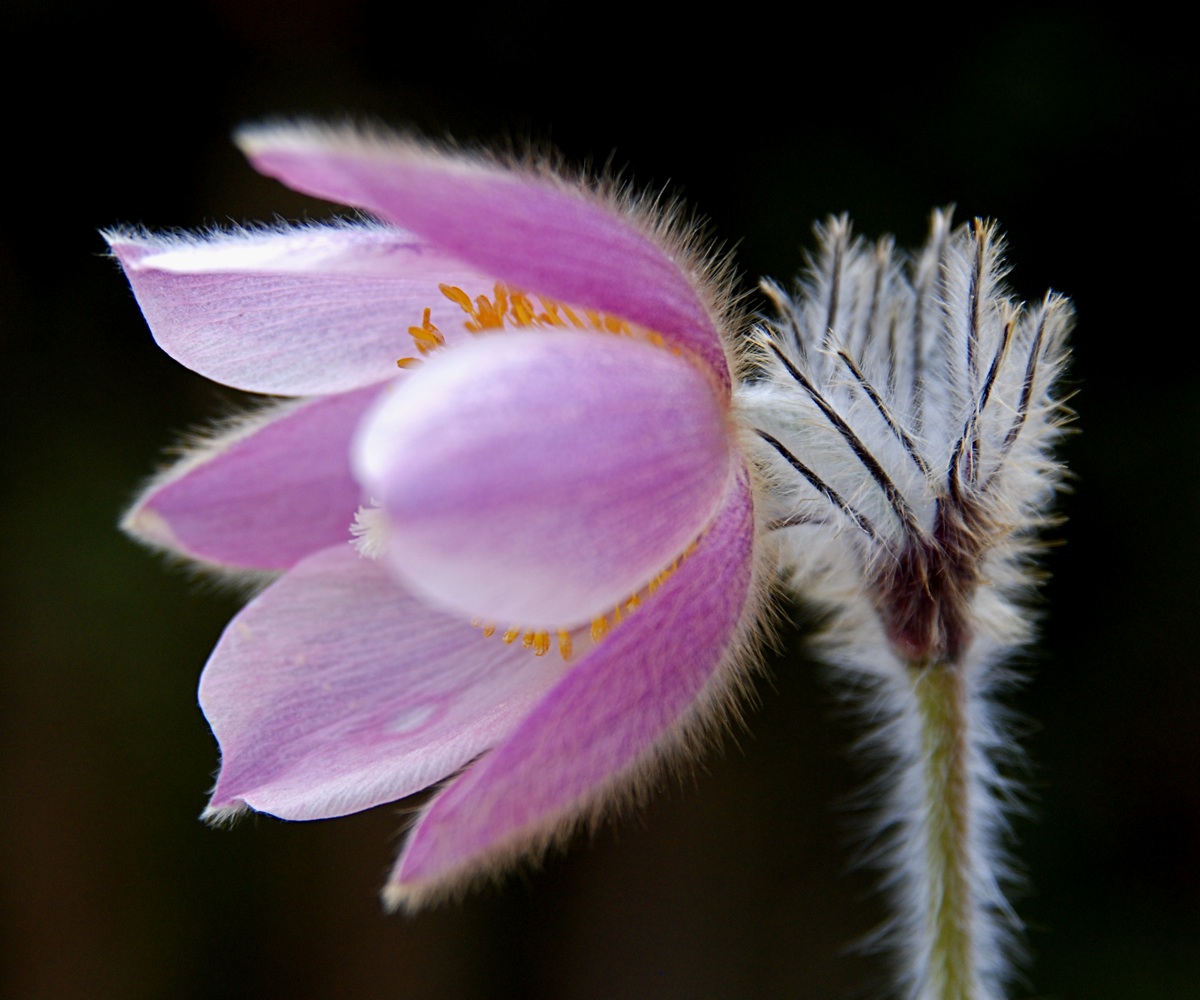
I don't think an image has been posted for today: I propose Tradescantia tharpii, surely the most magnificent dayflower I know of. It grows in rocky glades in Kansas, Missouri and perhaps neighboring states as well. It is quite local in nature, apparently (and I think variable). Bluebird nursery wholesales this plant, and their form is outstanding: virtually stemless. and very hairy. It blooms for a long time. Flower color is either pink or lavender blue. It is easy to grow and has not shown signs of weediness (unlime most any other dayflower)...
Panayoti, if you keep slinging this native plant eye-candy at us, we're all going to catch the plant-obsession VIRUS (if we don't already have it). I want 2, 3 or 10 of those tharpii thingies please. There was a period when I was investigating some of the native midwestern Tradescantia, not sure how I missed T. tharpii, it's a furry must-have beauty. OHHH, I see it is available on the 2009-2010 NARGS Surplus Seedex, so in goes my order tomorrow ;D ;D ;D
I bought this as Tradscantia tharpii. Obviously not. Compared to regular hybrids like Purple Profusion (T. x andersoniana) which I grow, flowers are the same size, height half to two-thirds of PP,and leaf length half of PP. Stems thicker, and very succulent. Any ID guesses?
The last pic shows true color.
P.S. Purple Profusion really does have purple shoots in the early spring, but the color does last long. I received it from the cultivar's originator.
I know that feeling so well. I'm hoping that my surplus seed request manages to secure Trifolium macrocephalum which Mark posted great pictures of in the "Trifolium" board. Plus all the other goodies that I didn't get round to last time - like Allium flavum ssp. tauricum - this time from Mark's "Allium Central" website.
I know that feeling so well. I'm hoping that my surplus seed request manages to secure Trifolium macrocephalum which Mark posted great pictures of in the "Trifolium" board. Plus all the other goodies that I didn't get round to last time - like Allium flavum ssp. tauricum - this time from Mark's "Allium Central" website.
My Surplus Seed Order is being sent in today... Malcolm, I hope you didn't snag the last bit of Trifolium macrocephalum, I put it on my list too! And if you don't get any A. flavum ssp. tauricum, let me know, I can send some... you need to have little orange, red, and pastel sunset shade onions in your garden.
I hope we both get it - otherwise I hope there's enough in the packet to split it.
And you're quite right about what I hope I'm going to get with the Allium - it just looks so good -wonderful and so summery in the color mix and the mix of sizes.
Don't forget, all you working guys, Lori reminded us that Trifolium macrocephalum is available from Alplains, along with some other choice alpine Trifolium, http://www.alplains.com/
Image of the day: Crocus biflorus ssp. isauricus, started blooming yesterday, beating its earliest flowering by 2 weeks! It is a wee thing, very cute... so cute that I'm showing several photos. The sun was strong yesterday, with the glare it was hard not to get washed out photos, but you'll get the idea.
Very lovely, Mark! I have some biflorus in my garden too and other species as well but they are still covered by 40cm of snow. Some should have flowered by now.
Very lovely, Mark! I have some biflorus in my garden too and other species as well but they are still covered by 40cm of snow. Some should have flowered by now.
Yours will be up soon enough I'm sure. What surprised me, is that the ground is still quite frozen in most of the yard and garden, so walking around looking things over this past weekend, the two days unusually warm and sunny, I did not spot any crocus near flowering except Crocus vitellinus, normally always the first to bloom. Then suddenly these were in bloom yesterday, popping out of the bare ground like magic :D
If I'm lucky, I might have my first crocus open by April 1...rare for them to be open earlier. That is a lovely C. biflorus selection. I have C. biflorus var. tauri.
Photo of the day: Rhodiola rosea. Here is one that enjoys a distribution throughout the northern hemisphere. Locally, they grow within the kiss of the sea and as you can see, don't require much soil to thrive!
Todd, I have seen many "rosenrot" (Rhodiola rosea) in Norway. They grow from sea level to the highest mountains. But I have never seen an individual like this!
If I'm lucky, I might have my first crocus open by April 1...rare for them to be open earlier. That is a lovely C. biflorus selection. I have C. biflorus var. tauri.
You know, Todd, you live in VINLAND and I thought the climate was mild there?
Rhodiola rosea is extremely common everywhere in the Altai mountains I traveled last summer in both Kazakhstan and Mongolia. I took a lot of pictures of it, although the one I am appending is rather typical. I found some monstruouse forms and quite a few other Rhodiola spp. on the trip as well, which I wrote about in Ray Stephenson's terrific Sedum Society Newsletter (first half of my piece is in January 2010, number 92; the second half is out in the next issue).
This is being harvested in Russia in large quantities because of its supposed medicinal properties: There's actually a huge literature on its healing and vitality-enhancing properties, and there is quite an industry promoting and selling it (I'm a bit concerned about overcollection over time). Not quite as serious a problem as Rhinocerus horn or Tiger bones, but worrisome.
Just noticed we're a day or two behind on Booker's little project here, so in honor of my son's eighteenth birthday (yes, it is today!) I shall post what I think is the most beautiful and wonderful of all Rhodiolas: actually, there are quite a few gems in the genus, but this one is one I actually grew for many years (as Rhodiola kirilowii--a different species actually). This apparently should be called Rhodiola linearifolia, and I found it in a lush meadow just below treeline in the Tien Shan, just above Almaty (one of the most magnificent days in my life, which I am writing up for the NARGS bulletin)...This grows in somewhat drier spots than most of the R. rosea I have observed. Not for those who don't love orange!
Amazing how well distributed Rhodiola rosea is.....never thought about them being in the Altai!
[/quote]You know, Todd, you live in VINLAND and I thought the climate was mild there? [/quote]
Who told you we were mild? Were you reading the Viking Sagas? Lies, all lies! LOL! We are not nearly as mild as you my friend. We have the cold Labrador Current while you get the Gulf Stream.
Wonderful Rhodiola everyone, enjoyed seeing the variation of R. rosea.
A reprise on a former "Image of the Day"; I had more flowers on Crocus biflorus ssp. isauricus open, but one is different, it has 10 petals! I am told that this can sometimes happen, and that in subsequent years the flowers will go back to normal, although there are a couple stable multipetalous forms in cultivation.
Here are two photos of my decempetalous form (in the lower right in each photo).
Not to mention that lovely form of Crocus biflorus..my crocuses are starting to kick in in earnest. Looks to be a good year for bulbs. Waiting for it to warm up enough to go out and make a big dent in spring cleanup today (gorgeous sunny weather).
Wonderful Rhodiola everyone, enjoyed seeing the variation of R. rosea.
A reprise on a former "Image of the Day"; I had more flowers on Crocus biflorus ssp. isauricus open, but one is different, it has 10 petals! I am told that this can sometimes happen, and that in subsequent years the flowers will go back to normal, although there are a couple stable multipetalous forms in cultivation.
Here are two photos of my decempetalous form (in the lower right in each photo).
Mark, You must keep an eye on this one! Maybe it is stable. I have had crocuses with 7 tepals but none like this regular pentameric one.
We finally hit 40 F today...warmest day for 2010. Still lots of snow in the garden but in the few melted areas, I see a couple of crocus and daffs just poking up.
We had 40F last week but today we have had 35F snow and sun alternating. However I observed the first crocuses (C. tommasinianus I think or a hybrid) in my garden! While I were looking a hawk took one of the blackbirds too!
It is a beaut! I had a yellow crocus - one of the common commercially available sorts - produce a flower with extra petals (not sure if it was truly double) one year, but it seemed to be a one-time thing.
Here's a photo for today. Minuartia austromontana is quite common on dry alpine slopes here, but is probably not one that attracts much attention... The effect it makes, even though it lacks or has only rudimentary petals, is really quite interesting.
Here's a close-up, too, to show the sepals and few, rudimentary petals.
That Minuartia is a new one for me: I don't think we have it in our austro montanas...
The various Arenarias and Minuartia are really a terrific lot, and generally good performers in the garden. I notice more and more accruing over the years in my garden. I must photograph some this coming year!
I puzzled over the identity of that one for a very long time... I think I finally pinned it down, but if anyone has a different opinion, please let me know!
Kelaidis wrote:
The various Arenarias and Minuartia are really a terrific lot, and generally good performers in the garden. I notice more and more accruing over the years in my garden. I must photograph some this coming year!
I, for one, am certainly looking forward to seeing them!
In Norway the wild Minuartia are small but can be showy if you use a magnifying glass. Some of the Arenarias are better when you find them in the high mountains along glaciers etc.
The genus I choose today is not very common in Norway, but this species I found in Turkey last summer at about 3000m on the rim of Nemrut Volcano where it was very common. Do anybody grow Orobanche in their garden?
The genus I choose today is not very common in Norway, but this species I found in Turkey last summer at about 3000m on the rim of Nemrut Volcano where it was very common. Do anybody grow Orobanche in their garden?
That looks like an Orangebanche to me ;D ;D ;D I find these things interesting wherever you find them. I wonder what it parasitizes?
I don't grow any Orobanche but I had one arise spontaneously in the front yard one year - not so spectacularly-coloured as yours but I found it very interesting nonetheless! I'll have to look back through my old photos and figure out the species (of the 3 that occur here).
Trond, being parasitic, I expect Orobanche are next to impossible in cultivation....you'd need the host species for starters!
Yes, I know! But people seems to try to grow anything, so why not this? I have tried to infest my ivy with ivy broomrape but no luck yet. (That is I haven't seen anything.)
I thought I had responded to this post on Orobanche, but apparently haven't as I read over it. I think I was trolling my thousands of digital pictures trying to find the picture of it, but indeed, Orobanche can be grown and I have grown them very well on several occasions. I believe the species I grew was our local one (fasciculata?) which resembles O. uniflora in its white phase--very small, looking like a miniature Indian pipe. I found some in seed once and collected it, and then I scattered it on the Pawnee Buttes trough at Denver Botanic Gardens (I collected it in a prairie, and this was a prairie trough, I figured it might like it). You can imagine my chagrin a year or two later when a hundred or more stems of the Orobanche popped up all over the trough---I think quite a bit of the seed germinated. The gardener in charge of the garden freaked out, not knowing what I had done. I explained it was not a bad thing, but he wasn't convinced. I have been guilty of this sort of "seed scattering" strategy throughout the gardens over the years, so that now that anything anomalous occurs everyone blames me. Scattering seed of challenging plants is usually the best way to grow them: that's how I first grew Dactylorhiza as well. Fritz Kummert showed a spectacular slide of Phelypaea coccinea, possibly the most spectacular temperate Orobanch, although I have seen a very showy scarlet Orobanche in South Africa as well (and a spectacular bright purple one in Kazakhstan last summer: I shall have to dig into my files and dig these up!) . My trough orobanches lasted two or three years and petered out (they were parasitic on Artemisia frigida, I believe: the artemisia persists). I grew them in the ground as well, where they lasted a bit longer.
Fascinating comments on Orobanche and such, will return to this subject, but first, a couple new images of the day:
After 3 days of gale force winds and 10" of rain, yesterday the sun came out, and so did a number of Crocus chysanthus hybrid seedlings in their 4th year from seed. Interesting too, that the chrysanthus hybrids are blooming 2 weeks earlier than in any of the past 10 years, but even with the early date, bees were busy visiting the blooms. The first two photos show a purplish-beige and yellow combination (showing genes from C. chysanthus 'Advance'), the last photo showing the same plant but with flowers more closed rendering a cream-beige appearance.
Is this a deliberate cross you have made or just Mother Nature? My crocuses self sow but I have never collected seed. I let them spread in the lawn.
Mosty Mother nature, but I assist with the effort (pollen painting, seed harvesting then scratching in the seed in situ). Mother Nature and I, we're a team :D
Tis crocus season here. One of my very favorite croci is C. gargaricus, a Turkish delight. It is amusing how the little golden "lipstick" spears show brilliant color as they emerge directly from the soil. The small golden orange goblets are among the brightest of all crocus species. Update photo,2 days after the first photo.
Iris tigridia (I hope I have the name right) is usually the first of the rhizomatous irises to bloom for me, and I notice it was up (glorious weather in the 70's last two days: now several inches of snow are expected today and tomorrow--otherwise it might even have popped). I obtained it from one of the Czechs (Jurasek?) years ago and have grown it under this name: can anyone verify it? It looked a bit like the Iris potaninii I saw last summer in Mongolia, and doubtless they are allied in the same section (Pseudoregelia, I believe). It has a bit of a resemblance to humilis and manchurica for that matter: these little Central Asian miniatures are all lovely: I wish I had lots of collections of all of them to really have a sense of their range of variation (and relationship to one another)!
"Iris tigridia" is sold by Beaver Creek (otherwise perfect in their names), but I am reasonably sure their plant is actually I. bloudowii: will show pix of that when it blooms again in a few weeks: it is more closely allied to humilis: I saw it last summer in Kazakhstan. It grows in more alpine, wetter habitats.
(image renamed to indicate possible identity correction - MMcD)
Iris tigridia (I hope I have the name right) is usually the first of the rhizomatous irises to bloom for me, and I notice it was up (glorious weather in the 70's last two days: now several inches of snow are expected today and tomorrow--otherwise it might even have popped). I obtained it from one of the Czechs (Jurasek?) years ago and have grown it under this name: can anyone verify it? It looked a bit like the Iris potaninii I saw last summer in Mongolia, and doubtless they are allied in the same section (Pseudoregelia, I believe). It has a bit of a resemblance to humilis and manchurica for that matter: these little Central Asian miniatures are all lovely: I wish I had lots of collections of all of them to really have a sense of their range of variation (and relationship to one another)!
"Iris tigridia" is sold by Beaver Creek (otherwise perfect in their names), but I am reasonably sure their plant is actually I. bloudowii: will show pix of that when it blooms again in a few weeks: it is more closely allied to humilis: I saw it last summer in Kazakhstan. It grows in more alpine, wetter habitats.
(image renamed to indicate possible identity correction - MMcD)
Panayoti, I think you nailed it, looking through Jim Waddick and Zhao Yu-tang's Iris of China, I would agree this lovely Iris comes closer to Iris bloudowii; the disposition of the flower components, particularly the sudden erect bifid style-arms at the apex, fit the description, and of course, the yellow flower color. I renamed the uploaded photo accordingly. Iris tigidia is described as having violet flowers. We need to get Iris-maestro Jim Waddick over here onto the NARGS Forum!!!
Helleborus niger is soooo sloooooowwww, taking years to bulk up, but so worth it. In summer I scratch in the seed that reliable sets, and now have many seedlings growing close by. This species is much lower growing than many Helleborus species, and hardier too, thus an excellent one for shade to partially shaded rock garden situations. The deep green foliage always looks great. The winter-burned leaves evident in the photo are of a nearby Epimedium which needs to have its leaves cut off before the spring flush.
We've had H. niger blooming here and there for several months now, and holding up quite well. I clicked on your picture, and your's doesn't quite look like any of ours (and each one I grow or the dozen or so at Denver Botanic Gardens each has its own character). Yes, H. niger is the queen of Hellebores and certainly one of the most essential garden plants. It's starting to self sow a bit much for me and I hate digging up the seedlings, even if they do go to good homes! You never know if a slightly pinker or slightly larger flowered one might not be among them. Our Lenten roses are now kicked in, and Helleborus thibetanus is almost over. We finally have Helleborus versicarius: there's a picture of it at the bottom of Mike Kintgen's recent blog: http://www.botanicgardensblog.com/2010/03/16/whats-happening-in-the-rock... Our sun is so intense that there are daffodils blooming on south walls all over town, while the crocuses in shady parts of the garden have yet to open. Tulipa biflora is blooming its head off at the Gardens (the white Iranian form). Spring is defnitely sprung!
Our sun is so intense that there are daffodils blooming on south walls all over town, while the crocuses in shady parts of the garden have yet to open. Tulipa biflora is blooming its head off at the Gardens (the white Iranian form). Spring is definitely sprung!
That's the difference between your climate and mine! Although the spring is definitely sprung here too, the sun is low in the sky and not intense at all. Today we reached the 10C mark for the first time this year :) But H.niger and others of the genus are in flower and a lot of others too.
No garden plant today but a wild plant I found two or three years ago. First find ever in Norway! It is more common further south and I think it also are found in North America. Summer-flowering.
No garden plant today but a wild plant I found two or three years ago. First find ever in Norway! It is more common further south and I think it also are found in North America. Summer-flowering.
A pretty plant. The extent of its distribution seems vaguely reported.
Distribution of L. vulgare is generally attributed to Western Europe and North Africa, although I found Russian web sites that report the species is there too.
Seeing the suggestion that Limonium vulgare occurs in Saskatchewan and Ontario (a very peculiar and nontypical distribution for Canadian species), I was surprised and had to take a closer look... It's actually introduced. It's described as a "waif" - "an ephemeral introduction, not persistently naturalized".
I think this (status: introduced) would explain the apparent "dispute" with eFlora of NA.
Updated Image of the Day: this year perhaps due to some combination of weather conditions, Helleborus niger is changing to a strong pink color, more so than in previous years. Here's the photo link taken just 4 days ago, and two photos taken recently. http://nargs.org/smf/index.php?topic=24.msg1123#msg1123

Comments
Mark McDonough
Re: Image of the day
Sun, 03/07/2010 - 4:34pmPanayoti, if you keep slinging this native plant eye-candy at us, we're all going to catch the plant-obsession VIRUS (if we don't already have it). I want 2, 3 or 10 of those tharpii thingies please. There was a period when I was investigating some of the native midwestern Tradescantia, not sure how I missed T. tharpii, it's a furry must-have beauty. OHHH, I see it is available on the 2009-2010 NARGS Surplus Seedex, so in goes my order tomorrow ;D ;D ;D
Richard T. Rodich
Re: Image of the day
Sun, 03/07/2010 - 7:15pmI bought this as Tradscantia tharpii. Obviously not. Compared to regular hybrids like Purple Profusion (T. x andersoniana) which I grow, flowers are the same size, height half to two-thirds of PP,and leaf length half of PP. Stems thicker, and very succulent. Any ID guesses?
The last pic shows true color.
P.S. Purple Profusion really does have purple shoots in the early spring, but the color does last long. I received it from the cultivar's originator.
Richard T. Rodich
Re: Image of the day
Sun, 03/07/2010 - 7:20pmDang! I sent in my suplus seed order yesterday!
McGregorUS (not verified)
Re: Image of the day
Mon, 03/08/2010 - 1:18amI know that feeling so well. I'm hoping that my surplus seed request manages to secure Trifolium macrocephalum which Mark posted great pictures of in the "Trifolium" board. Plus all the other goodies that I didn't get round to last time - like Allium flavum ssp. tauricum - this time from Mark's "Allium Central" website.
Mark McDonough
Re: Image of the day
Mon, 03/08/2010 - 6:23amMy Surplus Seed Order is being sent in today... Malcolm, I hope you didn't snag the last bit of Trifolium macrocephalum, I put it on my list too! And if you don't get any A. flavum ssp. tauricum, let me know, I can send some... you need to have little orange, red, and pastel sunset shade onions in your garden.
McGregorUS (not verified)
Re: Image of the day
Mon, 03/08/2010 - 8:52amI hope we both get it - otherwise I hope there's enough in the packet to split it.
And you're quite right about what I hope I'm going to get with the Allium - it just looks so good -wonderful and so summery in the color mix and the mix of sizes.
Richard T. Rodich
Re: Image of the day
Mon, 03/08/2010 - 12:54pmI had ordered T. macrocephalum as well. Us three (maybe more?) will have to post if we get them and have enough to share.
Mark McDonough
Re: Image of the day
Tue, 03/09/2010 - 7:25amDon't forget, all you working guys, Lori reminded us that Trifolium macrocephalum is available from Alplains, along with some other choice alpine Trifolium, http://www.alplains.com/
Image of the day: Crocus biflorus ssp. isauricus, started blooming yesterday, beating its earliest flowering by 2 weeks! It is a wee thing, very cute... so cute that I'm showing several photos. The sun was strong yesterday, with the glare it was hard not to get washed out photos, but you'll get the idea.
Trond Hoy
Re: Image of the day
Tue, 03/09/2010 - 7:41amVery lovely, Mark! I have some biflorus in my garden too and other species as well but they are still covered by 40cm of snow. Some should have flowered by now.
Mark McDonough
Re: Image of the day
Tue, 03/09/2010 - 8:08amYours will be up soon enough I'm sure. What surprised me, is that the ground is still quite frozen in most of the yard and garden, so walking around looking things over this past weekend, the two days unusually warm and sunny, I did not spot any crocus near flowering except Crocus vitellinus, normally always the first to bloom. Then suddenly these were in bloom yesterday, popping out of the bare ground like magic :D
Todd Boland
Re: Image of the day
Tue, 03/09/2010 - 11:39amIf I'm lucky, I might have my first crocus open by April 1...rare for them to be open earlier. That is a lovely C. biflorus selection. I have C. biflorus var. tauri.
Richard T. Rodich
Re: Image of the day
Tue, 03/09/2010 - 11:54pmwonderful crocus, Mark. Love the markings on the perianth tubes and the backs of the sepals too.
Todd Boland
Re: Image of the day
Wed, 03/10/2010 - 7:58amPhoto of the day: Rhodiola rosea. Here is one that enjoys a distribution throughout the northern hemisphere. Locally, they grow within the kiss of the sea and as you can see, don't require much soil to thrive!
Cliff Booker
Re: Image of the day
Wed, 03/10/2010 - 8:58amSuperb rhodiola, Todd ... and a lovely photograph.
Trond Hoy
Re: Image of the day
Wed, 03/10/2010 - 10:17amTodd, I have seen many "rosenrot" (Rhodiola rosea) in Norway. They grow from sea level to the highest mountains. But I have never seen an individual like this!
Trond Hoy
Re: Image of the day
Wed, 03/10/2010 - 1:34pmYou know, Todd, you live in VINLAND and I thought the climate was mild there?
Panayoti Kelaidis
Re: Image of the day
Fri, 03/12/2010 - 11:35amRhodiola rosea is extremely common everywhere in the Altai mountains I traveled last summer in both Kazakhstan and Mongolia. I took a lot of pictures of it, although the one I am appending is rather typical. I found some monstruouse forms and quite a few other Rhodiola spp. on the trip as well, which I wrote about in Ray Stephenson's terrific Sedum Society Newsletter (first half of my piece is in January 2010, number 92; the second half is out in the next issue).
This is being harvested in Russia in large quantities because of its supposed medicinal properties: There's actually a huge literature on its healing and vitality-enhancing properties, and there is quite an industry promoting and selling it (I'm a bit concerned about overcollection over time). Not quite as serious a problem as Rhinocerus horn or Tiger bones, but worrisome.
Panayoti Kelaidis
Re: Image of the day
Fri, 03/12/2010 - 11:40amJust noticed we're a day or two behind on Booker's little project here, so in honor of my son's eighteenth birthday (yes, it is today!) I shall post what I think is the most beautiful and wonderful of all Rhodiolas: actually, there are quite a few gems in the genus, but this one is one I actually grew for many years (as Rhodiola kirilowii--a different species actually). This apparently should be called Rhodiola linearifolia, and I found it in a lush meadow just below treeline in the Tien Shan, just above Almaty (one of the most magnificent days in my life, which I am writing up for the NARGS bulletin)...This grows in somewhat drier spots than most of the R. rosea I have observed. Not for those who don't love orange!
Panayoti Kelaidis
Re: Image of the day
Fri, 03/12/2010 - 11:53amJust found my monstruose image of Rhodiola rosea from Mongolia.
It's really kinda ugly!
Todd Boland
Re: Image of the day
Sat, 03/13/2010 - 5:48amAmazing how well distributed Rhodiola rosea is.....never thought about them being in the Altai!
[/quote]You know, Todd, you live in VINLAND and I thought the climate was mild there?
[/quote]
Who told you we were mild? Were you reading the Viking Sagas? Lies, all lies! LOL! We are not nearly as mild as you my friend. We have the cold Labrador Current while you get the Gulf Stream.
Mark McDonough
Re: Image of the day
Sat, 03/13/2010 - 6:17amWonderful Rhodiola everyone, enjoyed seeing the variation of R. rosea.
A reprise on a former "Image of the Day"; I had more flowers on Crocus biflorus ssp. isauricus open, but one is different, it has 10 petals! I am told that this can sometimes happen, and that in subsequent years the flowers will go back to normal, although there are a couple stable multipetalous forms in cultivation.
Here are two photos of my decempetalous form (in the lower right in each photo).
Panayoti Kelaidis
Re: Image of the day
Sat, 03/13/2010 - 8:21amWow! Love that waterlily flowered crocus Mark...
Not to mention that lovely form of Crocus biflorus..my crocuses are starting to kick in in earnest. Looks to be a good year for bulbs. Waiting for it to warm up enough to go out and make a big dent in spring cleanup today (gorgeous sunny weather).
Trond Hoy
Re: Image of the day
Sat, 03/13/2010 - 9:03amMark, You must keep an eye on this one! Maybe it is stable. I have had crocuses with 7 tepals but none like this regular pentameric one.
Todd Boland
Re: Image of the day
Sun, 03/14/2010 - 12:43pmThat is one stunning crocus!
We finally hit 40 F today...warmest day for 2010. Still lots of snow in the garden but in the few melted areas, I see a couple of crocus and daffs just poking up.
Trond Hoy
Re: Image of the day
Sun, 03/14/2010 - 2:07pmWe had 40F last week but today we have had 35F snow and sun alternating. However I observed the first crocuses (C. tommasinianus I think or a hybrid) in my garden! While I were looking a hawk took one of the blackbirds too!
Lori S. (not verified)
Re: Image of the day
Sun, 03/14/2010 - 4:27pmIt is a beaut! I had a yellow crocus - one of the common commercially available sorts - produce a flower with extra petals (not sure if it was truly double) one year, but it seemed to be a one-time thing.
Here's a photo for today. Minuartia austromontana is quite common on dry alpine slopes here, but is probably not one that attracts much attention... The effect it makes, even though it lacks or has only rudimentary petals, is really quite interesting.
Here's a close-up, too, to show the sepals and few, rudimentary petals.
Panayoti Kelaidis
Re: Image of the day
Sun, 03/14/2010 - 6:03pmThat Minuartia is a new one for me: I don't think we have it in our austro montanas...
The various Arenarias and Minuartia are really a terrific lot, and generally good performers in the garden. I notice more and more accruing over the years in my garden. I must photograph some this coming year!
Lori S. (not verified)
Re: Image of the day
Sun, 03/14/2010 - 6:25pmI puzzled over the identity of that one for a very long time... I think I finally pinned it down, but if anyone has a different opinion, please let me know!
I, for one, am certainly looking forward to seeing them!
Trond Hoy
Re: Image of the day
Mon, 03/15/2010 - 3:46pmIn Norway the wild Minuartia are small but can be showy if you use a magnifying glass. Some of the Arenarias are better when you find them in the high mountains along glaciers etc.
The genus I choose today is not very common in Norway, but this species I found in Turkey last summer at about 3000m on the rim of Nemrut Volcano where it was very common. Do anybody grow Orobanche in their garden?
Todd Boland
Re: Image of the day
Mon, 03/15/2010 - 5:01pmMust say I've not grown any Minuartia although we have a couple of descent species in Newfoundland.
Trond, being parasitic, I expect Orobanche are next to impossible in cultivation....you'd need the host species for starters!
Mark McDonough
Re: Image of the day
Mon, 03/15/2010 - 7:02pmThat looks like an Orangebanche to me ;D ;D ;D I find these things interesting wherever you find them. I wonder what it parasitizes?
Lori S. (not verified)
Re: Image of the day
Mon, 03/15/2010 - 8:55pmI don't grow any Orobanche but I had one arise spontaneously in the front yard one year - not so spectacularly-coloured as yours but I found it very interesting nonetheless! I'll have to look back through my old photos and figure out the species (of the 3 that occur here).
Trond Hoy
Re: Image of the day
Tue, 03/16/2010 - 12:13amYes, I know! But people seems to try to grow anything, so why not this?
I have tried to infest my ivy with ivy broomrape but no luck yet. (That is I haven't seen anything.)
Panayoti Kelaidis
Re: Image of the day
Wed, 03/17/2010 - 6:29amI thought I had responded to this post on Orobanche, but apparently haven't as I read over it. I think I was trolling my thousands of digital pictures trying to find the picture of it, but indeed, Orobanche can be grown and I have grown them very well on several occasions. I believe the species I grew was our local one (fasciculata?) which resembles O. uniflora in its white phase--very small, looking like a miniature Indian pipe. I found some in seed once and collected it, and then I scattered it on the Pawnee Buttes trough at Denver Botanic Gardens (I collected it in a prairie, and this was a prairie trough, I figured it might like it). You can imagine my chagrin a year or two later when a hundred or more stems of the Orobanche popped up all over the trough---I think quite a bit of the seed germinated. The gardener in charge of the garden freaked out, not knowing what I had done. I explained it was not a bad thing, but he wasn't convinced. I have been guilty of this sort of "seed scattering" strategy throughout the gardens over the years, so that now that anything anomalous occurs everyone blames me. Scattering seed of challenging plants is usually the best way to grow them: that's how I first grew Dactylorhiza as well. Fritz Kummert showed a spectacular slide of Phelypaea coccinea, possibly the most spectacular temperate Orobanch, although I have seen a very showy scarlet Orobanche in South Africa as well (and a spectacular bright purple one in Kazakhstan last summer: I shall have to dig into my files and dig these up!) . My trough orobanches lasted two or three years and petered out (they were parasitic on Artemisia frigida, I believe: the artemisia persists). I grew them in the ground as well, where they lasted a bit longer.
Mark McDonough
Re: Image of the day
Wed, 03/17/2010 - 7:06amFascinating comments on Orobanche and such, will return to this subject, but first, a couple new images of the day:
After 3 days of gale force winds and 10" of rain, yesterday the sun came out, and so did a number of Crocus chysanthus hybrid seedlings in their 4th year from seed. Interesting too, that the chrysanthus hybrids are blooming 2 weeks earlier than in any of the past 10 years, but even with the early date, bees were busy visiting the blooms. The first two photos show a purplish-beige and yellow combination (showing genes from C. chysanthus 'Advance'), the last photo showing the same plant but with flowers more closed rendering a cream-beige appearance.
Trond Hoy
Re: Image of the day
Wed, 03/17/2010 - 2:05pmIs this a deliberate cross you have made or just Mother Nature? My crocuses self sow but I have never collected seed. I let them spread in the lawn.
Mark McDonough
Re: Image of the day
Thu, 03/18/2010 - 4:49pmMosty Mother nature, but I assist with the effort (pollen painting, seed harvesting then scratching in the seed in situ). Mother Nature and I, we're a team :D
Mark McDonough
Re: Image of the day
Thu, 03/18/2010 - 5:07pmTis crocus season here. One of my very favorite croci is C. gargaricus, a Turkish delight. It is amusing how the little golden "lipstick" spears show brilliant color as they emerge directly from the soil. The small golden orange goblets are among the brightest of all crocus species. Update photo,2 days after the first photo.
Richard T. Rodich
Re: Image of the day
Thu, 03/18/2010 - 7:50pmMy want list just keeps getting longer and longer...
Panayoti Kelaidis
Re: Image of the day
Fri, 03/19/2010 - 8:22amIris tigridia (I hope I have the name right) is usually the first of the rhizomatous irises to bloom for me, and I notice it was up (glorious weather in the 70's last two days: now several inches of snow are expected today and tomorrow--otherwise it might even have popped). I obtained it from one of the Czechs (Jurasek?) years ago and have grown it under this name: can anyone verify it? It looked a bit like the Iris potaninii I saw last summer in Mongolia, and doubtless they are allied in the same section (Pseudoregelia, I believe). It has a bit of a resemblance to humilis and manchurica for that matter: these little Central Asian miniatures are all lovely: I wish I had lots of collections of all of them to really have a sense of their range of variation (and relationship to one another)!
"Iris tigridia" is sold by Beaver Creek (otherwise perfect in their names), but I am reasonably sure their plant is actually I. bloudowii: will show pix of that when it blooms again in a few weeks: it is more closely allied to humilis: I saw it last summer in Kazakhstan. It grows in more alpine, wetter habitats.
(image renamed to indicate possible identity correction - MMcD)
Todd Boland
Re: Image of the day
Sun, 03/21/2010 - 5:39pmWetter habitats! I'll have to see if they still offer it...I am planning an order with Beaver Creek shortly.
Mark McDonough
Re: Image of the day
Sun, 03/21/2010 - 8:06pmPanayoti, I think you nailed it, looking through Jim Waddick and Zhao Yu-tang's Iris of China, I would agree this lovely Iris comes closer to Iris bloudowii; the disposition of the flower components, particularly the sudden erect bifid style-arms at the apex, fit the description, and of course, the yellow flower color. I renamed the uploaded photo accordingly. Iris tigidia is described as having violet flowers. We need to get Iris-maestro Jim Waddick over here onto the NARGS Forum!!!
Mark McDonough
Re: Image of the day
Mon, 03/22/2010 - 12:36pmHelleborus niger is soooo sloooooowwww, taking years to bulk up, but so worth it. In summer I scratch in the seed that reliable sets, and now have many seedlings growing close by. This species is much lower growing than many Helleborus species, and hardier too, thus an excellent one for shade to partially shaded rock garden situations. The deep green foliage always looks great. The winter-burned leaves evident in the photo are of a nearby Epimedium which needs to have its leaves cut off before the spring flush.
Panayoti Kelaidis
Re: Image of the day
Tue, 03/23/2010 - 5:34amWe've had H. niger blooming here and there for several months now, and holding up quite well. I clicked on your picture, and your's doesn't quite look like any of ours (and each one I grow or the dozen or so at Denver Botanic Gardens each has its own character). Yes, H. niger is the queen of Hellebores and certainly one of the most essential garden plants. It's starting to self sow a bit much for me and I hate digging up the seedlings, even if they do go to good homes! You never know if a slightly pinker or slightly larger flowered one might not be among them. Our Lenten roses are now kicked in, and Helleborus thibetanus is almost over. We finally have Helleborus versicarius: there's a picture of it at the bottom of Mike Kintgen's recent blog: http://www.botanicgardensblog.com/2010/03/16/whats-happening-in-the-rock...
Our sun is so intense that there are daffodils blooming on south walls all over town, while the crocuses in shady parts of the garden have yet to open. Tulipa biflora is blooming its head off at the Gardens (the white Iranian form). Spring is defnitely sprung!
Trond Hoy
Re: Image of the day
Tue, 03/23/2010 - 10:30amThat's the difference between your climate and mine! Although the spring is definitely sprung here too, the sun is low in the sky and not intense at all. Today we reached the 10C mark for the first time this year :) But H.niger and others of the genus are in flower and a lot of others too.
Trond Hoy
Re: Image of the day
Wed, 03/24/2010 - 11:29amNo garden plant today but a wild plant I found two or three years ago. First find ever in Norway! It is more common further south and I think it also are found in North America. Summer-flowering.
Mark McDonough
Re: Image of the day
Thu, 03/25/2010 - 6:03amA pretty plant. The extent of its distribution seems vaguely reported.
Limonium vulgare, Mediterranean Sea lavender, found in 2 Canadian provinces
http://plants.usda.gov/java/profile?symbol=LIVU3
...although disputed in the new online Flora of North America
http://www.efloras.org/florataxon.aspx?flora_id=1&taxon_id=118606
Distribution of L. vulgare is generally attributed to Western Europe and North Africa, although I found Russian web sites that report the species is there too.
Nice photos of L. vulgare here:
http://molbiol.ru/forums/uploads/a001/b007/post-12150-1159887673.jpg
http://farm1.static.flickr.com/71/195433996_cd13683c83.jpg?v=0
http://www.zoonar.de/img/www_repository2/f4/d9/58/10_6c96f6f4d8846382bd0...
I have tried small rock garden species like bellidifolium and minutum in the past, but none lived long here :(
Mark McDonough
Re: Image of the day
Thu, 03/25/2010 - 6:05amMore open-pollinated Crocus chrysanthus hybrids, I do like these very much (so do the bees, and in this case, a fly).
Lori S. (not verified)
Re: Image of the day
Thu, 03/25/2010 - 12:16pmSeeing the suggestion that Limonium vulgare occurs in Saskatchewan and Ontario (a very peculiar and nontypical distribution for Canadian species), I was surprised and had to take a closer look... It's actually introduced. It's described as a "waif" - "an ephemeral introduction, not persistently naturalized".
I think this (status: introduced) would explain the apparent "dispute" with eFlora of NA.
OK, I can rest easy again... LOL!
Mark McDonough
Re: Image of the day
Fri, 03/26/2010 - 8:39amUpdated Image of the Day: this year perhaps due to some combination of weather conditions, Helleborus niger is changing to a strong pink color, more so than in previous years. Here's the photo link taken just 4 days ago, and two photos taken recently.
http://nargs.org/smf/index.php?topic=24.msg1123#msg1123
Pages