This Gladiolus we found growing in almost pure volcanic rock a few places on Mt Kenya. Don't know the species. Anybody who has suggestions?
Trond, I posted links to both of your photos to the Pacific Bulb Society group, and I have an answer for you, it is Gladiolus watsonioides. See the following two responses, there are some cultivation clues.
Response from John Grimshaw, Gloucestershire, UK: This is Gladiolus watsonioides in its finest form, once known as G. mackinderi. It is one of the outstanding plants of Mt Kenya.
I am currently selecting images for my talk 'Switchbacks Yes, Suburbs No: Alpines in Tropical Africa' which I'll be presenting at the NARGS Western Winter Study Weekend in Medford, Oregon, on Saturday March 6th - more details available from: http://www.nargs.org/images/stories/wwsw/west10home.html Gladiolus watsonioides will be one of the plants I'll be speaking about.
Response from Ernie DeMarie, Tuckahoe NY: It is Gladiolus watsonioides, which I remember well from some material a prof brought back from a trip to Kenya and gave to me back when I was doing my thesis work (on pelargonium species tissue culture) at Cornell. I grew it there and at NYBG for many years, it never really goes dormant in the sense that it does not like to go bone dry for long periods of time. It makes scads of cormlets and is self fertile. In a cool greenhouse it tended to flower in summer. A very pretty plant and not terribly difficult to grow.
In keeping with the Gladiolus theme, here is G. saundersii growing at our BG in Newfoundland. It is proving very hardy and reliable, blooming in September-October.
Aaaaah, Todd. You warm the cockles of my heart with the Gladiolus saundersii. It brings sweet memories of the Drakensberg back to me. I have seen this quite a few places in Lesotho, although my first encounter was in March of 1997 with Jim Archibald on that magnificent place, Joubert's Pass, in the Witteberg spur of the Drakensberg. We saw both G. saundersii andG. dalenii growing along the road. It was a particularly tall, stunning form of dalenii. , which we thought we found in seed as well: the seed all turned out to be saundersii when grown on. Oh well!
There are probably a few dozen wonderful Glads in the Drakensberg, but my favorite South African glad has to be G. alatus, that grows in vast colonies in the West Cape (probably not very frost hardy). It does have some look alike cousins that make it up to the colder karoo, so we can dream, perhaps, of one day taming this. Although it does run at the root (tut! tut!) This picture was taken on a field trip out of that enchanting town of Franschoek.
This image is from the "cover" of the second issue of the online magazine International Rock Gardener.... main page here: http://www.srgc.org.uk/logs/index.php?log=international Bringing rock gardeners from around the world together...... 8) Cover photo is by Zdenek Zvolánek of Iris rosenbachiana f. nicolai ´Cormozak´ in his Czech garden.
Ian and/or Maggi, that's a stunning Iris and a stunningly crisp photograph, indeed an image for the day... a welcome sight on this cold gloomy snowy-rainy day. :)
Mark, you are just way to creative with the avatar function here. I suppose I could at least get a crayon and color mine in. :)
Well, I cut my teeth doing avatar fun on the Scottish forum. What can I say, I'm unemployed, have lots of time on my hands during winter months, and I like to goof around and keep things lively, one of the fun aspects of being on a wiki-powered-blog-Forum such as this. On your avatar, I'd like to see Audrey II start moving! Here we have a plant "Image of the Day", but I keep pace with an Avatar of the Day as well.
This Gladiolus we found growing in almost pure volcanic rock a few places on Mt Kenya. Don't know the species. Anybody who has suggestions?
Trond, I posted links to both of your photos to the Pacific Bulb Society group, and I have an answer for you, it is Gladiolus watsonioides. See the following two responses, there are some cultivation clues.
Response from John Grimshaw, Gloucestershire, UK: This is Gladiolus watsonioides in its finest form, once known as G. mackinderi. It is one of the outstanding plants of Mt Kenya.
I am currently selecting images for my talk 'Switchbacks Yes, Suburbs No: Alpines in Tropical Africa' which I'll be presenting at the NARGS Western Winter Study Weekend in Medford, Oregon, on Saturday March 6th - more details available from: http://www.nargs.org/images/stories/wwsw/west10home.html Gladiolus watsonioides will be one of the plants I'll be speaking about.
Response from Ernie DeMarie, Tuckahoe NY: It is Gladiolus watsonioides, which I remember well from some material a prof brought back from a trip to Kenya and gave to me back when I was doing my thesis work (on pelargonium species tissue culture) at Cornell. I grew it there and at NYBG for many years, it never really goes dormant in the sense that it does not like to go bone dry for long periods of time. It makes scads of cormlets and is self fertile. In a cool greenhouse it tended to flower in summer. A very pretty plant and not terribly difficult to grow.
Hello folks, I am back! Been offline for a week (skiing cross country in the mountains).
Thanks Mark, I have registered the name! Watsonioides is an appropriate name, the glad reminded me of Watsionias i saw in South Africa.
In case anyone is wondering, I just edited the colour of the text in the quote above, so that it was visible against the white background... my first official act as moderator. 8)
Sounds like a wonderful trip, Trond. I assume it was back-country skiing, as opposed to track-set routes? I hope you were able to take some photos!
Here's a scenery-based photo for today... the subalpine-alpine meadows of Healy Pass in Banff National Park, which can filled with Erythronium grandiflorum around the July 1st weekend in a good bloom year.
Sounds like a wonderful trip, Trond. I assume it was back-country skiing, as opposed to track-set routes? I hope you were able to take some photos!
Not back-country this time! We had to follow tracks as the snow was very unfirm. Even with skis you sank 1m deep due to no mild weather at all since the first snowfall. We have a small cabin at the timberline - it is not alpine, more an undulating plane with no high peaks, just piggybacks! Furthermore it was cold, about -20 oC and I did not bring my camera either! (My wife had hers.)
Here's how the landscape looks like 1100-1200m (last spring and last fall):
I like your Banff picture, Lori! The Banff area seems to be worth making acquaintance with! And I should love to beheld Erythroniums in situ. I have some selections in my garden and they behave quite well.
What a fascinating area, Trond! Would the word "tundra" be an apt description?
Maybe it looks a little like tundra, but it is not. It is no permafrost and one of the reasons for few trees is that the area has been grazed for centuries (mountain dairy - a usage disappearing). The soil is shallow and acidic, consist of huge deposits of moraine or hard quartz type bedrock. The flora is relatively poor. Norway spruce (Picea abies), Scots pine (Pinus sylvestris) and Downy birch (Betula pubescens) make up the treecover. Common juniper (Juniperus communis) and dwarf birch (Betula nana) are the commonest shrubs in addition to a lot of different Ericaceaes and crowberry (Empetrum nigrum). You can find pockets with better soil and more interesting plants (at least for me) like orchids and wintergreens (Pyrolaceaes).
What a beautiful bearberry in fall colour. I guess the setting is not quite so wild as it looks, then (re. grazing). Mind you, there is also grazing in some of the foothills & mountain parks around here (e.g. Kananaskis Provincial Park)... land that is publicly held, but in which old grazing leases are still honoured. (This is of beef cattle, though, that summer in the highlands, relatively untended, not dairy cattle.) In your ski trip area, is it public land, on which farmers/ranchers hold grazing leases?
The farmers down in the valleys have rights from "the dawn of time" to let their cattle and sheep graze in the mountain pastures in summertime. The cows were for milk to make cheese and butter. The farmers also have rights to wood and fish and game, however, the land is free to be walked in for everybody and you can buy licences for fishing and hunting. It is not very far from roads or cabins, unfortunately.
It always amazes me that there is still so much open land in Europe. If Americans (from the U.S.) had populated Europe for the same amount of time, every little bit of land would be gobbled up.
Undoubtedly true... and yet Europeans seem to come to the Canadian mountain parks, at least, to experience some vestige of wilderness - to see a place that is not colonized by villages, almost regardless of elevation, where not so many mountain passes have been traversed by roads, and where not so many of the valleys have had ski-lifts and chalets built... places that have not been so thoroughly used by people for so long. Perhaps that is merely my impression, from the (few) people we run into in the backcountry... I stand to be corrected, if so. :)
It always amazes me that there is still so much open land in Europe. If Americans (from the U.S.) had populated Europe for the same amount of time, every little bit of land would be gobbled up.
??? I have ventured across the USA by car back and forth 3 times, and one thing that always amazed me, is the vast VAST areas of no habitation and development whatsoever. In the last decade and a half, my travels have been limited to coast to coast travels via airplane, but looking down upon the scenery from airplane heights still show vast areas of nothingness (in terms of development), or near nothingness. It amazes me that there is so much open land in the USA, but that's a good thing.
Since this is supposed to be the Image of the Day thread, let me post a few photos of a wonderful crocus from 2009, Crocus suaveolens.
So, how much longer for those to start blooming again in your area? I'm sure I'll be green with envy to hear the answer! Bulbocodium vernum is always my earliest way up here in the hinterlands, with March 20th being the earliest bloom; crocuses (I only have the commonly-available species/varieties) won't start until early April, at the earliest, all weather-dependent, of course.
Along with everything else about it, I really like the short, stubbiness of your C. suaveolens, Mark. Does the trait continue as the foliage grows too? In other words, are the leaves shorter too, compared to other crocus?
It always amazes me that there is still so much open land in Europe. If Americans (from the U.S.) had populated Europe for the same amount of time, every little bit of land would be gobbled up.
Wonderful pitures, Trond.
Thank you! But for the open land in Europe - You can't draw conclusions about Europe from pics of Norway! Lots of Germans and Dutch people (and others) come here to escape crowdedness (and pick mushrooms).
So, how much longer for those to start blooming again in your area? I'm sure I'll be green with envy to hear the answer! Bulbocodium vernum is always my earliest way up here in the hinterlands, with March 20th being the earliest bloom; crocuses (I only have the commonly-available species/varieties) won't start until early April, at the earliest, all weather-dependent, of course.
My photos are named with the image date, so last year was a lucky early spring and I took those photos on March 27, 2009, about 2 weeks earlier than normal, most years they flower early to mid April. The first crocus to bloom is always C. vitellinus, blooming with the snowdrops. My snowdrops, planted close to the sunny south side of my house, are in bloom now, and C. vitellinus has sprouted (no flowers yet), but most of the yard is entombed with a thick crust of icy snow; it is snowing again today. For a bit of sunshine, here is a photo of Crocus gargaricus, another early bloomer.
The snow is receding, the crocus are poking up through the soil, and it will not be long before they're in flower. To help get us there, here is a photo from last march of Crocus angustifolius, with a fine stand of C. etruscus 'Rosalind' in the background.
Do you keep record of all your plants, Mark? I have not names for all mine. I loose the labels and don't bother to make new ones. I am waiting for my crocuses now, but this plant was in flower at Xmas times when it was covered in snow and has not been seen since!
Do you keep record of all your plants, Mark? I have not names for all mine. I loose the labels and don't bother to make new ones. I am waiting for my crocuses now, but this plant was in flower at Xmas times when it was covered in snow and has not been seen since!
Trond, I'm not very good with records, although I try to keep some, particularly on things I collect, like Epimedium. A couple rules help; I always place two plant labels when I plant, one in front and one in back of the plant, so if one label gets lost, there should be another. I also photograph plants and pull out the label and make a "personal information photo" with label in sight, to remind me just what plant I'll looking at (again, most important for collections of things). One thing I'm bad at, is renaming my digital photos... they often are just downloaded with default numerical names, so it can be tough later on to figure out what is what.
Your having a beautiful red Hellebore in bloom at xmas time tells me our winter is much harder, no Hellebore would dare show any activity here until March at the earliest. Just checked my earliest one, H. niger, but it is still half encased in ice, it'll be 2-3 weeks more before it is in bloom. Just checked my photo records from last year, and see H. niger was in good bloom on March 27th... two photos uploaded. The second photo has an arrow pointing to a seedling. In fact, they are beginning to seed around a lot, which I'm happy about.
Mark, your H. niger looks healthy and floriferous!
I have two different clones, and one starts flowering in December, the other in March. On both he flowers are often a little hidden by the big leaves. I don't like to cut them off. And I am not good at keeping records of my plants. Try to remember as much as possible but cultivar names .... not a chance!
It looked as though there's nothing listed for today, so I propose Clausia aprica as plant of the day: I grew these from seed from Alexandra Bertukenko nearly ten years ago. At first they spread like wildfire and I feared this would be the new pest...but then one day they were suddenly all gone and I am yearning to have them in my garden again. Very fragrant and it bloomed for quite a long time. Anybody else had consistent luck with this striking Central Asian?
It looked as though there's nothing listed for today, so I propose Clausia aprica as plant of the day: I grew these from seed from Alexandra Bertukenko nearly ten years ago. At first they spread like wildfire and I feared this would be the new pest...but then one day they were suddenly all gone and I am yearning to have them in my garden again. Very fragrant and it bloomed for quite a long time. Anybody else had consistent luck with this striking Central Asian?
Hmmm, that's a fine looking plant, like an exceptional erysimum. I once ordered from Bertukenko, all kinds of wonderful sounding stuff, but the seed arrived in the days of my being impossibly tied down from work and with a very long 3-hr daily commute, and did not have much resulting from the expenditure. I still have one Euonymus from her collection in a pot, a most slow growing thing so far.
So Panayoti, what do you think is the clausia of your plant's demise... er, I mean cause.
I get the biggest kick outa your avatars, Mark! Keep it up...
Now back to Clausia etc.: I know it looks superficially like a wallflower, but I think it's more closely allied to Parrya etc. I posted about it hoping someone else could elucidate my dilemma.
I have had the "explosive invasiveness followed by untimely demise" syndrome happen repeatedly to me in various gardens. I recall how Viola koreana looked as though it would swamp the Botanic Gardens and then disappear. The same happened with Silene keiskei, Viola cornuta, Geranium sessiliflorum var. nigricans and lots of other items: often when the garden is freshly tilled, some plant will find the condition perfect, but as the soil settles down and other plants fit in, some aspect of the soil texture or chemistry suddenly makes the seemingly invasive plant settle down to a dull roar, or even become hard to grow. I have wondered if it wasn't possibly due to a virus infecting these plants. I've observed the same phenomenon with some of the supposedly invasive weeds that get native plant people so worked up (I believe there are plants that are truly weedy, but instances like this make me angry at their extreme reactionary point of view): thirty years ago I remember seeing vast swaths of our Front Range foothills turned a brilliant yellow by Linaria dalmatica: I panicked. A few years later, ask I hiked the same areas, I noticed the Linaria was completely gone. One cannot generalize on one year's experience, obviously!
Assuming it is acceptable via the "fair use" provision of material posted on the internet, today's Image of the Day is Townsendia aprica, a rare endemic of Utah. To cover the bases, in addition to the photo itself, I include the link to the photo on the U.S. Fish & Wildlife web site.
Every now and then one comes across a quintessential image that embodies a genus, this is certainly it. In this view, the flower color is light peach pink, but the flowers can be yellow, joining with Townsendia jonesii var. lutea as the only two Townsendia that have yellow flowers. http://www.fs.fed.us/wildflowers/rareplants/profiles/tep/townsendia_apri...
I get the biggest kick outa your avatars, Mark! Keep it up...
Now back to Clausia etc.: I know it looks superficially like a wallflower, but I think it's more closely allied to Parrya etc. I posted about it hoping someone else could elucidate my dilemma.
I have had the "explosive invasiveness followed by untimely demise" syndrome happen repeatedly to me in various gardens. I recall how Viola koreana looked as though it would swamp the Botanic Gardens and then disappear. The same happened with Silene keiskei, Viola cornuta, Geranium sessiliflorum var. nigricans and lots of other items: often when the garden is freshly tilled, some plant will find the condition perfect, but as the soil settles down and other plants fit in, some aspect of the soil texture or chemistry suddenly makes the seemingly invasive plant settle down to a dull roar, or even become hard to grow. I have wondered if it wasn't possibly due to a virus infecting these plants. I've observed the same phenomenon with some of the supposedly invasive weeds that get native plant people so worked up (I believe there are plants that are truly weedy, but instances like this make me angry at their extreme reactionary point of view): thirty years ago I remember seeing vast swaths of our Front Range foothills turned a brilliant yellow by Linaria dalmatica: I panicked. A few years later, ask I hiked the same areas, I noticed the Linaria was completely gone. One cannot generalize on one year's experience, obviously!
Can't it be that the plants use up a necessary nutrient or produce a toxin killing itself?
It is a grey day (I have been up for some hours but you folks are probably still sleeping...) so I look through my pictures of spring flowering bulbs (waiting for the snow to recede). 'Katherine Hodgkin' (or is it Katharine?) is one of the best early irises to grow here and it incrises well and take wet winters with no problems. However early slugs can devour the flowers.
AAAaaah! 'Katherine Hodgkin': One of my favorites too. It thrives for us, and normally would be in bloom now, but we are weeks behind this spring. I have been amazed the Dutch have managed to mass produce this that it's for sale cheaply in Garden Centers all over Denver in the Fall! They must produce hundreds of thousands of these. And I remember when it was a very expensive bulb...
I think your suggestion that the demise of exploding populations of would be invasives in our garden is due to using up nutrients is a real possibility. Probably likelier than a quick virus or other disease...how to test it?
Back to the Hodgkins: I remember Jim Archibald speaking fondly of them as growers and collectors. I was surprised to read about them recently in one of Bruce Chatwin's book of essays: their son is a famous contemporary English painter, Howard Hodgkin. http://www.tate.org.uk/servlet/ArtistWorks?cgroupid=999999961&artistid=1...
They are also related to the scientist who discovered Hodgkin's Lymphoma. Fascinating how things tie together!
I have been amazed the Dutch have managed to mass produce this that it's for sale cheaply in Garden Centers all over Denver in the Fall! They must produce hundreds of thousands of these. And I remember when it was a very expensive bulb...
Word of caution on any of the mass produced bulbs, they can be virused. I bought a 25-count bag at Home Depot (chain of super-sized home & garden building supply stores) for a ridiculous low price, as I recall about $6 or $7 dollars. Here are two photos, one in 2008, the other in 2009. Virused plants show up having the blotchy blue streaks, most evident at the top of the standards. Do I hand dig and remove the ones that show the virus, or dig them all out? Some of the reticulate Iris are just showing their noses poking through the soil today.
Trond, in terms of the correct name on this cultivar, I have seen it as Katherine (least often), Katharine (very often), and Kathryn (also very often). You are correct, I believe it is supposed to be 'Katharine Hodgkin'. I tried to google and find links to lists of registered Iris names, but in the few minutes I looked did not find it.
Not quite sure which of your two pictures mean to show the virused plants: they both look mighty good to me!
I know the traditional clone of Iris bucharica we grow is probably virused (in junos they show up as yellowish mosaic like squares on the leaves (hence, perhaps, "mosaic" virus) I've been told it's tobacco mosaic virus, vectored by smokers fingers as well as aphids). I think that they can recover (just as humans recover from viruses)--at least in our climate the virus is less evident than it used to be and I did not remove them. I know that sounds blasphemous...but..but...but. If we did everything we were told to do we would be saints and our gardens would probably be empty...
Not quite sure which of your two pictures mean to show the virused plants: they both look mighty good to me!
I know the traditional clone of Iris bucharica we grow is probably virused (in junos they show up as yellowish mosaic like squares on the leaves (hence, perhaps, "mosaic" virus) I've been told it's tobacco mosaic virus, vectored by smokers fingers as well as aphids). I think that they can recover (just as humans recover from viruses)--at least in our climate the virus is less evident than it used to be and I did not remove them. I know that sounds blasphemous...but..but...but. If we did everything we were told to do we would be saints and our gardens would probably be empty...
When I uploaded the 2008 photo on SRGC, it generated some shreiks of "Virus". In fact, it is common on the active Crocus message threads on SRGC for virus warnings to be declared. Janis Ruksans, having extensive experience with mass producing plants, seems particularly alert to the possibility of virus in the images posted by forum members. It seems that many of the Dutch grown bulbs are indeed virused, and that some varieties of Crocus chrysanthus for example, have been lost or nearly lost due to virus. It might have more to do with monocultures and mass producing on a large scale. I was warned to destroy the virused Iris 'Katharine Hodgkin' before it infects and destroys all my reticulata Iris.
I re-uploaded the 2008 and 2009 photo (this is the same patch), notice in 2008 there is more of the tell-tale dark blue irregular blotching and streaking, whereas in 2009 there is less. In the photos, I added red "vectors" to show where the naughty patches are :o
I have looked at my picture of Katharine H. but can't see signs of virus. The photo is not the best, though, I can remember that I was a couple of days late - they had been at their zenith.
My Katherine appears virus-free as well. I am surprised it does as well as it does in Newfoundland considering our rainfall (we just had 118 mm in 24 hours!)
Amazing that the first flower of the season is open in my garden. Erica carnea 'Bell's Extra Special'. It bloomed under the snow as the snow just melted from it 5 days ago and today is the first chance I got to look at the spot of pink in the yard. None of the other Erica even show colour. I guess in warmer climes this one would bloom in December-January. Meanwhile, a few crocus are just poking through the ground. I did see crocus and galanthus in bloom in parts of the city up against the south side of houses. Spring can't be far off!
Enough Virus Talk! Your 'Katharine Hodgkin' look pretty nifty to me, Mark. But I suppose discretion is the better part of valor.
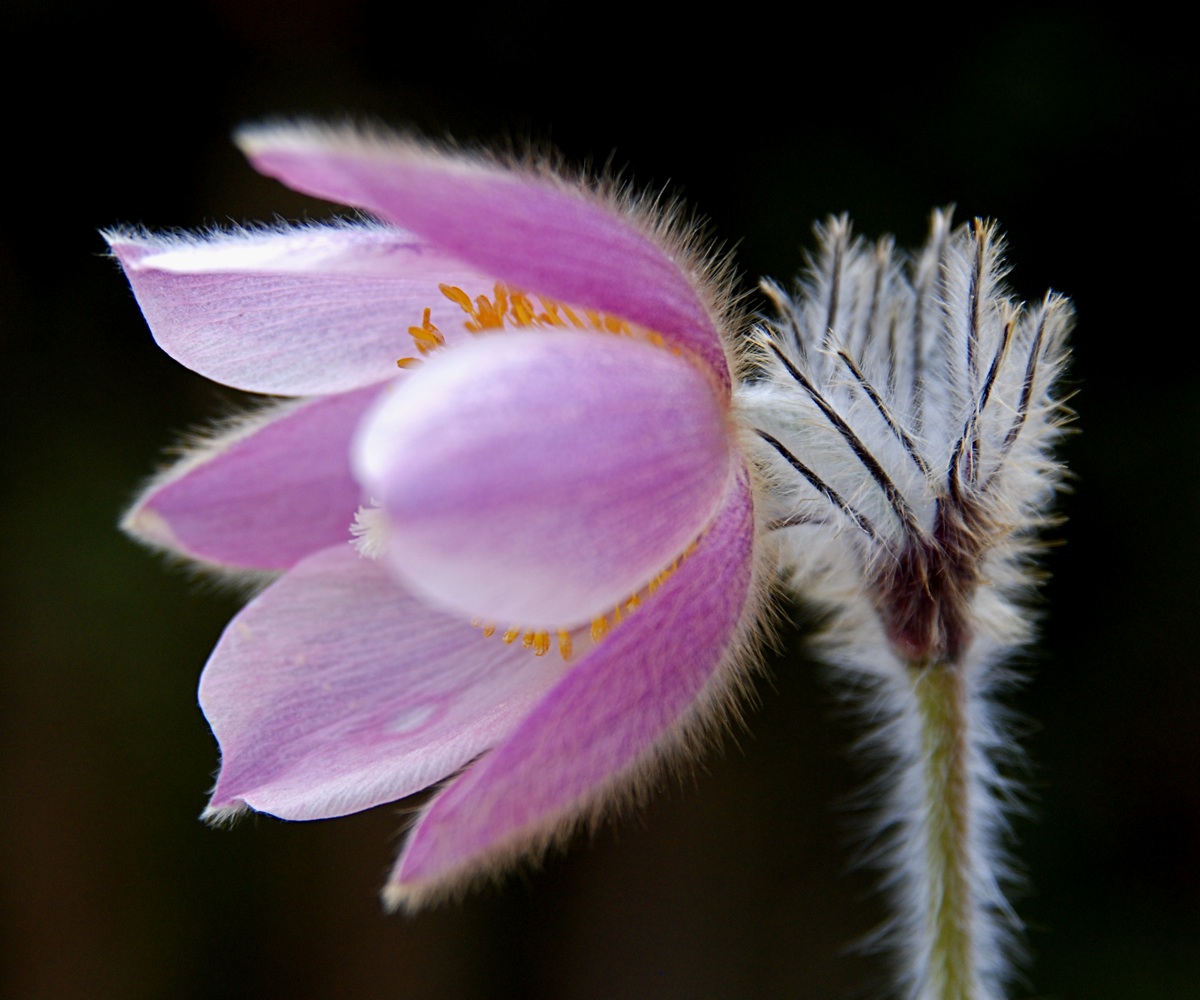
I don't think an image has been posted for today: I propose Tradescantia tharpii, surely the most magnificent dayflower I know of. It grows in rocky glades in Kansas, Missouri and perhaps neighboring states as well. It is quite local in nature, apparently (and I think variable). Bluebird nursery wholesales this plant, and their form is outstanding: virtually stemless. and very hairy. It blooms for a long time. Flower color is either pink or lavender blue. It is easy to grow and has not shown signs of weediness (unlime most any other dayflower)...
Amazing that the first flower of the season is open in my garden. Erica carnea 'Bell's Extra Special'. It bloomed under the snow as the snow just melted from it 5 days ago and today is the first chance I got to look at the spot of pink in the yard. None of the other Erica even show colour. I guess in warmer climes this one would bloom in December-January. Meanwhile, a few crocus are just poking through the ground. I did see crocus and galanthus in bloom in parts of the city up against the south side of houses. Spring can't be far off!
Todd, it's a beautiful and bright heather, and the burnished orangy foliage adds to the bright effect. I am the kiss-of-death with heathers, I go to a NARGS meeting and see a presentation on them (with plants available for purchase), I get excited and buy a bunch, but at home the plants sulk and die with surprising speed waiting for me to construct a heath bed someplace... pathetic. But I'm keeping it on my "ToDo" list, to one day grow heaths and heathers and create a pathwork quilt of bright foliage and flowers.

Comments
Cliff Booker
Re: Image of the day
Mon, 02/22/2010 - 10:31amMagnificent combination, Panayoti ... thanks for posting.
Mark McDonough
Re: Image of the day
Tue, 02/23/2010 - 11:39amTrond, I posted links to both of your photos to the Pacific Bulb Society group, and I have an answer for you, it is Gladiolus watsonioides. See the following two responses, there are some cultivation clues.
Response from John Grimshaw, Gloucestershire, UK:
This is Gladiolus watsonioides in its finest form, once known as G.
mackinderi. It is one of the outstanding plants of Mt Kenya.
I am currently selecting images for my talk 'Switchbacks Yes, Suburbs No:
Alpines in Tropical Africa' which I'll be presenting at the NARGS Western
Winter Study Weekend in Medford, Oregon, on Saturday March 6th - more
details available from:
http://www.nargs.org/images/stories/wwsw/west10home.html
Gladiolus watsonioides will be one of the plants I'll be speaking about.
Response from Ernie DeMarie, Tuckahoe NY:
It is Gladiolus watsonioides, which I remember well from some material a prof
brought back from a trip to Kenya and gave to me back when I was doing my thesis
work (on pelargonium species tissue culture) at Cornell. I grew it there and at
NYBG for many years, it never really goes dormant in the sense that it does not
like to go bone dry for long periods of time. It makes scads of cormlets and is
self fertile. In a cool greenhouse it tended to flower in summer. A very
pretty plant and not terribly difficult to grow.
Todd Boland
Re: Image of the day
Wed, 02/24/2010 - 6:33amIn keeping with the Gladiolus theme, here is G. saundersii growing at our BG in Newfoundland. It is proving very hardy and reliable, blooming in September-October.
Todd Boland
Re: Image of the day
Wed, 02/24/2010 - 6:39amA closer view to show the exqusite markings.
Panayoti Kelaidis
Re: Image of the day
Thu, 02/25/2010 - 7:19amAaaaah, Todd. You warm the cockles of my heart with the Gladiolus saundersii. It brings sweet memories of the Drakensberg back to me. I have seen this quite a few places in Lesotho, although my first encounter was in March of 1997 with Jim Archibald on that magnificent place, Joubert's Pass, in the Witteberg spur of the Drakensberg. We saw both G. saundersii andG. dalenii growing along the road. It was a particularly tall, stunning form of dalenii. , which we thought we found in seed as well: the seed all turned out to be saundersii when grown on. Oh well!
There are probably a few dozen wonderful Glads in the Drakensberg, but my favorite South African glad has to be G. alatus, that grows in vast colonies in the West Cape (probably not very frost hardy). It does have some look alike cousins that make it up to the colder karoo, so we can dream, perhaps, of one day taming this. Although it does run at the root (tut! tut!) This picture was taken on a field trip out of that enchanting town of Franschoek.
Margaret Young
Re: Image of the day
Thu, 02/25/2010 - 4:33pmThis image is from the "cover" of the second issue of the online magazine International Rock Gardener....
main page here: http://www.srgc.org.uk/logs/index.php?log=international
Bringing rock gardeners from around the world together...... 8)
Cover photo is by Zdenek Zvolánek of Iris rosenbachiana f. nicolai ´Cormozak´ in his Czech garden.
Mark McDonough
Re: Image of the day
Thu, 02/25/2010 - 4:39pmIan and/or Maggi, that's a stunning Iris and a stunningly crisp photograph, indeed an image for the day... a welcome sight on this cold gloomy snowy-rainy day. :)
Margaret Young
Re: Image of the day
Thu, 02/25/2010 - 4:42pmYou having that kind of weather too, eh? Horrible, isn't it? Thank goodness for sunny flower pictures to transport us to a better place!
ZZ is still having too much winter, as well.... I think we're all a bit fed up of it in the Northern Hemisphere, right now!
Glad you like the photo... it enlarges well for the pdf., I posted a reduced version here.
PS: It's Maggi aboard at the moment, by the way....after midnight here and the Boss is fast asleep :)
Richard T. Rodich
Re: Image of the day
Thu, 02/25/2010 - 5:18pmThat is a fantastic a pic of a fantastic form! I have seed of Iris rosenbachiana. Let's hope for the best . . .
Mark, you are just way to creative with the avatar function here. I suppose I could at least get a crayon and color mine in. :)
Mark McDonough
Re: Image of the day
Thu, 02/25/2010 - 5:29pmWell, I cut my teeth doing avatar fun on the Scottish forum. What can I say, I'm unemployed, have lots of time on my hands during winter months, and I like to goof around and keep things lively, one of the fun aspects of being on a wiki-powered-blog-Forum such as this. On your avatar, I'd like to see Audrey II start moving! Here we have a plant "Image of the Day", but I keep pace with an Avatar of the Day as well.
Panayoti Kelaidis
Re: Image of the day
Thu, 02/25/2010 - 11:03pmOmigod, Marko! Hope you didn't use that Galanthoavatar on the SRGC site: they'd all be wanting seed and adding it to their collections! ;D
Todd Boland
Re: Image of the day
Fri, 02/26/2010 - 4:01pmWell my avatar is a bit squished and I don't know why...where's Hugh?
That iris is to die for...but another that would not like the aquatic alpine conditions I have to contend with.
Trond Hoy
Re: Image of the day
Sat, 02/27/2010 - 10:58amHello folks, I am back! Been offline for a week (skiing cross country in the mountains).
Thanks Mark, I have registered the name! Watsonioides is an appropriate name, the glad reminded me of Watsionias i saw in South Africa.
Lori S. (not verified)
Re: Image of the day
Sat, 02/27/2010 - 11:04amIn case anyone is wondering, I just edited the colour of the text in the quote above, so that it was visible against the white background... my first official act as moderator. 8)
Lori S. (not verified)
Re: Image of the day
Sat, 02/27/2010 - 5:46pmSounds like a wonderful trip, Trond. I assume it was back-country skiing, as opposed to track-set routes? I hope you were able to take some photos!
Here's a scenery-based photo for today... the subalpine-alpine meadows of Healy Pass in Banff National Park, which can filled with Erythronium grandiflorum around the July 1st weekend in a good bloom year.
Trond Hoy
Re: Image of the day
Sat, 02/27/2010 - 11:20pmNot back-country this time! We had to follow tracks as the snow was very unfirm. Even with skis you sank 1m deep due to no mild weather at all since the first snowfall. We have a small cabin at the timberline - it is not alpine, more an undulating plane with no high peaks, just piggybacks! Furthermore it was cold, about -20 oC and I did not bring my camera either! (My wife had hers.)
Here's how the landscape looks like 1100-1200m (last spring and last fall):
Trond Hoy
Re: Image of the day
Sat, 02/27/2010 - 11:30pmI like your Banff picture, Lori! The Banff area seems to be worth making acquaintance with! And I should love to beheld Erythroniums in situ. I have some selections in my garden and they behave quite well.
Trond Hoy
Re: Image of the day
Sun, 02/28/2010 - 9:36amJust to show where we go skiing. This is from last year.
Lori S. (not verified)
Re: Image of the day
Sun, 02/28/2010 - 10:21amWhat a fascinating area, Trond! Would the word "tundra" be an apt description?
Trond Hoy
Re: Image of the day
Sun, 02/28/2010 - 11:00amMaybe it looks a little like tundra, but it is not. It is no permafrost and one of the reasons for few trees is that the area has been grazed for centuries (mountain dairy - a usage disappearing). The soil is shallow and acidic, consist of huge deposits of moraine or hard quartz type bedrock. The flora is relatively poor. Norway spruce (Picea abies), Scots pine (Pinus sylvestris) and Downy birch (Betula pubescens) make up the treecover. Common juniper (Juniperus communis) and dwarf birch (Betula nana) are the commonest shrubs in addition to a lot of different Ericaceaes and crowberry (Empetrum nigrum). You can find pockets with better soil and more interesting plants (at least for me) like orchids and wintergreens (Pyrolaceaes).
Lori S. (not verified)
Re: Image of the day
Sun, 02/28/2010 - 1:03pmWhat a beautiful bearberry in fall colour.
I guess the setting is not quite so wild as it looks, then (re. grazing). Mind you, there is also grazing in some of the foothills & mountain parks around here (e.g. Kananaskis Provincial Park)... land that is publicly held, but in which old grazing leases are still honoured. (This is of beef cattle, though, that summer in the highlands, relatively untended, not dairy cattle.) In your ski trip area, is it public land, on which farmers/ranchers hold grazing leases?
Trond Hoy
Re: Image of the day
Sun, 02/28/2010 - 2:23pmThe farmers down in the valleys have rights from "the dawn of time" to let their cattle and sheep graze in the mountain pastures in summertime. The cows were for milk to make cheese and butter. The farmers also have rights to wood and fish and game, however, the land is free to be walked in for everybody and you can buy licences for fishing and hunting. It is not very far from roads or cabins, unfortunately.
Richard T. Rodich
Re: Image of the day
Sun, 02/28/2010 - 6:08pmIt always amazes me that there is still so much open land in Europe. If Americans (from the U.S.) had populated Europe for the same amount of time, every little bit of land would be gobbled up.
Wonderful pitures, Trond.
Lori S. (not verified)
Re: Image of the day
Sun, 02/28/2010 - 6:24pmUndoubtedly true... and yet Europeans seem to come to the Canadian mountain parks, at least, to experience some vestige of wilderness - to see a place that is not colonized by villages, almost regardless of elevation, where not so many mountain passes have been traversed by roads, and where not so many of the valleys have had ski-lifts and chalets built... places that have not been so thoroughly used by people for so long. Perhaps that is merely my impression, from the (few) people we run into in the backcountry... I stand to be corrected, if so. :)
Mark McDonough
Re: Image of the day
Sun, 02/28/2010 - 7:39pm??? I have ventured across the USA by car back and forth 3 times, and one thing that always amazed me, is the vast VAST areas of no habitation and development whatsoever. In the last decade and a half, my travels have been limited to coast to coast travels via airplane, but looking down upon the scenery from airplane heights still show vast areas of nothingness (in terms of development), or near nothingness. It amazes me that there is so much open land in the USA, but that's a good thing.
Since this is supposed to be the Image of the Day thread, let me post a few photos of a wonderful crocus from 2009, Crocus suaveolens.
Lori S. (not verified)
Re: Image of the day
Sun, 02/28/2010 - 8:06pmSo, how much longer for those to start blooming again in your area? I'm sure I'll be green with envy to hear the answer!
Bulbocodium vernum is always my earliest way up here in the hinterlands, with March 20th being the earliest bloom; crocuses (I only have the commonly-available species/varieties) won't start until early April, at the earliest, all weather-dependent, of course.
Richard T. Rodich
Re: Image of the day
Sun, 02/28/2010 - 8:25pmAlong with everything else about it, I really like the short, stubbiness of your C. suaveolens, Mark. Does the trait continue as the foliage grows too? In other words, are the leaves shorter too, compared to other crocus?
Trond Hoy
Re: Image of the day
Sun, 02/28/2010 - 11:38pmThank you!
But for the open land in Europe - You can't draw conclusions about Europe from pics of Norway! Lots of Germans and Dutch people (and others) come here to escape crowdedness (and pick mushrooms).
Trond Hoy
Re: Image of the day
Sun, 02/28/2010 - 11:42pmWell Mark, now I have to go out digging in the snow to look for my crocuses! Last year they were in full bloom at this time.
Mark McDonough
Re: Image of the day
Mon, 03/01/2010 - 4:40amMy photos are named with the image date, so last year was a lucky early spring and I took those photos on March 27, 2009, about 2 weeks earlier than normal, most years they flower early to mid April. The first crocus to bloom is always C. vitellinus, blooming with the snowdrops. My snowdrops, planted close to the sunny south side of my house, are in bloom now, and C. vitellinus has sprouted (no flowers yet), but most of the yard is entombed with a thick crust of icy snow; it is snowing again today. For a bit of sunshine, here is a photo of Crocus gargaricus, another early bloomer.
Mark McDonough
Re: Image of the day
Wed, 03/03/2010 - 4:06amThe snow is receding, the crocus are poking up through the soil, and it will not be long before they're in flower. To help get us there, here is a photo from last march of Crocus angustifolius, with a fine stand of C. etruscus 'Rosalind' in the background.
Trond Hoy
Re: Image of the day
Wed, 03/03/2010 - 9:48amDo you keep record of all your plants, Mark? I have not names for all mine. I loose the labels and don't bother to make new ones.
I am waiting for my crocuses now, but this plant was in flower at Xmas times when it was covered in snow and has not been seen since!
Mark McDonough
Re: Image of the day
Wed, 03/03/2010 - 11:25amTrond, I'm not very good with records, although I try to keep some, particularly on things I collect, like Epimedium. A couple rules help; I always place two plant labels when I plant, one in front and one in back of the plant, so if one label gets lost, there should be another. I also photograph plants and pull out the label and make a "personal information photo" with label in sight, to remind me just what plant I'll looking at (again, most important for collections of things). One thing I'm bad at, is renaming my digital photos... they often are just downloaded with default numerical names, so it can be tough later on to figure out what is what.
Your having a beautiful red Hellebore in bloom at xmas time tells me our winter is much harder, no Hellebore would dare show any activity here until March at the earliest. Just checked my earliest one, H. niger, but it is still half encased in ice, it'll be 2-3 weeks more before it is in bloom. Just checked my photo records from last year, and see H. niger was in good bloom on March 27th... two photos uploaded. The second photo has an arrow pointing to a seedling. In fact, they are beginning to seed around a lot, which I'm happy about.
Trond Hoy
Re: Image of the day
Wed, 03/03/2010 - 11:47amMark, your H. niger looks healthy and floriferous!
I have two different clones, and one starts flowering in December, the other in March. On both he flowers are often a little hidden by the big leaves. I don't like to cut them off.
And I am not good at keeping records of my plants. Try to remember as much as possible but cultivar names .... not a chance!
Panayoti Kelaidis
Re: Image of the day
Thu, 03/04/2010 - 5:41pmIt looked as though there's nothing listed for today, so I propose Clausia aprica as plant of the day: I grew these from seed from Alexandra Bertukenko nearly ten years ago. At first they spread like wildfire and I feared this would be the new pest...but then one day they were suddenly all gone and I am yearning to have them in my garden again. Very fragrant and it bloomed for quite a long time. Anybody else had consistent luck with this striking Central Asian?
Cliff Booker
Re: Image of the day
Thu, 03/04/2010 - 7:14pmHedysarum hedysaroides nestles at the base of the imposing Cinque Torre in the Italian Dolomites.
Mark McDonough
Re: Image of the day
Thu, 03/04/2010 - 7:32pmHmmm, that's a fine looking plant, like an exceptional erysimum. I once ordered from Bertukenko, all kinds of wonderful sounding stuff, but the seed arrived in the days of my being impossibly tied down from work and with a very long 3-hr daily commute, and did not have much resulting from the expenditure. I still have one Euonymus from her collection in a pot, a most slow growing thing so far.
So Panayoti, what do you think is the clausia of your plant's demise... er, I mean cause.
Panayoti Kelaidis
Re: Image of the day
Fri, 03/05/2010 - 7:32amI get the biggest kick outa your avatars, Mark! Keep it up...
Now back to Clausia etc.: I know it looks superficially like a wallflower, but I think it's more closely allied to Parrya etc. I posted about it hoping someone else could elucidate my dilemma.
I have had the "explosive invasiveness followed by untimely demise" syndrome happen repeatedly to me in various gardens. I recall how Viola koreana looked as though it would swamp the Botanic Gardens and then disappear. The same happened with Silene keiskei, Viola cornuta, Geranium sessiliflorum var. nigricans and lots of other items: often when the garden is freshly tilled, some plant will find the condition perfect, but as the soil settles down and other plants fit in, some aspect of the soil texture or chemistry suddenly makes the seemingly invasive plant settle down to a dull roar, or even become hard to grow. I have wondered if it wasn't possibly due to a virus infecting these plants. I've observed the same phenomenon with some of the supposedly invasive weeds that get native plant people so worked up (I believe there are plants that are truly weedy, but instances like this make me angry at their extreme reactionary point of view): thirty years ago I remember seeing vast swaths of our Front Range foothills turned a brilliant yellow by Linaria dalmatica: I panicked. A few years later, ask I hiked the same areas, I noticed the Linaria was completely gone. One cannot generalize on one year's experience, obviously!
Mark McDonough
Re: Image of the day
Fri, 03/05/2010 - 8:49amAssuming it is acceptable via the "fair use" provision of material posted on the internet, today's Image of the Day is Townsendia aprica, a rare endemic of Utah. To cover the bases, in addition to the photo itself, I include the link to the photo on the U.S. Fish & Wildlife web site.
Every now and then one comes across a quintessential image that embodies a genus, this is certainly it. In this view, the flower color is light peach pink, but the flowers can be yellow, joining with Townsendia jonesii var. lutea as the only two Townsendia that have yellow flowers.
http://www.fs.fed.us/wildflowers/rareplants/profiles/tep/townsendia_apri...
Trond Hoy
Re: Image of the day
Fri, 03/05/2010 - 9:21amCan't it be that the plants use up a necessary nutrient or produce a toxin killing itself?
Trond Hoy
Re: Image of the day
Sat, 03/06/2010 - 1:14amIt is a grey day (I have been up for some hours but you folks are probably still sleeping...) so I look through my pictures of spring flowering bulbs (waiting for the snow to recede). 'Katherine Hodgkin' (or is it Katharine?) is one of the best early irises to grow here and it incrises well and take wet winters with no problems. However early slugs can devour the flowers.
Panayoti Kelaidis
Re: Image of the day
Sat, 03/06/2010 - 5:49amAAAaaah! 'Katherine Hodgkin': One of my favorites too. It thrives for us, and normally would be in bloom now, but we are weeks behind this spring. I have been amazed the Dutch have managed to mass produce this that it's for sale cheaply in Garden Centers all over Denver in the Fall! They must produce hundreds of thousands of these. And I remember when it was a very expensive bulb...
I think your suggestion that the demise of exploding populations of would be invasives in our garden is due to using up nutrients is a real possibility. Probably likelier than a quick virus or other disease...how to test it?
Back to the Hodgkins: I remember Jim Archibald speaking fondly of them as growers and collectors. I was surprised to read about them recently in one of Bruce Chatwin's book of essays: their son is a famous contemporary English painter, Howard Hodgkin. http://www.tate.org.uk/servlet/ArtistWorks?cgroupid=999999961&artistid=1...
They are also related to the scientist who discovered Hodgkin's Lymphoma. Fascinating how things tie together!
Mark McDonough
Re: Image of the day
Sat, 03/06/2010 - 6:46amWord of caution on any of the mass produced bulbs, they can be virused. I bought a 25-count bag at Home Depot (chain of super-sized home & garden building supply stores) for a ridiculous low price, as I recall about $6 or $7 dollars. Here are two photos, one in 2008, the other in 2009. Virused plants show up having the blotchy blue streaks, most evident at the top of the standards. Do I hand dig and remove the ones that show the virus, or dig them all out? Some of the reticulate Iris are just showing their noses poking through the soil today.
Trond, in terms of the correct name on this cultivar, I have seen it as Katherine (least often), Katharine (very often), and Kathryn (also very often). You are correct, I believe it is supposed to be 'Katharine Hodgkin'. I tried to google and find links to lists of registered Iris names, but in the few minutes I looked did not find it.
Panayoti Kelaidis
Re: Image of the day
Sat, 03/06/2010 - 12:36pmNot quite sure which of your two pictures mean to show the virused plants: they both look mighty good to me!
I know the traditional clone of Iris bucharica we grow is probably virused (in junos they show up as yellowish mosaic like squares on the leaves (hence, perhaps, "mosaic" virus) I've been told it's tobacco mosaic virus, vectored by smokers fingers as well as aphids). I think that they can recover (just as humans recover from viruses)--at least in our climate the virus is less evident than it used to be and I did not remove them. I know that sounds blasphemous...but..but...but. If we did everything we were told to do we would be saints and our gardens would probably be empty...
Mark McDonough
Re: Image of the day
Sat, 03/06/2010 - 1:40pmWhen I uploaded the 2008 photo on SRGC, it generated some shreiks of "Virus". In fact, it is common on the active Crocus message threads on SRGC for virus warnings to be declared. Janis Ruksans, having extensive experience with mass producing plants, seems particularly alert to the possibility of virus in the images posted by forum members. It seems that many of the Dutch grown bulbs are indeed virused, and that some varieties of Crocus chrysanthus for example, have been lost or nearly lost due to virus. It might have more to do with monocultures and mass producing on a large scale. I was warned to destroy the virused Iris 'Katharine Hodgkin' before it infects and destroys all my reticulata Iris.
I re-uploaded the 2008 and 2009 photo (this is the same patch), notice in 2008 there is more of the tell-tale dark blue irregular blotching and streaking, whereas in 2009 there is less. In the photos, I added red "vectors" to show where the naughty patches are :o
Trond Hoy
Re: Image of the day
Sat, 03/06/2010 - 1:57pmI have looked at my picture of Katharine H. but can't see signs of virus. The photo is not the best, though, I can remember that I was a couple of days late - they had been at their zenith.
Todd Boland
Re: Image of the day
Sun, 03/07/2010 - 7:43amMy Katherine appears virus-free as well. I am surprised it does as well as it does in Newfoundland considering our rainfall (we just had 118 mm in 24 hours!)
Todd Boland
Re: Image of the day
Sun, 03/07/2010 - 7:49amAmazing that the first flower of the season is open in my garden. Erica carnea 'Bell's Extra Special'. It bloomed under the snow as the snow just melted from it 5 days ago and today is the first chance I got to look at the spot of pink in the yard. None of the other Erica even show colour. I guess in warmer climes this one would bloom in December-January. Meanwhile, a few crocus are just poking through the ground. I did see crocus and galanthus in bloom in parts of the city up against the south side of houses. Spring can't be far off!
Panayoti Kelaidis
Re: Image of the day
Sun, 03/07/2010 - 7:54amEnough Virus Talk! Your 'Katharine Hodgkin' look pretty nifty to me, Mark. But I suppose discretion is the better part of valor.
I don't think an image has been posted for today: I propose Tradescantia tharpii, surely the most magnificent dayflower I know of. It grows in rocky glades in Kansas, Missouri and perhaps neighboring states as well. It is quite local in nature, apparently (and I think variable). Bluebird nursery wholesales this plant, and their form is outstanding: virtually stemless. and very hairy. It blooms for a long time. Flower color is either pink or lavender blue. It is easy to grow and has not shown signs of weediness (unlime most any other dayflower)...
Mark McDonough
Re: Image of the day
Sun, 03/07/2010 - 4:23pmTodd, it's a beautiful and bright heather, and the burnished orangy foliage adds to the bright effect. I am the kiss-of-death with heathers, I go to a NARGS meeting and see a presentation on them (with plants available for purchase), I get excited and buy a bunch, but at home the plants sulk and die with surprising speed waiting for me to construct a heath bed someplace... pathetic. But I'm keeping it on my "ToDo" list, to one day grow heaths and heathers and create a pathwork quilt of bright foliage and flowers.
Pages