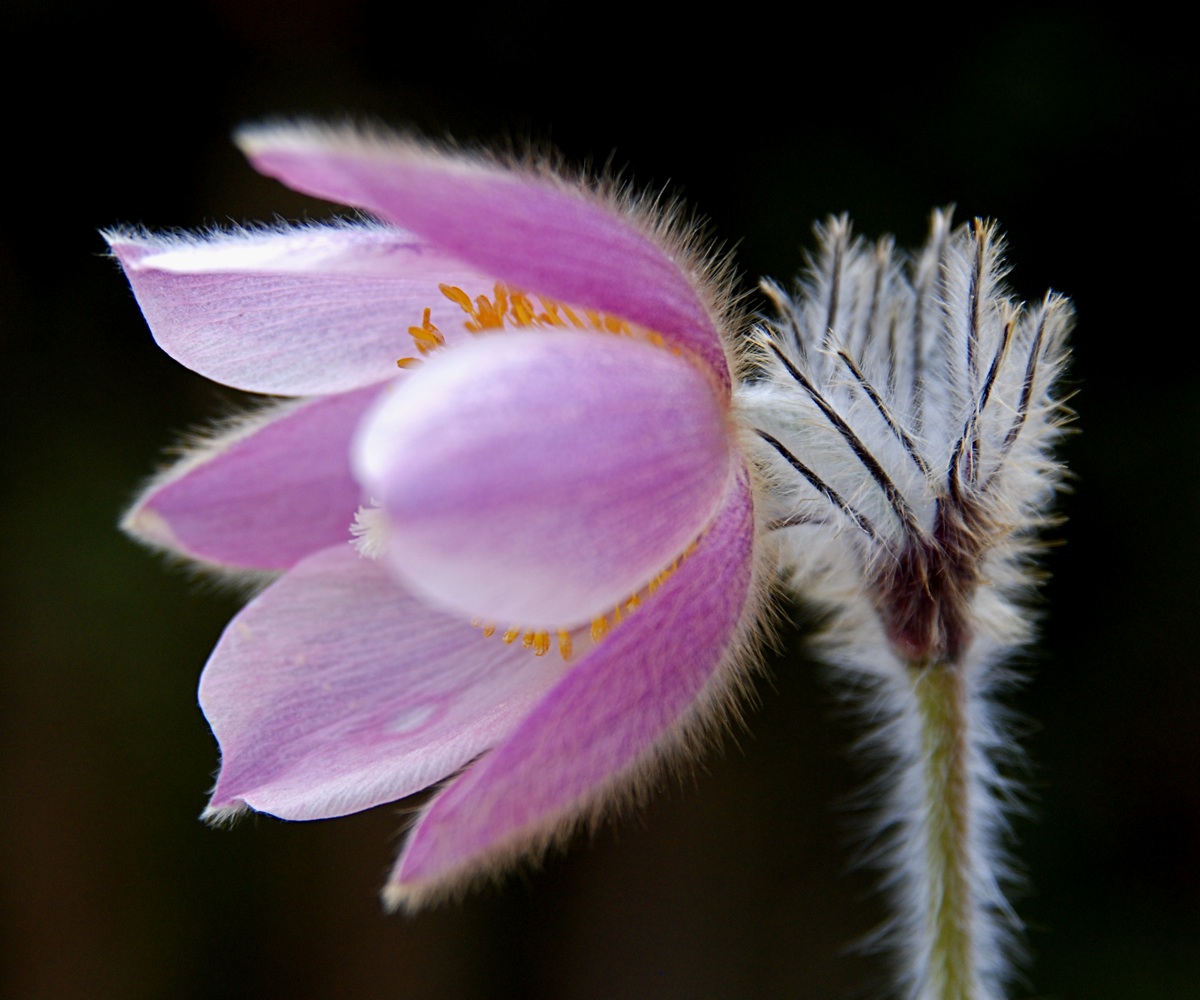
That's a great idea, Cliff! (and a most wonderful photo.) I grow a few Pulsatilla species, but not vernalis. I just received seed of it this year. Have you (or anyone) found anything different as to its germination requirements in comparison to other Pulsatillas?
Many thanks Rick. The Spring Pasque Flower is one of my favorite plants and one of the absolute gems of the high altitude snow melt zones in the European Alps. Not difficult to germinate if the seed is fresh the resultant seedlings can be quite variable but usually worth persisting with until flowering. Please do not be tempted to pamper these seedlings in any way.
It grows here in a state of virtual neglect out in the front yard - no special care or attention at all. Mine are white-flowered, re. the variability that was mentioned. Seed starting was straight-forward - easy, warm germinator.
Great idea Cliff and to keep the ball rolling I offer this. Its Rhodothamnus chamaecistus, not in cultivation, but photographed in the mountains of western Slovenia. I just think it is beautiful.
Another of my all time favorite plants, Malcolm and one that we are fortunate enough to see thriving in the Dolomites each year (and flowering, but not as well, in large pots in my garden).
Beautiful image of a super plant. Who will rise to the challenge tomorrow?
Great idea Cliff and to keep the ball rolling I offer this. Its Rhodothamnus chamaecistus, not in cultivation, but photographed in the mountains of western Slovenia. I just think it is beautiful.
This plant is one of the real charmers of the Ericaceae.... my favourite plant family.... and your photo shows it in peak condition, Malcolm. Still under snow here in Aberdeen, so such pictures are a treat!
What a wonderful plant! I'd love to try one in Newfoundland...we are the king of ericaceous plants when it comes to natives...however, if Rhodothamnus needs lime it might not be happy here.
That Townsendia condensata is one of my favourite, the flower is 5cm in size, soft hairy leaves, fast grower in sunny very dry place, unfortunately monocarpic. I just like it - looks like a soft ball.
Townsendia grows rather easily in the sunniest part of our Arboretum Rock Garden. We've had no expreience with condensata at the Arboretum, though. I think hookeri or maybe montana. I don't know if any of our Minnesota Chapter members have tried T. condensata. We will certainly keep it in mind! Thanks for the photo.
is this photograph of wild plants, or are they ones you are growing in Poland? They are very nice - quite charming.
This is photo from my garden, plants are located under roof overhangs by my house in pure granite gravel. In regular conditions in my garden it would rot off very quickly.
I have seeds of this one to try this year...yes it's too bad they are so short-lived. makes for a lot of work to keep them going year to year.
It may be much easier to keep it going by immediate sowing. I've done it last year just after seed ripening and new seedlings shot after a couple of weeks in the same place. Now new plants are of 2cm size but probably 'll be flowering next year.
Hello to all. Greetings from north central Tennessee. Pouring rain here today. Attached is one of my favorite Cornus shot at Cataract Falls, Avalon Peninsula, Newfoundland Summer 2007. Actually Todd it was the day my wife & I visited you in St. John's. Great job with the website. I'm still learning how to use it ;D
Regards to all, Paul H. Schneider, Eastern Sun Studio & Gardens, Portland, TN
As a kid who spent nearly every summer weekend in wild northern Minnesota near the Ontario border, I am very familiar with this species. Back then I dismissed it as "boring", since many other more "interesting" flora abounded in the area - pitcher plants, sundews, more than a dozen species of orchids, etc. But I have now become rather fond of Cornus canadensis, and have seen it native in a few places in southern Minnesota, too.
As a kid who spent nearly every summer weekend in wild northern Minnesota near the Ontario border, I am very familiar with this species. Back then I dismissed it as "boring", since many other more "interesting" flora abounded in the area - pitcher plants, sundews, more than a dozen species of orchids, etc. But I have now become rather fond of Cornus canadensis, and have seen it native in a few places in southern Minnesota, too.
Thanks Rick, I grew up in northern NY near the Vermont border. We could find C. canadensis occasionally, usually in Vt. or NH. With clay soil & thuggish summer heat here in north central TN, it is one that I doubt would be very happy.
Here is my contribution to plant of the day...Diapensia lapponica...creme de la creme of our native alpines but extremely difficult to grow in cultivation. We have a single plant in the Memorial University Botanical Garden alpine house that is now 3 years and going...every one we tried outside died within weeks. This picture is in the wild where they are actually reasonably common in Newfoundland.
Very interesting, Todd. What do you suppose is the critical difference between the alpine house and outdoors in your location, as opposed to where the plant grows in nature?
Outside I think it gets too hot where our BG is close to sea-level. The alpine house is lightly shaded so the heat is not nearly as intense. In the wild, Diapensia grows in open, windy areas that are often foggy thus intense heat is not a problem. St. John's is far from hot but relatively speaking we are hotter than where Diapensia would normally grow.
This is one of the most popular of the cultivars which has appeared in the last 20 years and this is one of those depressingly beautiful specimens that some people manage to take to alpine plant shows!
I thought I'd post this picture of Allium crenulatum. It's taken in the Olympic Mountains, Washington State, and I thought it was so attractive against the dark shale. I'll post another picture in the Bulbs section as well.
This picture is from a few years ago and the whole thing has now gone but for four or five years it was as good as this. So it can be good outside.
'Lismore Carmine' is halfway down on the left hand side and round the right hand side there is 'Lismore Pink' which I think is even more beautiful. They are both hybrids involving Saxifraga georgei and really want a slightly more moist atmosphere than is typical here. We're not fantastically cold, or fantastically hot (often at least) but we are often very dry which is usually the determining factor for what does well long term.
I would think Newfoundland might be ideal for this sort of saxifrage.
Hi Todd and Malcolm, I must begin by stating that the Sax' wasn't mine - simply another image captured at an AGS national show - but it may not have been grown in an alpine house - perhaps in a frame, perhaps simply covered with a sheet of glass to protect it at flowering time? As Malcolm's image superbly illustrates these wonderful sax's can be grown and flowered extremely well outside (here in northern England anyway) and really, the use of an alpine house is little different to protecting the plant with glass. Temperatures in an unheated greenhouse (in the depths of winter anyway) are seldom much greater than outside. Greatly looking forward to meeting you in May, Todd - will be in touch by personal mail as soon as all the details are to hand. If you could order a little sunshine in advance please? :D
Those saxes from outside are impressive! Yes, we can do fairly well with Kabschias, but they still do best in troughs or tufa rather than in the open garden...frost heaving is terrible in this climate but tufa/trough plants don't seem to suffer.
Here is one of my troughs...albeit with not too many blooming at the time.
What terrific-looking troughs (both Malcolm's and Todd's)! Seeing those, I'm compelled to renovate mine yet again...
To brighten this winter day a little, here is an alpine potentilla species from Kananaskis Prov. Park, eastern slope Rockies... (I have posted a photo of what I believe to be the same species in the ID forum, and I hope someone can identify it.)
That's an exquisite Potentilla Lori.....there are not too many alpinish types in Alberta. Leaves remind me of nivea but the flowers are much larger than our local form of nivea.
Yes, I love seeing them! Well, even with not that many to choose from, I'm getting totally confused - the alpine potentillas with trifoliate leaves that occur here are P. hyparctica, P. nivea, P.ovina (3 to 5 leaflets), P. uniflora and P. villosa (according to Moss & Packer)... Help! ;D
(P.S. Oops, forgot P. hookeriana too, with 3-5 leaflets... ackk!)
Hmmm, what to post, what to post... Okay, here's Polemonium confertum, confined, sadly to a trough, and so far from its home in the Colorado Rockies. I'd truly LOVE to see some pix of this growing in situ, to appreciate its full glory in a beautiful setting... Will any of the American alpine gardeners/hikers take up this challenge and show us some??? ;)
Polemonium are among my favourites but I can't seem to keep the alpine types going for more than a year or two. Must say I've never grown P. confertum.
Anemone parviflora is a common alpine along the limestone barrens of northern Newfoundland where they bloom from late June through July.
Judging from the photo record, it looks like I probably got Polemonium confertum in 2007 (from Beaver Creek) so it will be interesting to see how much longer it lasts. I did notice last summer that there are little offsets coming up around it in the trough.
What a fabulous scene! I recognize Silene acaulis and a gentian (maybe G. verna?) What are the darker pink in the center right and the pale yellow at the top?
I like Saxifragas and other small rock garden plants very much, unfortunately I can't grow many of them in my maritime climate. I can neither grow these plants,but I dreamt of when I saw them!
I haven't been to the Dolomites but I am dreaming of trek there some time. And Todd, I forgot to say it is from Mt Kenya, Kenya. I have never been so cold as when lying in a wet sleeping-bag high up in the mountain under the equatorial stars waiting for starting to walk early in the morning! But the vistas and the otherworldly (yes, exactly the right word!) plants made up for cold nights. (I am used to sleep outside in the winter here in Norway, but my sleeping-bag got soaking wet and took time to dry.)
Image for today: Anemone narcissiflora in Maritime Alps - maybe it is not my favourite plant but in nature it looks fabulous in high alpine meadows - photo taken on 2000m on limestone ridge. It takes me back there to warm summer in our black-and-white too long winter. :)
I love all these Kenyans! I don't have a copy of Goldblatt's Glads north of S Africa, but I have a hunch this would be in there: what a wonderful color! Sunbird pollinated, I suspect.
My image is closer to home: Paeonia cambessedessii blooming with Gentiana acaulis in my home rock garden. This plant is my pride and joy: obtained five or six years ago from Arrowhead Alpines: it flowers so early that the flowers last for several weeks. It's a little bit too big for a classic rock garden, perhaps. But I am really bad at rules.
I always arrange a little party at my house when these are in bloom...it's fun to hear the little yelps as people walk around the bend and see these...

Comments
Richard T. Rodich
Re: Image of the day
Tue, 02/02/2010 - 7:15amThat's a great idea, Cliff! (and a most wonderful photo.) I grow a few Pulsatilla species, but not vernalis. I just received seed of it this year. Have you (or anyone) found anything different as to its germination requirements in comparison to other Pulsatillas?
Cliff Booker
Re: Image of the day
Tue, 02/02/2010 - 8:50amMany thanks Rick. The Spring Pasque Flower is one of my favorite plants and one of the absolute gems of the high altitude snow melt zones in the European Alps. Not difficult to germinate if the seed is fresh the resultant seedlings can be quite variable but usually worth persisting with until flowering. Please do not be tempted to pamper these seedlings in any way.
Lori S. (not verified)
Re: Image of the day
Tue, 02/02/2010 - 11:57amIt grows here in a state of virtual neglect out in the front yard - no special care or attention at all. Mine are white-flowered, re. the variability that was mentioned. Seed starting was straight-forward - easy, warm germinator.
Todd Boland
Re: Image of the day
Tue, 02/02/2010 - 12:39pmI tried vernalis once...ended up being just plain old vulgaris. Love the tawny silkiness of vernalis!
McGregorUS (not verified)
Re: Image of the day
Wed, 02/03/2010 - 7:10amGreat idea Cliff and to keep the ball rolling I offer this. Its Rhodothamnus chamaecistus, not in cultivation, but photographed in the mountains of western Slovenia. I just think it is beautiful.
Cliff Booker
Re: Image of the day
Wed, 02/03/2010 - 7:21amAnother of my all time favorite plants, Malcolm and one that we are fortunate enough to see thriving in the Dolomites each year (and flowering, but not as well, in large pots in my garden).
Beautiful image of a super plant. Who will rise to the challenge tomorrow?
Margaret Young
Re: Image of the day
Wed, 02/03/2010 - 8:38amThis plant is one of the real charmers of the Ericaceae.... my favourite plant family.... and your photo shows it in peak condition, Malcolm.
Still under snow here in Aberdeen, so such pictures are a treat!
Maggi Young
McGregorUS (not verified)
Re: Image of the day
Wed, 02/03/2010 - 9:06amAnd its intriguing because it's a limestone plant, unlike most of the Ericaceae!
Todd Boland
Re: Image of the day
Wed, 02/03/2010 - 1:20pmWhat a wonderful plant! I'd love to try one in Newfoundland...we are the king of ericaceous plants when it comes to natives...however, if Rhodothamnus needs lime it might not be happy here.
McGregorUS (not verified)
Re: Image of the day
Wed, 02/03/2010 - 1:55pmI don't think its too fussy in cultivation, just in the wild, as I understand it.
Hoppel (not verified)
Re: Image of the day
Thu, 02/04/2010 - 12:21amThat Townsendia condensata is one of my favourite, the flower is 5cm in size, soft hairy leaves, fast grower in sunny very dry place, unfortunately monocarpic. I just like it - looks like a soft ball.
McGregorUS (not verified)
Re: Image of the day
Thu, 02/04/2010 - 8:00amis this photograph of wild plants, or are they ones you are growing in Poland? They are very nice - quite charming.
Todd Boland
Re: Image of the day
Thu, 02/04/2010 - 8:15amI have seeds of this one to try this year...yes it's too bad they are so short-lived. makes for a lot of work to keep them going year to year.
Richard T. Rodich
Re: Image of the day
Thu, 02/04/2010 - 2:02pmTownsendia grows rather easily in the sunniest part of our Arboretum Rock Garden. We've had no expreience with condensata at the Arboretum, though. I think hookeri or maybe montana. I don't know if any of our Minnesota Chapter members have tried T. condensata. We will certainly keep it in mind! Thanks for the photo.
Hoppel (not verified)
Re: Image of the day
Fri, 02/05/2010 - 12:52amThis is photo from my garden, plants are located under roof overhangs by my house in pure granite gravel. In regular conditions in my garden it would rot off very quickly.
Hoppel (not verified)
Re: Image of the day
Fri, 02/05/2010 - 12:57amIt may be much easier to keep it going by immediate sowing. I've done it last year just after seed ripening and new seedlings shot after a couple of weeks in the same place. Now new plants are of 2cm size but probably 'll be flowering next year.
Cliff Booker
Re: Image of the day
Fri, 02/05/2010 - 3:04amPretty plant from the Dolomites for today's image ... the gorgeous honey-scented Thlaspi rotundifolium.
THLASPI ROTUNDIFOLIUM
Paul H. Schneider
Re: Image of the day
Fri, 02/05/2010 - 1:18pmHello to all. Greetings from north central Tennessee. Pouring rain here today. Attached is one of my favorite Cornus shot at Cataract Falls, Avalon Peninsula, Newfoundland Summer 2007. Actually Todd it was the day my wife & I visited you in St. John's.
Great job with the website. I'm still learning how to use it ;D
Regards to all, Paul H. Schneider, Eastern Sun Studio & Gardens, Portland, TN
Richard T. Rodich
Re: Image of the day
Fri, 02/05/2010 - 6:41pmWelcome to the forum, Paul!
As a kid who spent nearly every summer weekend in wild northern Minnesota near the Ontario border, I am very familiar with this species. Back then I dismissed it as "boring", since many other more "interesting" flora abounded in the area - pitcher plants, sundews, more than a dozen species of orchids, etc.
But I have now become rather fond of Cornus canadensis, and have seen it native in a few places in southern Minnesota, too.
Todd Boland
Re: Image of the day
Sat, 02/06/2010 - 12:16pmCornus canadensis is perhaps THE most common woodland plant in Newfoundland...we also have Cornus suecica which is equally as nice.
Great looking Thlaspi Cliff!
Paul H. Schneider
Re: Image of the day
Sat, 02/06/2010 - 12:50pmThanks Rick, I grew up in northern NY near the Vermont border. We could find C. canadensis occasionally, usually in Vt. or NH. With clay soil & thuggish summer heat here in north central TN, it is one that I doubt would be very happy.
Todd Boland
Re: Image of the day
Sun, 02/07/2010 - 3:45pmHere is my contribution to plant of the day...Diapensia lapponica...creme de la creme of our native alpines but extremely difficult to grow in cultivation. We have a single plant in the Memorial University Botanical Garden alpine house that is now 3 years and going...every one we tried outside died within weeks. This picture is in the wild where they are actually reasonably common in Newfoundland.
Lori S. (not verified)
Re: Image of the day
Sun, 02/07/2010 - 4:47pmGorgeous photos, all!
Very interesting, Todd. What do you suppose is the critical difference between the alpine house and outdoors in your location, as opposed to where the plant grows in nature?
Lori
Todd Boland
Re: Image of the day
Mon, 02/08/2010 - 10:35amOutside I think it gets too hot where our BG is close to sea-level. The alpine house is lightly shaded so the heat is not nearly as intense. In the wild, Diapensia grows in open, windy areas that are often foggy thus intense heat is not a problem. St. John's is far from hot but relatively speaking we are hotter than where Diapensia would normally grow.
Cliff Booker
Re: Image of the day
Tue, 02/09/2010 - 11:19amAn image from an Alpine Garden Society Show (at Blackpool, Lancashire, U.K. in March 2009) of a fine Saxifraga 'Lismore Carmine'.
SAXIFRAGA 'LISMORE CARMINE'
McGregorUS (not verified)
Re: Image of the day
Wed, 02/10/2010 - 4:58amThis is one of the most popular of the cultivars which has appeared in the last 20 years and this is one of those depressingly beautiful specimens that some people manage to take to alpine plant shows!
McGregorUS (not verified)
Re: Image of the day
Wed, 02/10/2010 - 5:04amI thought I'd post this picture of Allium crenulatum. It's taken in the Olympic Mountains, Washington State, and I thought it was so attractive against the dark shale. I'll post another picture in the Bulbs section as well.
Todd Boland
Re: Image of the day
Wed, 02/10/2010 - 2:35pmStunning Allium Malcolm...I have lots of Allium in the garden but I have not tried that species.
That is a wonderful saxifrage Cliff but growing in an alpine house seems like cheating. If it looked like that outdoors, then I'd be REALLY impressed.
McGregorUS (not verified)
Re: Image of the day
Thu, 02/11/2010 - 12:53amThis picture is from a few years ago and the whole thing has now gone but for four or five years it was as good as this. So it can be good outside.
'Lismore Carmine' is halfway down on the left hand side and round the right hand side there is 'Lismore Pink' which I think is even more beautiful. They are both hybrids involving Saxifraga georgei and really want a slightly more moist atmosphere than is typical here. We're not fantastically cold, or fantastically hot (often at least) but we are often very dry which is usually the determining factor for what does well long term.
I would think Newfoundland might be ideal for this sort of saxifrage.
Cliff Booker
Re: Image of the day
Thu, 02/11/2010 - 4:31amHi Todd and Malcolm,
I must begin by stating that the Sax' wasn't mine - simply another image captured at an AGS national show - but it may not have been grown in an alpine house - perhaps in a frame, perhaps simply covered with a sheet of glass to protect it at flowering time?
As Malcolm's image superbly illustrates these wonderful sax's can be grown and flowered extremely well outside (here in northern England anyway) and really, the use of an alpine house is little different to protecting the plant with glass. Temperatures in an unheated greenhouse (in the depths of winter anyway) are seldom much greater than outside.
Greatly looking forward to meeting you in May, Todd - will be in touch by personal mail as soon as all the details are to hand. If you could order a little sunshine in advance please? :D
Todd Boland
Re: Image of the day
Thu, 02/11/2010 - 7:57amThose saxes from outside are impressive! Yes, we can do fairly well with Kabschias, but they still do best in troughs or tufa rather than in the open garden...frost heaving is terrible in this climate but tufa/trough plants don't seem to suffer.
Here is one of my troughs...albeit with not too many blooming at the time.
Lori S. (not verified)
Re: Image of the day
Thu, 02/11/2010 - 10:08pmWhat terrific-looking troughs (both Malcolm's and Todd's)! Seeing those, I'm compelled to renovate mine yet again...
To brighten this winter day a little, here is an alpine potentilla species from Kananaskis Prov. Park, eastern slope Rockies... (I have posted a photo of what I believe to be the same species in the ID forum, and I hope someone can identify it.)
Todd Boland
Re: Image of the day
Fri, 02/12/2010 - 4:21amThat's an exquisite Potentilla Lori.....there are not too many alpinish types in Alberta. Leaves remind me of nivea but the flowers are much larger than our local form of nivea.
Lori S. (not verified)
Re: Image of the day
Fri, 02/12/2010 - 5:29amYes, I love seeing them!
Well, even with not that many to choose from, I'm getting totally confused - the alpine potentillas with trifoliate leaves that occur here are P. hyparctica, P. nivea, P.ovina (3 to 5 leaflets), P. uniflora and P. villosa (according to Moss & Packer)... Help! ;D
(P.S. Oops, forgot P. hookeriana too, with 3-5 leaflets... ackk!)
Lori S. (not verified)
Re: Image of the day
Sat, 02/13/2010 - 9:42amHmmm, what to post, what to post...
Okay, here's Polemonium confertum, confined, sadly to a trough, and so far from its home in the Colorado Rockies.
I'd truly LOVE to see some pix of this growing in situ, to appreciate its full glory in a beautiful setting... Will any of the American alpine gardeners/hikers take up this challenge and show us some??? ;)
Lori S. (not verified)
Re: Image of the day
Mon, 02/15/2010 - 1:41pmWhat, no one to take up the challenge? How unfortunate...
Here is Anemone parviflora, one of the species that blooms just after the snow melt in the eastern slope Rockies.
Todd Boland
Re: Image of the day
Mon, 02/15/2010 - 3:43pmPolemonium are among my favourites but I can't seem to keep the alpine types going for more than a year or two. Must say I've never grown P. confertum.
Anemone parviflora is a common alpine along the limestone barrens of northern Newfoundland where they bloom from late June through July.
Lori S. (not verified)
Re: Image of the day
Mon, 02/15/2010 - 3:58pmJudging from the photo record, it looks like I probably got Polemonium confertum in 2007 (from Beaver Creek) so it will be interesting to see how much longer it lasts. I did notice last summer that there are little offsets coming up around it in the trough.
Cliff Booker
Re: Image of the day
Mon, 02/15/2010 - 6:18pmBeautiful images folks ... can we encourage more members to post?
An outcrop in the Dolomites that would grace any garden.
Snowing lightly again here in Lancashire, England.
Lori S. (not verified)
Re: Image of the day
Mon, 02/15/2010 - 6:58pmWhat a fabulous scene! I recognize Silene acaulis and a gentian (maybe G. verna?) What are the darker pink in the center right and the pale yellow at the top?
Cliff Booker
Re: Image of the day
Mon, 02/15/2010 - 10:53pmHi Lori,
The darker pink is just another colour form of Silene acaulis and the cream-yellow is a Saxifraga (probably) caesia.
Trond Hoy
Re: Image of the day
Tue, 02/16/2010 - 1:58amI like Saxifragas and other small rock garden plants very much, unfortunately I can't grow many of them in my maritime climate. I can neither grow these plants,but I dreamt of when I saw them!

Todd Boland
Re: Image of the day
Tue, 02/16/2010 - 3:53pmCliff that image in the Dolomites is stunning. Trond, your Kenyan (?) image is otherworldly!
Cliff Booker
Re: Image of the day
Tue, 02/16/2010 - 9:48pmMany thanks Todd - hopefully you might enjoy a few more images from these magnificent mountains on 5th May? :D
Armeria maritima alpina
Trond Hoy
Re: Image of the day
Wed, 02/17/2010 - 4:08amI haven't been to the Dolomites but I am dreaming of trek there some time.
And Todd, I forgot to say it is from Mt Kenya, Kenya.
I have never been so cold as when lying in a wet sleeping-bag high up in the mountain under the equatorial stars waiting for starting to walk early in the morning! But the vistas and the otherworldly (yes, exactly the right word!) plants made up for cold nights. (I am used to sleep outside in the winter here in Norway, but my sleeping-bag got soaking wet and took time to dry.)
Hoppel (not verified)
Re: Image of the day
Fri, 02/19/2010 - 4:05amImage for today: Anemone narcissiflora in Maritime Alps - maybe it is not my favourite plant but in nature it looks fabulous in high alpine meadows - photo taken on 2000m on limestone ridge. It takes me back there to warm summer in our black-and-white too long winter. :)
Lori S. (not verified)
Re: Image of the day
Fri, 02/19/2010 - 12:26pmWhat a beautiful sight, Michal! Thanks for posting it.
Trond Hoy
Re: Image of the day
Fri, 02/19/2010 - 11:31pmThis Gladiolus we found growing in almost pure volcanic rock a few places on Mt Kenya. Don't know the species. Anybody who has suggestions?
Panayoti Kelaidis
Re: Image of the day
Sun, 02/21/2010 - 6:40amI love all these Kenyans! I don't have a copy of Goldblatt's Glads north of S Africa, but I have a hunch this would be in there: what a wonderful color! Sunbird pollinated, I suspect.
My image is closer to home: Paeonia cambessedessii blooming with Gentiana acaulis in my home rock garden. This plant is my pride and joy: obtained five or six years ago from Arrowhead Alpines: it flowers so early that the flowers last for several weeks. It's a little bit too big for a classic rock garden, perhaps. But I am really bad at rules.
I always arrange a little party at my house when these are in bloom...it's fun to hear the little yelps as people walk around the bend and see these...
Todd Boland
Re: Image of the day
Sun, 02/21/2010 - 2:26pmPanayoti, you're killing me with that peony!
Pages