
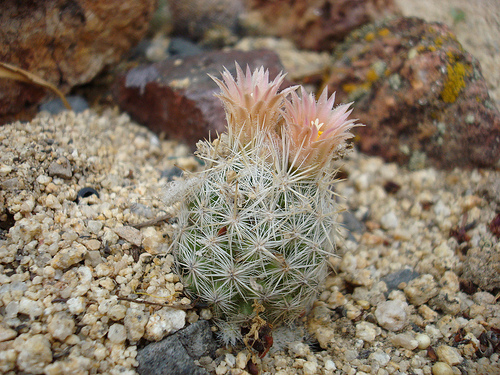
The teeny tiny treasure is Escobaria sneedii ssp. sneedii. The tiny white marbles stacked one on top of another look like they should tumble and roll away. They stay put however with only an occasional escapee.
These are found in New Mexico through to western Texas and grow in very well drained sights that receave some summer rain. Winters are dry with lows of 10 F. My two plants withstand temps down to 0 F for the past five years showing no sign of damage.
Rare in it's native habitat. These tiny cactus can often form large mounding clumps, with a lopsided pyramid look reaching a foot or more across.
There are two subspecies and one other species in the Escobaria sneedii complex. E. sneedii ssp sneedi, E. sneedii ssp leeii and E. guadalupensis (syn. E. orcuttii ). They are all closely related and occupy the same territories so intermediate or hybrid plants occur. The status of E. sneedii ssp leeii as a sub species is also tenuous since it is restricted only one, small canyon surrounded by populations classified as E. sneedii ssp. sneedii.
First two shots are of E. sneedii ssp leeii
Third and fourth of E sneedii ssp sneedii
Fifth of E. guadalupensis (syn. E. orcuttii )


Comments
Richard T. Rodich
Re: A teeny tiny treasure for the dry rock garden.
Wed, 05/19/2010 - 4:03pmI grew what I bought as Escobaria leei from High Country Gardens. It survived through three winters in a trough here in zone 4. But I think was damaged the third winter, as I'm not even sure if it actually grew at all the ensuing spring and summer. By the end of the fourth winter, it had kicked the bucket.
But it certainly is a cute thing. I assume it was Escobaria sneedii ssp. leeii
Panayoti Kelaidis
Re: A teeny tiny treasure for the dry rock garden.
Thu, 05/20/2010 - 3:57amI couldn't find my picture of E. leei, but did find one of E. sneedii var. sneedii blooming in a trough in Pueblo belonging to Bill Adams, of Sunscapes Nursery.
I never cease to be amazed how hardy and wonderful E. leei is: we have huge mounds at Denver Botanic Gardens, and I have them tucked here and there in my troughs at home. They are even bedded out, as it were, at the public park at Kendrick Lake (where I get seed every year because there are no other Escobaria planted nearby so it should be "pure"). I am now growing most of the Escobaria of the Chihuahan desert that are hardy: there are a lot of them. I have a sneaking suspicion that some clever botanist will one day try and lump most of them together, because truth be said, they are an awful lot like one another when you grow them side by side and they all hybridize it seems. At least the whole E. sneedii, organensis, orcuttii, dasyacantha, tuberculosa, zilziana, etc. etc. groups! The same, of course, could be said of the Auricula section in Primula, or half the penstemons!
John P. Weiser
Re: A teeny tiny treasure for the dry rock garden.
Thu, 05/20/2010 - 5:41amPK
I have wondered if my plants are correctly identified. I notice in the sneedii picture you posted that the central spines protrude above the radial spines substantially. On my plants the central spines are hardly noticeable. When I touch the surface I only feel a slight roughness and no sharp prickles.
I will take a macro of the surface and post it. Your opinion as to whether this is a ssp. sneedii or ssp leei would be appreciated.
The more I delve into this question the more I am convinced I have misidentified the subspecies.
Well for the present until they are lumped together by that clever botanist who upturns the apple cart. ::)
John P. Weiser
Re: A teeny tiny treasure for the dry rock garden.
Thu, 11/17/2011 - 6:30am2011 photos of Escobaria sneedii var. leei in flower. The last photo also includes Escobaria vivipara varieties, rosea and buoflama.
Richard T. Rodich
Re: A teeny tiny treasure for the dry rock garden.
Fri, 11/18/2011 - 3:03amA most interesting spiraling to the young stamens on Escobaria sneedii var. leei. And the color that would be drab with most other cactus, is quite pleasing given the white/silver background.
Trond Hoy
Re: A teeny tiny treasure for the dry rock garden.
Fri, 11/18/2011 - 3:39pmI had some potfuls of Escobara. I don't know which species but they looked similar to your first picture of E sneedii spp sneedii, John. However they all died last winter -spring. I don't know why, they were indoors but experienced some degrees below the freezing point. However, they should tolerate that? (They were kept dry of course) Anyway - I miss them :'(
Robert Nold
Re: A teeny tiny treasure for the dry rock garden.
Mon, 11/21/2011 - 6:13pmEscobaria sneedii subsp. leei has spines bent backward towards the stem. Otherwise they're pretty much the same.
Another difference is that sneedii subsp. sneedii is an endangered species, whereas leei is "just" threatened, and can be legally sold.
Bob
(forgive the lateness of my reply)
DesertZone (not verified)
Re: A teeny tiny treasure for the dry rock garden.
Tue, 11/22/2011 - 9:35pmI had one for a few years until this spring it died, but could have died do to lack of water the summer before. It may have been dead longer than I thought. I have lost some cactus do to lack of summer irrigation. We get all of water in the winter. :)
John P. Weiser
Re: A teeny tiny treasure for the dry rock garden.
Wed, 11/23/2011 - 7:57amAaron
They do indeed like a little water now and again in the summer. You and I rarely if ever get monsoon rains like they are used to.
I've also had cacti die and not realize it till much later. The ones with tight dense spines are usually crispy, before I notice there is a problem. Too late by then!! :rolleyes:
DesertZone (not verified)
Re: A teeny tiny treasure for the dry rock garden.
Wed, 11/23/2011 - 5:09pmThat is so true. :)
Manfroni (not verified)
Re: A teeny tiny treasure for the dry rock garden.
Sat, 03/03/2012 - 4:56amI have an Escobaria leei in my cactus garden... it's cool because every time some friend comes over I ask them if they can find the cactus among all the white gravel! That's also why I had to leave the tag next to it, otherwise I would lose track of it too!!! lol I still did not see it bloom... does it bloom in the late Spring? If so, I still have to wait then!
https://fbcdn-sphotos-a.akamaihd.net/hphotos-ak-snc7/425585_353577724676470_100000727366705_1107436_1613747010_n.jpg
Manfroni (not verified)
Re: A teeny tiny treasure for the dry rock garden.
Sat, 03/03/2012 - 5:00amThese are also my Escobaria vivipara and minima. The minima is super tiny!!!! I can't wait to see it blooming!
https://fbcdn-sphotos-a.akamaihd.net/hphotos-ak-ash4/423348_353579181342991_100000727366705_1107441_527752251_n.jpg
DesertZone (not verified)
Re: A teeny tiny treasure for the dry rock garden.
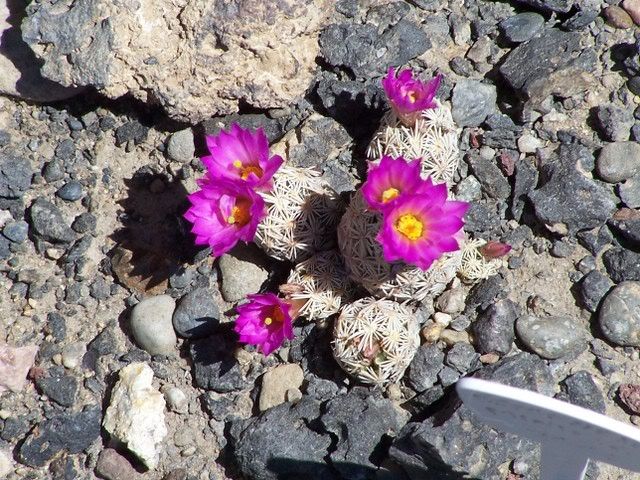
Sat, 03/03/2012 - 8:33amHere is mine from summers past. It died over one wet winter. :(
Manfroni (not verified)
Re: A teeny tiny treasure for the dry rock garden.
Sat, 03/03/2012 - 9:21amWow, it looks amazing! I find it strange that they die that fast! I think it rained quite a lot this winter and mine are still doing fine...
I guess the way I plant my cactus ends up to be working... when ever I transplant a cactus from the pot, I make a hole slightly larger than the pot, and I place the cacti in the hole from the pot, and I fill all the voids only with gravel, no soil at all... I figured the soil will eventually build up between the gravel anyway....
John P. Weiser
Re: A teeny tiny treasure for the dry rock garden.
Sat, 03/03/2012 - 3:48pmYour Escobaria leei blends into the light colored gravel very well indeed. It should bloom when the temperatures start to hit the nineties. At least that's when mine start to bloom. They will have tiny pink blossoms.
I have tried Escobaria minima several times it does not survive outdoors for me. I get down into the single digits at least once or twice a winter. They are adorable little creatures.
The Escobaria vivipara group are a hardy bunch well worth growing.
Andy71 (not verified)
Re: A teeny tiny treasure for the dry rock garden.
Sat, 03/03/2012 - 4:24pmJohn, I hope that E. organensis that I sent you survives there. It is very closely related to the E. sneedii plants.
John P. Weiser
Re: A teeny tiny treasure for the dry rock garden.
Mon, 03/05/2012 - 6:02amAndi
I checked it today so far so good!! :D
DesertZone (not verified)
Re: A teeny tiny treasure for the dry rock garden.
Mon, 03/05/2012 - 7:38pmI think it died in the wet winter here because it was under a foot of snow for over a month and was below 0F a few times.
I think your winters are much warmer than mine. I was surprised that it lived through a few winters (covered) here...like maybe two winters. :)
Martin Tversted (not verified)
Re: A teeny tiny treasure for the dry rock garden.
Mon, 03/05/2012 - 10:28pmEscobaria sneedii and the subspecies leeri both survive outside here in central Denmark. temps to minus 24C and both cold and rain. Obviously they are places in a sheltered place with lots of drainage and all the sun we have when we have it. But they are among the more hardy coldhardy cacti. Trond, I have extras...
Martin
Trond Hoy
Re: A teeny tiny treasure for the dry rock garden.
Tue, 03/06/2012 - 8:10am;D ;D ;D
BTW the succulents I got from you seem to have survived so far!
cohan (not verified)
Re: A teeny tiny treasure for the dry rock garden.
Sun, 04/29/2012 - 1:15pmGreat species! Esp love the salmony flower colours... Really doubt any of these would be hardy here, maybe for the indoor collection sometime..