
Forums:
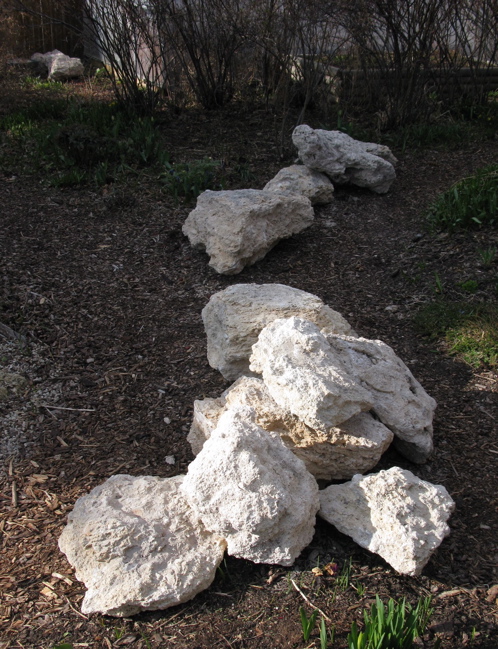
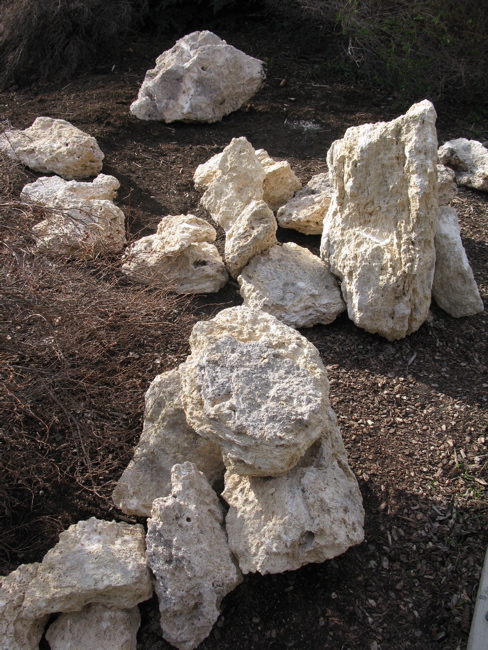
So, tomorrow, we start building the extension to last year's little tufa garden... after our backs rest up from today's efforts, aided hugely by the 2 strong young fellows from the tufa supply company, at unloading the truck! Here is a portion of the raw materials scattered through our yard... a pallet (a ton) of tufa in various sizes, plus 5 massive boulders (several hundred more pounds), and 5 bags of half-inch tufa gravel...
Comments
Tim Ingram (not verified)
Re: The making of a tufa garden
Fri, 09/16/2011 - 4:16amPeter Korn's website by the way is http://www.peterkornstradgard.se/english/eindex.htm
He grows an extraordinarily wide range of plants with great sensitivity to their ecological requirements. I only wish I was 25 years younger!
Richard T. Rodich
Re: The making of a tufa garden
Fri, 09/16/2011 - 8:44amIt always goes back to the combination of environmental factors working together. I agree that tufa would win out in the end over sand, but is not necessarily true all the time. I remember reading multiple times in Jānis Rukšāns's book Buried Treasure how many bulbous plants he found in situ in Central Asia grew in clay, when the accepted garden culture is "perfectly draining soil".
Trond Hoy
Re: The making of a tufa garden
Sat, 09/17/2011 - 12:27amYou have to look both at the growing medium and the climate. You can't separate the two. What works in one place doesn't necessarily work another place with a different climate.
The summer temperature is also very important - not only the winter mean and low spells.
youngman54 (not verified)
Re: The making of a tufa garden
Sun, 11/06/2011 - 8:30amStunning!! what a project. Cant wait to see it developing as its planted up. keep the photos coming.
Lori S. (not verified)
Re: The making of a tufa garden
Sun, 05/13/2012 - 8:43pmI acquired some more tufa on the weekend and put in tufa bed #5... it's not done yet, but the structure is completed. So I guess I certainly will have room for all the new plants! :) The new bed is the differently-coloured one... it's been wet down to pack the planting mix.
Trond Hoy
Re: The making of a tufa garden
Sun, 05/13/2012 - 11:31pmLooks terrific!
A question, do you get invading moss or lichens in your tufa beds? Such porous rock would be to the liking of moss here.
Anne Spiegel
Re: The making of a tufa garden
Mon, 05/14/2012 - 5:52amAnd here too, Trond. I haven't found it to cause a problem although I pick it out when it gets close to some thing that wants dry conditions as well as lime.
Richard T. Rodich
Re: The making of a tufa garden
Mon, 05/14/2012 - 8:43pmVery inspiring, Lori! 8)
Anne Spiegel
Re: The making of a tufa garden
Tue, 05/15/2012 - 6:42amWonderful work, Lori. Keep us posted on the planting, please.
Trond, I agree with what you said about climate. In the American west, you can find many plants growing in heavy clay. But this soil exists along with 10% humidity and very, very dry little rainfall and intense sun. That clay dries rock hard. If you grew the same plants in the same condiitons in the northeast with our average rain fall of 30-40 inches, they plants would not survive, because the clay would be muck all the time. Ditto the use of pumice in mixes. Here it would keep the mix much too wet. Everything has to betailored to your conditions which calls for experimenting with a lot of plants. (And a large plant cemetary for the failures)
Anne Spiegel
Re: The making of a tufa garden
Tue, 05/15/2012 - 6:46amLori, re: "gyra rock" (a term new to me, too). I once heard a lecture about drainage which compared "round" to "angular". It's true that round gravel drains much faster, but it's difficult to find. Probably the most superior drainage would come from a pot full of marbles!
Trond Hoy
Re: The making of a tufa garden
Tue, 05/15/2012 - 12:28pmAnne, my failures never get to the cemetery, they are taken care of by a plentiful crew of scavengers . . . . .
Lori S. (not verified)
Re: The making of a tufa garden
Sat, 05/19/2012 - 8:07pmThank you for the comments!
Yes, as Anne noted, moss does love tufa! The oldest area of the tufa bed is not built up very high (it has actually sunk somewhat into the old rose bed that was there - wish I'd built it up more) and presumably remains somewhat wetter, and has a fair bit of moss in the crevices. I'll pick it off if it seems to be taking over any plantings.
That's right! The maximum porosity would come from uniform spheres (i.e. marbles) arranged in cubic packing (that is, with the spheres directly lined up one on top of the other, not offset); the larger these cubic-packed, uniform spheres, the higher the permeability. I've always thought it very odd that "sharp" (i.e. angular, as opposed to round) sand/gravel is always recommended for gardening to provide "the best drainage", when physics proves the opposite. Other than that basic fallacy, it's probably pretty much a moot point anyway, as any other addition of finer material to that sand will clog up the pore space and reduce the permeability anyway.
Final product, awaiting planting. It's still a darker colour than the rest, as it has again been wet down. Basic dog's grave shape, but as the other tufa mounds give it some context, I guess I can live with it. :)
Richard T. Rodich
Re: The making of a tufa garden
Sat, 05/19/2012 - 10:04pmA fine example of determined success! :o
Which way is north?
Trond Hoy
Re: The making of a tufa garden
Sat, 05/19/2012 - 11:03pmAn excellent montane terrain! And what is the name of the mountain range? "The four sisters"?
Sellars (not verified)
Re: The making of a tufa garden
Sun, 05/20/2012 - 7:13pmA super project Lori. It will be fun getting it planted.
I agree that rounded particles would provide better drainage but I don't think drainage is the only consideration in selecting sand for a rock garden bed even in our wet climate here on the west coast.
As noted by Christian Korner in his seminal work, Alpine Plant Life, Functional Ecology of High Mountain Ecosystems, alpine soil profiles, counter to expectations, often contain large fractions of very fine grain sizes right down to fine clay material. This type of soil, while being well-drained also becomes quite compact over time and few alpines in nature grow in loose sand beds. When you walk across a fellfield or climb over a moraine, the soil is mostly compact under foot. On really loose scree slopes, plants such as Collomia debilis var. larsenii seem to be magically growing in loose stones. However this is a brilliant illusion. Collomia debilis var. larsenii has long flexible stems that grow up through the scree from a deep taproot embedded in fine-grained soil at the base of the scree. The flowers and foliage appear at the end of the stems above the loose stones. The scree flows around the plant and provides a coarse mulch but the plant is not really ‘growing in scree’ at all. It’s growing in soil at the base of the scree.
A point emphasized in Alpine Plant Ecology by John Good and David Millward is that one purpose of soil is to anchor the plants. Alpine plants need to be well-anchored in nature otherwise they would be uprooted in strong winds, avalanches and movement of scree. Plants growing in rock cracks and crevices are certainly well-anchored. The roots of alpines on compact fellfields find cracks which open up in freeze-thaw conditions or crevices between stones and the finer matrix. Because alpine plants have evolved to be well- anchored, it is probable that they prefer more compact soil conditions in the garden.
Lewisia cotyledon is an interesting example of a plant with thick roots that like to be firmly anchored. The plant will tolerate being root-bound in a small pot for years and is virtually indestructible in that condition. However, if you plant Lewisia cotyledon out in the garden in a vertical crevice which is recommended for good drainage, some plants will expire in a few seasons. I suspect that they do not tolerate soil movement around their roots, which frequently occurs in rock gardens constructed with a coarse sand mix. The soil in vertical crevices needs to be really well-compacted before planting and even then there is likely to be soil movement over time.
For building raised rock garden beds I use coarse sand with angular particles that also contains a small percentage of crusher fines. This type of medium drains well but also compacts over time providing stability for the plant roots. I think sand with rounded particles would remain too loose.
Anne Spiegel
Re: The making of a tufa garden
Mon, 05/21/2012 - 7:30amDavid, Lewisia cotyledon here is difficult to keep for long. L. tweedyi. on the other hand, will last for many years with excellent flowering. It doesn't seem to need vertical planting. I have some plants growing in a perfectly flat bed, with excellent drainage and way down a shovel of the richest compost I could make. It seems to be a heavy feeder and responds well to a shot of "blossom booster" when it starts growth in the spring. With a few exceptions, L. cotyledon just wants to be in someone else's garden.
Lori S. (not verified)
Re: The making of a tufa garden
Mon, 05/21/2012 - 8:19amFascinating stuff, David! Thank you for posting it. I must look up those books!
Lori S. (not verified)
Re: The making of a tufa garden
Mon, 05/21/2012 - 8:39amGreat info, Anne and David. That's the value of this forum - having access to the experiences and observations and advice of accomplished alpine gardeners like Anne and David!
:D
Pages