
Forums:
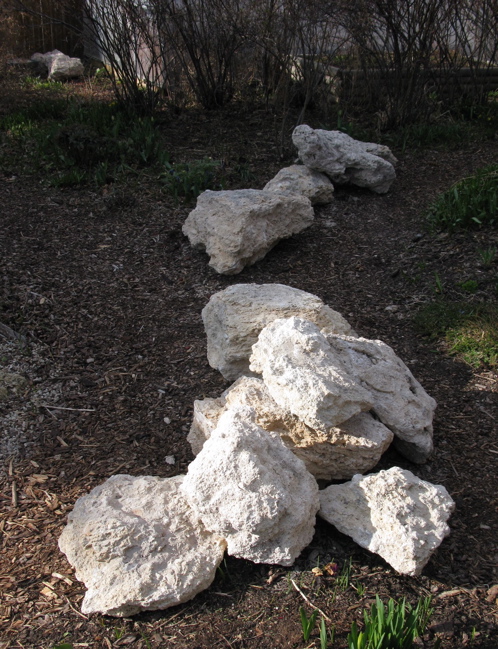
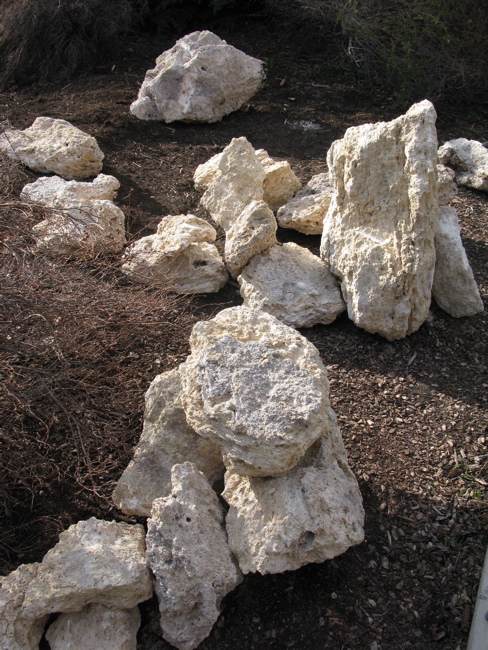
So, tomorrow, we start building the extension to last year's little tufa garden... after our backs rest up from today's efforts, aided hugely by the 2 strong young fellows from the tufa supply company, at unloading the truck! Here is a portion of the raw materials scattered through our yard... a pallet (a ton) of tufa in various sizes, plus 5 massive boulders (several hundred more pounds), and 5 bags of half-inch tufa gravel...
Comments
Trond Hoy
Re: The making of a tufa garden
Sun, 05/09/2010 - 10:31amNow you have to show the result too!
I have never used tufa, don't think I can get it here in Norway either. While all my neighbours have brought stones and rocks out of their gardens I have brought the same into mine in tons. I use rock, stone, gravel, sand etc in all kind of beds, even Rhododendron plantings.
Lori S. (not verified)
Re: The making of a tufa garden
Sun, 05/09/2010 - 11:13amSure, as long as the results aren't too embarrassing, I'll be sure to show them. As you can tell by the fact that I'm on the computer, I'm still "thinking" about the tufa bed design! ;D
tropicalgirl251... (not verified)
Re: The making of a tufa garden
Sun, 05/09/2010 - 12:40pmHi Lori
looks like you will have a great rock garden with that tufa . where did you get the tufa. I am interested in buying some tufa rocks while visiting calgary during long weekend
krish
Lori S. (not verified)
Re: The making of a tufa garden
Sun, 05/09/2010 - 4:17pmHi, Krish! I got the tufa from Rocky Mountain Tufa in Brisco, B.C. - it's a very good place to deal with and their stone is reasonably priced, particularly if you are buying it in quantity. Here's a link to their site, if you want to look or inquire, and they advertise in the NARGS Rock Garden Quarterly, as well:
http://www.tufa.bc.ca/
From the info I was sent re. pricing, I see that they actually do mail order! (Wow, one would certainly want to check out the shipping cost for that! Tufa is relatively light, so far as rocks go, but I don't think I'd want to pay for mailing it to anybody!)
It's too bad you are not here next weekend, as they always bring a load of tufa to the Calgary Rock and Alpine Garden Plant Sale, which is on Saturday. But, a small number of other places in Calgary also sell tufa (probably supplied by RMT, I suspect). Ornamental Stone (403-275-5550) is one I discovered, as I did a little phoning around earlier on. You may see tufa rocks for sale that are drilled with large holes (2-3" diameter) for planting... I would advise avoiding these, as the holes are much too large for successful planting. (If you want, you can drill your own planting holes easily, if you have access to a power drill with a wood bit - 1" across is more like it.)
Okay, I guess I'm not that easily embarrassed ;D... here's the conclusion of Step 1, the laying of the major pieces, which have been firmed up with packed-in soil. Excuse all the dirt - it will get hosed off, before I partially fill the crevices with a gritty mix; then a top dressing of the tufa gravel will eventually go on.
I'll have to buy a few more pieces of tufa myself next weekend... it never fails in any stone project that I'm left at the end with a few pieces that don't seem to fit anywhere! We need a few transition pieces to mesh "the mountain" a bit more smoothly with the surroundings and to link it with the now-very-modest-seeming old tufa garden!
Hmm, some of the more upright, jutting pieces put me in mind of Stonehenge... I mean the one from This is Spinal Tap, not the real one. ;D ;D
The photo doesn't seem to show the scale... the big boulders (described as "2'x2' ") were miserable brutes to put in place. Despite that I am tall, and pretty strong and fit, I could only just wiggle them around and flop them over. DH was able, somehow, to bull them into place, after moving them with a dolly. Yikes, if it was just me, they'd still be laying where the guys left them yesterday!
Richard T. Rodich
Re: The making of a tufa garden
Sun, 05/09/2010 - 6:22pmI am glad you gave some size dimension to the photo. I would've been way off.
I like it. It's more in line with what I envision my crevice garden to be. Right now, yours kind of looks like the backbone of a stegasaurus ;D to me. Photos are so two dimensional. I can't wait to see what it is really like.
Lori S. (not verified)
Re: The making of a tufa garden
Sun, 05/09/2010 - 6:54pmGreat, when are you coming to visit? I'll bake a cake! ;)
Yes, it does look strangely miniaturized in the photo! To give a better idea of scale, the potentilla in the left rear is 4' tall; the bush to the right rear is an immense sweet-berry honeysuckle* (don't let anyone tell you these things only get to 3' tall)... The tallest "peak" in the bed is 28", and the bed is 12' by ~8' in its broadest dimensions, with a U-shaped entrant in the front, for my eventual viewing pleasure. ;D
*We have since determined that it's an amazing 14' wide by 9' tall - not at all what we were led to expect.
Todd Boland
Re: The making of a tufa garden
Tue, 05/18/2010 - 7:41amI'm so jealous! I wish I had access to tufa!
Trond Hoy
Re: The making of a tufa garden
Tue, 05/18/2010 - 1:43pmCan't you make your own? Mix cement/mortar and peat!
Richard T. Rodich
Re: The making of a tufa garden
Tue, 05/18/2010 - 8:07pmTrond, you are talking about hypertufa. Todd is talking about natural tufa rock.
Lori S. (not verified)
Re: The making of a tufa garden
Tue, 05/18/2010 - 8:42pmAnd here's the final product, with planting areas/crevices built up with gritty soil, and a tufa gravel top dressing...
1) I attempted to mesh it, more or less, to last year's little tufa garden in the foreground... (with a slight change in bedding plane direction there from the new bed to the old bed but just try to imagine the old bed is a rock slide or moraine... errr, yeah, that would explain it. ;D Hey, I'm a geologist - trust me! - this can happen! :D )
2) The view from the back door... I don't like the contrast to the bark mulch that we used for all our paths... but, in its favour, bark mulch is a lot easier to weed than gravel, so I guess it can stay. (Remember? I've already explained that I'm very lazy!)
3) An imprint of a birch log in the tufa; even the lenticles are preserved.
4) Lots of interesting crags
5, 6) And many natural planting holes where the tufa formed around branches or where plant material may have decayed out.
Now, on to planting, which I started this evening! :)
Lori S. (not verified)
Re: The making of a tufa garden
Tue, 05/18/2010 - 8:53pmA thought occurred to me... I hope these photos don't dissuade anyone from building alpine beds, LOL! I'm pretty much just making it up as I go, so rest assured that you will do a better job than this, if you are a beginner just considering it! ;) ;D
Mark McDonough
Re: The making of a tufa garden
Tue, 05/18/2010 - 9:34pmLori, it looks awesome... you've used tremendous restraint to not stuff plants in prematurely... observe the terrain, then make judgements about what should go where. Keep us posted, it is great fun "watching" a new garden being built... please keep showing us the progress.
Trond Hoy
Re: The making of a tufa garden
Wed, 05/19/2010 - 3:51amYes, I know! But when you haven't the real thing, what do you do?
We have no tufa here in Norway either so people use other kind of stone or hypertufa.
Trond Hoy
Re: The making of a tufa garden
Wed, 05/19/2010 - 3:59amDon't be afraid! Although the planting is the funniest, I like working with stone, tufa or not! It can be hard work but very satisfactory when finished.
Now we are awaiting your plant choises! And the mature result in years to come....
Richard T. Rodich
Re: The making of a tufa garden
Thu, 05/20/2010 - 8:06pmDoesn't look at all like a stegasaurus backbone now, but the "bones" are certainly well placed. It's gonna be a great garden!
Lori S. (not verified)
Re: The making of a tufa garden
Sat, 05/22/2010 - 7:16pmThank you. Let's hope it grows plants! ;)
Some views...
Excuse the plastic tags where you see them - I will remove these later when I map it out.
1) Convolvulus holosericeus (from Pavelka; 1500m, Bozkir, Turkey; dwarf compact cushions; silky silver short leaves, solitary stemless white flowers, white to pale yellow; dry stoney places; 2008 seed) with rooted cuttings of Saxifraga cv., placed into tufa crevice.
2) Dracocephalum heterophyllum, foreground - very attractive little plants - (from Pavelka; 4100m, Anyemaquen Shan, Quinghai, China; cushions, glaucous-green dentate leaves, 10-15cm, flowers white to yellow, stoney places, screes; 2008 seed) and Tanacetum tibeticum (from Pavelka; 5000m, Tanglang La Pass, Zanskar, India; dwarf suffruticose silvery-grey cushions 5-15cm; erect scapes with 2-5 yellow flowers; 2005 seed).
Trond Hoy
Re: The making of a tufa garden
Sun, 05/23/2010 - 12:15pmI like your mountain! Does it have a name? How do you decide what plants to use?
Richard T. Rodich
Re: The making of a tufa garden
Sun, 05/23/2010 - 4:05pmI wouldn't say that is so eccentric. Some people call their cars by name, why not a garden feature?
Go for it!
Lori S. (not verified)
Re: The making of a tufa garden
Sun, 05/23/2010 - 4:48pmAs if I need to seek out ways to be more eccentric... ::)
Well, I suppose I could pay homage to a local landmark and call it Tunnel Mountain... ;D ;D
Lori S. (not verified)
Re: The making of a tufa garden
Sun, 05/23/2010 - 5:07pmTrond, so far as selecting plants, it is more the case of having to plant up all the seedlings I grew this spring... which I chose on the basis of things that were unfamiliar and sounded interesting! Yes, pretty well-thought-out and restrained, I know... ;D ;D
I ordered from the NARGS and SRGC seed exchanges, did a couple of trades, and then... swooned at the seedlists produced by the Czech seed collectors, Mojmir Pavelka and Vojtech Holubec, and made wildly-adventuresome orders! It was great fun to grow them, and it will be fascinating to see which species are able to winter over here. I am hoping that our relative high elevation/cool summers will be favorable to some of the high alpine species from China and elsewhere. Many of the seeds were collected from plants growing in limestone areas, so that may be positive for the tufa bed (though I admit it was not a factor in choosing the seeds).
Some more views:
1) Rheum rhizostachyum, another very attractive little plant (Holubec: Tajikistan: Yazgulem Range, Pamir, 3800m, gneiss scree; caespitose perennial plant; 2 ovate ground leaves, 15 cm long, flowering spikes 15cm long, red prominent fruits; 2006 seed)
http://www.efloras.org/florataxon.aspx?flora_id=2&taxon_id=242343403
2) From front to back, Potentilla caulescens (Pavelka: 1800m, Alps, Italy; tufted plant 5-15cm, green leaves, many white flowers in dense raceme; limestone rocks; 2007 seed),
Saussurea stella (Pavelka:4500m, Shaluli Shan, Sichuan, China; dwarf tufted plant, stemless blue flowers, red-purple leaves in autumn; alpine meadows; 2008 seed),
Campanula dolomitica (bought from Beaver Creek), and
Achillea aleppica ssp. zederbaueri (Pavelka:1600m, Karaman, Turkey; very good dwarf silver-gray plant 5-15cm, linear leaves, yellow flowers in dense corymb, 2008 seed).
3) From front to back - Campanula ptarmicifolia (Pavelka; 2500m, Sipikor Dag, Turkey; dense tufts or compact cushions; narrow spathulate leaves, erect stems 10-25cm, blue flowers in spike, 2008 seed),
Campanula seraglio - NARGS seedex,
Lancea tibetica (Holubec; China: Litang, Sechuan, 4200m, eroded open soil; small caespitose plant, 3-5cm high , lanceolate leaves in rosettes, rose flowers in low racemes, black sessile berries; 2007 seed).
Yes, undoubtedly somewhat overplanted, but then, this is zone 3, with unfamiliar plants, among which a few are monocarpic or biennial, so there will undoubtedly be losses. (And my preference, as I've mentioned, is to get them in the ground and find out about them, rather than to take care of them in pots. :))
An aside... Bigger is definitely better with rock gardens. Already, I need more space... ! ;D
Trond Hoy
Re: The making of a tufa garden
Mon, 05/24/2010 - 8:55amThay's very good! Building mountains to have space for your plants (many special ones too)! I do something like it - buy interesting seeds or plants. And then lacking appropriate space having to make it. But I have not built any mountains yet. Have to do it, I presume!
Richard T. Rodich
Re: The making of a tufa garden
Mon, 05/24/2010 - 4:35pmI'm thinking my garden will be a mountain range. ;D I guess that means the walkways will be passes . . .
Oh my, maybe I am getting a bit eccentric. I'm sure those of you living in the mountains are just rolling your eyes.
Lori S. (not verified)
Re: The making of a tufa garden
Fri, 07/09/2010 - 8:57pmHere I am, with astounding boldness, posting a couple of "completed" photos... as if anything in the garden is ever completed!
Has there been progress on the rock garden plan, Rick?
Cliff Booker
Re: The making of a tufa garden
Sat, 07/10/2010 - 8:54amVERY, very pretty ... !
Richard T. Rodich
Re: The making of a tufa garden
Sat, 07/10/2010 - 10:25amYou should be proud, Lori.
Ground breaking for my garden will be late Aug - Sept, when I can get time off from work. It will have permanent paths that double for water drainage, especially in spring before ground thaw, and to "match" the woodland garden nearby in the same "watershed."
Lori S. (not verified)
Re: The making of a tufa garden
Sat, 07/10/2010 - 10:38amThanks! I brace myself, however, for comments of a more critical nature, which one must always expect when "opening up" on a public forum!
Re. tufa vs. other rock, I am surprised that we (DH and I) now seem to prefer the look of the tufa, as compared to the so-called "iron ledgestone" (siliceous slate) we used in the other bed. Something of a change, as we'd both considered the tufa not terribly attractive, albeit very useful for alpine-growing. Going forward, as we extend the ledgestone bed, we plan to build it up a lot more.
We are (finally) in a stage of removing old, overgrown, not-terribly-interesting shrubs from various areas of the yard (gaining in each step an area equivalent to that of a modern subdivision back yard!), so I would not be surprised if there is not opportunity to extend this tufa bed soon, as well. (I'd like to continue to build onto the backside of it... to even out those gap-toothed peaks a bit!)
Sounds like a well-thought-out plan, Rick.
Trond Hoy
Re: The making of a tufa garden
Sun, 07/11/2010 - 2:25amI would not even out "the gap-toothed peaks"! They look like a mountain range and give more slightly variable habitats to fill with plants. Raising a second range behind seems very appropriate - making a valley in between the mountain ranges! I am jealous!
Tim Ingram (not verified)
Re: The making of a tufa garden
Sun, 09/04/2011 - 12:17amI've been thinking of doing this for a while and have at last found a source of tufa but haven't yet plucked up courage to go ahead (there is always so much else to do!). Finding this thread is quite an inspiration! Unfortunately I can't get hold of really large boulders which would be most dramatic. There are not too many gardeners in the UK using tufa in such a way and the latest and very effective 'fashion' is the crevice garden. Of course I would like to have both, in addition to sand beds!! A lot of construction in the offing!
deesen (not verified)
Re: The making of a tufa garden
Sun, 09/04/2011 - 1:47amLucky man Tim. I recently discovered a salvage yard with quantities of rockery sized re-claimed limestone and granite but the £100 per ton plus delivery cooled my ardour!
Sellars (not verified)
Re: The making of a tufa garden
Sun, 09/04/2011 - 6:28amTim: Why not have a tufa bed built as a crevice garden using sand as the underlying material? After years of experimentation that is how I build all my tufa beds now. Some plants like a longer root run so they are planted in the crevices between the tufa. I plant Saxes directly in the tufa. I have found that in our climate, sand is the best material to build with tufa as sand is well-drained and essentially weed free. In the last tufa bed I constructed I incorporated a small diameter soaker hose at the base of the sand and it seems to work well to draw the roots of plants down deeper. Otherwise I have found shallower rooted plants in a sand bed can suffer from lack of water in a dry summer even with surface sprinkling.
Tim Ingram (not verified)
Re: The making of a tufa garden
Sun, 09/04/2011 - 10:46amDavid - many thanks for that advice. I have read yours and others articles in the Quarterly and found them very stimulating, especially since few growers describe their experiences here in the UK. I will do as you suggest, and I like the idea of incorporating a soaker hose. Once I get going I will put progress on this thread.
Lori S. (not verified)
Re: The making of a tufa garden
Tue, 09/06/2011 - 1:04pmWell, if all goes according to schedule, Phase
IIIII of our tufa garden begins on Friday, with the delivery of materials... 4500 pounds of tufa, 10 bags of 1/2" tufa gravel, 5 bags of tufa sand, 2 yards of 7mm gyra rock, and a yard of topsoil (for contouring the subsurface). (If more material is needed, it'll be acquired on an "as-needed" basis. We'll see how this amount works out.) I'll be trying to correct my beginner's errors of the first phase... better drainage, specifically.Stay tuned... !
deesen (not verified)
Re: The making of a tufa garden
Tue, 09/06/2011 - 2:06pmWOW, 4500 pounds of tufa!!
http://english-tufa-rock.co.uk/page9.php?view=preview&image=4&category=0
This piece £16.99 in England (about $27.0)
Lori S. (not verified)
Re: The making of a tufa garden
Tue, 09/06/2011 - 2:16pm:o :o
Wow, I've got to figure out a way to buy it here and sell it there! ;D
Edit: Correcting myself, I guess this will actually be Phase III, not II... There may be a Phase IV next year... or not, maybe this will be enough tufa for us.
Trond Hoy
Re: The making of a tufa garden
Wed, 09/07/2011 - 6:58amI assume the English tufa is handmade?
David, can you use coke as a black substitute? You can afford painting it too!
Lori S. (not verified)
Re: The making of a tufa garden
Wed, 09/07/2011 - 7:22amFor that price, one would hope it was handcrafted by skilled artisans, but no, I'm sure it's naturally-formed.
deesen (not verified)
Re: The making of a tufa garden
Wed, 09/07/2011 - 11:37am;D ;D ;D
Lori S. (not verified)
Re: The making of a tufa garden
Sun, 09/11/2011 - 8:30amWork in progress...
There will be another slightly-lower mound to the right of the new one, to be put in place today, with a path in between. The big path to the back gate is to the right of that. There is more tufa laid out elsewhere in the yard. (Actually, it turns out that we bought 7500 pounds of tufa, rather than the ordered 4500 lbs... it was available on the truck, and not spoken for, as it turned out, so... :o)
Anne Spiegel
Re: The making of a tufa garden
Sun, 09/11/2011 - 11:02amLori, I've found this to be true also. We almost always seem to have a period of extended drought during the summer now. I plant between pieces of tufa for a deep root run and have found that plants will also put roots into the tufa. Another way is to drill a hole right through the tufa. Some roots will extend into the sand beneath and other roots will still go inot the tufa. There is very little I plant directly into the tufa anymore - the garden is too big to water, and during extended drought, the water isn't available from our well.
Lori S. (not verified)
Re: The making of a tufa garden
Sun, 09/11/2011 - 11:24amThanks, Anne. I am using a mix of tufa sand and gyra rock (7mm rounded gravel) as the planting medium this time... plus a little peat. I have been using these beds more as a tufa crevice garden to date, as you suggest, with plants stuck in between the tufa pieces. There are also some plantings into crevices in the pieces of tufa plus into some drilled holes in the tufa (for mainly saxifrages).
Back to work now... :)
deesen (not verified)
Re: The making of a tufa garden
Sun, 09/11/2011 - 1:39pmIf envy and jealousy are sins, boy am I sinning ;D
Cliff Booker
Re: The making of a tufa garden
Sun, 09/11/2011 - 2:10pmLori, I'm with David ... enjoy your magnificent gardening experience.
Lori S. (not verified)
Re: The making of a tufa garden
Sun, 09/11/2011 - 3:12pm:)
Progress through the day...
Mark McDonough
Re: The making of a tufa garden
Sun, 09/11/2011 - 7:42pmLori, I can't wait until you show us the next amazing variety of alpines grows between your tufa crevices next year. I spy that wonderful bluish Satureja on the left hand side in your second photo. I'm envious of your gardens, and sigh, I look at my garden this year and it's almost totally overcome with tall weeds; I've had so little time to do anything in the garden.
Richard T. Rodich
Re: The making of a tufa garden
Sun, 09/11/2011 - 8:44pmI am equally impressed, too!
And you have all that extra tufa without the shipping charge...
Maybe you should sell to the UK... ;D
Lori S. (not verified)
Re: The making of a tufa garden
Sun, 09/11/2011 - 9:45pmThank you for the comments!
Boy, are my arms tired... and they look like I've been taming wildcats - all scratched and scraped! With the extra tufa purchase (glad we did it), there was enough to do paths through the new beds, and enough for another smaller tufa bed somewhere... somewhen... (Whew, that was enough for now!)
Not to say this is what should be done ;), but this is what we did, in summary...
The bigger, structural pieces were put in place (with much standing back to look at it, to see if the angles and shapes were pleasing) and then some of the mounded topsoil was packed in around their bases to stabilize them. With the big pieces put in place, the gyra rock-sand-little bit of peat mix was then packed into all the crevices, using pieces of wooden board (1"x 2", 2"x 2") and a dandelion weeder for smaller crevices. (The goal is for all pieces to be completely firm, so that I can crawl all over it for planting and weeding without dislodging any pieces.) The pathways were done the same way... the tufa pieces fitted against the structural pieces to help hold them in place, and the mix packed in to make them all stable and firm. Then, building upwards, there was more filling-in with the gyra/sand planting mix and chinking-in of spaces to keep the planting mix from spilling out (more of this needs to be done). We then set the water sprinkler on it to wet things down and help it all settle... then I'll go over it again and look for places that need more packing tomorrow night. Then, eventually, the top dressing of 1/2" tufa gravel can be added.
And then, the trays of seedlings left over from spring can finally find homes!
Strangely, the pile of gyra rock in the alley seemed not to diminish no matter how much we took from it; there is an ample quantity put away for "sanding" the walks during the winter, we used it as a border all around, etc.... either my estimate of what we'd need was off, or we got rather more than the 2 yards ordered (Stuart claims the latter)... We wanted to get it out of the alley, so hauling the remainder into the yard was the day's last chore.
Margaret Young
Re: The making of a tufa garden
Mon, 09/12/2011 - 5:09pmWell done, Lori.... and Stuart!
What a great job you've been making of these tufa gardens. Now, of course, if anyone wonders why there is such a shortage oftufa around, we now know its all at Lori's place!
I won't be offering to arm-wrestle you anytime soon after all that hauling rock ;) ;) (Not sure why I would be wanting to.... but you get my drift.... get exercise that rock hauling!)
deesen (not verified)
Re: The making of a tufa garden
Tue, 09/13/2011 - 1:16amLori, what is "gyra" rock please?
Lori S. (not verified)
Re: The making of a tufa garden
Tue, 09/13/2011 - 6:56pmThanks, Maggi! It's fortunate that tufa and other stone is available around here at (relatively) low cost.
Well, I'm sure it goes without saying that normally I'd be delighted to arm-wrestle you ( ??? ;)), but I feel that perhaps I should save my strength for more gravel-packing on the weekend! ;D ;D
I have no idea why it's called "gyra rock" - and can't find any references to explain it so perhaps it's just a local term? - but anyway, it's fine gravel/pebbles, in this case sieved to a nominal size of 7mm (though actually the size varies quite a bit; perhaps 7mm is an average/median?) The individual particles are naturally rounded (so probably from a fluvial deposit of glacial age) and usually rather oval-shaped with a longer and a shorter axis.
(NB. The more consistent the grain size and the better the rounding, the better the permeability, by the way... as opposed to the common misconception that "sharp" particles, i.e. angular ones, yield the best permeability.)
Tim Ingram (not verified)
Re: The making of a tufa garden
Wed, 09/14/2011 - 8:58amI really must get going after all this from Lori! But now I'm torn after listening to Peter Korn describe his garden in Sweden (at Lamberton, Ron McBeath's nursery, last Saturday). He uses sand and gravel on an epic scale and should be able to give Lori a good run for his money! Seriously the description of his garden was truly remarkable and inspirational but I suspect tufa wins out at the end of the day for the choicest of plants.
Pages