
Forums:
The March Issue of the e-magazine from the Scottish Rock Garden Club is now online here:
http://www.srgc.org.uk/logs/index.php?log=international
.... you can be sure we have a hyperlink from the name of Zdeněk Zvolánek to the NARGS 2010 "Romancing the Rockies The Marriage of Plant and Stone " July 11-14, 2010, to be held in Denver & Salida, Colorado !
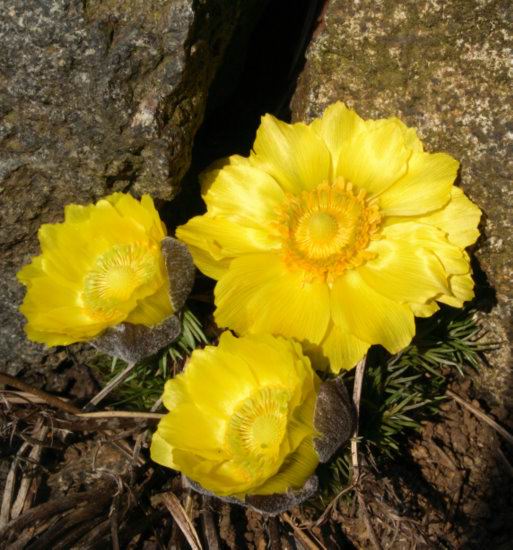
Here is a photo, by ZZ, from the March issue, of Adonis vernalis .....
Comments
Todd Boland
Re: International Rock Gardener e-magazine
Fri, 03/11/2011 - 3:50pmGreat images Cliff...as per usual!
deesen (not verified)
Re: International Rock Gardener e-magazine
Sun, 03/13/2011 - 12:17pmI've already painted the banner "Bring the Bookeroo Home" I'll be outside 10 Downing Street in the morning ;D
cohan (not verified)
Re: International Rock Gardener e-magazine
Sun, 03/13/2011 - 2:26pmGood luck with the travel! Lovely images of spring :)
Cliff Booker
Re: International Rock Gardener e-magazine
Mon, 03/14/2011 - 1:52amMany thanks for your support David ... British diplomacy worked, we arrived home at lunchtime on Saturday. Now we have to fight for some meagre compensation ... wish us luck, we will need it! ;D ;D
Thanks once again Cohan.
Margaret Young
Re: International Rock Gardener e-magazine
Sat, 03/26/2011 - 1:28pmThe March issue of International Rock Gardener - IRG15 - is now online.
http://www.srgc.org.uk/logs/logdir/2011Mar251301088655IRG15_March_2011.pdf
Featuring -
Joan and Liam McCaughey's selection from the Tien Shan; 'Silk Road Blues'
Kata and Ferenc Zoltan's photo essay of striking natural plant combinations: 'Alpine Groupings and Rock Gardens in Nature'
Vlastimil Braun on Daphne malyana
and introducing an article from Paige Woodward on an Iris "re-found" in Afghanistan
Picture: Ranunculus glacialis photo by Zoltan Ferenc.
[attach=1]
Margaret Young
Re: International Rock Gardener e-magazine
Fri, 04/29/2011 - 8:54amAnd in issue 16 of IRG we have that very article!
IRG16 for April 2011 is now online.....
http://www.srgc.org.uk/logs/logdir/2011Apr281304030775IRG16_April2011.pdf
The cover photo is Tulipa orthopoda by Vladimir Kolbintsev, formerly a research scientist at the Aksu-Dzhabagly nature reserve and regarded Kazakhstan‘s leading naturalist.
Also included are articles by Dieter Zschummel ,Todd Boland, Cedrik Haškovec and Štěpánka Haškovcová.
[attach=1]
Moltkia coerulea in the Ala Dag
Tim Ingram (not verified)
Re: International Rock Gardener e-magazine
Wed, 05/04/2011 - 6:09amWhat a wonderful resource the IRG is - I've only discovered it through this website as I am ashamed to say I don't belong to the Scottish Rock (I have thought of joining for many years but always felt the South-East of England and Scotland were poles apart climate wise - although I regularly got seed from Jack Drake's nursery years ago). However, like you say elsewhere, Ian, the ethos of the SRGC lies much closer to my vision of gardening, and it seems a great surprise that the AGS remains rather resistant to any change. Having only recently realised how effective the web can be for discussion I am becoming a total convert. My only worry is that I may not get out in the garden as much as I would like!
Margaret Young
Re: International Rock Gardener e-magazine
Wed, 05/04/2011 - 12:21pmThank you, Tim.... we do hope to get that reaction for the IRG!
The SRGC has an international membership and a truly active international membership at that.... the Forum of the SRGC Website, which we are delighted to say formed part of the model for this NARGS Forum, is a meeting place for our thousands of members around the world and is a vibrant resource that is open to all, whether "official" SRGC members or not.... how else could we properly fulfil our charitable remit to spread knowledge and encourage interest in the mountain plants that so fascinate us?
You would soon find that there are a great many others involved in the SRGC with similar growing conditions to yourself.... not least fellow English folk! :D
Maggi Young
Todd Boland
Re: International Rock Gardener e-magazine
Sat, 05/07/2011 - 5:43amI'm very pleased with the layout of my serpentine article...looks great! (or course the entire IRG looks great!)
Margaret Young
Re: International Rock Gardener e-magazine
Thu, 05/12/2011 - 11:51amThanks, Todd.
We've added a 'paypal donate button' so that folks who appreciate the work the SRGC volunteers are doing with the website projects can show their appreciation in a tangible fashion, should they so wish! Such donations will help to pay for the increased bandwidth needed for all the IRG and Bulb Log readers 8)
Margaret Young
Re: International Rock Gardener e-magazine
Fri, 05/27/2011 - 5:09amIRG 17 for May 2011 is now online:
http://www.srgc.org.uk/logs/logdir/2011May261306444476IRGMay2011.pdf
We celebrate the centenary of the rock garden at Wisley, with Paul Cumbleton and introduce a new section in the IRG Forum area, devoted to the Garden History : http://www.srgc.org.uk/smf/index.php?topic=7231.0 Dr John Page is well known for his interest in this subject and welcomes any contributions to the Forum pages on the history of gardens , particularly rock gardens, around the world.
This month's IRG cover picture is Campanula morettiana, photographed by Gita Piatková of the Czech Republic.
Margaret Young
Re: International Rock Gardener e-magazine
Wed, 07/06/2011 - 5:30amOops! I quite forgot to let you Folks know that the June IRG is online......many thanks to the NARGS member who reminded me :-[
IRG June 2011 is here - http://www.srgc.org.uk/logs/logdir/2011Jun271309163193IRG18-June2011.pdf
As a seeming antidote to all those summer holiday venues, there's a trip to the Awakino Ski Field in New Zealand :o Don't panic, this is the southern hemisphere we're talking about, so Steve Newall's pictures are of some of NZ's finest alpine plants... but no snow!!
This map shows the location.....
Anne Spiegel
Re: International Rock Gardener e-magazine
Wed, 07/20/2011 - 7:35amYet another fascinating issue, Maggi. You just keep topping yourself. I'll be on the lookout for the Leptinella pictured. There is something absolutely irresistible about plants with exserted stamens (Phacelia sericea, Valeriana supina etc.)
Margaret Young
Re: International Rock Gardener e-magazine
Thu, 07/21/2011 - 6:24amThanks Anne.
Yes, isn't there? Funny how these things catch our attentioin and admiration.
In the next issue there are echoes of the latest NARGS bulletin, with reports from the Picos de Europa from the Czech pairing of Cedrik and Štěpánka Haškovec .... I think there will be much to please readers ;)
Margaret Young
Re: International Rock Gardener e-magazine
Tue, 07/26/2011 - 5:53amApologies to those of you trying to acces the SRGC website and Forum today, 26th July 2011 and contacting me to ask what is wrong.
Our server is experiencing some sort of technical disruption and the sites are temporarily inaccessible.
Sorry for any inconvenience... at least we have the NARGS Forum to enjoy !
Will make another post to let you know when "normal service" is resumed :)
Maggi
Mark McDonough
Re: International Rock Gardener e-magazine
Tue, 07/26/2011 - 5:57amThanks for letting us know Maggi,
I was wondering what's up with the connection, assuming the SRGC server was down for some reason. Hope that service is restored soon, imagine the withdrawal SRGC Forumists will be going through :'(
Margaret Young
Re: International Rock Gardener e-magazine
Tue, 07/26/2011 - 6:26amGetting my "fix" happily here in the meantime, Mark.... so many threads to catch up on 8)
Margaret Young
Re: International Rock Gardener e-magazine
Tue, 07/26/2011 - 10:10amAfter brief spell back in operation the SRGC Server has failed again.... sorry Folks!
Margaret Young
Re: International Rock Gardener e-magazine
Tue, 07/26/2011 - 11:28amOkay, after some stops and starts I think the SRGC site and Forum is back in operation.
Sorry for the disruption Folks, wish we could control such things.
Margaret Young
Re: International Rock Gardener e-magazine
Thu, 07/28/2011 - 11:40amTime for a new IRG edition: http://www.srgc.org.uk/logs/logdir/2011Jul281311872373IRG19.pdf
This month's IRG has contributions from Jules Fouarge, Cedrik and Štěpánka Haškovec, Zdeněk Zvolánek and J. Ian Young.
There is talk of Campanulas, Gentians and Hypericums, from Turkey and the Himalayas, as well as visits to the Picos de Europa and the Cascades.
If the IRG is showing you plants that you would love to grow, remember the wonderful Seed Exchanges of all the main plant organisations such as NARGS, SRGC and AGS that can give you access to such seed and also support them with donations of seed from your own garden.
These photos of orchids from the Picos de Europa are from the Haškovecs.
Ophrys apifera
Orchis provincialis
There is more about the IRG here: http://www.srgc.org.uk/smf/index.php?board=34.0 :)
Margaret Young
Re: International Rock Gardener e-magazine
Thu, 08/25/2011 - 3:38pmAugust 2011 issue of IRG is now online .....we return to the subject of Campanula morettiana, and hear more from Cedric and Štěpánka Haškovec .....
http://www.srgc.org.uk/logs/index.php?log=international - for main IRG menu
http://www.srgc.org.uk/logs/logdir/2011Aug251314305515IRG20August_2011.pdf - for August Issue
http://www.srgc.org.uk/smf/index.php?topic=7778.0 for further item and photos
Mark McDonough
Re: International Rock Gardener e-magazine
Sat, 08/27/2011 - 3:51pmMaggi, I've tried downloading the August PDF both from the link here on NARGS, and from the main IRG page, and it starts downloading then gives a message that it cannot download the file because it is damaged. Does anyone else get the same results I'm getting? Maybe the PDF needs to be reposted?
Update: I'm getting the same error message on any IRG issue I try to download and view.
Trond Hoy
Re: International Rock Gardener e-magazine
Sat, 08/27/2011 - 11:07pmNo, Mark. I download all of them with no trouble at all. Each download in about to seconds.
Michael J Campbell (not verified)
Re: International Rock Gardener e-magazine
Sun, 08/28/2011 - 2:52amThe same thing happened me,I downloaded Adobe reader update ( reader update 10) and it worked perfect then.
Mark McDonough
Re: International Rock Gardener e-magazine
Sun, 08/28/2011 - 6:31amI had Acrobat Reader 9.4.5, and actually received an automatic update yesterday, so believed my Reader was fairly up to date. Just upgraded to version 10.1, now the IRC PDFs download and view okay.
Margaret Young
Re: International Rock Gardener e-magazine
Wed, 08/31/2011 - 3:42amSorry to hear you have had this difficulty, Mark and Michael. The IRG pdf is saved to be backward compatible to Adobe Acrobat reader 7 so I am at a loss to know what was wrong. :-X
Margaret Young
Re: International Rock Gardener e-magazine
Fri, 09/30/2011 - 4:54amSeptember 2011 Issue of International Rock Gardener is now online.
Here are some extra pictures from Cliff Booker to add to his article..... there are yet others relating to this issue in the SRGC Forum: http://www.srgc.org.uk/forum/index.php?topic=7893.0
Extra images from Cliff:
"These images were all taken in the Picos de Europa and feature as follows:-
IMAGE ONE : The Bookers' travelling companions, John and Clare Dower, on a viewing platform above La Hermida gorge and John taking his life in his hands on this usually very busy road to capture a cliff-dwelling campanula.
IMAGE TWO : Picos views and bottled temptations.
IMAGE THREE : Serapias and Anacamptis blooms.
IMAGE FOUR : Picos scenes and poppies.
IMAGE FIVE : Orchis ustulata and Picos flowers.
IMAGE SIX : Potes to Fuente De.
Richard T. Rodich
Re: International Rock Gardener e-magazine
Fri, 09/30/2011 - 6:58amI just previewed the September IRG, and can't wait to start reading!
Wow!
Margaret Young
Re: International Rock Gardener e-magazine
Fri, 10/28/2011 - 2:29amOctober IRG is online...... http://www.srgc.org.uk/logs/logdir/2011Oct271319742037IRG22October_2011.pdf
we hope there is something there to interest you....... :)
You will find a link to a pdf full index of the IRG including this latest issue here: http://www.srgc.org.uk/forum/index.php?topic=4850.msg217837#msg217837
Margaret Young
Re: International Rock Gardener #22
Sat, 11/05/2011 - 1:18pmRE: article on Colchicum in the 'International Rock Gardener'
In IRG 22 I expressed doubt that colchicum were truly to be found "wild" in the UK and was pleased to hear from John Grimshaw, who wrote that he " thought you'd be interested to know that C. autumnale is wild here at Colesbourne & around - there's a patch on the main roadside a couple of miles away, but always associated with ancient woodland. It's curiously inconspicuous in flower though".
John's note came with an accompanying photograph which he is happy for me to share here.
I replied that I was much surprised by this and "I'm sceptical enough to think that they are naturalised, if ancient, escapees but it's an interesting record."
John replied again...
"Dear Maggi,
Your scepticism is unfounded: Colchicum autumnale is a genuine native with, at least formerly, a wide distribution especially in western England. The 1948 Flora of Gloucestershire says: 'Common over most of the county, especially on the Cotswolds.' Unfortunately, it has lost a lot of sites to agricultural improvement & thus from being essentially a meadow plant it is now found mostly in woodland. An old man in the village once told me he could remember meadows having their soil scraped off completely to eradicate Colchicum, it being potentially poisonous to cattle."
I remain doubtful as to how such a bulb might have truly survived ancient ice-ages to be considered "native" in so far as "the purists" regard the term.... but in the light of recent findings of Rhododendron ponticum pollen and remains in the UK from extremely distant times, which would suggest that this much maligned "invasive" plant is in fact a true native, then perhaps I am just too suspicious for my own good!
Many thanks to John for this insight and for the use of his photo of these elegant flowers.
Margaret Young
Re: International Rock Gardener e-magazine
Fri, 11/25/2011 - 5:45amThe November Issue of IRG is online now http://www.srgc.org.uk/logs/logdir/2011Nov241322170676IRG_23_-_November2...
We return to the ever popular subject of Turkey and her plants .... this country is, of course, species rich and the appetite to learn more of the plants who inhabit that large and diverse region seems undimmed.
For the bulb lovers, J. Ian Young encourages an interest in the dwarf narcissus of the "hoop petticoat" type, so invaluable for flowering through the northern hemisphere winter as well as into spring.
Putoria calabrica in cultivation.... photo by ZZ (Zdeněk Zvolánek)
Mark McDonough
Re: International Rock Gardener e-magazine
Fri, 11/25/2011 - 6:01amAnother superb issue, all of the Turkish plants shown are mouth watering gems, I like Aethionema subulatum the best, what a stunning cretaure it is. :)
Margaret Young
Re: International Rock Gardener e-magazine
Fri, 11/25/2011 - 6:10amThanks, Mark. The diversity of the Turkish flora will never lose it's attractions, I think.
Yes, that Aethiomema is a cutie.... I see the Ontario NARGS chapter has a note about it's germination..... to sow the seed at 4 degrees ..... http://www.onrockgarden.com/germination-guide/aethionema-subulatum-subulata
Mark McDonough
Re: International Rock Gardener e-magazine
Fri, 11/25/2011 - 6:16amSuch a specific temperature sowing requirement, no wonder it's rare in cultivation ;D Good to know it's being grown, must keep an eye out for seed.
Margaret Young
Re: International Rock Gardener e-magazine
Fri, 11/25/2011 - 6:23amVladislav Piatek sells seed.. and perhaps some of the other Czechs....
Not sure if Wrightman Alpines stocks the plant...... :-\
Lori S. (not verified)
Re: International Rock Gardener e-magazine
Fri, 11/25/2011 - 6:41amCan't wait to delve into this issue!
In case others are wondering, the oh-so-specific temperature for starting the seed comes, I'd be willing to bet, from Dr. Deno's publications of his germination work... In his very regulated studies, a "cold" period for seed conditioning was standardized at 40 deg F... hence the 4 deg C quoted on the ORGS website. (A "warm" period was standardized at 70 deg F or 20 deg C.) In order to hold to scientific method and get real comparative data on germination rates, he had to do this, but the home gardener need not be so exacting. ;)
cohan (not verified)
Re: International Rock Gardener e-magazine
Wed, 12/21/2011 - 9:19pmMy understanding of this 4C temperature is that typical stratification requirements are for a period of cold but not freezing temperatures? Not counting those that need freeze/thaw to break tough seed coats or inhibitors...
Stunning issues as always-- I was behind by a few and had a pleasant evening a few weeks back catching up :)
Margaret Young
Re: International Rock Gardener e-magazine
Thu, 12/22/2011 - 5:20amCertainly the strangely fluctuating temperatures we are having here in the UK at the moment must be confusing the living daylights out of the seeds... plenty plants seem mixed up and as for the gardeners... well! :P
Good to hear we are producing happy reading for you, Cohan. :)
Richard T. Rodich
Re: International Rock Gardener e-magazine
Thu, 12/22/2011 - 10:05amSee here, Cohan:
http://nargs.org/smf/index.php?topic=274.msg12949#msg12949
cohan (not verified)
Re: International Rock Gardener e-magazine
Mon, 12/26/2011 - 12:57amThanks, Rick, that's exactly what I have read elsewhere.. Note- winter here is certainly mostly below freezing for months here, but there are months in fall and spring with temps at night and/or ground level with temps not getting far above freezing.. I haven't yet done much experimenting with local species, but I think, like most places, various species have various strategies...
Harold Peachey
Re: International Rock Gardener e-magazine
Mon, 12/26/2011 - 3:44amI always thought that germination/stratification temperatures referred to soil (medium) temperatures so temporal fluctuating air temperatures were misleading.
Trond Hoy
Re: International Rock Gardener e-magazine
Mon, 12/26/2011 - 11:48amAccording to Norwegian literature regarding stratification, the most effective temperature is about 5C.
The endogenous dormancy of seeds have several reasons but one is induced by the hormone abscisic acid and ended by the hormone gibberellic acid. This makes it necessary to have a certain metabolic activity.
Richard T. Rodich
Re: International Rock Gardener e-magazine
Mon, 12/26/2011 - 9:05pmExactly right. Air temperature can only be used insofar as to help generalize what ground temps might be. Without the knowledge of actual soil temperature, we must realize that air temperature is only one of the factors that affects soil temps.
Richard T. Rodich
Re: International Rock Gardener e-magazine
Mon, 12/26/2011 - 9:08pmThat's very interesting, Trond. If you happen across the data again, I'd be interested in which types of seeds/germination modes were tested.
Trond Hoy
Re: International Rock Gardener e-magazine
Tue, 12/27/2011 - 9:45amOk, I'll keep it in mind.
I found this however, but it is about seeds from forest trees (Abies, Pinus etc).
http://www.skogfroverket.no/Web/Froverksdrift/forbehandling.htm
Margaret Young
Re: International Rock Gardener e-magazine
Mon, 01/02/2012 - 5:52amTwo years of IRG completed :
the December issue of IRG is now online.
A slight departure from our usual format, as you will discover; there is a calendar for you to print out. :D
http://www.srgc.org.uk/logs/index.php?log=international
Thanks to all our contributors and helpers over the year and to those who have given encouragement.
To Glassford Sprunt and Richard Green for their proof-reading, Maggi gives particular thanks.
Glassford continues to prepare the IRG Index and the up to date index for all 24 issues is included in the December 2011 issue.
With kindest regards for a Good New Year from Maggi, ZZ and JI
edit to add cover photo.....
cohan (not verified)
Re: International Rock Gardener e-magazine
Sun, 01/15/2012 - 9:31pmA lovely calendar- no surprise there :)
Margaret Young
Re: International Rock Gardener e-magazine
Mon, 01/16/2012 - 2:44amAw, shucks! Thank you Cohan :-* Just thought it would be fun!
m
Trond Hoy
Re: International Rock Gardener e-magazine
Mon, 01/16/2012 - 3:43amThank you Cohan for bringing this site up! I hadn't looked at it for a while!
And thank you Maggi and all who have contributed to this beautiful magazine! I have now printed the calendar too ;)
Margaret Young
Re: International Rock Gardener e-magazine
Thu, 01/26/2012 - 2:48pmWelcome to a new year of IRG.
The January issue is now online, beginning with a look back to some plants that are popular now as they were forty years ago. Some things never change, it seems.
Grahame Ware explores his affection for a little snapdragon and Fritz Kummert shares his delight in an unassuming Idaho native.
Ranunculus haastii... photo Doug Logan
Pages