Forums:
Can anyone ID this little (8" high by 12" across), shrub please? We have a number of them dotted around the garden but cannot remember where we got them or what they are called. Thanks.
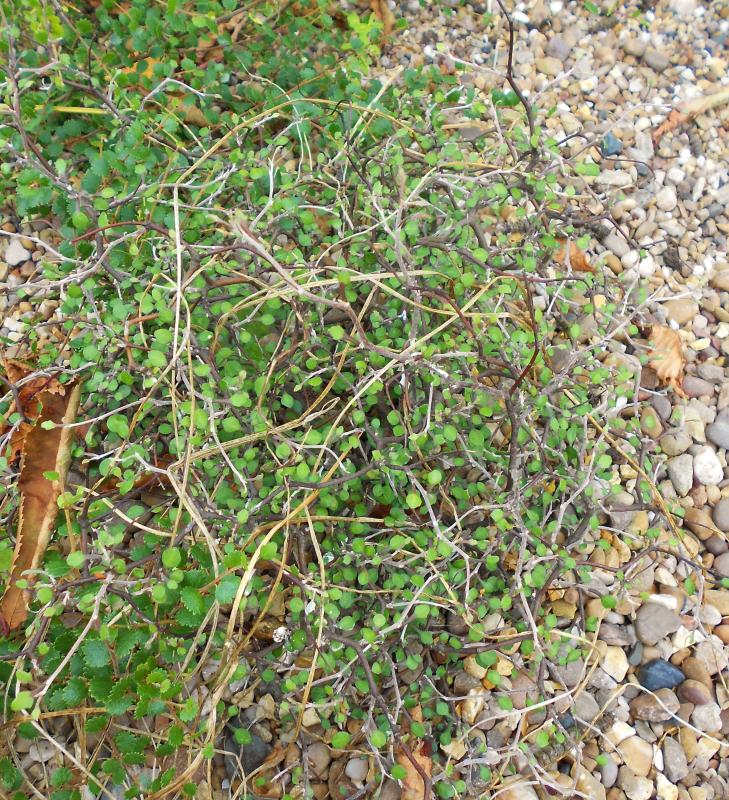
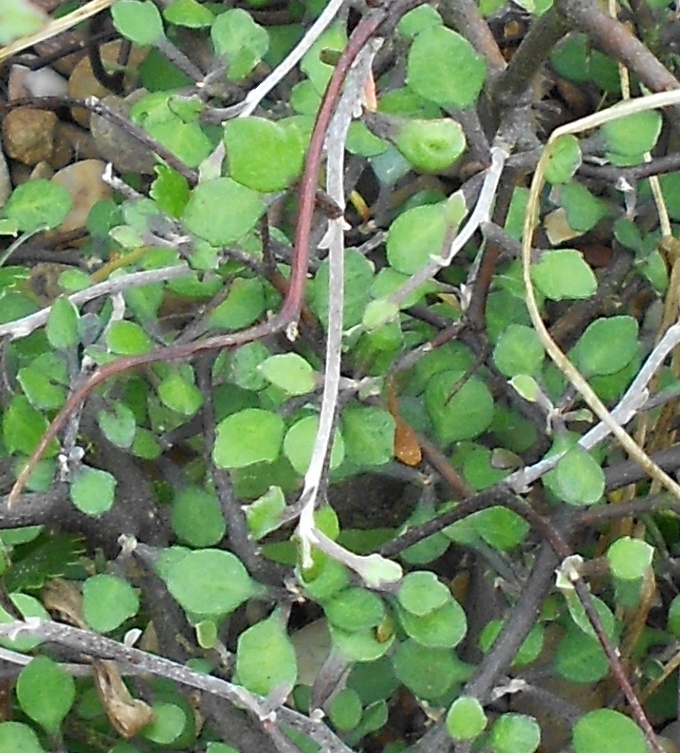

Can anyone ID this little (8" high by 12" across), shrub please? We have a number of them dotted around the garden but cannot remember where we got them or what they are called. Thanks.
Comments
David L (not verified)
It is a good example of a
Mon, 07/22/2013 - 4:24amIt is a good example of a divaricating shrub ie the branches are all entangled. I am fairly certain it is a New Zealand native called Corokia cotoneaster. It will produce yellow star-shaped flowers which are quite attractive followed by red/orange berries.
I have found a picture of the plant in flower which I am attaching
David L (not verified)
Here is the image( after the
Mon, 07/22/2013 - 4:33amHere is the image( after the second try)
Longma (not verified)
Thank you David. That's
Mon, 07/22/2013 - 5:01amThank you David. That's exactly what it is. We have had them for ( we guess ) around five years, and so far they haven't flowered. This has come as a very nice surprise and now we have something to look forward to from these intriguing little plants.
Mark McDonough
Cute little shrub. Just
Mon, 07/22/2013 - 6:37amCute little shrub. Just googled to check on hardiness, rated USDA Zone 8-10, so definitely not hardy here. Photos when the plant is in abundant red fruit look good too, a second show.
Margaret Young
David Quote :"It is a good
Mon, 07/22/2013 - 11:04amDavid Quote :"It is a good example of a divaricating shrub ie the branches are all entangled. I am fairly certain it is a New Zealand native called Corokia cotoneaster. It will produce yellow star-shaped flowers which are quite attractive followed by red/orange berries.
I have found a picture of the plant in flower which I am attaching"
I recall being intrigued by this shrub when you showed some, complete with Mrs Lyttle for scale on a perilous hillside, back in 2007 in the SRGC forum, David .....
http://www.srgc.net/forum/index.php?topic=161.msg2499#msg2499 (photo 6)
I think a few are growing it in Scotland too.
Maggi
Mark McDonough
Not really a little shrub
Mon, 07/22/2013 - 11:15amNot really a little shrub after all, my goodness those wind-pruned shrubs in the SRGC link are huge (huge in width dimension, but still appearing like they stand a a good meter tall as well, quite a view to remember).
Longma (not verified)
Mark McD wrote:
Mon, 07/22/2013 - 12:22pm[quote=Mark McD]
Not really a little shrub after all...........
[/quote]
WOW, you're certainly right there Mark!! ( need that popping eyes emoticon! )
I'm wondering how old those plants on the SRGC link are? Our plants have hardly moved at all in, approx, five years. They are growing in a very lean, nutrient poor, bulb bed, so maybe this has dwarfed them. Thank goodness! Still, they do look so wonderful growing out there 'in nature'. Shame on us, we never realised these were such interesting plants.
Margaret Young
Mark McD wrote:
Tue, 07/23/2013 - 4:23amLongma wrote: WOW, you're certainly right there Mark!! ( need that popping eyes emoticon! )
I'm wondering how old those plants on the SRGC link are? Our plants have hardly moved at all in, approx, five years. They are growing in a very lean, nutrient poor, bulb bed, so maybe this has dwarfed them. Thank goodness! Still, they do look so wonderful growing out there 'in nature'. Shame on us, we never realised these were such interesting plants.
I wouldn't be a bit surprised if those New Zealand plants are very old indeed - look at the presumed great age of the large "vegetable sheep" in the NZ mountains. So many mountain plants grow to be venerable ancients - part of their charm whether they are a Pinus aristata in America, Raoulia eximia in NZ or Loiseleuria procumbens, Silene acaulis and Salix herbacea, which would probably be our nearest equivalent in Scotland.
David L (not verified)
IMYoung wrote:
Tue, 07/23/2013 - 4:15am[quote=IMYoung]
I recall being intrigued by this shrub when you showed some, complete with Mrs Lyttle for scale on a perilous hillside, back in 2007 in the SRGC forum, David .....
I think a few are growing it in Scotland too.
Maggi
[/quote]
Maggi, you must have an encyclopediac memory to have located that particular posting. Mrs Lyttle was brought up in Tulsa Oklahoma which is on the flattish side and has over the years been taken to many interesting places. After a visit to the Thousand Acre Plateau in the Matiri Valley she vowed never to come tramping/backpacking/botanising with me again! So much for years of training negotiating perilous hillsides.
Corokia cotoneaster has a wide distribution and is found in a variety of sites usually in drier harder situations, it can grow up to about a metre and a half. A lot of New Zealand genera have divaricating species in them as well as more conventional shrubs. The best known genus containing a large proportion of divaricating members is Coprosma (Rubiaceae) with over 60 species- not all divaricating. Other genera containing examples are are Myrsine (Primulaceae), Raukaua (Araliacea), Pittosporum (Pittosporaceae), Melicope (Rutaceae), Teucridium (Lamiaceae) Olearia (Asteraceae), Muehlenbeckia( Polygonaceae) and Melicytus (Violaceae). The divaricating habit is believed to have evolved in response to moa browsing; it is difficult and energetically expensive for a bird to consume sufficient leaves from these shrubs. They cannot shear the twigs off easily. Mammals do not have such problems; hare and possums can browse divaricating shrubs without difficulty as they can gnaw off the twigs and the bark.
An alternative theory is that the divaricating form evolved in response to cold dry windy conditions during the glacial maximums. My view is that neither explanation precludes the other . Small tough leaves protected by a cage of branches would be helpful for the survival of the plant under both scenarios.
I should do a posting of divaricates at some stage - there are plenty to choose from.
Richard T. Rodich
I grew this as a houseplant
Mon, 07/22/2013 - 8:05pmI grew this as a houseplant for several years.