A native plant in bloom (a little past its peak) on June 28th in the grasslands in Bowmont Park, Calgary:
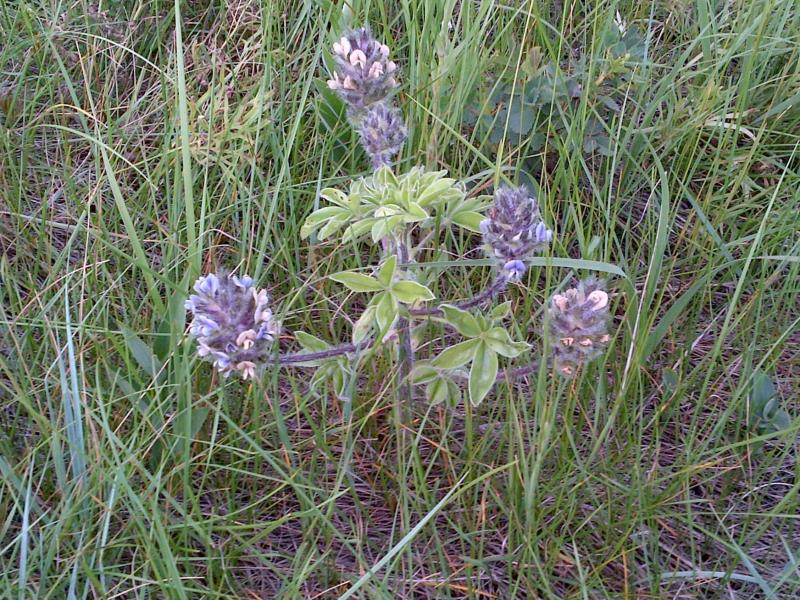
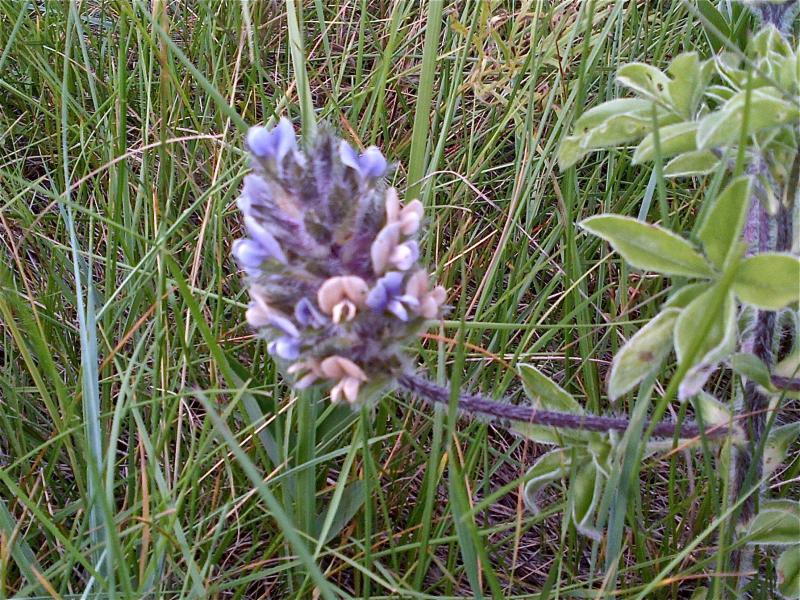
(Please excuse the fuzzy Blackberry photos - it's not too great at close-ups.)

A native plant in bloom (a little past its peak) on June 28th in the grasslands in Bowmont Park, Calgary:
(Please excuse the fuzzy Blackberry photos - it's not too great at close-ups.)
Comments
Mark McDonough
Interesting plant, I'm not
Sun, 06/30/2013 - 4:43amInteresting plant, I'm not familiar with it. Unusual how it stands up so straight. Being curious about the common name I googled, this wikipedia page explains its use in making flour. There is also a closup of the flowers, which enlarges several time, up to a bee's-eye view.
http://en.wikipedia.org/wiki/Psoralea_esculenta
Further investigation, shows that this plant should be called Pediomelum esculentum these days.
http://plants.usda.gov/java/profile?symbol=PEES&photoID=pses_001_avd.tif
http://wisplants.uwsp.edu/scripts/detail.asp?SpCode=PEDESC
On the USDA site, I was taken with how attractive Pediomelum megalanthum is, take a look:
Pediomelum megalanthum (Woot. & Standl.) Rydb., Intermountain Indian breadroot
http://plants.usda.gov/java/profile?symbol=PEME7&photoID=peme7_001_ahp.jpg
http://plants.usda.gov/java/largeImage?imageID=peme7_001_ahp.jpg
http://plants.usda.gov/java/largeImage?imageID=peme7_002_ahp.jpg
Lori S. (not verified)
Excellent info, Mark.
Sun, 06/30/2013 - 10:19amExcellent info, Mark.
This particular photo from one of your links shows what I noticed (but couldn't photograph clearly with the Blackberry) - the flowers on a single flower stalk (or different flower stalks on the same plant) can vary from purple to pink to yellow (or puce).
http://wisplants.uwsp.edu/scripts/bigphoto.asp?bigphoto=PEDESC_NOLL2.jpg&taxon=Pediomelum%20esculentum%20(Pursh)%20Rydb.&phog=Christopher%20Noll&spcode=PEDESC
Richard T. Rodich
I would have expected the
Mon, 07/01/2013 - 8:08amI would have expected the multicolors would be due to flower age, and the Wisconsin site pic seems to support that. However your first photo, Lori, does not. On the older clusters, even the new flowers are the "other" color.
I've been on the watch for this species on my prairie walks for quite some time, but have yet to find it. It's even been cataloged on a couple of the prairies I've been to. To date, I've only seen a relative, Pediomelum argophyllum.
Trond Hoy
I have seen neither but I
Mon, 07/01/2013 - 8:47amI have seen neither but I have heard of the genus Psoralea!
Lori S. (not verified)
Silver-leaf psoralea is a
Mon, 07/01/2013 - 9:12amSilver-leaf psoralea is a familiar one from when we used to visit Theodore Roosevelt National Park in North Dakota, a fantastic badlands, grasslands and riparian setting. Beautiful leaves.
Mark McDonough
The leaves are indeed
Sun, 07/07/2013 - 9:18pmThe leaves of Pediomelum argophyllum are indeed beautiful, so smooth and silvery, worth growing for the foliage alone!