
I find the seed raising discussions on this Forum of Gene, Rick and others absolutely fascinating.
I have no experience in the use of fluorescent lights ,baggies, etc as living in a somewhat 'soft' climate i just sow seed and place it outside as soon as i receive it,regardless of the time of the year.
If i consider the pots are getting too wet i place a poly sheet over the pots .It's not a fail safe method - Sure :) in an individual pot i lose a few to rot but not all however ,as a number do come up.
Following are current pics with the date of sowing --unfortunately i haven't kept records of when germination occured ,(might need to look at doing so from now on).
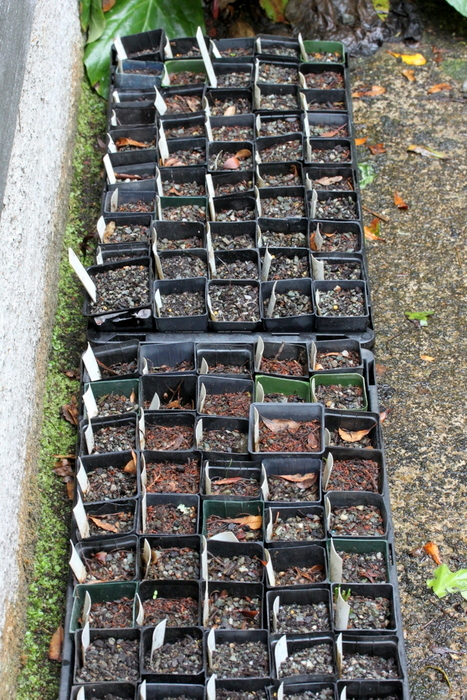
Some of the seed trays .
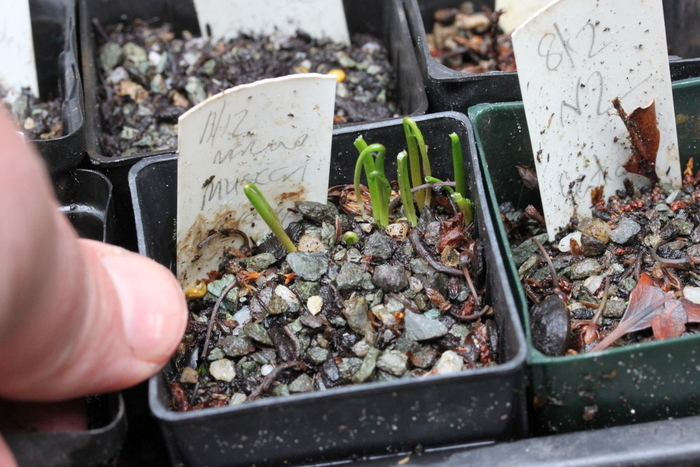
Muscari macrocarpum -- x Tasmania sown in late Nov 2012-- My thumb shows the size of the small pots that I generally use.
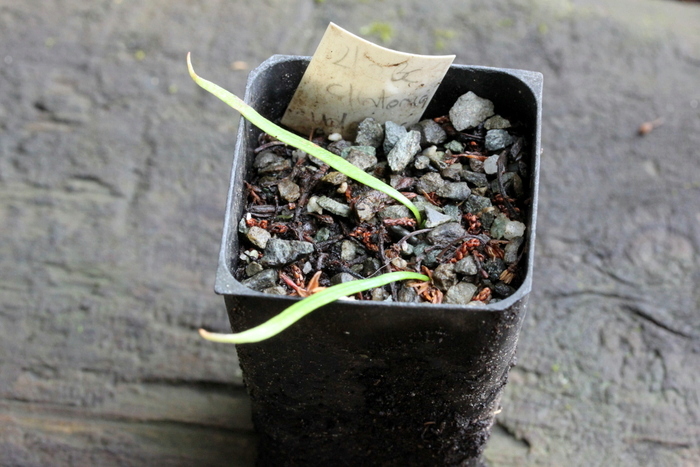
Clintonia udensis-- x AGC of BC sown early Feb 2010.
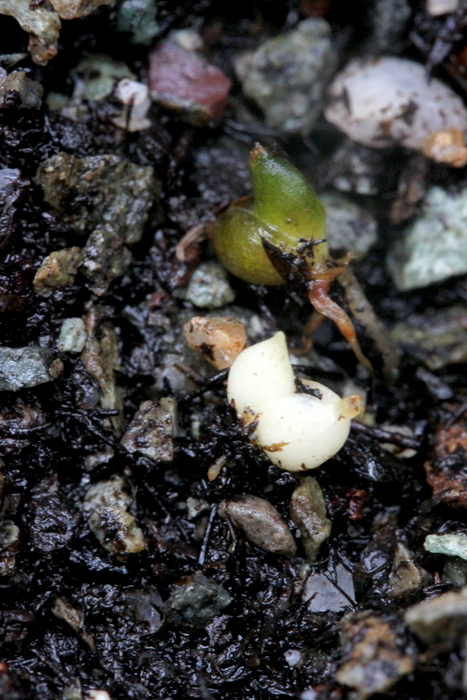
Lilium wigginsii --x Gene sown mid spring ,beginning of Nov 2011 .
Pulsatilla turczaninovii --x Rick sown early winter ,middle of June 2012.
Cheers Dave.

Comments
Richard T. Rodich
Re: Seed starting chronicles 2013
Sat, 02/23/2013 - 8:27pmThen would you say they would germinate better at 50 or 60F, as opposed to 70F?
Lori S. (not verified)
Re: Seed starting chronicles 2013
Sun, 02/24/2013 - 9:46amSome seedling photos -
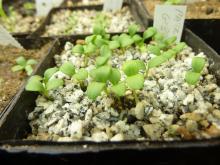
Patrinia gibbosa - germinated in 8 days at room temperature with no pretreatment; photo 7 days after germination:
Geum rivale ex. Leonard's Variety - germinated in 7 days at room temperature with no pretreatment; photo 7 days after germination:
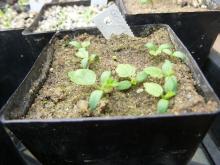
Silene asterias - germinated in 7 days at room temperature with no pretreatment; photo 7 days after germination:
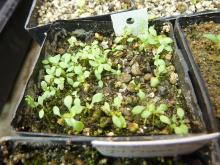
Astragalus purshii - germinated in 6 days at room temperature after scarification; photo 17 days after germination:
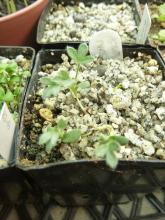
Trifolium nanum- germinated in 2 days at room temperature after scarification; photo 20 days after germination:
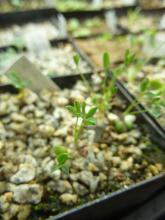
Oxyria digyna - germinated in 8 days at room temperature
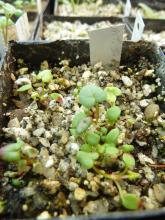
after scarification(Sorry, correction - not scarified; I was copying and pasting from the previous entries and failed to notice the difference); photo 20 days after germination:Rhodiola rhodantha -germinated in 6 days at room temperature
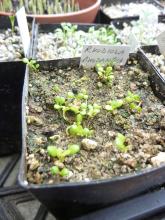
after scarification(Correction); photo 17 days after germination:cohan (not verified)
Re: Seed starting chronicles 2013
Mon, 02/25/2013 - 10:45amLori- did the Rhodiola need scarification? Atypical for Crassulaceae..
Lori S. (not verified)
Re: Seed starting chronicles 2013
Mon, 02/25/2013 - 5:49pmNo, sorry, I didn't scarify the Rhodiola seeds. That was another error from my too hasty cut-and-paste.
cohan (not verified)
Re: Seed starting chronicles 2013
Wed, 02/27/2013 - 3:50pmGood to know, Lori, tks :)
Gene Mirro (not verified)
Re: Seed starting chronicles 2013
Fri, 03/01/2013 - 10:03amI sowed two batches of Dodecatheon pulchellum from two different sources on 2/2/13, and kept them at 60-65F. Neither has germinated. I've put them outside for cold treatment. I have never seen this species germinate at warm temps.
cohan (not verified)
Re: Seed starting chronicles 2013
Fri, 03/01/2013 - 10:31amGood to know, Gene; if /when I sow some of my locals I'll let you know what happens..
cohan (not verified)
Re: Seed starting chronicles 2013
Sat, 03/02/2013 - 11:18pmSown on Fe 24 and kept at warm, germination by Mar 01 at least (I hadn't checked for a couple of days):
From Mesa Gardens seed (I include the Mesa catalogue numbers as those are often referred to for the various collections):
283.63-Echinocereus viridiflorus DJF1470 n Hot Springs, SD
383.2-Escobaria missouriensis Garfield Co, Mt
410.09-Escobaria vivipara /18/ McHenry Co, ND
From a private trade:
Escobaria vivipara JWA014. Spruce Woods Provincial Park, MB
Another Echinocereus (triglochidiatus) and a couple of Agaves sown the same time at warm not yet showing anything; also numerous Pediocactus and several Sclerocactus sown at the same time and put out for cold strat, along with various non cactus alpines etc...
Lori S. (not verified)
Re: Seed starting chronicles 2013
Sun, 03/03/2013 - 12:33pmTaraxacum faeroense - germinated in 4 days at room temperature. Thanks for the seeds, Cohan!
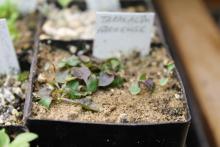
Lots of potting-on done this weekend...
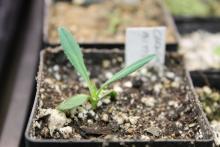
Carduncellus mitissimus - germinated in 12 days at room temperature.
Trifolium andersonii v. andersonii - germinated in 2 days at room temp after scarification; now at 34 days from germination.
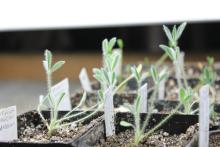
Trifolium nanum - germinated in 2 days at room temp after scarification; also now at 34 days from germination.
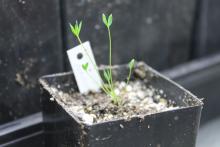
Erigeron aurantiacus - germinated in 7 days at room temp; also now at 34 days from germination.
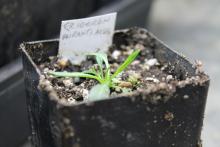
Erigeron caespitosus - I didn't note when this one germinated but it was also pretty rapid and at room temperature.
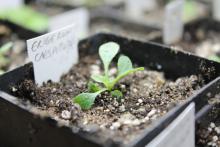
Salvia tchihatchevii - germinated in 22 days at room temperature; now at 27 days old; seeds from Pavelka (description: 900 m, Cankiri, Turkey; suffruticose low subshrub 20-30 cm, deeply cut leaves, whitish pink flws, stoney slopes, 2009 seed).
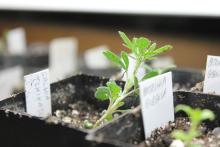
And more yet to pot on:
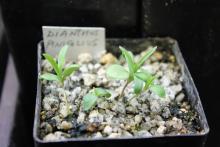
Dianthus pinifolius - germinated at room temperature.
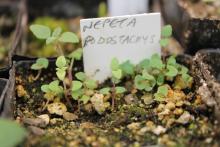
Nepeta podostachys - germinated at room temperature.
cohan (not verified)
Re: Seed starting chronicles 2013
Sun, 03/03/2013 - 12:51pmGood to hear those Taraxacum germinated! I was worried maybe the seed needed to be absolutely fresh.
Just a note, for me, they have not wanted full sun (at least not while potted, just got some in the ground in fall) and don't seem to like to be dry at all....
Lori S. (not verified)
Re: Seed starting chronicles 2013
Sun, 03/03/2013 - 1:08pmThanks for info, Cohan... (though I can't promise that I will baby them... I'm afraid it's survival of the fittest around here. ;) )
cohan (not verified)
Re: Seed starting chronicles 2013
Sun, 03/03/2013 - 3:17pmAnd in a different soil, aspect etc they may be happy with different conditions- and simply being in the ground is very different than the (deep) pot mine was in for a long time, since when I got the cutting, I had no place to plant it out.. my impression is that it is a species of some sort of boggy area, rather than a dry scree etc, though I'm not certain of that. The one I've put in the ground so far, I put at the foot of a rock bed in the low end of the property, a little below grade, but it hasn't been there long enough to judge.
Lori S. (not verified)
Re: Seed starting chronicles 2013
Sat, 03/09/2013 - 12:42pmCatching up...
The pots of various Androsace spp. were brought out of the cold room on March 2-3 after 6-7 weeks in the cold.
Androsace bisulca v. brahmaputrae - germination started at 6 days at room temp
Androsace hedraiantha - germination started in the cold Mar.2
Androsace hirtella - germination started in the cold Mar.2
Androsace incana - germination started at 6 days at room temp
Androsace spinuliferum - germinated started at 3 days at room temp
Androsace squarrulosa - germinated started at 6 days at room temp
Campanula incurva - germination started in the cold after 6 weeks chilling
Campanula scoparia - germination started in the cold after 6 weeks chilling
Cryptantha caespitosa - germination started in the cold after 6 weeks chilling
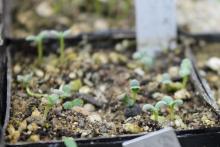
Cryptantha humilis - 6 weeks chilling; germination started in 2 days at room temp
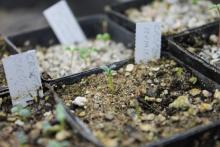
Cryptantha paradoxa - germination started in the cold after 6 weeks chilling; (NB. Alplains says this one doesn't need stratifying but recommends scarifying).
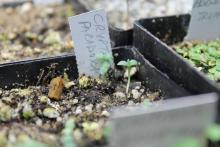
Various Eriogonum spp. were given 6 weeks cold and brought out to room temp on March 3...
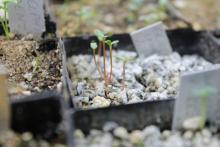
Eriogonum lobbii - germ started at 6 days room temp
Eriogonum ovalifolium v. eximium - germ. started in the cold on March 2
Eriogonum robustum - germ started in 2 days at room temp
Eriogonum sphaerocephalum v. sphaerocephalum - germ started in 2 days at room temp
Eriogonum thymoides - germ started at 2 room temp
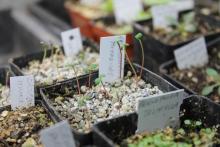
Delphinium menziesii - germ started in the cold after 6 weeks chilling
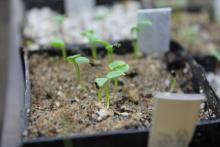
Physochlainia orientalis - germ in 13 days at room temp; no pretreatment; I grew these last year also but found that the seedlings did not do well after a while and planting out was not very successful (well, more accurately, a total failure!) Is there some trick to this plant?
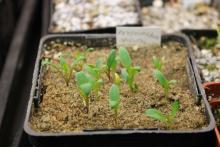
Erysimum capitatum var capitatum - germ in 3 days at room temp with no pretreatment; at ~30 days after germination:
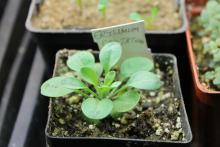
Gordon Tingley
Re: Seed starting chronicles 2013
Sat, 03/09/2013 - 2:57pmI'd share a photo of Ramonda myconii, and Ramonda nathaliae now that they have germinated, but I don't have a microscope to fit to the camera! ;D These have to be the smallest seedlings I've ever germinated.... hope to keep them going!
Amy Olmsted
Re: Seed starting chronicles 2013
Sat, 03/09/2013 - 5:32pmThe pots of various Androsace spp. were brought out of the cold room on March 2-3 after 6-7 weeks in the cold.
Lori, how cold is your cold room?? Does it go below freezing in there?
Lori S. (not verified)
Re: Seed starting chronicles 2013
Sat, 03/09/2013 - 5:50pmHi, Amy. The temperature in the cold room is 46 deg F right now. The temperature varies a bit but it doesn't freeze (except perhaps in directly under the air vent where we don't put anything anyway). It's on the northeast corner of the basement and the room stays very cool all summer. The walls that separate it from the adjacent furnace room and bathroom are insulated.
Gordon, I know what you're saying! I'm trying to grow Ramonda too and I can hardly distinguish the teensy little plants from some tiny bits of moss in the pot.
Gene Mirro (not verified)
Re: Seed starting chronicles 2013
Sat, 03/09/2013 - 9:40pmGordon, the only way I've ever been able to grow Ramonda and Haberlea is by placing the pots in a sealed plastic bag, and growing them under lights at around 60F. They need lime and fertilizer. But as soon as you fertilize them, the moss will start growing, unless you have sown them on grit or something like that. They are a big challenge.
http://www.srgc.net/forum/index.php?topic=71.msg722#msg722
Lori S. (not verified)
Re: Seed starting chronicles 2013
Sun, 03/10/2013 - 10:13amThat's good to know, Gene. Thank you for sharing your experience!
Gordon Tingley
Re: Seed starting chronicles 2013
Sun, 03/10/2013 - 12:39pmSame from me, Gene. Mine are planted in small trays- commercial potting soil with an addition of oyster shell grit, and then top dressed with vermiculite. The whole thing is under one of those seed starting "greenhouse" domes, and everything seems to be going fine. Just look forward to when the plants are large enough to prick out into separate pots.
Longma (not verified)
Re: Seed starting chronicles 2013
Wed, 03/13/2013 - 6:40amSeedlings of various members of the Fritillaria subgenus Liliorhiza are beginning to shoot up now, ;D
Richard T. Rodich
Re: Seed starting chronicles 2013
Wed, 03/13/2013 - 10:00pmOh my gosh, Ron, there's a Fritillaria army there! :o
You planted these last fall? I remember (I think) in one of Ian's Bulb Logs from years ago, he mentioned that some were having success with the American species planting in the spring, and he was planning on testing this out. Don't know whatever happened, though...
Longma (not verified)
Re: Seed starting chronicles 2013
Thu, 03/14/2013 - 1:22amI always sow in early December Rick. This is the same time that I start watering the bulbs, (the exception being F.striata, which I sow / water early November, as it like to be up and running here by December ). Seems to be good for all species, (under my conditions of course ).
deesen (not verified)
Re: Seed starting chronicles 2013
Thu, 03/14/2013 - 12:26pmWhat size pots are you sowing in Ron? They look pretty big ???
Longma (not verified)
Re: Seed starting chronicles 2013
Thu, 03/14/2013 - 1:13pmDepends upon the species David. For my own use I split the Liliorhiza into three growing 'styles'. The surface dwellers ( e.g. F. camschatcensis, F. dagana, F. maximowiczii ), those just below the surface ( F. pudica, F, affinis, F. recurva, F. ojaiensis, F. atropurpurea etc. ) and the deep species, ( F. pluriflora, F. agrestis, F. biflora, F. liliacea etc ). These categories are based on my observations of them growing from seed, here in UK, in my own media and conditions. I am sure that variations on these categories can be found in the 'wild' depending upon local conditions. The bulbs are formed at different depths and left there. These categories dictate pot size, as I have learned that ( again , for me) the best way to reach flowering size consistently is to sow the seed and never re-pot. I believe these plants resent disturbance ( even when 'dormant' ). It seems that most people who fail with bought bulbs of this group do so in the first year. If they can be established beyond the first year then they are really not to difficult to grow. I use the ' so called' deep rose pots style for all species. For the surface dwellers and just below 1 ltr. pots ( as shown here ) are adequate. For the 'deep dwellers' I use 3 ltr. Watering all 'categories' well when in growth ( and keeping the surface dwellers constantly moist all year) and then insulated without water ( for the other two categories, definitely not baked or any such nonsense, try to maintain a constant 'cool' soil temp. ) until following December when they get their first watering.
This has worked well for me here. I do have many hundreds of plants coming to flowering size and hope that by flowering many individuals some experience of the variation within each species can be documented.
deesen (not verified)
Re: Seed starting chronicles 2013
Thu, 03/14/2013 - 1:33pmWell though out Ron, I thought they looked like rose pots.
Longma (not verified)
Re: Seed starting chronicles 2013
Thu, 03/14/2013 - 1:45pmThey're the 'civilised' pots and 'specials' David. Some clones of F.affinis, F. atropurpurea and F.pudica produce such copious amounts of seed that they are sown in 3 foot long x 2 foot wide x 18 inches deep thick plastic 'fish storage' type boxes. ;D ;D .
This year I was able to plant out many hundreds of four year old F. affinis seedlings into a 1/4 acre grassy area of the garden. If they survive their first year I'm hoping I can liberate their brethren from their pots and let them do their thing 'au natural'! I supplemented this with a good number of bought in bulbs also for genetic variability.
Eccentric or just obsessed?? :rolleyes: :rolleyes: ;D
Gene Mirro (not verified)
Re: Seed starting chronicles 2013
Thu, 03/14/2013 - 4:43pmI always use oversized pots for bulbous plants. The soil mix has more stable temperature and moisture. The roots grow bigger, and so the bulbs get bigger faster. When the plants go dormant and I stop watering, there is still some moisture down deep in the pot, which simulates natural conditions.
Actually, I've gone a step further and am now plunging the entire undivided clump of seedlings into the garden beds in late April or early May. This gives me the best results of all. But this won't work if you let slugs, rodents and birds run rampant. I use inverted 17 inch flats to protect against rodents and birds. I use Metaldehyde slug bait. I'll post a photo when I get a chance.
Edit: Here I am using inverted 17" flats to protect seedlings:
[attachthumb = 1]
Longma (not verified)
Re: Seed starting chronicles 2013
Fri, 03/15/2013 - 5:38amI'm certainly going to give your 'clump and all' technique a go next year Gene, 8). Certainly the stoloniferous ones ( F. camschatcensis, F.dagana and F.maximowiczii ) would benefit greatly from this approach I think. They start to produce stolons in their second year and soon are just running round and round in the pots. Letting them loose like you do seems the right thing to do.
If I only have a couple of seed or have 'begged' a few grains of rice from a particular form, I use these deep plastic plug modules. It means many plants can be grown together ( making handling easier ) without an overload volume of potting mix per plant. As each plug is 6 inches deep, the plants still get some depth, and the benefits of this depth that Gene has pointed out. Again, they can stay in these modules, if required, until flowering size is achieved.
Tim Ingram (not verified)
Re: Seed starting chronicles 2013
Fri, 03/15/2013 - 8:18amRon - fantastic pictures of Fritillarias germinating. Will be great to see the results of planting out so many F. affinis. I have three or four different types of this in the garden and they all do well. It's a big encouragement to try more species outside.
Christopher Wyse
Re: Seed starting chronicles 2013
Fri, 03/15/2013 - 9:34amHi,
If anyone is interested, I created a blog with my seed starting techniques for various species, siting successes and failures. It's ongoing, but several species have germinated. Here is the link and my list of species. I put an asterisk by the ones that germinated.
http://chris-wyse.tumblr.com
Also, I'll probably have extra plants later this spring. If anyone wants some and I have them to spare, I'll give them free if you provide postage.
Chris
Lori S. (not verified)
Re: Seed starting chronicles 2013
Fri, 03/15/2013 - 10:22amInteresting, Chris.
From your blog:
"Better Method for GA-3 Treated Seeds
If there were no need to determine germination rates, the following method would probably be easier for raising gentians or any other seed requiring a chemical treatment.
Fill a small vial with the chemical (GA-3) solution at the desired concentration. Add the seeds to be treated, and leave them in the solution for the desired number of days. Then empty the solution and seeds into a coffee filter, and wash thoroughly with water. Sow the seeds directly on the growing medium."
How did you establish that this method is "better"? Better in comparison to what, also?
This seems to be the same method as recommended by Kristl Walek (whether it was original to her, I don't know) with the exception of rinsing the seeds prior to planting. (Deno, by contrast, recommended putting GA-3 directly on the moistened paper towel.) Just wondering what you are comparing it to, and what criterion is being used to say it is better (faster germination?, more germination?, better growing-on results?, easier to handle?, etc.).
Longma (not verified)
Re: Seed starting chronicles 2013
Fri, 03/15/2013 - 11:47amThe trial is Tim growing them amongst tall growing 'thuggish' grasses. I, like many others have found that this species is very good in a cultivated bed / border. It does seem to thrive still amongst grasslands in the USA ( probably in areas where it was formerly cultivated for food ), hence my experiment, here in UK. No matter how wet our summer, I think the prodigious grass growth will keep down the soil moisture levels. We'll see in a few months!
Christopher Wyse
Re: Seed starting chronicles 2013
Fri, 03/15/2013 - 12:10pmHi Lori,
My "Better Method for GA-3 Treated Seeds" is strictly easier regarding handling. It's what I would do the next time. I'm comparing it against the Deno method, which is what I used this year. It's a real pain to try move the seeds/seedlings later on - in my opinion, especially for small seed, it would be much easier to be able to sow directly in the soil.
I didn't see the post or article by Kristel Walek. I suggested rinsing the seeds because that was what Deno did, and I would want to limit GA-3 exposure to a set time frame (in my case, I used 10 days). I've seen other posts where the GA-3 was added directly to the soil. Maybe that would be just as good, if not even easier. As long as you could go for the appropriate amount of time without needing to water, there would be one less step. I assume that watering would remove the GA-3 from the soil.
Anyway, I wouldn't expect better germination with the "better" method.
Hope that clarifies - sorry for the confusion.
Chris
Richard T. Rodich
Re: Seed starting chronicles 2013
Fri, 03/15/2013 - 1:32pmNice blog, Chris.
I really appreciate the detailed information.
Lori S. (not verified)
Re: Seed starting chronicles 2013
Sat, 03/16/2013 - 12:38pmThanks for the additional info, Chris. I was not meaning to grill you but just wondering what "better" was in comparison to. It sounds like "better" refers more to avoiding Deno's paper towel method (due to difficulty in handling seedlings that have rooted into the paper towel?) than being specifically about use or effectiveness of GA-3... ?
(It might be worth mentioning that the paper towel method that has come to be named after Deno (though he writes that it came to him from another person, Margery Edgren) was said to be useful to him since it minimized watering and took up very little space - important, I'm sure, when one is conducting simultaneous experiments on huge numbers of species and seed batches of each. In his first publication, he says "about five hundred experiments can be conducted in one cubic foot"... that kind of puts everything into perspective. :o )
My reference to Kristl Walek was just referring to the instructions she sends out when one orders GA-3 from her, which is basically what you described (other than the part about rinsing off the seeds).
Christopher Wyse
Re: Seed starting chronicles 2013
Mon, 03/18/2013 - 9:27amNo problem Lori. You weren't grilling me. Clarification never hurts.
Regarding Kristl, I didn't order my GA-3 from her, so I didn't receive the instructions.
Chris
Gene Mirro (not verified)
Re: Seed starting chronicles 2013
Fri, 04/05/2013 - 4:59pmSome seedlings that were started under lights over the winter:
Campanula choruhensis, sown 12/23/12, transplanted into 5" deep bands:
[attachthumb = 1]
Edraianthus serpyllifolius major, sown 1/8/13, transplanted into 5" deep bands:
[attachthumb = 2]
Edraianthus graminifolius, sown 1/10/13, transplanted into 5" deep bands:
[attachthumb = 3]
Anthyllis montana, sown 1/19/13, transplanted into 5.5" deep bands:
[attachthumb = 4]
Jeffersonia dubia (seeds from Mark McDonough), Sternbergia lutea, Dodecatheon hendersonii:
[attachthumb = 5]
Lilium henryi citrinum, L. callosum, L. rosthorni, all sown 11/2012, transplanted to 2.6 liter pots:
[attachthumb = 6]
Gentianopsis crinita, sown 11/14/12, transplanted into 5" deep bands:
[attachthumb = 7]
They love the deep bands. The roots are already crowding out the bottom.
Mark McDonough
Re: Seed starting chronicles 2013
Fri, 04/05/2013 - 5:30pmStrong germination results there Gene, congrats on Gentiana crinita (I guess we're supposed to call it Gentianopsis crinita these days). It is native here, there's a reserve about 2 miles from my house where this is a well know feature plant; best of luck with growing it on to flowering, it is a beauty.
Good the see the Jeffersonia dubia plants growing so well for you too.
Tony Willis (not verified)
Re: Seed starting chronicles 2013
Sat, 04/06/2013 - 12:17pmNot sure where to put this but it shows some of the interesting results from breeding.
An interesting result from a cross I have made three years ago,first flowering.
I crossed a standard Crocus pelistericus with Crocus x gothenburgensis (pollen parent) and sowed the resultant seed in one pot. In the original cross for the x gothenburgensis the seed parent was the Crocus pelistericus and the pollen from Crocus scardicus.
Two of the seedlings are now in flower
Pictures
Crocus pelistericus seed parent
Crocus x gothenburgensis cr468 pollen parent
Crocus - seedlings
Toole (not verified)
Re: Seed starting chronicles 2013
Sat, 04/06/2013 - 1:21pmThey look so nice and healthy Gene.
Ps your envelope arrived and has been sown --thank you
They are all yummy :P Tony
Cheers Dave.
Richard T. Rodich
Re: Seed starting chronicles 2013
Sun, 04/07/2013 - 6:25amNice results for your first flowers, Tony!
Crosses are always so much more fun, intriguing, somehow more meaningful and pleasantly surprising when you do them yourself. As you know, it's not that terribly uncommon for colors to pop up "out of no where" with Lilium hybrids. I wonder how often it happen in Iridaceae?
Middleton (not verified)
Re: Seed starting chronicles 2013
Sun, 04/07/2013 - 12:46pmHere are some of my germination records this year. Lori, you passed along the incentive to document and save germination times and methods!
Warm germinators are put under a three shelf double fluorescent shop light set up. Cold treatment is either basement 4-10C in January, February or cold mudroom (alternates from 0C to 4C). Longer outdoor treatment is done in an unheated greenhouse. This winter in central Ontario, Canada we've had more snow with fewer severe dips (-25C -30C) in temperatures but longer lasting than in past years!
My simple rock garden is still snow covered but in a dry scree like area shoots are finally showing and brown is turning to green. Crocus are just starting to flower!
Arabis lemmonii germinated warm <40d
Bouteloua curpitendula germinated warm 20d
Campanula latifolia alba germinated warm < 30d
Clematis integrifolia 'Pangbourne Pink' soaked x 2hr; Germinated warm < 30d
Cremanthodium arnicoides germinated warm in 18 days
Dioscorea caucasica germinated @ 22C <30d
Escobaria vivpara ex South Dakota germinated warm 7d
Gentiana tibetica (Nargs) germinated @5-10C < 60d
Gladiolus flanaganii Germinated @ 10C < 30 days
Incarvillea sinensis germinated warm 5d
Lathyrus vernus germinated @ 20C < 30d
Lilium mackliniae 'Naga Pink' - germinated warm < 30d
Linum perenne 'Deep Creek Blue' ex Juab Co Utah Wild, germinated warm 5d
Lithophragma affine germinated @ 5-10C <60d
Mimulis cupreus germinated warm in 8d
Moraea alticola germinated warm in 17d
Nomocharis aperta germinated warm in 18 d
Onosma albo-roseum - 6 wks cold; then to 20C x 21d = 1strong & 1 weak seedling germinated; pot to unheated GH for further germination?
Oxytropis megalantha-scarified germinated warm in 3d
Penstemon barbatus germinated warm <30d
Petrocallis (Draba)pyrenaica WILD germinated warm in 10d
Petrophytum caespitosum germinated warm < 30d
Petrorhagia saxigraga germinated warm 5d
Phlox pulvinata blue 2cm Wyoming: Albany Co 3354m G in 9weeks in unheated GH in plastic bag
Primula chionantha ssp sinopurpurea germinated warm < 30days
Primula florindae red germinated warm <30days
Roscoea humeana - one seedling germinated warm; pot to basement
Salvia dorrii ssp dorrii - 3 seedlings germ warm in 8 day;s to GH for further G
Schizanthus grahamii germinated warm in 6d
Germination of pots in plastic bags starting in the greenhouse after 3 months are
Allium beesianum
Collomia debilis var larsenii
Eriogonum lobbii
Erythronium californicum
Gentiana siphonantha
Leptodactylon pungeons
Penstemon fruticosa
Saxifraga kolenatiana
Sisyrinchium striatum species wild from Chile
Lori S. (not verified)
Re: Seed starting chronicles 2013
Thu, 04/11/2013 - 6:58pmWow, what a fabulous collection, Sharon!
From where did you get Arabis lemmonii? It's not one that gets much attention though I think it's very interesting (have only seen one once).
I got home this evening from a conference and was delighted to find that Pedicularis densiflora has germinated! My fitful previous attempts with a couple of other species were total failures. More detail to follow...
Middleton (not verified)
Re: Seed starting chronicles 2013
Sat, 04/13/2013 - 8:29amLori, the Arabis lemmonii came from the British Columbia Alpine Club. I was attracted to its succulent looking leaf formation in your photo on another site! Did you not have this in your garden?
The Pedicularis at first looks like Echium. I’m sure it will be a relaxing plant to admire, kidding. It seems to be of some ethnobotanical interest to some? You never know what will turn up using Google! Seems I received seed from this year’s Seed Exchange too but didn’t get it sown! Will try it in a vermiculite bag.
Here are further germinations as of April 12, 2013. Seed sown in January through to the beginning of this week.
Androsace spinulifera germinated in 7 days @20C
Anemone coronaria germinated in 60 days @5C-10C
Aquilegia laramiensis germinated in 63 days @5C-10C
Astragalus chamaeleuce was scarified; germinated in 7 days at 20C
Astragalus whitneyi was scarified; germinated in 7 days @20C
Campanula thyrsoides germinated in 20 days @20C
Dianthus alpinus 'Joan's Blood' 3 yr old seed germinated in 20d at 20C
Dodecatheon hendersonii ex 'Sooke'; germination started in 60 days @5C-10C
Dracocephalum heterophyllum germinated in 7 days @20C
Eriogonum douglassi var douglassi germinated in 7 days @20C
Eriogonum ovifolium started to germinate in 70 days after alternating winter temps in unheated greenhouse
Erythronium hendsersonii started to germinate in 60 days after alternating winter temps in unheated greenhouse
Gentiana siphonantha germinated in 52 days @5C-10C
Leptodactylon pungens germinated in unheated greenhouse of alternating winter temps in 70 days
Megacodon stylophorus germinated in 27 days @5C-10C
Minuartia laricifolia germinated in 42 days @5C-10C
Oenothera caespitosa ssp crinita germinated in 3 days @20C
Physaria acutifolia germinated in vermiculite bag in 12 days @20C
Primula laurentiana germinated in alternating winter temps in GH in 60 days
Primula wilsonii germinated in 40 days @20C
Saussurea obvallata had no germination at 20C x 5 weeks; to unheated GH for alternating spring temperatures
Saussurea species gold germinated in 5 days @20C
Saxifraga kolenatiana germinated in 67 days in alternating winter temps in unheated GH
Saxifraga oppositifolia germinated in 70 days in alternating winter temps in unheated GH
Soldanella montana germinated in 80 days @5C-10C
Townsendia leptotes germinated in 4 days @20C
Lori S. (not verified)
Re: Seed starting chronicles 2013
Sat, 04/13/2013 - 8:41amNo, and I've only ever seen it once in the wild, which was when I took the picture! I must watch out for seeds. I also found the succulent leaves most interesting.
Another amazing collection of seedings!! Are you filling some new alpine beds?
Lori S. (not verified)
Re: Seed starting chronicles 2013
Sat, 04/13/2013 - 10:11amCalceolaria biflora - germinated in 36 days at room temperature. I had a couple of purchased plants winter over outdoors here many years ago, so I'm hopeful...
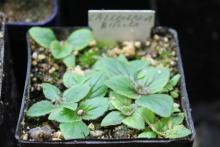
Updates on:
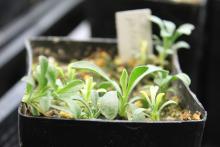
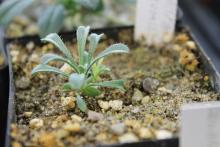
Cryptantha paradoxa - germination started in the cold after 6 weeks chilling; (NB. Alplains says this one doesn't need stratifying but recommends scarifying).
Penstemon erianthus v. redactus - germinated in the cold after 6 weeks of stratification:
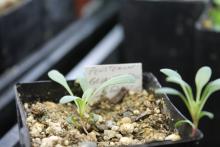
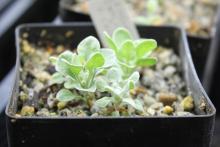
Eriogonum robustum - in the cold room for 6 weeks; germinated in 3 days at room temperature:
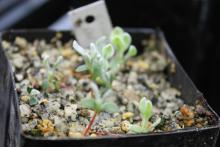
Cryptantha humilis - 6 weeks chilling; germination started in 2 days at room temp:
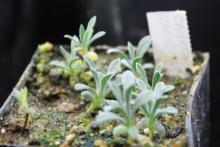
Eriogonum ovalifolium v. eximium - germinated in the cold after 6 weeks of stratification:
Cryptantha caespitosa - germination started in the cold after 6 weeks stratification:
Campanula scoparia - germinated in the cold after 6 weeks stratification:
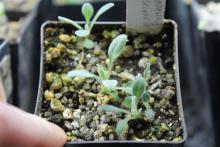
Richard T. Rodich
Re: Seed starting chronicles 2013
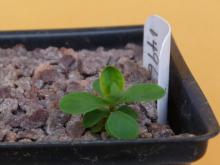
Tue, 04/16/2013 - 10:06amHypericum pallens - emerged in 13 days at room temperature. But only one germinated out of 20 seeds!
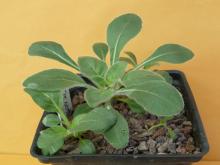
Oenothera caespitosa ssp. crinita - emerged in 10 days (the large one) at room temperature, and the others in about 17 days. This seed was wild collected by John Weiser (Thanks!). I need to transplant these!
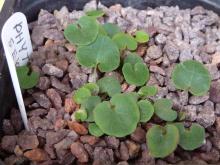
Phyteuma serratum - emerged in 16 days at room temperature.
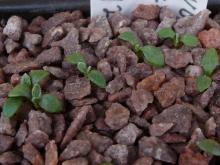
Three Townsendia spp., all planted at the same time at room temperature.
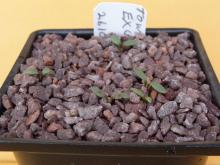
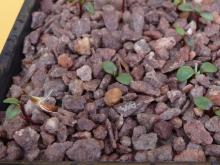
Townsendia excapa - emerged in 12 days.
Townsendia rothrockii emerged in 5 days. On the bottom left, you can see what the seed looks like, still attached to the seedling.
Townsendia spathulata emerged in 6 days.
Richard T. Rodich
Re: Seed starting chronicles 2013
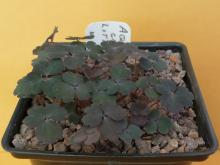
Sat, 04/20/2013 - 10:21pmAquilegia canadensis Little Lanterns emerged in 17 days at room temperature.
Allium sacculiferum emerged in 18 days at room temperature. When I transplanted these, the little buggers' onion smell was easily as strong as mature plants!
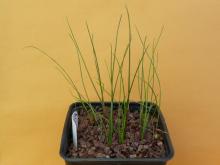
And thanks for the seed, Mark!
Physaria didymocarpa emerged in 5 days at room temperature.
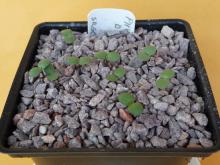
Erigeron pinnatisectus emerged in 4 days at room temperature.
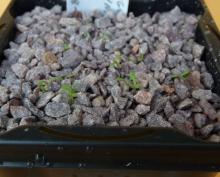
Iberis taurica emerged in 5 days at room temperature.
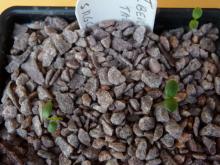
Trond Hoy
Re: Seed starting chronicles 2013
Sat, 04/20/2013 - 11:52pmRick and Lori, your seedlings look very healthy!
Mark McDonough
Re: Seed starting chronicles 2013
Sun, 04/21/2013 - 11:17amWow, lots of good looking and promising seedlings coming along. Lori, happy to see that Allium sacculiferum is coming up well. And what is Aquilegia canadensis 'Little Lanterns' like?
My seed sowing fell miserably behind this year, changed jobs in November and scrambling to learn the new role, was very busy and traveling quite a bit, then became ill for approximately a 3 month period, finally surgery and now recovery. That said, I'm glad I did sow some seed last autumn, because now most flats are showing germination.
My seed flats spend the winter outdoors, protected from squirrels and chipmunks with wire mesh. In this photo, I removed the wire on three flats, I bend the wire to be more hoop-house shaped as the leaves and stems grow. The top two flats are Jeffersonia dubia, and the bottom flat is Epimedium grandiflorum f. flavescens 'Nanum' open-pollinated seed. To the left of the top-most open flat, you can see more seedlings, that is Jeffersonia dubia Korean Form.
Epimedium elongatum; even with small seed pots I cover with wire mesh.
Anemonopsis macrophylla; germinated last year, flat left on ground overwinter, and young plants are ready to plant out.
Pages