
I start out with a couple web links I found, showing Epimedium in the wild in China. This particular site has 5 species listed; I'm featuring two of their links. The first is to Epimedium brevicornu, with some nice photos:
E. brevicornu:
http://www.gaolongxiao.com/chinese/product/product_view.asp?productid=1083
Next is E. grandiflorum:
http://www.gaolongxiao.com/chinese/product/product_view.asp?productid=1086
The site also shows a plant listed as E. pubigerum, but the photos themselves have watermark captions as Epimedium hunanense, yet the photo depict neither species! Looks more like the starry white flowers of E. stellulatum or pubescens (my guess is, it resulted from confusion between the similar names of pubigerum and pubescens. The moral is, doesn't trust everything found on the internet; lots of bogus misinformation out there.
Comments
gerrit (not verified)
Re: Epimedium 2012
Sun, 05/20/2012 - 9:50amEvery year the last one. Epimedium ilicifolium. Nice eppie.
Mark McDonough
Re: Epimedium 2012
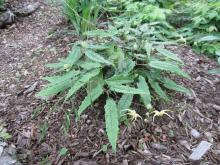
Sun, 05/27/2012 - 10:26amI agree Gerrit, Epimedium ilicifolium is a nice eppie. Is yours finishing up now? You clone looks a little bit different than mine, I think there are a number of clones in cultivation, the leaves on my plants looks more narrow... I like the look of your plant with fuller leaves. Mine is setting seed, still flowering, and making fresh new flower stems, all at the same time, t is one that I find tends to rebloom. In the photo, you can see a few blooms, a stem with seed pods, but harder to see are several new flower stems just forming.
E. ilicifolium:
One that I'm finally impressed by (took several years to "get going"), is E. x 'Windfire', with numerous upright stems and bright yellow flowers with ascending spurs, still making a good show. Its been blooming for weeks.
A young plant of Epimedium x 'Flame Thrower', purchased last year as a tiny start, it's already putting on a fair show of red and cream-yellow flowers, big and spidery they are.
Other species just starting to flower include 'The Giant', E. elongatum, E. membranaceum, and a number of hybrids with membranaceum... photos to follow.
gerrit (not verified)
Re: Epimedium 2012
Sun, 05/27/2012 - 11:27amMy E. illicifolium is still with flowers as you can see. There are still buds and it's setting seed at the same time, just the same as your plant. Last week we had hot weather with temps between 25 and 28 degrees. Very clear intense blue skys with a hot burning sun. Dangerous conditions for eppies. I had to cover the plants with shadow material. And it's going on for the next days.
A very special one indeed. I like the tall uprising stems. With so many yellow flowers. A very healthy hybrid, strong. With davidii-blood, I presume?
tropicalgirl251... (not verified)
Re: Epimedium 2012
Sun, 05/27/2012 - 12:26pmI have five Epimediums in my garden. Epimedium grandiflorum nanum and Epimedium grandiflorum rubrum I got three years ago are doing very well. The next two (I do not have names) are also coming up nicely. Epimedium lishihchenii which grew very well last year is still emerging.
tropicalgirl251... (not verified)
Re: Epimedium 2012
Sun, 05/27/2012 - 12:28pmmore pictures
Mark McDonough
Re: Epimedium 2012
Sun, 05/27/2012 - 5:50pmHello Krish,
Epimedium grandiflorum 'Nanum' is a really good one, stays small for a long time, but when maturing in good woodland soil, it can get fairly large (although the leaflets stay tiny and charming). The second one is probably Epimedium x rubrum (a hybrid with E. alpinum), probably the single most common Epimedium in horticultural commerce, and a really good plant it is, one of my favorites. Hard to know about your unnamed ones, but suffice it to say, there is no such thing as a bad Epimedium, they're all so enjoyable, thanks for sharing.
Mark McDonough
Re: Epimedium 2012
Sun, 05/27/2012 - 6:35pmA view of 2-year and 3-year Epimedium hybrid seedlings. I evaluate them as much for foliage (if not more so) than flowers.
I have many hybrids between either E. brevicornu or the similar stellulatum, x the everblooming E. membranaceum, resulting in evergreen plants, with everblooming clouds of small white yellow-cupped flowers.
Two Epimedium davidii hybrids planted side-by-side. On the left is a tiny-flowered hybrid of E. davidii EMR, on the right is a different E. davidii hybrid with floriferous sprays of large bright yellow flowers:
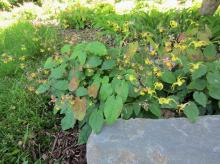
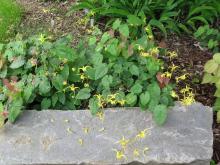
E. davidii selected hybrid on the left, on the right, a view to a nearby selected hybrid with pale speckled foliage.
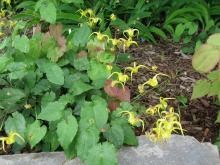
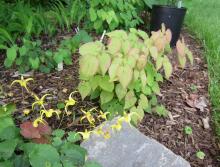
Another view of of a low luminous hybrid with pale chartreuse speckled foliage; it's on my "watch list".
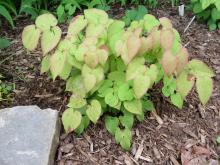
Two more views of the Epimedium davidiii EMR small-flowered red and yellow hybrid. Interestingly enough, when I visited Garden Vision Epimediums nursery a few weeks back, they had a large block of plants that looked exactly like my hybrid... when I checked the label, it too was labeled as an E. davidii EMR hybrid!
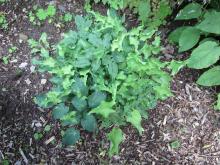
The following is a selection I made a few years back, a dense squiggly-leaved plant, which is interesting to grow as a foliage plant alone.
Richard T. Rodich
Re: Epimedium 2012
Sun, 05/27/2012 - 7:10pmSome nice results, Mark. It seems I've forgotten what "EMR" means...
Mark McDonough
Re: Epimedium 2012
Sun, 05/27/2012 - 7:21pmEpimedium davidii EMR refers to one of the original collections of this species, EMR4125, made by Martyn Rix in the Mupin Valley (now Baoxing), the first clone of this species introduced into the United States (this info, from one of the past Garden Vision Epimedium catalogs).
Mark McDonough
Re: Epimedium 2012
Mon, 05/28/2012 - 6:13amKrish, back to your unnamed "eppies", I think the first one in the photo labeled "Epimedium sp.jpg" might be 'Pink Elf', which is becoming a popular item in the nursery trade.
tropicalgirl251... (not verified)
Re: Epimedium 2012
Mon, 05/28/2012 - 7:52amHi Mark
I got the Epimedium as "pink champagne" from the local nursery.Thanks for identifying the other ones. Do you have any idea which Epimediums are hardy for our climate
Krish
Mark McDonough
Re: Epimedium 2012
Mon, 05/28/2012 - 9:46amKrish, I'm wondering if the Epimedium purchased as 'Pink Champagne' is of mistaken identity, the spurs look much too short, and the ascending sepals as opposed to down-curved sepals doesn't quite fit, it looks more like 'Pink Elf' to me. Here's a few links to compare. It could be that the flowers on your plant are not fully expanded yet, but I have a hunch that it might have be a nursery mixed up.
Epimedium 'Pink Elf'
http://www.plantdelights.com/Epimedium-Pink-Elf-PP-17228-Perennial-Fairy...
Epimedium 'Pink Champagne'
http://davesgarden.com/guides/pf/showimage/299261/
http://davesgarden.com/guides/pf/showimage/299262/
Regarding hardiness, hard for me to comment on plants for your Zone 3 climate; I know that many Epimediums are rated to Zone 4; so you might need to experiment. Hardiness information for Epimedium seems to be hard to come by, although here in Zone 5, few if any have been lost directly to winter cold; those I have lost over winter were in a highly weakened state after a summer and fall of severe drought.
gerrit (not verified)
Re: Epimedium 2012
Mon, 05/28/2012 - 10:20amMark, I agree your ID about E."Pink Elf". Krish,look at my posting, reply 137.
About hardiness: Last winter we had several days with temps up to minus 23 degrees. But we had about 20 to 30 cm of snow to cover the plants. That's essential. So, no losses here.
gerrit (not verified)
Re: Epimedium 2012
Mon, 05/28/2012 - 10:41amIt's lovely to see your new promising hybrids. Just only for flowercolours one should grow them.
Epimedium davidii EMR4125 is one of my absolute favourites. But now I see your hybrid with two colours, I think you improved one of the best Epimediums.
Mark McDonough
Re: Epimedium 2012
Mon, 05/28/2012 - 12:44pmOne of the latest blooming eppies is Epimedium elongatum, from Sichuan Province, China, found in mountains between 9,000-12,000 feet. It is a delightful species, with rounded crimp-edged leaves; a refined upright grower with flower stems reaching 2' (60 cm). The first flowers are just beginning to open, small red outer sepals and yellow ascending spurs, the flowers about 1/2 the size of the great yellow spiders of E. membranaceum (also starting to flower now, another late bloomer). Notice how glandular the stems are on E. elongatum. Suggested to be cold hardy to at least Zone 4.
Epimedium elongatum:
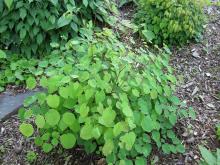
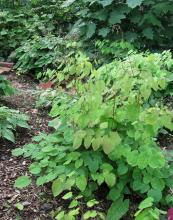
A hybrid showing some appealing pastel leaf coloration, another one selected for the foliage.
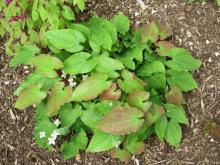
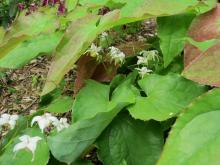
A sempervirens hybrid that's very unique, although I'm at a loss to explain the possible parentage, aside from sempervirens. The spring foliage is heavily speckled red unlike any other eppie in the garden, it has handsome sprays of white flowers, wide clear white sepals that curve downwards, and light yellow cups, the flowers quite visible at first. Later, the foliage overtakes the stems, but flowering continues for many weeks. This one has deep leather-red evergreen winter foliage (last photo, taken Dec. 17, 2011).
selected E. sempervirens hybrid:
Epimedium sp. "The Giant" is starting to take off, making many tangled sprays of warm tan-color blooms, great narrow spiders, the mouth of the spurs are toasted a dark brown color, marvelous!
gerrit (not verified)
Re: Epimedium 2012
Tue, 05/29/2012 - 1:50pmMaybe you can start building a pergola above your giant in order to relax in its shadow.
tropicalgirl251... (not verified)
Re: Epimedium 2012
Tue, 05/29/2012 - 3:29pmMark I think you are right.I came across many nurseries having wrong labels.But I am not very familiar with these plants to tell the difference. The Epimedium lishihchenii flowered nicely last year but the last dry fall weather might have affected it.
tropicalgirl251... (not verified)
Re: Epimedium 2012
Tue, 05/29/2012 - 3:30pmsorry I messed up my quote again
Mark McDonough
Re: Epimedium 2012
Tue, 05/29/2012 - 5:12pmKrish, Epimedium lishihchenii is one that I lost in the drought of summer-fall 2010. While it was alive going into winter 2010-2011, it was so weakened by drought that it perished that winter; it was a large and impressive mature clump; beautiful leathery veined foliage and large yellow spider flowers. This species was available on the Garden Vision Epimedium catalog this year, and I bought a replacement. It shall be very interested to see how various Epimedium species and hybrids do for you in a Zone 3 climate, there's so little information out there on eppie cold hardiness, please keep reporting your experiences with them. :)
By the way, when quoting messages on the forum, you can use the quote button. If you edit any of the quoted information, perhaps to shorten it, be sure to leave the opening "quote" (the word "quote" by itself within a pair of brackets), followed at the end with a final "/quote" also within brackets, all of which is then followed by your own response. I hope that helps :)
Lori S. (not verified)
Re: Epimedium 2012
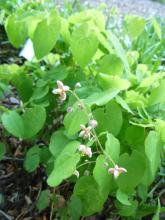
Wed, 05/30/2012 - 8:21pmIs this really E. x cantabrigiense, Mark? The flowers are very small and rather washed out.
Mark McDonough
Re: Epimedium 2012
Wed, 05/30/2012 - 8:52pmI think it could be E. x cantabrigiense indeed, a hybrid between E. alpinum and E. pubigerum; the very small flowers certainly have the right flower shape. It is variable in color, and can be pale salmon. There are darker red-&-yellow forms, that at least in the US, have been dubbed by Epimedium master Darrell Probst as E. x cantabrigiense "Red Form", that named form originating from Jerry John Flintoff. Here are 4 photos of the "red form".
Mark McDonough
Re: Epimedium 2012
Sat, 06/30/2012 - 6:26amLate-flowering eppies continue to flower, including E. elongatum, membranaceum, and many of the hybrids with membranaceum, rhizomatosum, and davidii. The eppies were prolific with seed this year, although I missed most of it when I was travelling to Dallas Texas one week, but did manage to catch seed of some varieties, to attempt growing on open-pollinated progeny.
Epimedium elongatum is a late bloomer, still looking good and starting to produce pods (still waiting for them to mature):
E. fangii didn't bloom this year, not sure why, but it makes up for it with truly unique and attractive foliage.
I have this one rather strange Epimedium hybrid took 4 years to flower from seed, which I thought to be a hybrid of E. rhizomatosum, but I'm not really sure what it is. It has very late sprouting foliage, which is low, small, and crinkly, of a bluish-green color, and cascading stems of very small white and yellow flowers. In the close-up view, notice the abundance of developing seed pods (which have been harvested and sown).
Epimedium - rhizomatosum hybrid?
One that flowers late and for a very long time (still in bloom now) is another E. rhizomatosum hybrid, with nice big yellow incurved spidery flowers. Notice the worm on the 2nd photo, which was starting to eat into a developing seed pod; occasionally I find such evidence of worm holes drilled into seed pods of Epimedium and Iris.
Epimedium seed - bagged and cleaned. My latest practice is to use plastic baggies to collect epimedium seed pods that are plump and ready to open, within a couple days most pods will open and spill seed on their own, the seed staying fresh and plump in the baggies. Once cleaned, they're sown in peat flats and left out in the open in a shaded location, and kept watered all summer, for germination next spring.
I've shown this method before, but I will often use twigs cut-to-fit to divide a flat into 2-3 sections for sowing diferent varieties. I cover the seed thinly with soil, then top-dress with fine decomposed pine bark mulch. Last, I cover with wire mesh to keep chipmunks and squirrels from digging and eating the seed, seemingly a favorite food for such vermin.
Left photo: open-pollinated seed of "Mark's Star" ;) on the left and E. brachyrrhizum on the right.
Center-right: protected seed flat of open-pollinated E. ilicifolium.
Mark McDonough
Re: Epimedium 2012
Sun, 07/15/2012 - 6:22amLeft: in spite of continuous tunneling by moles in this bed of young 2nd-year hybrid Epimedium seedlings, most seedlings have survived the battlegrounds.
Right: self-sown Epimedium seedlings presents a quandry, what do I do with all the seedlings? This past winter, being as mild as it was, there must be thousands of self-sown epimedium seedlings this year. I've been in process of digging them up and planting them in peat flats; I can fit 30 seedlings per flat. The goal is to eventually row these out in new beds, see what they produce in their 3rd year, then decide if any are "keepers", otherwise they will be donated to the local Garden Club annual plant sale each spring. In the photo, the flats with wire over them and nothing green showing, are some of this year's Epimedium seed that was collected and sown.
Mark McDonough
Re: Epimedium 2012
Sat, 08/18/2012 - 5:52pmOne particular Epimedium membranaceum hybrid (membranaceum x rhizomatosum) is standing out as an excellent ever-bloomer, hasn't missed a beat throughout July and August so far; keeps making low sideways branches filled with yellow flowers. How nice to have epimediums putting on a show here in mid-late August. In growth, the plant is tighter and lower growing than regular E. membranaceum.
Trond Hoy
Re: Epimedium 2012
Sun, 08/19/2012 - 12:12amAnd when can we look for this one at the local nursery selected and named by Mark McDonough? I would buy at least 3 specimens!
Mark McDonough
Re: Epimedium 2012
Sat, 09/29/2012 - 7:21pmFollowing up on the Epimedium membranaceum hybrid shown 2 messages above (cross is E. membranaceum x rhizomatosum), it just gets better and better, flowering non-stop. Here it is, near the end of October, and it is still forming new stems and buds, with big sprays of incurved golden flowers... there are hundreds of flowers and buds. I have decided to name this hybrid, it's the only one out of many similar crosses that so consistently flowers non-stop into autumn. Two views of this everbloomer, photos taken on this rainy late September day.
Richard T. Rodich
Re: Epimedium 2012
Sat, 09/29/2012 - 8:06pmHow about Epimedium 'ReMARKable' ... Kinda catchy, wouldn't you say?
A very apt description. The hybrid is quite a breakthrough, isn't it?
Mark McDonough
Re: Epimedium 2012
Sat, 09/29/2012 - 8:19pmThat's very funny, but I LIKE IT, a catchy name to be sure. I was going to follow up with a plea for suggestions of a proper name, I agonize over such things. I will give it serious consideration, although a name-play that depends on capitalization might fall short. After growing an extensive collection of Epimedium, I wondered why no one has focused on the very few late species, such as everblooming membranaceum, to a lesser extent late-blooming rhizomatosum, to develop all-season flowering epimediums. I would love to get such plants flowering in pink and other colors; there is always another year.
Mark McDonough
Re: Epimedium 2012
Sat, 09/29/2012 - 9:04pmAnother hybrid seedling catches my eye, the one shown below is E. (stellulatum x membranaceum) x various hand-made crosses, including E. wushanense "Spiney leaf form" and ilicifolium. The leaf shape here is very spine-edged, much more so that than either species, so I look forward to seeing the flowers this spring, 3 years from seed.
Trond Hoy
Re: Epimedium 2012
Sat, 09/29/2012 - 11:58pmI place an order of 5 plants ;) ;D
BTW, the penstemon I bought is Penstemon 'Rich Ruby'! The one I bought was wrongly labeled :-\
Your last hybrid catches my eye even without flowers, Mark!
gerrit (not verified)
Re: Epimedium 2012
Thu, 10/04/2012 - 8:03amIt is remarkable indeed, such a non-stop flowering Epimedium. It is worth having a name and being available for customers. I would buy one for sure. But I think, this is not the end. In fact there are many species and cultivars with a better performance. The round-shaped leaves are not very special. So I think there is much to improve. Mark, this is a wonderful plant using in hybridization efforts. Perhaps a breakthrough, yes.
Mark McDonough
Re: Epimedium 2012
Thu, 10/04/2012 - 6:58pmGood to hear your feedback Gerrit, I think you have summarized it well, while this hybrid is a standout for non-stop flowering, its main value is for further development of a line of everblooming Epimediums. Another desirable trait, it has very low foliage, while unremarkable, the leafage definitely remains low and rock garden sized; a favorable attribute in my opinion.
gerrit (not verified)
Re: Epimedium 2012
Fri, 10/05/2012 - 12:09pmRight Mark, go on. I'm your biggest fan :o ;D
Right again. As you know, I had the idea of creating dwarf Epimediums with my mother-plant, Epimedium davidii CPC. Unfortunately he died in what we call here a horror-winter. To get a new one, I have to travel to Belgium. I'll do this next spring. So I support your efforts to use your hybrid in a program with other existing dwarf-Epimediums, like for instance your wonderful E.lilliputian.
Mark McDonough
Re: Epimedium 2012
Fri, 10/05/2012 - 6:21pmSorry to hear of the loss of your E. davidii form. With the prolonged drought we had two years ago, plants were so weakened that some died over winter, and others struggled for yet another year, but even with good rainfall in 2011, some finally gave up after being unrecoverably weakened the year before. I have replaced most of them, but still have a few more to re-purchase if I can. I can sympathize with the loss; in the world of typically long-lived Epimediums, they've become our babies :-) They can be both difficult and costly to replace.
In this general view of several E. sempervirens cultivars and hybrids, #1 is a selected superior hybrid of E. sempervirens that mounds up beautifully, holds its flower *above* the leaves, has dark green veined leaves, awesome late autumn/early autumn foliage color, and awesome spring foliage color. It is one to continue hybridizing with. #2 is E. sempervirens 'Vega', a wonderful low-growing selection with very shiny foliage and bright spring and fall foliage color. I have earmarked this one for hybridization. #3 is a selected hybrid E. sempervirens x grandiflorum, quite intermediate, with shiny evergreen looking foliage but not evergreen in truth, and it gets the large voluminous 2nd flush of foliage (not a desirable trait). In the lower left (sorry, forget to add a number) is E. x youngianum 'Liliputian'.
In this photo, the plant pointed at with a red arrow is a very dwarf E. sempervirens hybrid, exceptionally compact and small leaved, and typical of the species, no major 2nd flush of foliage. The compact plant is 5 years old, and remains only a couple inches tall in leaf. Once again, I find this to be an exciting find to get such a dwarf plant, that is clearly of the shiny-leaf evergreen type, but so miniature. Yet again, another one to use for further breeding.
gerrit (not verified)
Re: Epimedium 2012
Sat, 10/06/2012 - 10:04amGood to see your promising small Epimediums. I was surprised they are sempervirens-hybrids. Unfortunately I have none of them in my collection. Available here is E. sempervirens 'White purity'.
Thanks for posting.
Mark McDonough
Re: Epimedium 2012
Sun, 10/07/2012 - 8:12amEpimedium sempervirens is a very interesting species, in my opinion valuable for hybridization. Its main attribute is foliage, which can show startling color in both spring and fall, among the very best in the genus. The leaves also show a distinctive sheen. Cultivars such as 'Candy Hearts' and 'Cherry Hearts' are outstanding with glossy heart-shaped leaves intensely suffused pink and red, spring and fall. Since the leaves are semi-evergreen, the late leaf color typically lasts until December. In some forms, the leaves are near black maroon is spring and fall, and of course, there is that magnificent variegated form just called "Variegated #1" by Garden Vision (see links below):
http://nargs.org/smf/index.php?topic=178.msg1628#msg1628
http://nargs.org/smf/index.php?action=dlattach;topic=943.0;attach=26793;...
I have every form of sempervirens that Garden Vision offered over the years (15). Of those, the ones I like best are the two mentiond above, but also 'Vega', 'Secret Arrow', 'Aurora', and the fantastic hybrid 'Violet Queen' which is surely a more complex hybrid (suspected to be x grandiflorum v. violaceum). See link below for photo of plant in full flower:
http://nargs.org/smf/index.php?action=dlattach;topic=178.0;attach=3332;i...
Only this last one is really showy in flower, an example demonstrating its potential in hybridization, not only for beautiful foliage plants, but for sheer flower power too. The species weakness is having pale so-so flowers, often half hidden in the foliage.
gerrit (not verified)
Re: Epimedium 2012
Wed, 10/10/2012 - 10:26amIn order to find some Epimedium sempervirens in Europe, I searched the web. E.sempervirens 'White purity' is the only member of this species found.
Of course I knew this fantastic E. sempervirens 'Violet Queen'. Once seen, You'll never forget it. (an Epimedium-lover of course)
Well, we have to be patient and wait until this species crosses the ocean. In the mean time we'll watch your stunning pictures.
Pages