
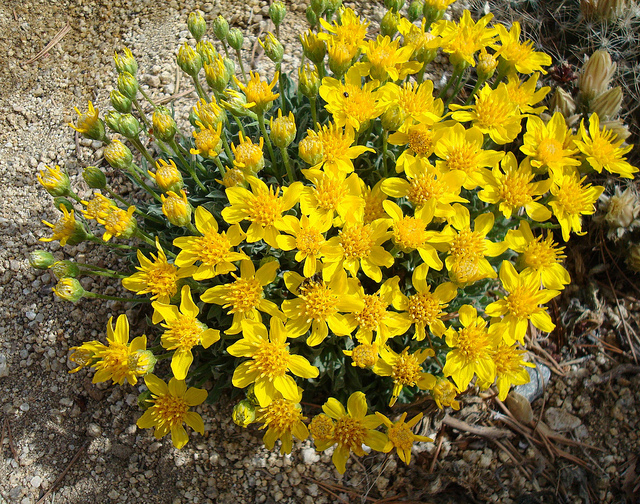
Stenotus acaulis (syn. Haplopappus acaulis)is a very nice dwarf aster from the Western states (CA,NV,OR,WA,ID,MT,WY,CO,and AZ). It's range starts at the Eastern Sierra Nevada Range traveling eastward across the Great Basin Wasache and Uinta ranges. Then crossing the Middle Rockies and into the Wyoming Basin. Within this vast range there is a lot of variability and integration among regionally distinct populations.
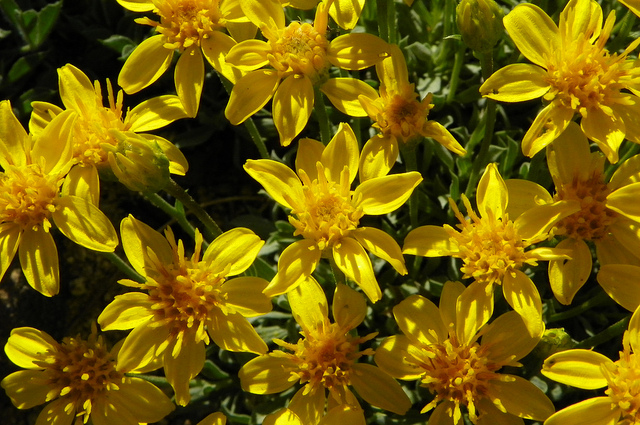
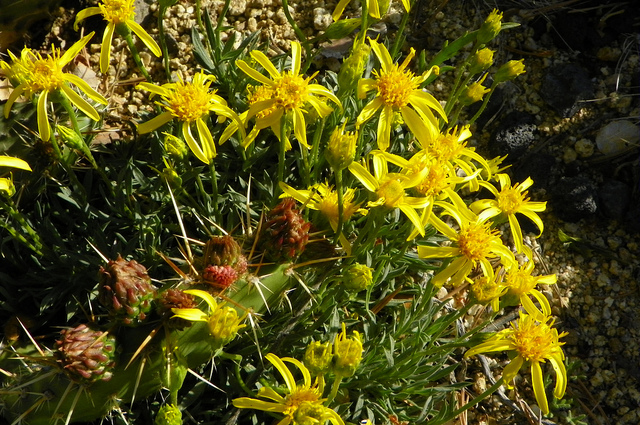
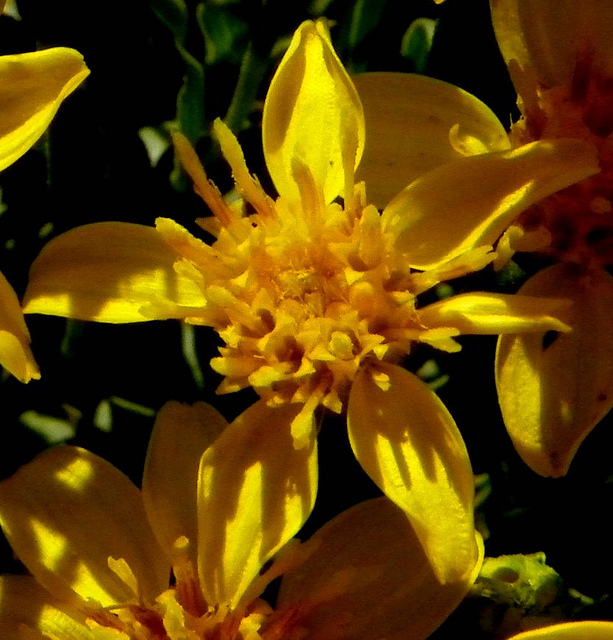
This little mat forming desert and alpine daisy, forms condensed 2"(2cm) tall mats of upward pointing lance shaped leaves, that dry through the summer and become very prickly to the touch. The yellow spring flowers are held above the mats from 1"-4" (2.5-10cm). In the populations of the Eastern Great Basin you can see plants with wider full petals blooming along side plants with strap like petals. Both forms equally charming.
It is not uncommon to see wild mats with portions dead and the remainder flourishing. As the mats expand their new rosettes send down, their own sets of new wiry tap roots. This makes it fairly easy to separate new cuttings.
http://www.calflora.org/cgi-bin/species_query.cgi?where-calrecnum=7784
http://plants.usda.gov/java/profile?symbol=STAC
http://www.efloras.org/florataxon.aspx?flora_id=1&taxon_id=220012965


Comments
Trond Hoy
Re: Stenotus acaulis
Sat, 01/07/2012 - 2:46amJohn, that one is one of the prettiest Asteraceaes I have seen ever! You say it is easy from cuttings - how is it from seed?
John P. Weiser
Re: Stenotus acaulis
Sat, 01/07/2012 - 5:19amI find it easy from seed. Grow it on a sand bed in your climate!! ;)
Lori S. (not verified)
Re: Stenotus acaulis
Sat, 01/07/2012 - 7:55pmYou'd probably want to make it a very substantial and raised sand bed, with all the rain in your climate, Trond! :o
Looks like a terrific rock garden plant. Your first photo, which I assume is an example of the wide-petalled form, is especially spectacular.
I had to look up the genus Stenotus, having not even heard of it before. Wow, the former "Haplopappus" species have sure been scattered to the winds.
Trond Hoy
Re: Stenotus acaulis
Sat, 01/07/2012 - 11:52pmJohn, that is no problem ;)
Lori, at home it had been necessary with an umbrella too!
I had some nice Leontopodiums started from seed last year but those I planted at home are a complete mess by now although I've had almost no freezing temps so far. However I planted some t my mountain cabin and some at my summerhouse too. Hope they fare better!
If I get Stenotus acaulis I think I'll plant them at my summerhouse - in a raised sandbed ;)
Tim Ingram (not verified)
Re: Stenotus acaulis
Sun, 01/08/2012 - 5:34amJohn - those are really great pictures to go with your Erigeron bloomeri. The prospect of a much bigger sand bed looms more and more! I may have to redesign parts of the garden. I still toy with the idea of a year round covered bed for some of these plants, because our summers can be so variable, but maybe a sand bed on a sufficient scale would obviate the need for this.
Todd Boland
Re: Stenotus acaulis
Mon, 01/16/2012 - 7:04amI have one seedling going through its first winter outdoors......generally western NA alpines do not make it in my wet climate but I did invert a pot over the plant to keep the crown dry, so we will see (I do that with many westerners with mixed results...certainly helps rather than hinders!)
cohan (not verified)
Re: Stenotus acaulis
Wed, 02/01/2012 - 3:47pmLovely, John! I think Alplains has this under some name or other..
John P. Weiser
Re: Stenotus acaulis
Wed, 02/01/2012 - 4:23pmAlplains has it listed as Haplopappus acaulis. They list several regional varieties form the Rocky Mountain area.
Brian_W (not verified)
Re: Stenotus acaulis
Tue, 01/15/2013 - 5:13pmGreetings,
Nice set of photos and great information. I find this species growing abundantly in the Pryor mountains where it forms solid soccer ball sized cushions. The really old specimens often have eroded bases revealing a stout twisted tap root.
Brian
Anne Spiegel
Re: Stenotus acaulis
Tue, 01/15/2013 - 6:29pmJohn, wonderful pictures of the stenotus (haplopappus). I can't keep up with all the name changes. I've admired this plant often in the wild, but have had great difficulty in getting it to last in my garden. I've tried it in raised and sloped scree, raised sand beds and still no success. Hymenoxys acaulis, on the other hand, lasts for years and flowers wonderfully. I must be doing something wrong, but haven't figured it out yet. Any ideas?
John P. Weiser
Re: Stenotus acaulis
Wed, 01/16/2013 - 11:23amIt goes completely dormant out here from mid July through September. You may want to try it in as dry a sight as possible. Other than that I don't think it's too picky about soil and such.