
Forums:
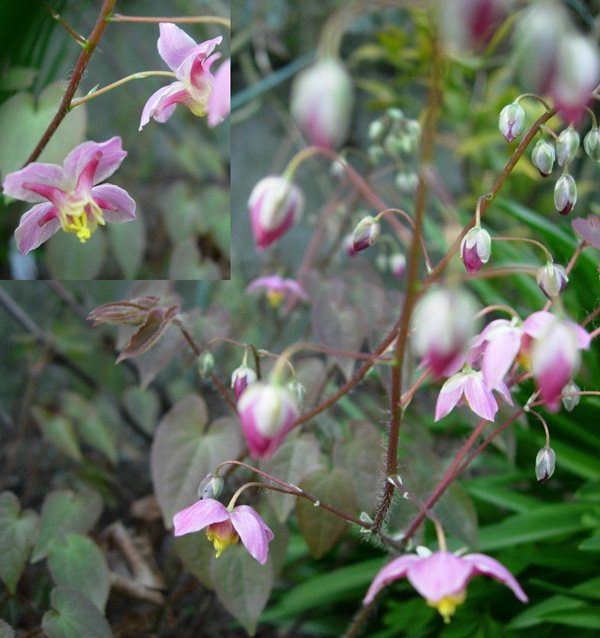
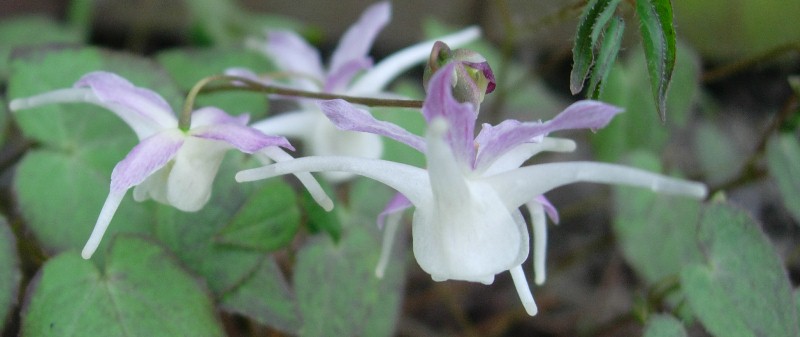
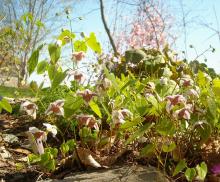
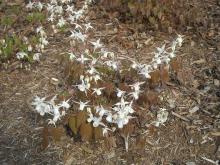
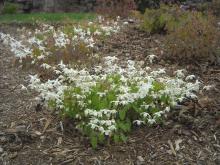
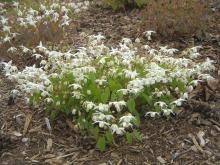
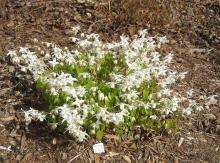
The first Epi's are in flower here :D :D :D
E. x versicolor 'Cherry Tart'
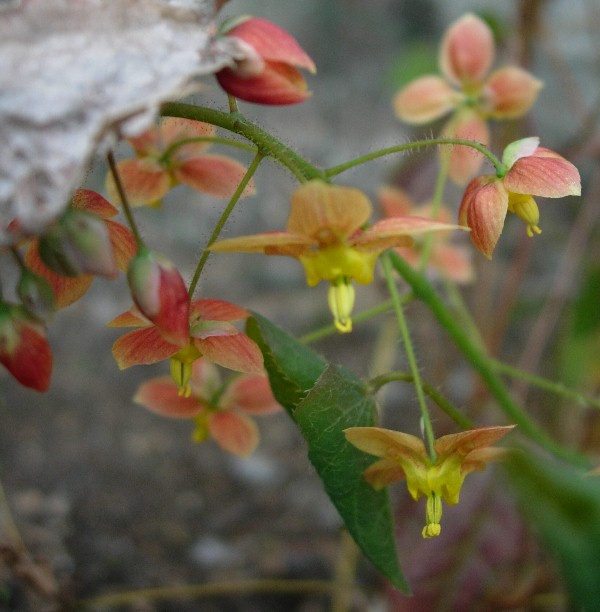
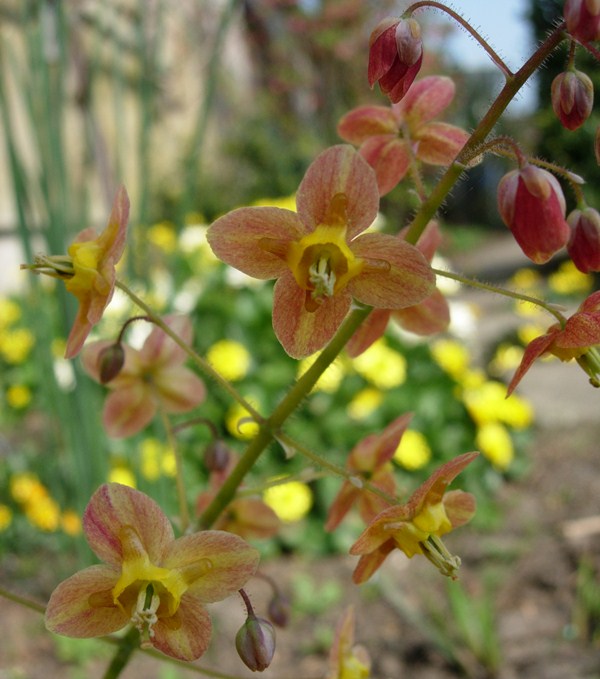
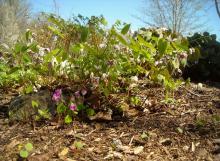
E. x warleyense (I suspect this is E. x warleyense 'Orangekönigin', like the one on the next pic...but I'm not sure, so until I'm sure I'll keep it named as the pure hybrid)
E. x warleyense 'Orangekönigin'
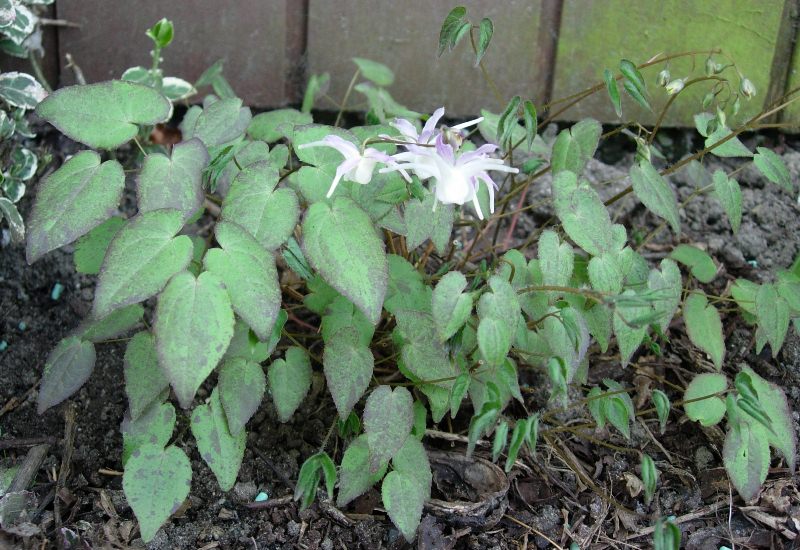
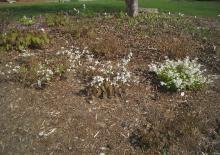
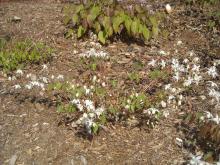
and a very young plant of E. x youngianum 'Freckles' Cc. 950080 (2 last pics)
Comments
Mark McDonough
Re: Epimedium 2011
Sun, 03/27/2011 - 8:22amExcellent start to the Epi season Wim! We're in suspended animation here, sunny but days so cold and just above freezing that even the crocus aren't opening up, and with deep freezes at night.
E. x versicolor 'Cherry Tart' is by far one of the best of the newer introductions by Darrell Probst, a real beauty, and one of the few x versicolor cultivars. Not sure if this one is fertile, as most versicolor cultivars are sterile.
So I went digging through my photos of E. x warleyense, and I don't have any good comparative shots of it with the cultivar 'Orangekönigin'. It is reported that the latter has flowers a shade or two paler than x warleyense, but with darker orange veins, and has shorter rhizomes thus forming a denser clump. I found a few photos of E. x warleyense, but none that are true closeup views of the flowers, and no photos of 'Orangekönigin', so I will try to get some photos later on. I do find that regular E. x warleyense is sterile and produces no pollen, on the other hand 'Orangekönigin' does produce pollen. Based on photo dates, my plants typically start blooming the first week of May.
If one grows E. x warleyense in full sun, as I do, the leaves take on beautiful bronzy red and orange tones, whereas in shade they remain bright green. Also, it flowers much more heavily in sun, making an orange splash in the spring landscape.
For information only: hybrid seedlings of E. x youngianum 'Freckles' will often inherit the varied leaf speckling.
Todd Boland
Re: Epimedium 2011
Thu, 03/31/2011 - 3:14amI picked up a E. wushanense at the WWSW last month..it has 4 flower stems in the basement window. Suppose to be evergreen but I doubt it will be in my area...not even sure it will be hardy but the holly-like leaflets were too cool to pass up!
Mark McDonough
Re: Epimedium 2011
Fri, 04/01/2011 - 9:28amTodd, that's a great species to "pick up". I don't grow the regular more upright form (wish I did), but do grow the one Darrell Probst calls the "spiny-leaved form" which is lower growing. This winter seemed to be a particularly hard text-book winter to challenge the evergreeniness of supposedly evergreen plants in New England. If I have time, I'll post the results from this year later on. As always however, E. wushanense "spiny-leaved form" came through looking fairly good but with some leaf burn, whereas some of the species I characterize as reliably evergreen such as E. pinnatum ssp. colchicum and E. pubigerum took a total beating... I have already trimmed off the foliage for the spring season.
Todd Boland
Re: Epimedium 2011
Fri, 04/01/2011 - 6:05pmMine has spiney-edged leaves...I wonder if it will turn out to be the smaller form. The plants came from Phillip McDougal.
This 'spring' has been so horrid it will still be weeks before I know the status of plants in the garden. I expect my dwarf Japanese maple, Sharp's Pygmy, will be toast as the snow is as hard as concrete and still has feet to melt. Evergreens will probably be fine (no exposure to cause winter burn) EXCEPT for being like pancakes. Oh when I think of my evergreen ferns not to mention hellebores.
Reed (not verified)
Re: Epimedium 2011
Fri, 04/01/2011 - 6:12pmIt is evergreen at 9 Deg. here in Oregon with no snow. :)
James
Trond Hoy
Re: Epimedium 2011
Fri, 04/01/2011 - 11:44pmNo Epimediums here yet!
Wim, where do you get your plants from?
WimB (not verified)
Re: Epimedium 2011
Sun, 04/03/2011 - 1:45amTrond,
my Eppies come from different sources. Some from Koen van Poucke: http://www.koenvanpoucke.be/, some from Epimedium nursery: http://www.epimedium.be/nederlands/home.html and some from Darrell Probst. The ones I've shown here this year already come from Epimedium nursery.
Trond Hoy
Re: Epimedium 2011
Sun, 04/03/2011 - 9:24amThanks, Wim. It is a pity Norway isn't a EU member, makes mailing plants very difficult!
WimB (not verified)
Re: Epimedium 2011
Sun, 04/03/2011 - 10:57pmYou're welcome. Does Norway have a very strict import policy? I thought it was exempt from all red tape under EEA (European Economic Area) law? I believe we (in Belgium) may import up to 5 plants from Norway with a rootball without having to apply for a phyto. (I'm not very sure, though)
Trond Hoy
Re: Epimedium 2011
Mon, 04/04/2011 - 9:41amIt is a strict private import policy on plants although we are a EEA member. They say they are afraid of diseases but I suspect the nursery industry and big retailers (in Norway) want the marked to themselves. Live plants is difficult but bulbs are easier. And I can import 50 small packets of garden seeds in one parcel.
gerrit (not verified)
Re: Epimedium 2011
Wed, 04/06/2011 - 10:46amHello fellow forum members,
This is my first contribution on this thread. Let me introduce myself to those who doesn't know me yet. My name is Gerrit and I live in Holland in an agreeable climate. Mild winters and cool summers, enough rainfall. I am especially dedicated to the genus Epimedium. I started 4 years ago and my collection is extending every year.
The E. season has already started here, due to the very warm and sunny spring so far on.
E. fire dragon grows in a trogue, which is placed against the southwall of the house. Under a deciduous tree. The plants are developing quickly in spring.
E. black sea.
E. brachyrrhizum, the first flowers on one stem. The other stems are not developed yet.
E. davidii 'dwarf form', beautiful big yellow flowers in the same trogue.
Gerrit
Trond Hoy
Re: Epimedium 2011
Wed, 04/06/2011 - 11:44amHello Gerrit! Nice to meet you and your Epimediums! (The warm spring weather stops right north of you - here it is wt spring weather :( )
Richard T. Rodich
Re: Epimedium 2011
Wed, 04/06/2011 - 5:31pmWelcome to the forum, Gerrit!
That's a nice selection of Epimediums. Now I am wondering if what I have is misnamed. I bought it as Fire Dragon, but the bracts are barely tinted purple, and the buds open in a decidedly different fashion...
This is it:
Lori S. (not verified)
Re: Epimedium 2011
Wed, 04/06/2011 - 10:43pmHi, Gerrit, and welcome to the forum! What beautiful plants!
gerrit (not verified)
Re: Epimedium 2011
Wed, 04/06/2011 - 11:11pmHello Rick
I presume your plant is E. amber queen. A fantastic plant by the way.
Gerrit.
Mark McDonough
Re: Epimedium 2011
Thu, 04/07/2011 - 3:50amHello Gerrit, happy to see you here in the Epimedium thread, with an excellent start to the season. I must pick up 'Fire Dragon', such a wonderful color combination, and now that I'm working again, I won't feel guilty about buying a few plants ;) Glad you show 'Black Sea' too, it is a good one that seems so seldom grown, again with a unique flower color effect. I haven't placed any Epimediums in troughs, but the photo of a dwarf E. davidii in a trough suggests these look quite at home in a trough, I might thy that.
I agree with your suggestion that Rick's Epimedium is 'Amber Queen', another one that I hope to get this year. Just 25 F (-4 C) here this morning, the cold nights are retarding plant growth, still waiting for warmer weather to start the main spring flush of growth... mo epimediums are showing any spring growth yet. Off to work!
Mark McDonough
Re: Epimedium 2011
Sat, 04/09/2011 - 6:05pmI'm so excited, last year while unemployed, I had unlimited time to play in the garden and I spent lots of time hand-pollinating Epimediums, and sowed approximately 45 flats of fresh harvested seed from both my crosses and some OP (open pollinated) seed. The flats were protected with wire mesh (chipmunks and squirrels love to eat the seed). Checking the flats today on this warm almost summer-like day, many are showing germination. In fact, what I first noticed on a few flats was the layer of decomposed pine bark mulch I top dress with, was curiously raised up, and upon inspection, found that germination is so prolific that it is literally jacking up the mulch layer :D I watered them well, with the dryish mulch settling back in. Maybe in another week or two, I'll report back and take some pics.
Amy Olmsted
Re: Epimedium 2011
Sat, 04/09/2011 - 6:24pmOMG!! Now that you are gainfully employed where are you going to find the time and space for all those seedlings??!! :o :o :o
Mark McDonough
Re: Epimedium 2011
Sat, 04/09/2011 - 6:43pmI have enough space, but time will be the challenge. On this Epimedium hybridization project, I am totally motivated! Not knowing if I would ever find a job, I scoped out my targeted Epimedium hybridization for 2011, but now must put much of that on the shelf, except from what I might be able to do on weekends.
In sunny parts of the yard, some ornamental tree are finally getting large enough to produce some shade, so I can underplant with Epimedium. This photo isn't very good, but you'll get the idea, I use this "tree ring" under Cornus kousa 'Milky Way' to underplant with approximately 120-130 epimedium seedlings. In this view, it was recently planted the summer of 2010 with 1 & 2 year old seedlings. After 3 years, when plants start growing in together, I dig them all out, mark and replant the ones I like, and I give away others to friends and my town's local garden club plant sale. Now, with 45 flats, I will probably be digging up a much greater expanse of sod ;D
gerrit (not verified)
Re: Epimedium 2011
Sun, 04/10/2011 - 9:22amEpimedium setosum.
Very small flowers, in front of a 'huge' Helleborus.
Gerrit.
Mark McDonough
Re: Epimedium 2011
Sun, 04/10/2011 - 11:41amVery small flowers as you say, but overall a most elegant and charming little species. Funny that you mentioned E. setosum; when I was checking my seed flats for any sign of Epimedium germination, it was E. setosum and E. brevicornu that have germinated first (representing both manual crosses and open pollinated seed). We're getting several very warm sunny days in a row which is activating strong epimedium growth; I noticed lots of buds on E. epsteinii curled up near the base. Glad I cut back all my eppies this past fall, I don't like doing it in the spring because invariably I end up breaking some of the new shoots and flower stems.
gerrit (not verified)
Re: Epimedium 2011
Sun, 04/17/2011 - 1:31amHere some new E., blooming.
Epimedium x youngianum 'Kozakura'
Epimedium 'Togen'
Epimedium acuminatum 'Night Mistress'
Epimedium davidii
Epimedium dolichostemon
Epimedium grandiflorum 'White Queen'
Epimedium grandiflorum 'Lilafee'
Richard T. Rodich
Re: Epimedium 2011
Sun, 04/17/2011 - 7:48amWonderful epimediums, Gerrit. The color on the acuminatum Night Mistress is superb!
With your E. davidii, is that normal for your plant to have such short spurs?
This is the Epimedium davidii I grow:
(photo from a previous year)
P.S. I added the species names in your photos to the post text so they can be found using the search function of the web site.
gerrit (not verified)
Re: Epimedium 2011
Sun, 04/17/2011 - 9:36amYes Rick, I see what you mean. I searched my pictures from last year and they look the same, so obviously we have different clones.
I see, I have to add names. Thank for doing it.
WimB (not verified)
Re: Epimedium 2011
Sun, 04/17/2011 - 10:48amGerrit,
I've never seen a E. davidii with such short spurs either. It's nice.
Here are some plants from my garden: flowers and young leaves:
Epimedium 'Domino'
Epimedium grandiflorum 'Freya'
Epimedium grandiflorum 'Spring Wedding'
Epimedium 'Amanagowa'
Epimedium 'Kaguya Hime'
Epimedium 'Pink Champagne'
Epimedium 'Akebono'
Epimedium x sasakii
Epimedium x youngianum 'Merlin'
WimB (not verified)
Re: Epimedium 2011
Sun, 04/17/2011 - 10:51amSome leaf variation:
Epimedium grandiflorum 'Freya'
Epimedium grandiflorum 'Lilafee'
Epimedium grandiflorum 'Spring Wedding'
Epimedium 'Pink Champagne'
Epimedium 'Spine Tingler'
Epimedium x versicolor 'Cherry Tart'
Epimedium x youngianum 'Azusa'
Epimedium x youngianum 'Freckles'
WimB (not verified)
Re: Epimedium 2011
Sun, 04/17/2011 - 10:55amAnd an Epi I received as an alternate form of E. x sasakii which it clearly is not! ??? ???
Mark McDonough
Re: Epimedium 2011
Sun, 04/17/2011 - 11:15amHello Epimedium fans, much to respond to here, many tempting beauties! Will chime in later on tonight, but with this quick hit-and-run post, here are a couple photos of Epimedium seed germination. After heavy rains again last night, almost all flats are showing strong germination, and Jeffersonia seed is just starting too.
Left: E. grandiflorum 'Red Queen' OP seedlings (open pollinated, although I made a few "assists" ;D)
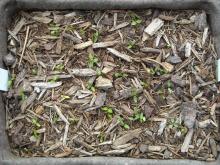
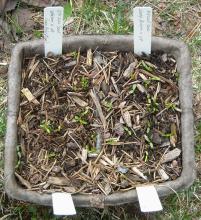
Right: E. setosum OP on left half, E. sempervirens 'Aurora' OP seedlings on the right half.
While the seedling density may appear moderate, the shredded bark mulch cover is literally lifting up, there are hundreds more seedlings on their way up :D
WimB (not verified)
Re: Epimedium 2011
Sun, 04/17/2011 - 12:26pmThat's fun to see, I'm glad you got such a good germination for your seeds....It's nice to see the start of Mark's Epi's nursery... ;) ;)
I got some Jeffersonia dubia seeds of a very good dark form last year and they have all germinated too. I didn't expect them to be that easy to germinate.
gerrit (not verified)
Re: Epimedium 2011
Wed, 04/20/2011 - 10:28amBlooming here, while we have a summer in April with temps up to 25 deg C. Another 4 days to go with such abnormal weather.
Epimedium grandiflorum 'Queen Esta'. A beautiful species with very dark emerging leaflets and purple flowers.
cohan (not verified)
Re: Epimedium 2011
Wed, 04/20/2011 - 3:10pmLots of pretties! Some really great leaves and flowers..
Mark McDonough
Re: Epimedium 2011
Wed, 04/20/2011 - 6:53pmHiya Gerrit, a nice one, showing E. grandiflorum 'Queen Esta'. I have it planted very close to E. grandiflorum 'Dark Beauty', and it is very clear when comparing these two that they must be closely related, perhaps from the same cross. 'Dark Beauty' has more intense foliage coloration, but 'Queen Esta' is certainly desirable not only for the dark purplish leaf color in spring, but for the small leaflet size making for a handsome clump. Another one, E. grandiflorum 'Pierre's Purple' must surely be yet another kindred cultivar, again with dark purplish tinged spring foliage and small leaflets and purplish flowers. Here at least, these cultivars are relatively inexpensive and shouldn't be passed over for the more in-vogue cultivars, they're a relative bargain.
Mark McDonough
Re: Epimedium 2011
Wed, 04/20/2011 - 7:21pmCatching up!
@Gerrit, I really like 'Night Mistress', such large and dramatic color flowers. This is a Garden Vision Epimediums 2004 introduction from a wild-collected form (not a hybrid) by Darrell Probst... I missed my chance at buying it; hasn't appeared in the catalog for years. Darrell says it was collected at "high elevation locale near Nanchuan, China.
I see that 'Togan' and 'Freya' that Wim showed, are popular in Europe, but not available here that I'm aware of. :'(
Regarding E. davidii, I think two things are going on... Gerrit's photo show flowers at early stage, thus the spurs are not fully produced, and there are forms with rather short spurs. I really like the "boxy" look to the flower, with well developed boxy cup, distinct from most any other epi.
The photo of E. grandiflorum 'White Queen' shows that we must not dismiss the older cultivars; this one is exceptional and very inexpensive as Epimedium go ($6), with lovely bronzed new growth and really dense sprays of white purple-tinged flowers.
@Wim - nice shot of E. x 'Amanogawa', one of my very favorites, apparently a hybrid of E. acuminatum x dolichostemon. You captured the brownish yellow cup well, a most unique and desirable cultivar. You mention one called 'Spine Tingler' (one of Darrell Probst's introductions), yet the photo is listed as 'Sphinx Twinkler'. Is there really something called 'Sphinx Twinkler', or is the plant shown really 'Spine Tingler'? The tiny-flowered white and yellow one that is listed as not-sasakii; it looks like one of the E. sagittatum types, of which there are many species that have these tiny white and yellow flowers. Not sure what it is, but to be honest, I'm not overly fond of the E. sagittatum types... the flowers are just too small and insignificant, although the foliage can be nice.
gerrit (not verified)
Re: Epimedium 2011
Thu, 04/21/2011 - 10:56amThank you Mark for your interesting expose about E. gr. 'Queen Esta'. The relation between 'Queen Esta' and 'Dark Beauty' is intriguing. Both are found in the garden of Herald Epstein, I presume. Can you tell us more about it? About parents? And...the more expensive ounces are not always the best. I think: The best the genus Epimedium can offers us, so far on, are 'Dark Beauty' and 'Queen Esta'. ('Dark Beauty and 'Pierre's Purple' are not available here in the low country's)
WimB (not verified)
Re: Epimedium 2011
Thu, 04/21/2011 - 12:49pmMark,
there seems to have been a mix up with the name of 'Spine Tingler' here in Europe, a lot of breeders here sell E. 'Spine Tingler' as 'Sphinx Twinkler' :-X but it's the same cultivar!
Like you said, the small flowered Epi has no flowers to write home about, but the leaves are nice.
I ordered 'Dark Beauty' last year from Probst, I hope to be able to show pictures next year. It is a cross between E. grandiflorum ‘Silver Queen’ and E. grandiflorum ‘Yubae’ found in the garden of H. Epstein. Maybe Mark can tell us more about the parentage of 'Queen Esta'.
And because I like this plant so much, here are some pics (again :P) of E. 'Pink Champagne'
Jonathan Willis
Re: Epimedium 2011
Thu, 04/21/2011 - 4:54pmMark, just a heads-up that you haven't entirely missed your chance; the newly resurgent Collector's Nursery is offering 'Night Mistress' via mail-order:
http://www.collectorsnursery.com/cat03/index.php?main_page=product_info&...
I ordered one earlier this spring and now have a lovely 'Night Mistress' in hand. (I also splurged on a E. wushanense 'Spiny Leaf Form' after seeing your spectacular pictures!)
gerrit (not verified)
Re: Epimedium 2011
Sun, 04/24/2011 - 6:16amA view on Epimedium x omeiense 'Akane' in my garden. Picture 1 and 2.
On picture 3 the same plant, but together with E. 'Amanogawa'. Two stunners in one view.
Number 4 "Amanogawa' in close-up.
gerrit (not verified)
Re: Epimedium 2011
Sat, 04/30/2011 - 7:42amFrom my garden, Epimedium 'Mikinorii'. Named after the famous Japanese planthunter Mikinori Ogisu.
It's a young plant, 2 years old and I'm not particular enthusiast about it. The flowers are hided behind large leaves. The two toned flowers are okay.
Mark, I like to hear your opinion about this plant. You never discussed it on a one of the fora you participate, as far as I know. And I like to know wheather it is a spreader or a clumper.
Mark McDonough
Re: Epimedium 2011
Sat, 04/30/2011 - 9:07amWim, that mixup between the correct name 'Spine Tingler' somehow becoming 'Sphinx Twinkler' :rolleyes:, reminds me of the game where a group of people form a circle, one person wispers a phrase in their neighbor's ear, who turns around and wispers what they heard in their neighbor's ear, and by the time it goes around the circle it comes out as something completely different. Seems like someone tried interpreting some bad handwriting on a label; the genesis of name confusion... 40 years from now Epimedium aficionados will struggle to learn the true origins of such plants, if this name mistake continues to spread.
Wim and Gerrit: The Garden Vision Epimediums catalog says about E. grandiflorum 'Queen Esta': "a beautiful cultivar named by Harold Epstein after his wife, Esta. It was the first named seedling introduced from his garden". The parentage of 'Dark Beauty' is stated as an apparent cross between 'Yubae' and 'Silver Queen' (yet another spontaneous hybrid seedling in Harold Epstein's garden),although this doesn't seem entirely clear to me, there are other possibilities of species and cultivars that seem more likely to pass along dark foliage color.
Much more likely as one of the parents would be E. grandiflorum var. violaceum, which when first emerging has dramatically dark foliage which can take on various hues depending on exposure and as days go by. Other cultivars like E. grandiflorum 'Tama Mo Genpei' and E. g. var. violaceum 'Bronze Maiden' also have striking dark foliage. Then there are various youngianum and even some sempervirens that are very dark leaved, which when they cross with grandiflorum, do not always seem obvious as a cross... many so-called grandiflorum and even some youngianum are actually mixed heritage. Here are some photos of dark-foliaged types to give an idea of their similarity.
Early leaf emergence:
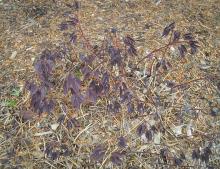
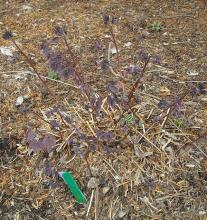
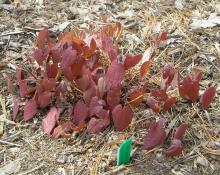
left: E. grandiflorum 'Dark Beauty', center: E. grandiflorum 'Queen Esta', right: E. grandiflorum var. violaceum
More developed leaves:
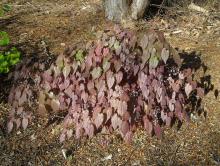
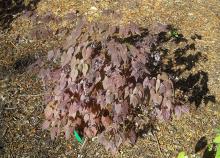
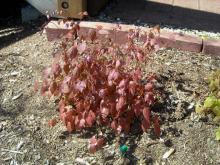
left: E. grandiflorum 'Dark Beauty', center: E. grandiflorum 'Queen Esta', right: E. grandiforum var. violaceum
As can be seen in the side-by-side comparison of 'Dark Beauty' and 'Queen Esta', they are very similar. As I stated before, I think 'Dark Beauty' is the better of the two. 'Queen Esta' is a bit more upright growing (less spreading) and has smaller more pointed leaflets, and foliage color that is more somber toned and lacking the rich coffee tones taken on by 'dark Beauty'.
E. grandiforum 'Tama No Genpei':
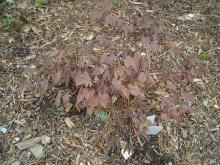
Left and right: E. grandiflorum var. violaceum 'Bronze Maiden':
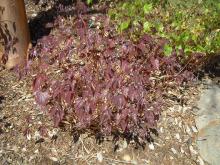
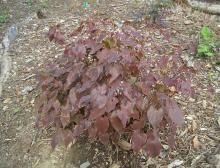
Hybrid seedling of E. sempervirens 'Aurora', with very dark leaves:
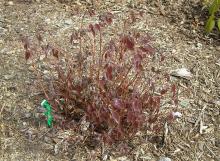
PS: Loved the pics of E. 'Pink Champagne', one can never has too much champagne ;) Mine is budded and should be photogenic by next weekend.
Mark McDonough
Re: Epimedium 2011
Sat, 04/30/2011 - 9:17amThanks Macjon, I wasn't aware that Collector's Nursery started back up again, even if just in a small way, I used to order from them. So far as ordering plants, I think I'll still have to "cool my heels" and hold back on much spending, as with my new job I took a 34% cut in pay, gas prices are crazy with my long daily commute, and next year is a "double-up college year" where I will have both of my girls in college next year, so will have extra financial concerns. But I think I do need this 'Night Mistress' ;)
Mark McDonough
Re: Epimedium 2011
Sat, 04/30/2011 - 9:30amGerrit, Epimedium x omeiense 'Akane' is yet another one on my "wish list", love the color on that one, and the flowers display pretty well too. Last year I moved and divided my largish plant of E. 'Amanogawa' into three pieces. One is ready to flower, another is just beginning to emerge, the third shows no signs of emergence yet!?! Maybe I divided it too late in the season, and with last year's summer long drought, perhaps I have lost one of the divisions. I'll be patient, it still may emerge late.
E. mikinorii is another that I don't have, can't recall ever seeing it listed here in the US. I know what you mean, some of the asiatic species have this tendency to hide their down-facing blooms under the leaves. I feel somewhat the same about E. epsteinii, but I think I'm just going to try to figure out a spot where I can plant it up high on an embankment, so that I can better see the flowers. Here are some shots. From above, the flowers are mostly visible, looking like pure white flowers with those extra wide sepals. From a low angle one can appreciate the beautiful dark earthy brown-pink centers. It took a long time to get established, but is now starting to run a little bit.
From above:
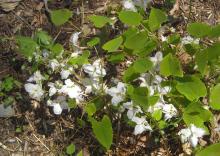
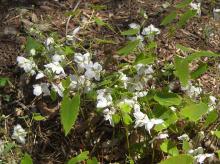
From a low side angle (notice the Jeffersonia dubia seedlings in the right-hand photo):
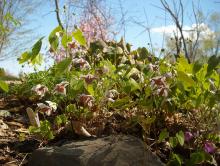
Mark McDonough
Re: Epimedium 2011
Sat, 04/30/2011 - 9:34amMacjon, I meant to say, just noticing that your message was your first message on the forum... a hearty WELCOME to the NARGS Forum. I see that you are close by, living in eastern Massachusetts. Ever get to visit Garden Vision Nurseries out near the center of the State, during one of their open-nursery days? Tell us about your experience with Epimediums.
Mark McDonough
Re: Epimedium 2011
Sat, 04/30/2011 - 8:20pmNow the fun begins, watching a new season unfold, and my selected 4 year old hybrids... to watch how they perform. And already, some one and two year hybrid seedlings are starting to bloom. In the past, I showed several hybrid seedlings from E. x youngianum 'Liliputian', one of which is the smallest Epimedium with pure white flowers. I have narrowed down the seedling plants to about 8-10 that show some interesting variation.
E. x youngianum 'Liliputian' itself is only just emerging, at least a week or two behind the hybrids. The hybrid plants are mostly earlier blooming. The best and most dwarf one, is budded up, but needs another week before I can show it. Here are three hybrids of interest that are flowering now, and already, one is showing to be much better than the others.
View of three E. x youngianum 'Liliputian' seedlings, notice the different growth forms: wide loose and spreading on the left, semi-compact, larger flowered and coffee-color-leaves in the center, and dwarf and floriferous on the right.
Same progression, left: wide, loose and spreading, center: larger flowered & coffee leaves, right: dwarf and ultra floriferous
Two more views of the dwarf ultra floriferous one.
Trond Hoy
Re: Epimedium 2011
Sun, 05/01/2011 - 12:13amMark, when do you start a nursery and mailorder service? ;D
Very exciting differences in the offspring and although one is as you we see more showy, the other two are also nice. The spreading one for example could do good in a woodland setting.
gerrit (not verified)
Re: Epimedium 2011
Sun, 05/01/2011 - 2:17amMark, enjoy the new season. Here in the low countries the epimediumseason is almost over. Due to the extreme weatherconditions. We've had a recordhigh temperature in April. 3 deg C. higher than normal. And almost no rainfall.
Mark McDonough
Re: Epimedium 2011
Mon, 05/02/2011 - 6:13pmMaybe some day Trond, when I reach retirement age, to perhaps run a small plant operation for "mad money".
Mark McDonough
Re: Epimedium 2011
Mon, 05/02/2011 - 6:18pmSorry to hear about the dry hot spell, sounds like our dreadful summer last year. So far this year, we've had a slow starting spring, and now with moderate cool to warm days and regular rain, it's been a very fine spring, and the eppies are happy. gerrit, do you grow any of the late blooming sorts, E. membranaceum is nearly everblooming, E. rhizomatosum can go well into summer (sporadically flowering), and E. elongatum is very late to bloom too.
Mark McDonough
Re: Epimedium 2011
Mon, 05/02/2011 - 6:56pmThe flush of growth and bloom on Epimediums has been outstanding, too many things to photograph (now, on weekends only since I'm back to working). Mt biggest regret is that I had a whole hybridization program scoped out for 2011 if I had remained unemployed, which is shelved until a different year in teh future, maybe when I retire. However, on the weekend I make opportunistic crosses. ;)
One of the earliest and showiest "eppies" is E. sempervirens 'Violet Queen', with sheer flower power and striking hot pink-red foliage that peaks after the flowers. I'm interested in hybridizing with this one, so I was able to manually pollinate 1/2 of this clump with pollen from yellow E. pinnatum colchicum... both are shown below.
Photos 1-3 E. sempervirens 'Violet Queen', photo 4 is a flat of OP (open pollinated) seedlings just germinating now, from seed sown spring 2010.
Left: evergreen foliage on E. pinnatum colchicum was battered from the winter ice layer this year, so I cut off all the foliage in spring for better visivility of the bright yellow flowers. Lots of pollen on the flowers, so I'm spreading pollen on several other species to see if the yellow color and evergreen habit can be imparted to hybrid offspring.
Center: Hot spring foliar color on E. x setosum. I plan on continuing to use this one, with tiny but perky little white flowers, for hybridization.
Right: E. grandiflorum 'Tama No Genpei', one of the better grandiflorums with nice coffee color spring foliage and rich pink & white flowers.
A rare one, E. qingchengshanense, a recently described species. Flowers somewhat like E. fargesii; delicate reflexed white sepals and purple spurs. It too is receiving borrowed pollen ;D and here again, I have hybrid seedlings germinating (form manual crosses).
Mark McDonough
Re: Epimedium 2011
Mon, 05/02/2011 - 8:45pmThis past winter, I bought a new tool that I envisioned would help with dividing Epimediums. Anyone who has tried dividing an Epimedium knows they build up into nearly impenetrable dense rhizomatous root balls making them extremely difficult to divide. The tool was from Sears (Sears Craftsman brand), although this weekend I found similar such tools at a hardware store made by Stanley, another well known name in tools. The tool is like a narrow super-heavy-duty trowel, but with a serrated cutting edge on one side. It if very thick, solid, and heavy... the weight making it balanced and most effective and easy to use.
In the 1st photo, I had dug up a mature 10-year old clump of E. x youngianum 'Murasaki-Juji', and used this new tool to easily saw through the rhizomes to make three intact divisions. I'm sure this tool will be very effective on dividing other tough perennials as well, a good buy at $15 US.
WimB (not verified)
Re: Epimedium 2011
Tue, 05/03/2011 - 5:48amMark,
really nice pics of great plants!
And that looks like a really handy tool, I should be able to find that here in Europe too.
here are some of the last in my garden:
E. dolichostemon
E. grandiflorum 'Yellow Princess'
E. x youngianum 'Tama Botan'
Pages