
I got bored and started planting a couple of weeks ago, and in short order, now have some seedlings to watch!
Aloinopsis spathulata - giving this another try; abundant germination in 1 week, warm
Astragalus coccineus - Alplains 2009 order; after scarifying, abundant germ in 1 week, warm
Astragalus missouriensis - Alplains 2009 order; after scarifying, germ in 1 week, warm
Astragalus purshii v. lectulus - from Alplains 2009 order; after scarifying, several germ in 1 week, warm
Globularia stygia - Pavelka 2010 order ; 1 germ after 6 days, warm
Oxytropis besseyi v. ventosa -Alplains 2009 order; after scarifying, several germ in 1 week, warm
Oxytropis lagopus -Alplains 2009 order; after scarifying, several germ in 1 week, warm
Oxytropis podocarpa - Alplains 2009 order; after scarifying, several germ in 1 week, warm
Penstemon venustus - NARGS #2400 2010 seedex - germ in cold room after 2 weeks
Saussurea stella - Pavelka 2010 order; a couple germ after 1 week, warm
Trifolium nanum -Alplains 2009 order; after scarifying, several germ in 1 week, warm
Trifolium owyheensis -Alplains 2009 order; after scarifying, several germ in 1 week, warm
Anyone else?
Comments
Mark McDonough
Re: Seed-starting chronicles 2011
Mon, 04/18/2011 - 12:14pmJust checked, my Ribes magellanicum overwintered and enters its 2nd year of life. It is about 9-10 cm tall.
Stephen, your overhead view of seed pots loots like a crazy quilt ;D
Trond Hoy
Re: Seed-starting chronicles 2011
Tue, 04/19/2011 - 5:14amI'll keep it in mind, Stephen, but my mind isn't what I would like it to be so you better do remind me later ;D
Lori S. (not verified)
Re: Seed-starting chronicles 2011
Tue, 04/19/2011 - 6:41pmLuetkea pectinata - surprisingly easy from seed.

http://www.wildgingerfarm.com/Luetkeapectinata-PartridgeFoot.htm
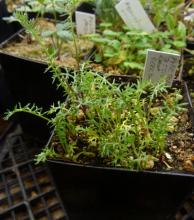
Scrophularia crithmifolia (Why, yeth, I do thspeak with a lisp.) I'm not sure why I'm growing this - it looks stunningly underwhelming...

http://www.euskal-herria.org/node/21594
Pyrethrum tatsiense
Toole (not verified)
Re: Seed-starting chronicles 2011
Wed, 04/20/2011 - 1:27amI keep on coming back to this thread to see what some of you are germinating :P --then searching the web or looking up the links to plants i am unfamiliar with.Wonderful........So much promise.
Here's my contribution ---A couple of pics of some of the results of the last 2/3 months, repotted last weekend into 1 litre pots.
Some of the North American contents are--
Viola pedata.
Lesquerella artica.
Asarum caudatum and A. hartwegii.
Others---
Various Cyclamen including C. graecum --C mirable x tilebarn--C.cilicium alba.
A number of Crocus --C mathewii --C longiflorus --C. niveus--C. goulimyi.
Tigridia chiapensis
Hepaticas
and others.
Oops nearly forgot --also an onion for Mark :) Allium wallichii.
Cheers Dave
Stephen Barstow
Re: Seed-starting chronicles 2011
Wed, 04/20/2011 - 3:17amWhat was it I was supposed to remind you?
Trond Hoy
Re: Seed-starting chronicles 2011
Wed, 04/20/2011 - 1:42pmDid I say anything? Can't remember I did :o
Richard T. Rodich
Re: Seed-starting chronicles 2011
Wed, 04/20/2011 - 7:50pmWith a three inch snowfall ten days ago that melted in three days, and yesterday's two inches that has melted today, I have a bunch of 40F germinators that have come up. Sow dates accompany, and it's clear that keeping pots for more than just one season pays off.
Fritillaria biflora - 2 Oct 2009
Fritillaria bucharica - 5 Oct 2010
Fritillaria carica - 2 Oct 2009, several. one seed germinated in 2010
Fritillaria collina - 5 Oct 2010
Fritillaria crassifolia ssp. kurdica - 2 Oct 2009, several. two germinated in 2010
Fritillaria pallidiflora - 5 Oct 2010
Fritillaria pyrenaica - 2 Oct 2009
Fritillaria sewerzowii - 5 Oct 2010
Fritillaria whittalii - 2 Oct 2009
Lewisia cotyledon - 2 Oct 2009
Penstemon whippleanus - 25 March 2010
Tulipa urmiensis - 1 March 2010
I have been candling my Fritillaria seed, as I do with Lilium seed. While the fritillaria embryos that I see are unmistakable, it is clear from my trials that these were not the only fertile seed: I still plant what may be chaff, and many have sprouted in batches where I had seen only one or two embryos. So candling for fertile fritillaria seed is not effective.
But then, if I had just asked, someone probably could have told me that...
Mark McDonough
Re: Seed-starting chronicles 2011
Wed, 04/20/2011 - 7:57pmRick, that's a lot of Frits! You'll have to show us again in 4-5 years when they bloom ;D
Dave, thanks for thinking of me and my alliums. Just so happens, that I'm getting excellent germination from a whole bunch of Alliums collected in Kazakhstan; here are a few of them. The species names and collection info is written on the seed pots.
Trond Hoy
Re: Seed-starting chronicles 2011
Wed, 04/20/2011 - 11:44pmJust numbers not names! Maybe some new species?
Mark McDonough
Re: Seed-starting chronicles 2011
Thu, 04/21/2011 - 3:42amSome are named; in the view above, there is A. caeruleum and A. drobovii, received about 5 different collections of the latter species, which is a species not generally in cultivation... in the following link, click on the paper icon on the far lest of the listing, then click on the thumbnail images... mot a great beauty, but may be interesting nonetheless.
http://pgrc-35.ipk-gatersleben.de/pls/htmldb_pgrc/f?p=265:3:3216571044925997::NO::P3_SCIENTIFIC_NAME:395
Gene Mirro (not verified)
Re: Seed-starting chronicles 2011
Sat, 04/23/2011 - 1:29pmSpeaking of patience: I sowed some Actaea pachypoda on 3/08. They are coming up now (4/11). They've been at outdoor temperature (near Portland, OR) all this time, in a slightly moist mix in a shaded place.
Tim Ingram (not verified)
Re: Seed-starting chronicles 2011
Sat, 05/21/2011 - 2:13amI've only just looked through this fascinating thread. Over the years running a small specialist nursery I tried to divide plants into manageable groups that needed different sowing regimes. Generally for a lot of alpines, and quite a few woodland plants our winters are not long and cold enough with snow cover to get really good germination. On those occasions when it is colder and we have prolonged snow we often found much better results. As soon as I see signs of seedlings I bring plants into a frost free greenhouse which warms up quite a bit in the late winter/spring sunshine!
The benefit of our winters though is that we get fluctuating temperatures and this is probably useful for many of the colder Mediterranean and semi-desert species I have tried, where temperatures do not stay so low right through the winter. Lori mentioned Lomatium columbianum earlier on and I have always sown this and other species as early as I have had seed and left outside all winter. Germination is often poor, but at least some come up. Umbellifers in general do much better from reasonably fresh seed sown in the autumn - older seed is usually dead, although I have had Eryngiums germinate well the second season. Once or twice I have gone to the lengths of putting seed (in damp sand) into a fridge for about 4 to 6 weeks. Several species stsrted to germinate in the fridge, including Lomatiums and Eriogonums, but unless you catch them just as they germinate or before they quickly etiolate and are less than easy to deal with. If you grow a lot of different things this quickly becomes very complicated, but it could be really useful for something special that has not germinated well by normal means.
It is great to hear how others get on with sowing seed (I have Deno's books but they become a bit mind-boggling after a time and I have always found it much more effective to use the time tested ways of sowing in pots). Hope I can add to the thread in the coming spring.
Mark McDonough
Re: Seed-starting chronicles 2011
Sun, 05/29/2011 - 5:33amI typically rely on the tried and true seed germination method of allowing Mother Nature to make germination happen, leaving the pots or flats outside for the winter and see what happens in spring. I like using wide peat flats, as I believe the moisture level stays more even than smaller plastic pots.
Here is some germination from varieties that Jane Hendricks generously sent me (thanks Jane!), Senecio pudicus on the left, and Thlaspi stylosum on the right, but only two seedlings of Allium brevistylum... maybe more will germinate later.
The flat of Aquilegia saximontana (true) from Jane, I was most anxious to see some germination. The other varieties shown above, germinated early spring, but no sign of life in the flat of A. saximontana... I figured that the seed must have failed. Then one day I noticed some germination, a few tiny seedlings. Now it is thick with seedlings, must have gotten 100% germination. I shouldn't watch seed pots every day, it's like waiting for water to boil or watching grass grow. ;D
Trond Hoy
Re: Seed-starting chronicles 2011
Sun, 05/29/2011 - 9:08amI have planted out my seedlings of Thlaspi stylosum today! I don't need to water, it is more likely they drown :-\
Tim Ingram (not verified)
Re: Seed-starting chronicles 2011
Mon, 05/30/2011 - 1:58pmMark - I know what you mean about watching seed pots; its one of those exciting spectator sports that no-one else can understand! Your epimedium beds look spectacular too - here the combination of rabbits and drought haven't done them much good but wushanense does grow well. I think they are even more popular in the States than in the UK. My special love has always been Jeffersonia dubia, and a pot of seedlings of this brings joy to the nurseryman!
Richard T. Rodich
Re: Seed-starting chronicles 2011
Sun, 06/12/2011 - 9:34pmI've never said I am a good grower, but I do have some successes. This is hopefully a good overall reference for some of the seedlings that have emerged this season for me. The gibberish after the plant name is formatted: xxxx-yy-zz
xxxx=source. If all digits, it's a NARGS seed ex number.
yy=year seed was collected.
zz=year planted.
A good portion of these are seeds that germinated in the second and even the third season after planting.
First Column – front to back
Ferula communis col. Spain 4257-08-10
Fontanesia fortunei SB-09-10
Vitaliana primuliflora col. France 4471-09-10
Penstemon whippleanus Ran-09-10 Lt,with 2 that germinated last year
Penstemon canescens 08-10
Second Column
Onosma euboica 2171-08-10 with a Silene (uniflora?) that germinated last year
Penstemon rupicola 2388-08-10
Pulsatilla alpina ssp. apifolia 2590-08-10
Penstemon glabrescens 2340-09-10
Sisyrinchium patagonicum 09XX440-09-10
Penstemon heterophylla Moy-09-10
Dianthus pavonius Ran-09-10
Third Column
Penstemon purpussii 2383-08-10
Phyteuma humile 2447-09-10
Iris pumila Vos-08-09
Aquilegia sp. Me-09-11
Iris sikkimensis 1782-09-11
Penstemon gomanii 2341-09-11
Fourth Column
Iris pumila Vos-08-09
Iris vicaria 1764-07-09
Thalictrum dasycarpum col. MI 1440-09-11
Aquilegia ecalcarata Me-09-11
Fifth Column
Sisyrinchium macrocarpum 2942-09-11
Pulsatilla kostyczewii 2625-09-10
Aquilegia vulgaris col. Slovenia 4072-08-10
Dianthus erinaceus Ver-09-10
?Aralia cachemirica 366-09-11w
Penstemon euglaucus 2334-09-11
Penstemon heterophylla 2345-09-11
Sixth Column
Acanthus hungarica Ver-08-09
Viola pedata 3199-09-11
Desmanthus illinoensis 07-09
Tulipa urumiensis Vos-08-10
Delphinium caucasicum Vos–10-11
Impatiens namchabarwensis Me-10-11
Ptilostemon afer 2429-10-11
Seventh Column
Corydalis ochroleuca Me-08-09
Anemone parviflora col. Alaska 4440-09-10
Anemon rivularis Sud-08,Vos-07-10
Pulsatilla alpina col Alps 4378-09-10
Delphinium triste Vos-10-11
Wulfenia baldaccii 2990-10-11
Aquilegia saximontana 315-10-11
Eight Column
Pulsatilla georgica 2616-09-10
Pulsatilla alpina col. Alps 4376-09-10
Pulsatilla violacea col. Georgia 4559-05/07-10
Pulsatilla alpina col. Alps 4375-09-10
Pulsatilla turczaninovii Me-10-11
Taraxacum pseudoroseum Boen-11-11
Alyssum pulvinare 167-10-11
Ninth Column
Allium togashi 149-10-11
Penstemon rupicola 2388-08-09
Stipa borysthenica 3006-08-11
Silene suksdorfii 2923-09-11
Tenth Column
Phemeranthus sediformis 2415-09-11
Silene uniflora ‘Rosea’ 2926-09-11
Aquilegia caerulea Me-08-11
Silene nigrescens col. Tibet 4521-10-11
Stipa borysthenica 3006-08-10
Lewisia cotyledon 1877-08-09
Styrax americanus ex Kankakee, IL Me-10-10
Mark McDonough
Re: Seed-starting chronicles 2011
Fri, 06/17/2011 - 7:58pmCool seed growing presentation Rick! This is a good example to illustrate one benefit of the way NARGS thumbnail image enlargements work, where it pops up a separate window. Click on the enlargement a second time and it displays at the full large image size (for jumbo-sized images, such as in this case)... now you can move the enlarged-image-window around partially off-screen to simultaneously read the columns of seedling identifications while finding the seedlings in the photo-diagram... what fun to look at all those germinated seedlings. Rick, you have a lot of transplanting to do!
Trond Hoy
Re: Seed-starting chronicles 2011
Mon, 06/20/2011 - 1:50pmYou have good taste Rick, almost the same species as I have sowed ;D But you have control, I have not :( Have been very busy the last weeks and seedlings are growing out of their pots.Too little time to plant them in separate pots.
Richard T. Rodich
Re: Seed-starting chronicles 2011
Mon, 07/25/2011 - 1:48pmSown on 14 July 2010, these are just over a year old:
Echinocereus viridiflorus and Echinocereus triglochidiatus
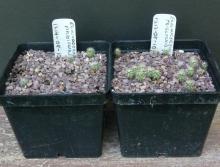
Echinocereus reichenbachii: ssp. perbellus, ssp. rigidissima, ssp. baileyi
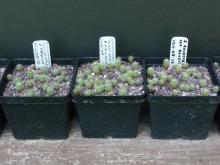
They all look about the same at this point...
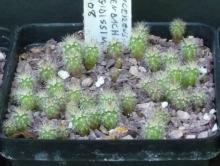
One month from sowing last year, this is what they looked like;
http://nargs.org/smf/index.php?topic=501.msg5305#msg5305
Fermi de Sousa
Re: Seed-starting chronicles 2011
Thu, 08/11/2011 - 4:08pmRick,

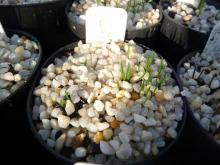
it just shows what patience we need in raising such things from seed.
Here is a slight experiment I tried with some seed form a SRGC Forum friend in NZ: Muscari pulchellum and Scilla italica. I sowed half of each pot with seed at about 1cm deep and the other half just under the gravel topping.
It appears that the seed have germinated at about the same time but the buried seed have left the seed caps under the soil!
cheers
fermi
Mark McDonough
Re: Seed-starting chronicles 2011
Sat, 08/13/2011 - 7:26amFermi, good side-by-side experiment. With Alliums, I struggle to find the right seed sowing depth, because some of the large-headed Melanocrommyum types when planted too shallow, invariably come up with the seed caps still on top, with the seedlings sometimes topping over and exposing the barely developed radical, so I agree it is better to sow some seed types a little more deeply to force the seed caps to shed upon emergence. In the long run, both methods work well enough, but one must also consider the possibility of burying seed too deeply with insufficient light to stimulate germination.
Mark McDonough
Re: Seed-starting chronicles 2011
Sat, 08/13/2011 - 7:49amWell, as I'm back to work with an even crazier schedule with extra long commutes and regional traveling, the idea of sowing seed "in situ" returns to the forefront as a most viable technique for those of us who have no time to coddle seedlings in pots. Some things I started in pots from last year's sowing, have already "fried" in the heat and even just a few hours of drought, as they suffer unattended. Not the case with seedlings sown directly in the ground.
In this view, here are 2-year seedlings of Helleborus niger that were direct sown, and 1-year seedlings of an Arisaema species. The intent is to use the direct sowing method to bring seedlings along for a year or two, then transplant established small plants... but counter to best intentions, sometimes these seedling scenarios mature into more permanent overcrowded mixes.
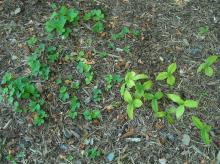
As sown as Arisaema seed is ripe in the late fall, I sow directly in the garden. The jagged edge seedlings of A. sikokianum are easy to recognize and don't need labeling. When I sow the seed, I spread the seed out a little bit.
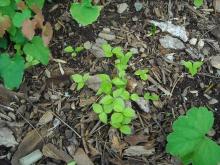
Now, I'm forever at war with chipmunks, and rarely do they do anything considered beneficial in the garden. One hallmark of their annoying activities, is packing their cheeks full of seed of any particular seed variety (often this or that species of tree, or some dastardly weed), then burying their seed caches into tight "plugs". In spring there appear small circular "bursts" of seedlings... always a single species, sometimes including bursts of hundreds of seedlings of Dicentra spectabilis (from my neighbors yard across the street). Fortunately, these are easy to weed out. But lo and behold, this year I found a tight circle of seedlings of Arisaema sikokianum, certainly from chipmunk sowing, the seed not spread out as I would have done.
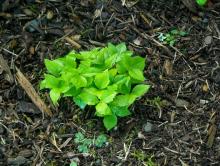
Arisaema heterophyllum, from direct sowing, already showing additional leaflets. The form I grow can reach 6' (2 m) tall.
Richard T. Rodich
Re: Seed-starting chronicles 2011
Sat, 08/13/2011 - 12:19pmAnd it seems, in this case, that the deep planted ones are doing better...
So when does the jaggedness disappear? the mature A. sikokianum I have seen have entire leaflets.
Fermi de Sousa
Re: Seed-starting chronicles 2011
Tue, 08/16/2011 - 1:07amRick,
I have to agree that the "deep" sown ones have sprouted a bit more generously than the shallow sown ones. I'll have to wait a bit longer to evaluate what success rate I get with each.
Mark,
I'm thinking that I'll have to try a few in ground sowings but mainly of things that don't transplant well for me - like astragalus! A problem we have here is predation by earth mites which keep down the number of self sown seedlings of autumn/winter/early spring germinators! germianting them in pots off the ground is one way to stop the mites apparently!
cheers
fermi
Mark McDonough
Re: Seed-starting chronicles 2011
Sat, 09/24/2011 - 5:19pmJust rediscovered your question Rick... not exactly sure when they loose the leaf jagginess, certainly mature plants have entire leaves without such fine jaggies. Interestingly, I grow a dwarf form of Arisaema amurense called 'Jagged Leaf' that Darrell Probst collected (I believe, from Korea)... I'll have to post photos some time.
Mark McDonough
Re: Seed-starting chronicles 2011
Sat, 09/24/2011 - 5:41pmLori, I am pleased to report that seed from you, of Allium ovalifolium var. ovalifolium, sown over 1 year ago, has germinated after our long periods of rain. Not a great photo, but you get the idea, there are 8-9 short bent-knee seedlings popping up! I have tried and tried many times with this species, and with my own Allium listera, and the darned things never germinate. maybe they need extra moist conditions, such as the weather we've had this year.
From a SRGC Forum member in Moscow I had received seed of Allium pseudoflavum (looks like the true species). I sowed the seed in a flat in late summer and they germinated in November, so I overwintered them on a warm windowsill. In early spring they had gone dormant. Leaving out the flat exposed to the weather all summer, even with lots of rain, I'm glad to see how they resprouted strongly over the past several weeks (the Codonoprasum Alliums tend to resprout with winter-hardy foliage in late summer to early fall).
http://www.srgc.org.uk/forum/index.php?action=dlattach;topic=2017.0;atta...
http://www.srgc.org.uk/forum/index.php?action=dlattach;topic=5766.0;atta...
A terrible photo, but just to show that the rare yellow-flowered Allium eriocoleum from Iran and Kazakhstan (mine collected in Kazakhstan), has resprouted in the last week or so. I'm happy about this, not being familiar with growing the species I worried that they died when they disappeared in the summer.
http://nargs.org/smf/index.php?action=dlattach;topic=177.0;attach=9745;i...
Last is the extra fine form of Allium caeruleum from DBG (Denver Bot garden). After the main plant flowers and dries up by midsummer, lots of small basal bulblets appear at the base of the stem; these can be harvested and planted... now with autum rains, they have resprouted. Behind the grass-like sprouts is a much larger mature plant with bigger foliage, along with many of the basal sprout leaves as well.
http://nargs.org/smf/index.php?topic=177.msg1254#msg1254
Mark McDonough
Re: Seed-starting chronicles 2011
Sun, 11/13/2011 - 11:42amCleaning up around my semi-smashed Magnolia trees (breakage from a surprise early-season 14" snowstorm when trees were in full leafage), I was pleased to find hundreds upon hundreds of Cyclamen purpurescens seedlings. Left to their own devices, I do get some seedlings, but I'm guessing it is chipmunks and squirrels that take most of the bounty, but if I sit on the ground in the shade of a magnolia tree when Cyclamen seed pods are ready to shatter, and spend an hour or so to gather and immediately scratch the seed in to expand the colony, it WORKS!
externmed (not verified)
Re: Seed-starting chronicles 2011
Fri, 04/13/2012 - 2:41pmBelatedly going to start some dryland seeds. Remembered coral sand sold in pet shops and may incorporate some of that.
Do folks sterilize their soil? Iv'e heard everything from pouring on boiling water to baking in the oven. Guessing wouldn't want to bake at too high a temp (150F? or 225F?) any experience?
Charles Swanson MA USA
Richard T. Rodich
Re: Seed-starting chronicles 2011
Fri, 04/13/2012 - 4:21pmI may start with a pasteurized potting mix, but stuff I add to it, like sand, grit, compost, etc. is not. Nor are my pots bleached or even cleaned well. I really don't understand all the fuss when you are not dealing with micropropagation techniques, or finicky seeds. I stick to the "all organisms work in unison, good and bad" principle.
Not that this is the only right way to do it, but it's the way I do it.
Lori S. (not verified)
Re: Seed-starting chronicles 2011
Fri, 04/13/2012 - 5:45pmMy process is much like Rick's... the base is potting soil but it's very heavily amended with sand, grit, and perlite. As I plant things out, I dump excess soil from the pots into a bin and then I reuse it the next winter. I never, ever wash pots. Seems to work OK - damping off is not a problem.
It sounds like coral sand would be pretty expensive if you need more than a little (given how such things are priced in the aquarium/pet trade). I take it you are looking to create a calcareous soil? If so, would it be possible to get that limestone grit that's intended to be fed to chickens (to provide CaCO3 for their egg laying)?
externmed (not verified)
Re: Seed-starting chronicles 2011
Sat, 04/14/2012 - 4:13pmThank you, Lori, Rick for the information and suggestions. Will go out shopping for poultry grit tomorrow. (I hate it when I buy an "alpine" plant and find it potted in commercial mix, and it so difficult to try to remove from the roots)
Charles Swanson MA USA
Pages