Forums:
I just need to check the picture possibilities here.
11 years from seeds and then the first flowers came. Also the first Yucca to grow in spring. 
Martin

I just need to check the picture possibilities here.
11 years from seeds and then the first flowers came. Also the first Yucca to grow in spring.
Martin
Comments
Richard T. Rodich
Re: Yucca nana
Wed, 03/30/2011 - 12:15pmBeautiful, Martin. The flower spike is just as wonderful as the flowers themselves. Maybe more!
Someday, I hope my Yucca nana looks that good...
John P. Weiser
Re: Yucca nana
Wed, 03/30/2011 - 10:11pmMartin very nice plant and photo. Yuccas in bloom are very dramatic and defiantly steal the show!
But they don't stop there. They give some of the best year round drama to the dry garden when the early morning or late afternoon sunlight reflects off the leaf fillaments. They seem to be on fire.
Here is my Yucca nana.
Martin Tversted (not verified)
Re: Yucca nana
Wed, 03/30/2011 - 11:12pmSeems like yours have serverel heards? Mine have devided into 4-5 new heads after flowering. I moved to a new location last fall so I had to dig it up. It revealed 50 cm of stem down into the soil and 15 cm above the soil.
Martin
John P. Weiser
Re: Yucca nana
Fri, 04/01/2011 - 11:28amIt does have several heads but has never flowered. I think the growing tip got damaged in it's youth.
Martin do you hand pollinate your Yucca flowers? I know I read and article, some time ago, on the process. I have been toying with the idea of doing it myself. I of course have the collection of yuccas but not the collection of moths I would need to pollinate them all.
Trond Hoy
Re: Yucca nana
Fri, 04/01/2011 - 11:34pmI have one Yucca (filamentosa maybe) in the garden but it doesn't grow well. Maybe Y nana had been a better doer? Seems to be a terrific plant!
Martin Tversted (not verified)
Re: Yucca nana
Sat, 04/02/2011 - 12:03amWeiser:
Yes, I have hand pollinated the yucca, no bugs to do it here in Europe which make hybridizing easy.
Some of the other 11 year old Y nanas I have are far from flowering.
Hoy:
Rainy winters are not Y nanas best, however, it should be treated as an alpine and have lots of drainage. I hope the next generation of flaccida x nana will have the best from both parent species.
Btw, I do have someextra nana or harrimaniae ssp.out there to send to Norway if interested.
Martin
cohan (not verified)
Re: Yucca nana
Wed, 04/13/2011 - 3:26pmNice! A species I'd like to try, for sure..
Robert Nold
Re: Yucca nana
Fri, 11/25/2011 - 8:11amHere it is again.
Bob
Tim Ingram (not verified)
Re: Yucca nana
Fri, 11/25/2011 - 12:59pmThat first photo of Martin's is very fine. I aim to try Yucca nana from seed. I have grown Y. harrimaniae (and sold plants on the nursery) for quite a few years and it seems quite variable. Here it is with Y. whipplei in the garden. I find that it quickly forms a short 'trunk' and I have to remove old leaves quite regularly. I think my favourite yucca could well be glauca for its very narrow leaves. They associate very well with many dryland alpines and small shrubs.
Robert Nold
Re: Yucca nana
Fri, 11/25/2011 - 3:32pmIs that an understatement! I imagine that botanists consider Yucca nana to be a small form of harrimaniae. I have several "harrimaniae" in the garden here, and none looks like another, except that they're obviously yuccas.
I got fed up with the treatments of Yucca in the various floras and sprang for Hochstaetter's non-cheap yucca books. They seem more reasonable to me.
Part of an unfinished drawing of Y. harrimaniae, attached.
Bob
Richard T. Rodich
Re: Yucca nana
Fri, 11/25/2011 - 4:33pmBob, your Yucca nana is especially fantastic!
Every twirl of a fiber is a piece of art. :o
Robert Nold
Re: Yucca nana
Fri, 11/25/2011 - 6:03pmI did that myself, of course, using a yucca-twirler.
According to Hochstaetter (who described it), it differs from Y. harrimaniae by having leaves less than 20cm long, a "shorter inflorescence", and pure white flowers.
That's probably not enough of a distinction for some botanists.
Bob
Richard T. Rodich
Re: Yucca nana
Fri, 11/25/2011 - 7:10pm:D Where can I get one of those yucca-twirlers? ;)(good one)
Martin Tversted (not verified)
Re: Yucca nana
Fri, 11/25/2011 - 11:59pmI have many kinds of small yucca forms in the size of harrimaniae-nana. I dont think the speciation is resolved and it is possible that the nana concept is just a variation of the other species.
Tim Ingram (not verified)
Re: Yucca nana
Sat, 11/26/2011 - 1:35amBob - very lovely painting! The past secretary of our local AGS Group was a fine botanical artist and we are aiming to display her work at the Spring Alpine Show we hold in Kent. It is a marvellous talent.
Cliff Booker
Re: Yucca nana
Sat, 11/26/2011 - 6:00amAnother example of Cindy's magnificent artwork, Bob? ... but what a legacy!
Robert Nold
Re: Yucca nana
Sat, 11/26/2011 - 7:40amYes, sorry, I forgot to mention that. She was working on a large drawing for an exhibit at RBG Kew.
Bob
DesertZone (not verified)
Re: Yucca nana
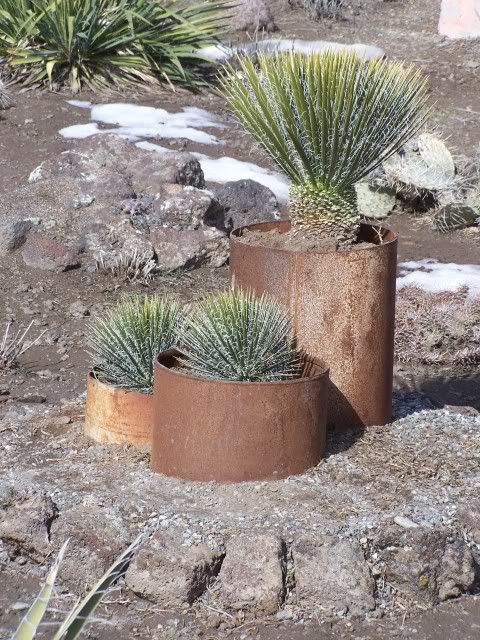
Mon, 11/28/2011 - 7:26pmHere is a couple.
DesertZone (not verified)
Re: Yucca nana
Mon, 11/28/2011 - 7:29pmI agree. 8)
Robert Nold
Re: Yucca nana
Tue, 11/29/2011 - 5:41pmAs far as I can tell, the only place where Yucca nana is accepted is in Hochstaetter's books. On the other hand, the only treatment of Yucca that I know that is the result of going out into the wild and looking at as many yuccas as possible, is also by Hochstaetter.
I noticed he was dismissed as a "hobbyist" in some publications, but who else has done as much field work? Especially in such as messy genus as Yucca, I would think that field work outweighed studying herbarium specimens in every respect. (I could be wrong.)
If you look at treatments of Yucca in various floras you will find almost no agreement at all as to the distribution of a number of species, not to mention reports that species grow in places where, in fact, they do not grow.
Bob
John P. Weiser
Re: Yucca nana
Tue, 11/29/2011 - 6:34pmI don't see this situation changing for the better. Field botanists and regional herbariums are finding it hard to get funding for projects and operations.The lion's share of current funding is being funneled into the genetic profiling of the plant kingdom. How is a geneticist sitting in an office even aware of what a species is supposed to look like, let alone be able to say were it's habitat begins and ends. How is he going to be able to tell the subtle differences, between varieties of a species, since they only test a very small portion of a specie's, genetic code in the first place? There seems to a push to make every species into a bar code, that you can scan with a hand held tricorder and positively identify. I don't see that happening any time in the foreseeable future. There are way too many plant species to begin dealing with. :rolleyes: There are many university botany programs that have dropped their taxonomy classes in favor of genetic research. Were will the future taxonomists come from? Who will update the treatments and back them up with vouchered specimens? With the climate changes predicted in the future, who is going to do the field research required to monitor the changes?
Lots of questions unanswered , but money talks!!
Robert Nold
Re: Yucca nana
Tue, 11/29/2011 - 8:30pmCactus are a complete mess. Some species have 25 synonyms.
I don't find any treatment that recognizes Opuntia debreczyi (nor, for that matter, O. rhodantha). You probably couldn't find two botanists who even agree on what constitutes a species, let alone whether or not a specimen represents a species.
It wouldn't really matter except for the very real possibility of buying the same plant over and over again, but with a different name each time.
Bob
John P. Weiser
Re: Yucca nana
Tue, 11/29/2011 - 9:43pmI agree that cactus are a mess and Opuntias the worst of the lot!! Yes there is a lot of doubt out there about the validity of debreczyi. Rhodantha as a group needs study, to see if it has valid varietal standing.
Here in a somewhat lengthy write up on the "species concept" that I found a good read.
The concept of a species is a surprisingly difficult concept, perhaps because it is so basic to our understanding of the world. After all, virtually the first question most people ask is "what is it?"
That "what is it" concept is designed to group things into similar and different categories. Those categories can vary enormously. Sometimes they are more specific than a "species". For example, a Golden Delicious apple is different from a Macintosh apple is different from a Winesap. Sometimes less specific. "hardwood" vs. "softwood".
In modern biology, we not only have the concept "within group" vs. "different group", but we have added the concept first of grouping at different levels "Cactus" vs. "Opuntia" vs. "Opuntia fragilis" vs. "Opuntia fragilis. var. brachyarthra" , and we have added the concept of reproductive isolation at the species level. In other words, we want to believe that species X every individual within the species is capable of producing offspring with any other individual, at least of a different gender, and that species X individuals cannot produce offspring with members of another species. And, of course, this concept works reasonably well for many groups. Robins don't have babies with scarlet tanagers, and with only a few exceptions (chihuahuas and St. Bernards) individuals within a species can produce offspring with another individual in that species.
However, even though we've added that concept, in reality it is neither obeyed by many "species", nor is it measured by biologists attempting to define species. The oak tree in front of my house will happily try to have sex with almost anything, including my nose. Imagine, for example, if I tried to publish an article "Opuntia fragilis and Opuntia polyacantha naturally hybridize, and have numerous offspring in some parts of the world. Therefore, they should be lumped into one species..." And the inverse of the concept isn't even true, that within a species individuals should be capable of producing offspring. Opuntia fragilis, for example, won't let pollen from genetically similar individuals fertilize its eggs. Which leads to a real absurdity: two clones of Opuntia fragilis should be two different species???
Well, I'm digressing. But my first point is that the very concept of a "species" is a messy one, and those of us interested in cactus should know that the cacti are a great example of this messiness. Everyone should keep in mind that the very concept of a "species" is fragile in this group. Call it reticulate evolution, hybridization, morphological complexity ...
Second. We define species based on appearance (and now increasingly on rather arbitrary concepts of DNA).
Third. Without a touchstone of some external measurable reality to help us determine species, we are always going to have disagreements. Lumpers will lump, splitters will split. We can look for guidance in things like morphological variation, DNA variation, etc., but we are always going to hear "looks like ..." or "could be a hybrid" ...
Therefore. The very concept of a "correct" species nomenclature is rather arbitrary. I commend you for you desire to be accurate and up-to-date, and indeed I do the very same thing in the herbarium I curate for example. But think of the very concept of what some of your species of interest are ... think of that as a sort of extended conversation. Benson, sitting in the corner, remarks that it is X. Anderson disagrees. Dave Ferguson tells a long story about the last time he saw it, and thinks it is Z. This is why one of the most important pieces of a scientific name isn't the name at all, but the authorities at the end of the name. So when you see Opuntia fragilis (Nutt.) Haw. that is a sort of scientific shorthand saying "the group of plants that Nuttall described first, and called Cactus fragilis. Then later Haworth decided they really belong in a different genus, and moved them to Opuntia fragilis.
So. Enjoy your cactus. Keep track of who they are and where they are from. Love them (maybe not giving them hugs though). And remember that all of those names will persist as long as we keep records, so Cactus fragilis Nuttall and Opuntia fragilis (Nutt.) Haw. are both ways of referring to the same kind of plant. And remember that a species, and a species name, is a uniquely human concept. My Opuntia fragilis is trying hard to live and reproduce, and it doesn't care what species it is.
Well, I've rambled on far too long. Can you tell my students get really hung up on the species concept? And that I've been teaching long enough to get notices that I'm eligible to retire???
Dr. Eric Ribbens
Biology
Western Illinois University
Macomb, IL 61455
Robert Nold
Re: Yucca nana
Wed, 11/30/2011 - 3:41pmCronquist was more succinct. "The smallest groups that are consistently and persistently distinct, and distinguishable by ordinary means."
Backeberg is said to have described a species from a moving train. (He was on the train.)
If you get seeds of Echinocereus triglochidiatus var. inermis, which is listed as an Endangered Species, you will get spineless plants, some with a few spines, and some indistinguishable from regular "trigs".
As you can see. (Sorry, leafage of Asphodeline damascena in the way.)
Bob
Tim Ingram (not verified)
Re: Yucca nana
Thu, 12/01/2011 - 8:09amThat was a really valuable discussion of the concept of 'species'. In one of my favourite books, 'The Living Garden' by E. J. Salisbury he prefaces his chapter on Plant Names with the saying 'Words are wise men's counters: they do but reckon by them, but they are the money of fools'. I imagine the implication is that there is a bit of the fool in all of us! There is a nice example with the same species that have a very wide range and will reproduce with adjacent populations right around their range, but those at opposite ends will not. I have learned recently that animals are much simpler in this regard than plants which have complex levels of polyploidy which makes sex even more tricky!
Tim Ingram (not verified)
Re: Yucca nana
Thu, 12/01/2011 - 11:55amTo get back to plants after that bit of philosophy - those yuccas in pots posted by Desert Zone are marvellous under whatever name! The biggest one must be quite an age.
Robert Nold
Re: Yucca nana
Thu, 12/01/2011 - 12:05pmI like the idea of yuccas in pots, too. That way you could move them to weed around them.
Here, you can get plants like that, imported from Texas. They're removed from the wild, growing on private land.
Of course there is a lot of controversy around this, but if you want a 3m tall Yucca faxoniana, you can get one.
Moving it, and digging the hole, are different stories.
Bob
John P. Weiser
Re: Yucca nana
Thu, 12/01/2011 - 3:55pmHere are a few photos of Yucca harrimaniae var. gilbertiana in bloom last summer.
Mark McDonough
Re: Yucca nana
Thu, 12/01/2011 - 5:48pmBeautiful plant John, the flower spike looks extra plump and showy emerging from the small leaf base.
DesertZone (not verified)
Re: Yucca nana
Thu, 12/01/2011 - 5:51pmIt grew very fast, it was trimmed becuase I had it by some rocks before I dug it up and moved it to the pot. I could not weed around it without a trim on the lower part. Yucca nana has very sharp leaves. :o
It flowered and died shartly after, I now have small one in its place. :)
DesertZone (not verified)
Re: Yucca nana
Thu, 12/01/2011 - 5:53pmVery nice! It never gets old to see pics from your garden. 8)
Trond Hoy
Re: Yucca nana
Sun, 12/04/2011 - 2:15amI think I have to try more Yuccas! I do not know where to plant them though - but I've got an idea ;)
John and DesertZone (Aaron?) you both have inspired me with your pictures ;D
Martin, those I got from you do well so far but I have them potted up and in a coldhouse till I am ready to try them outside ;)
Regarding the question of species:
Specimens are real entities, populations are real but species are artificial constrictions. You can never define a species to cover all kind of cases you'll find in nature. And definitions that hold in the wild will often fall apart when organisms are brought together in for example a garden. However, the concept of species is like all other taxa, a necessity to tally organisms and it also tells us about kinship.
DesertZone (not verified)
Re: Yucca nana
Sun, 12/04/2011 - 7:20amLots of cold hardy yuccas, but they like warm summers.
PS, you can call me DesertZone, Aaron or DZ....it don't matter to me, just as long as you get a response. :D
Martin Tversted (not verified)
Re: Yucca nana
Sun, 12/04/2011 - 8:29amIn countries with cool summer hybrids are the best. Y nana though are by far the most cool loving species I know of. Often starting to grow late March here. About hybrids a person like Benny Møller Jensen is working intensely with the production of new hybrids combining the coldwet tolerance of the filamentosa complex with stem and leaf differences from desert species.
Even hybrids betwin filamentosa and aborescent forms like elata seems to grow rather fast in our cool summers.
I have made the combination flaccida x nana myself and hope for something interesting. Another combination I made of (neomexicana x glauca ) x flaccida is showing a lot of vigor and maybe they will also grow well in Norway.
Martin
Robert Nold
Re: Yucca nana
Sun, 12/04/2011 - 3:20pmWhat about species like Y. pallida or rupicola? Both are hardy here, and though they will grow dry, they do come from wet climates (eastern and central Texas) and will take quite a bit of water.
I would think that hesperaloes (at least parviflora) would do well, too.
Bob
Trond Hoy
Re: Yucca nana
Mon, 12/05/2011 - 4:22amMartin, please tell me when you have anything to trade ;)
Bob, although eastern Texas is wet it also is warmer in summer than any place in Norway (or Denmark)! Summer heat is an important factor too.
Tim Ingram (not verified)
Re: Yucca nana
Mon, 12/05/2011 - 8:42amBob - you are right that Hesperaloe parviflora does OK, at least in our climate. I have grown it for quite a few years and it flowers every two or three years - really colourful. They are certainly well worth trying because they are easily raised from seed and if given a spot with reflected heat, say from a wall, they might flower more consistently. (Does Hesperaloe flower annually in the wild?).
Robert Nold
Re: Yucca nana
Mon, 12/05/2011 - 6:46pmI don't know. It's not a desert plant by any means. Say 100cm rain a year in the wild. Why it's completely hardy in Denver, I don't know. I imagine that the reason for its drought tolerance has something to do with evolution in the past; it doesn't flower here unless it gets quite a bit of rain (or irrigation) in spring.
A couple of other species, like H. campanulata, have overwintered here (I killed it by moving it around the garden too much) and H. funifera. There's a large plant of the latter at DBG, in a more or less protected location, but here, it turned to mush at 1 degree C warmer than it is right now. (-17C) Uh oh. There's another plant of funifera in the garden, covered with snow. Maybe it will be okay ....
Bob
Trond Hoy
Re: Yucca nana
Tue, 12/06/2011 - 11:47amNo plant in my garden will experience that (I hope)! The coldest in my time here (>25 years) is a few days of -16C, even last year which was extremely cold. Today we had +3C and sleet. Now it is +1 and you can fill what covers the ground in a glass and call it slush ;) With some colour added it looks great :o
However, my personal low record is -35C in Northern Norway.
100cm precipitation is more than they get in Oslo and more than I get at my summerhouse I think but much less than I get here.
cohan (not verified)
Re: Yucca nana
Sun, 12/18/2011 - 4:46pmLove it!
Fermi de Sousa
Re: Yucca nana
Tue, 12/20/2011 - 1:01amAfter reading about it on Alpine-L, possibly, or perhaps in one of Bob's books, I managed to germinate a few Yucca harrimaniae from last year's NARGS Seedex. I hope to see some get to flowering size - how long would it take? I wonder how big they'll get and whether I may have to site them very carefully to avoid those sharp leaves! Weeding will definitely be an issue those I think the Puya we have growing in another part of the rock garden would be worse - it has barbs facing downwards and upwards along the leaf edge so you're caught anyway you try to get in close!
cheers
fermi
cohan (not verified)
Re: Yucca nana
Tue, 12/20/2011 - 11:41amGood luck with that one, Fermi, sounds nice.. there has also been talk about it on TooColdForCactus yahoo group, and I think Alplains has offered it..
Martin Tversted (not verified)
Re: Yucca nana
Tue, 12/20/2011 - 11:47pmThe one from alplain looks very different to the one I have that wer e flowering
Fermi de Sousa
Re: Yucca nana
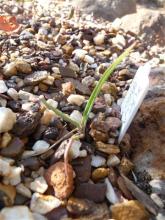
Wed, 12/21/2011 - 5:08pmHere's a pic of it as it is at present! I have a long way to go I think!
cheers
fermi