
Forums:
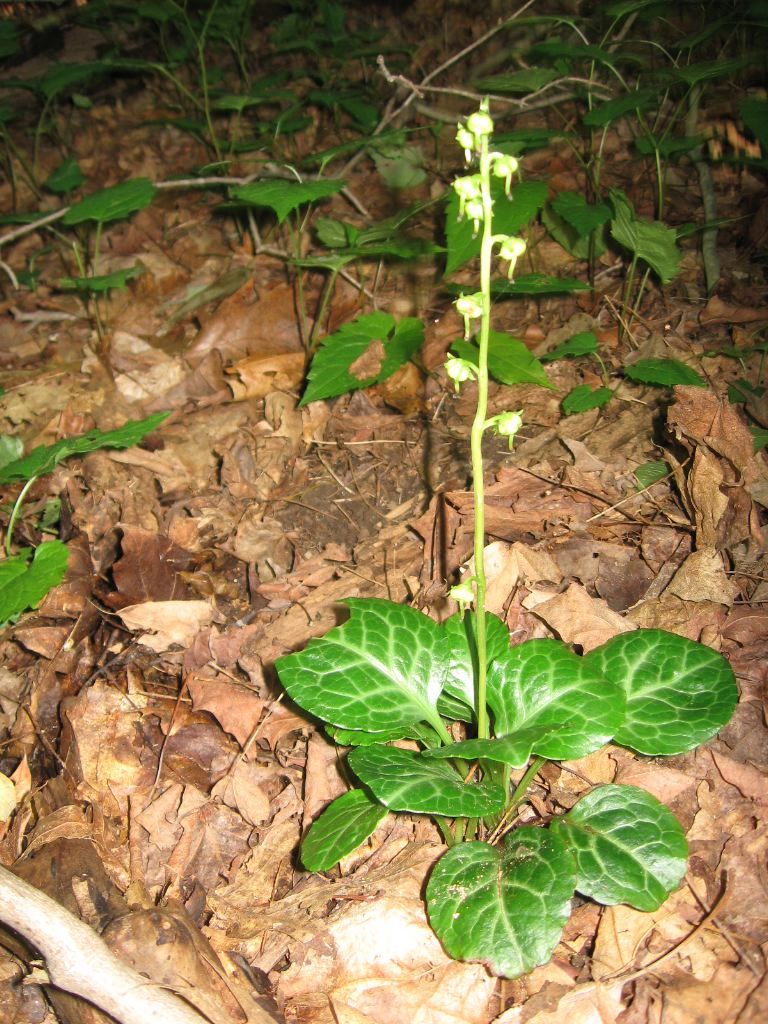
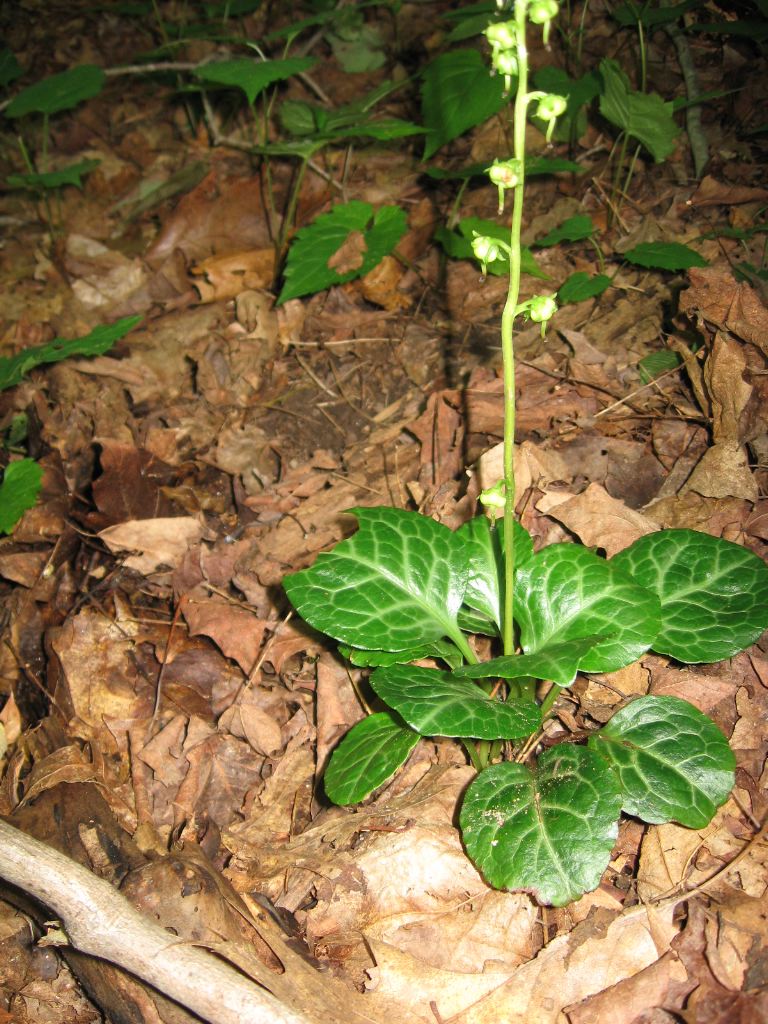
I found this on a rather steep north-facing shaded slope above a brook on my Connecticut property. The two-toned waxy leaves and flowering stalk (now going to seed) look like a Pyrola picta, but since that plant is native to the western U.S., never tried by me--and this is in the wild part of the property, never gardened--could it be Pyrola rotundifolia? My plant's basal leaves are much nicer than any picture I have seen of P. rotundifolia.
Barbara van Achterberg
Comments
Lori S. (not verified)
Re: Pyrola?
Wed, 07/28/2010 - 7:17pmI'm not familiar with Pyrola rotundifolia (doesn't occur here) but, if it's helpful, this site notes that the leaves often have lighter veins, as your plant does:
http://www.ct-botanical-society.org/galleries/pyrolaamer.html
Trond Hoy
Re: Pyrola?
Thu, 07/29/2010 - 12:59amPyrola rotundifolia is common here (in Norway), it has relatively huge flowers and the style is long and S-shaped. The form of the leaves are like your plant but I have never seen such yellow veins. The leaves of your plant are very decorative!
Todd Boland
Re: Pyrola?
Wed, 08/04/2010 - 3:16amPyrola rotundifolia also occurs in Newfoundland but I've never noticed such veined leaves on ours either.
vanachterberg (not verified)
Re: Pyrola?
Wed, 08/04/2010 - 10:40amThanks, everyone. Too bad I have only one plant, as the experts tell me that the leaves are so decorative. Maybe I'll be able to collect some--not all--of its seed.
Barbara van Achterberg, finally retired with more time to garden!
Panayoti Kelaidis
Re: Pyrola?
Thu, 08/05/2010 - 1:30pmI believe the commoner Pyrola in the east is P. elliptica. There is also a beautifully mottled Pyrola maculata which is common in parts of the Southeast. Your plant somehow suggests and intermediate of these to me.
Trond Hoy
Re: Pyrola?
Tue, 11/30/2010 - 1:10pmInteresting, Lis.
Do you transplant the Pyrolas from the woods (How do you do that - I think they are parasitic of mycelia?) or have you used seed? I have tried to move plants a few times but they never survive more than a year.
Trond Hoy
Re: Pyrola?
Sun, 12/05/2010 - 10:32amLis, maybe I can get seeds from Pyrola norvegica which now is regarded as a form of P. grandiflora. But not this fall, the woods where they grow are covered by snow. Though I have to wait till next spring and look for overwintered capsules or even till next fall.
Tony Willis (not verified)
Re: Pyrola?
Sat, 02/05/2011 - 3:28amThat is a beautiful plant. I have just received a single rosette of an un-named species as a cutting from a correspondent in China and from the leaves it would be difficult to tell them apart from that plant, but of course in flower they may be very different. I am a real fan of these plants and grow P. rotundifolia which grows locally and P. chlorantha from Greece and have just received cuttings of P. forrestiana and calliantha from China. I am also trying seeds of various species received from N. America this autumn.
Cliff Booker
Re: Pyrola?
Tue, 02/08/2011 - 11:11pmI love seeing stands of Pyrola rotundifolia in the Dolomites, often sheltering under conifers or Rhododendron ferrugineum. A plant that really deserves closer inspection ...
Pyrola rotundifolia
Paul T (not verified)
Re: Pyrola?
Wed, 02/09/2011 - 3:13amWow, Cliff. That is really pretty. I'm not familiar with it at all other than this topic.
cohan (not verified)
Re: Pyrola?
Wed, 03/09/2011 - 12:39amNice Pyrolas-- I like the marked leaves and white flowers, Cliff's also..
We talked about this genus at SRGC forum too, I'm going to try some transplants this year, I'm thinking timing might be important--maybe after flowering when they make new leaves? P asarifolium grows naturally all over my land (including some very large patches, but blooming is generally scattered in nature here), Orthilia secunda is just as widespread though though less numerous, and a couple patches of Moneses. P elipticala is widespread but much less common, and this is the one I'd most like to establish in the 'yard' since the others are already here!..
We also have another sp/form in wet wooded areas (the other species grow from moist open/mixedwoods to very dry locations under spruce) like asarifolia, but with smaller raised veined leaves, reply #4:
http://nargs.org/smf/index.php?topic=591.msg7010#new
Janet Novak
Re: Pyrola?
Wed, 04/06/2011 - 7:19pmI'm fairly familiar with the Pyrolas of Connecticut (I used to live in the state, and I was active in the Connecticut Botanical Society). I'm voting for Pyrola americana (syn rotundifolia). It's quite characteristic of the plant to have glossy leaves with lighter veins -- although your plant is probably more conspicuously veined than average. Pyrola americana is not exactly common in Connecticut, but it's not rare either.
The only other Pyrolas reported in Connecticut are P. elliptica and P. virens (syn. chlorantha). This is definitely not Pyrola elliptica, because that species has non-shiny leaves that are, well, elliptical rather than rotund. Pyrola virens is possible, but it's much less common in Connecticut than is P. americana.
Lori S. (not verified)
Re: Pyrola?
Fri, 04/08/2011 - 9:55pmWelcome to the forum, Janet! So glad you could join us!