
Forums:
I have a few North American bulbs now in bloom (mid-spring in the Southern Hemisphere);
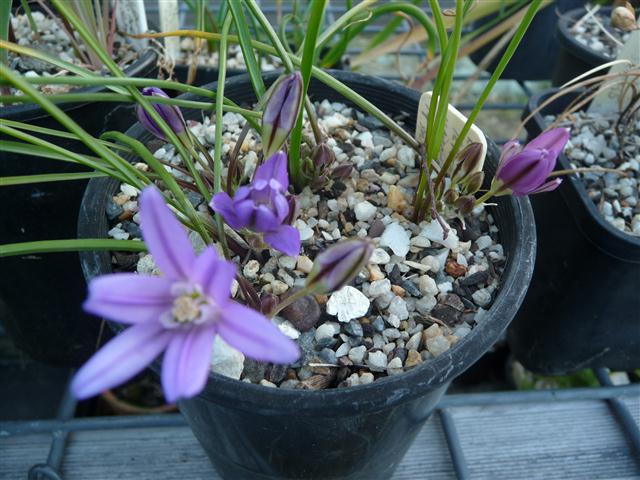
Brodiaea terrestris from NARGS Seedex 2008 donated by Jane McGary, two shades are evident in this pot,
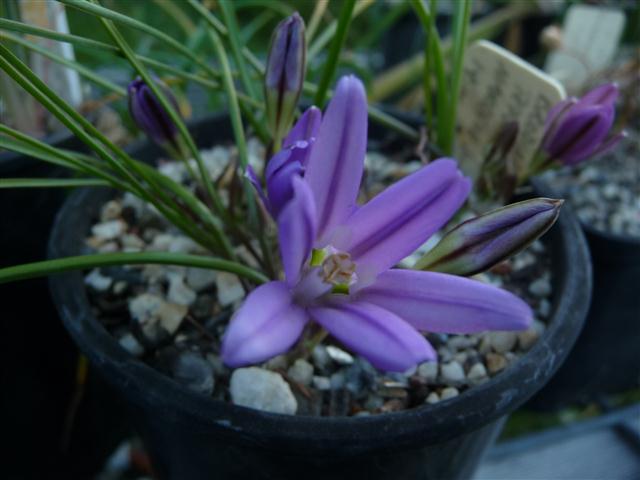
Brodiaea jolonensis, also from NARGS Seedex,


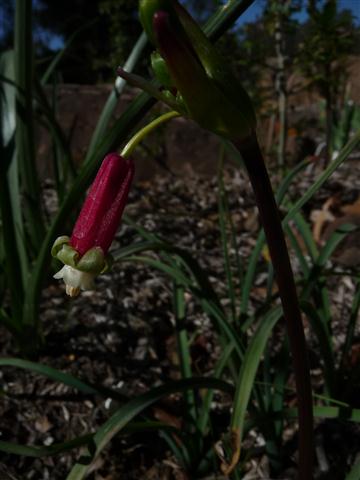
Dichelostemma ida-maia from bought bulbs last fall,

cheers
fermi
Comments
Kevin Drummond
From my admittedly limited
Fri, 09/22/2017 - 1:00pmFrom my admittedly limited experience with trilliums, I thought that the leaves on the chloropetalum were more up-turned and the edges potentially more wavy than those of the sessile species.
Based solely on the photos, I would have made the ID as T. sessile.
Certainly there are folks that have a great deal more experience with Trilliums than I, so hopefully they can provide you with a more concrete identification.
Harold Peachey
very nice-thanks
Sat, 09/16/2017 - 3:43amvery nice-thanks
Fermi de Sousa
Thanks, Harold,
Sun, 09/17/2017 - 10:47pmThanks, Harold,
someone else has suggested that it is Trillium chloropetalum rather than T. sessile.
I'm just glad to finally see it in flower!
cheers
fermi
Richard T. Rodich
I don't have an opinion for
Fri, 09/22/2017 - 3:50pmI don't have an opinion for you, Fermi, and I am still unsure of what my "T. sessile" really is. I bought it as T. sessile, and never gave it a second thought until I dug it up to divide it, and discovered the rhizome was not horizontal as it is supposed to be. My plant had several offsets, tightly held against the mother "bulb".
A friend sent me some plants of wild T. sessile and T. cuneatum from Illinois, which also has horizontal rhizomes.
Cuneatum had what I envisioned would be the typical horizontal growth:
But then I saw what he sent me as T. sessile:
They certainly looked vertical to me, but upon closer inspection I saw the horizontal rhizome:
It seems one of the better ways to distinguish species is with stamen and ovary characteristics, but the root configuration will certainly help. Not that you should dig yours up, but if you remember what it was like when you planted it, or for future reference.
Fermi de Sousa
The "themids" are in flower
Wed, 11/15/2017 - 4:08amThe "themids" are in flower in our Southern Hemisphere garden.
Triteleia terrestris
Triteleia ixioides
cheers
fermi
Fermi de Sousa
I found a packet of corms of
Tue, 01/02/2018 - 7:19pmI found a packet of corms of Triteleia (?laxa) 'Allure' which had been missed when planting out bulbs last fall
So they were planted in October when others of their clan were already in flower. Surprisingly not only did they grow but they have now come into flower
cheers
fermi
Pages