
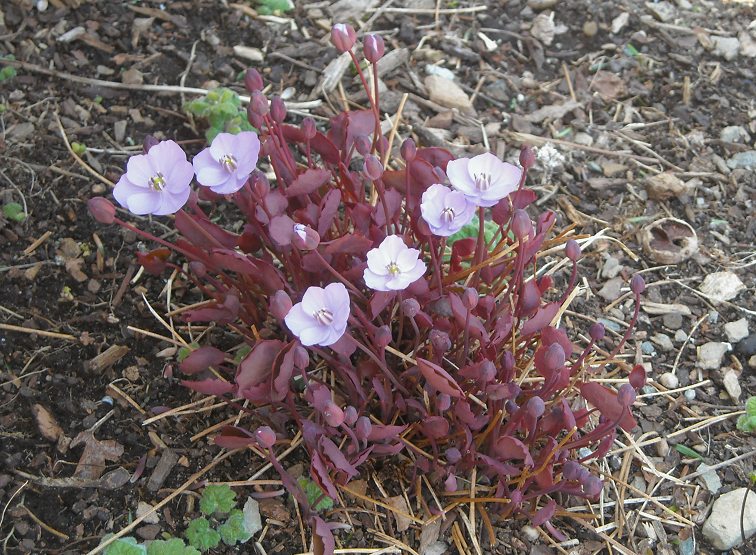
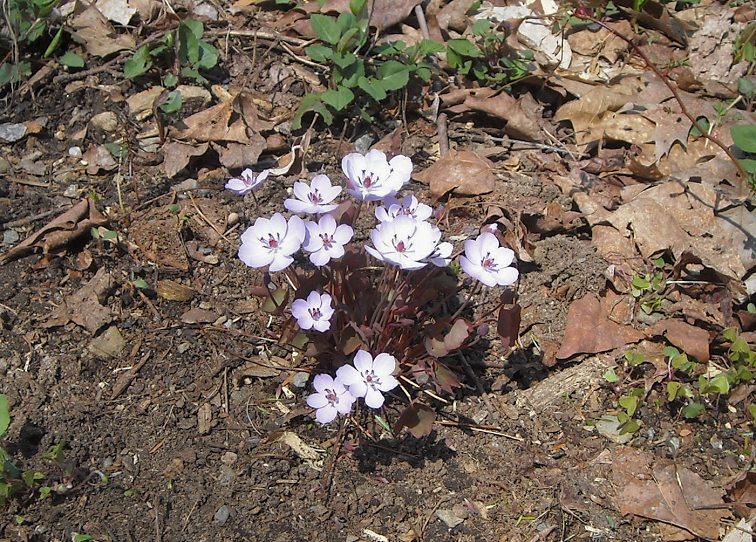
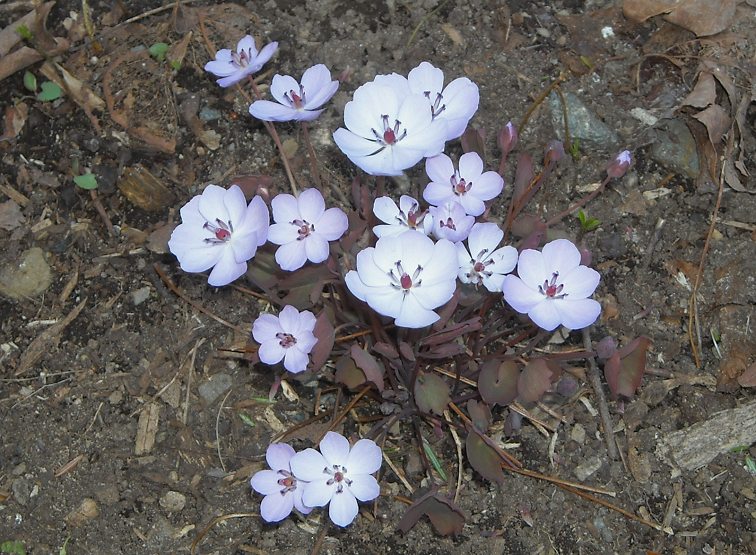
Just starting to flower is Jeffersonia dubia, fun to watch as they emerge, the foliage is beet red and rubbery looking (Photo 1). My plants are from a good dark color form, just opening their first couple blooms... flower color is deeper than what the photo captured. However, I wanted to showcase a form that Darrell Probst collected, CPC 3.10.97 (Cobblewood Plant Collection), selected on account of it's dark flowers (although my normal form are darker) and the red seed pods. In full flower on 04-04-2010, I note some other differences: the ovary is red (green in other dubia forms) and the stamens dark tipped (light color in other dubia forms).
Sun is very strong today, and my daughter's cheap entry-level Nikon Coolpix does a terrible job with white or light-colored flowers, and after several tries, settled on these washed out looking photos, but it is the best I can do. In the last photo, I used a sun baffle to tone down the bright light.
Comments
Richard T. Rodich
That J. dubia has certainly
Mon, 05/11/2015 - 9:01pmThat J. dubia has certainly outdone itself this season, Lori. As I recall, you were always hopeful that it would one day "break out".
Update on the J. diphylla seedlings.. Pic from May 1.
Lori S. (not verified)
They took off in 2012, with
Tue, 05/12/2015 - 10:34pmThey took off in 2012, with enough flower density to make an impressive sight. Terrific plant! I'm pleased that the seedlings I moved around last year have come up, too.
But that reminds me, I had J. diphylla somewhere... must go check on it tomorrow. Very well done with the seedlings!
CScott (not verified)
How did you germinate these?
Fri, 01/27/2017 - 7:10amHow did you germinate these?
Oscillating cold/warm cycles?
I have them out in an unheated garage?
Richard T. Rodich
When someone sent me fresh
Fri, 01/27/2017 - 2:26pmWhen someone sent me fresh seed in late June, I immediately scratched them into the soil, about 3mm deep.
They sprouted in early May.
Richard T. Rodich
Caroline, look here:
Sun, 01/29/2017 - 7:50pmCaroline, look here:
https://www.jstor.org/stable/2444529?seq=1#page_scan_tab_contents
It's really easy to set up a free account, and read the papers for free, just click the "Read on line" button, and go from there.
Mark McDonough
RickR wrote:
Thu, 02/02/2017 - 5:38am[quote=RickR]
Caroline, look here:
https://www.jstor.org/stable/2444529?seq=1#page_scan_tab_contents
It's really easy to set up a free account, and read the papers for free, just click the "Read on line" button, and go from there.
[/quote]
Thanks for the link Rick! I signed up, the free version allows adding up to 3 articles ( for reading only) to one's "bookshelf" for 2 weeks, after which they can be removed and new articles added . One can make screen captures of each page of an article as a workaround, for future reference.
The curious thing about the Jeffersonia germination article, a couple times they say there are 4 species (!) but only mention diphylla & dubia; there are a few published names of other Jeffersonia species but considered by The Plant List as synonyms or having "unresolved status". One thing learned from the article, is that 3 summer months of warm stratification is needed for the embryo to plump up by autumn, for successful germination the following spring, confirming the need for immediate sowing when seed is ripe.
Pages