Forums:
This (Antennaria dioica) is a common plant in the subalpine zone and in the lowland woods and higher up in the mountains too. You get it in different colors between red and white. The red ones are showiest.

This (Antennaria dioica) is a common plant in the subalpine zone and in the lowland woods and higher up in the mountains too. You get it in different colors between red and white. The red ones are showiest.
Comments
Richard T. Rodich
Re: Don't forget the red ones!
Mon, 09/13/2010 - 9:05amYou're on the list too, Mark, for verrucosus. If all goes well, I think it might be easier for you to root cuttings next summer. That's how I propagated mine. Likewise, I thought it might be easier for me to root cuttings of planipes, but Dirr only lists propagation from seed for sacalinensis so I'll stick with that for now. Yes, I'd like to try some seed, with a few different methods of preparation. Euonymus seed have a very oily coating, and some sources recommend washing in diluted soap first, although Dirr does not mention it.
Trond Hoy
Re: Don't forget the red ones!
Mon, 09/13/2010 - 1:22pmI'll get plenty of seeds later on europæus, if it is of interest. They germinate easily under the mother plant every year. However, I do not know if the seeds are 1, 2 or more years old when they decide to germinate.
Fermi de Sousa
Re: Don't forget the red ones!
Tue, 09/14/2010 - 4:17pmMark,
just as well it's also known as E. planipes as it's allowed into Oz under that name! (Yes, please!)
I took these pics before the sun came out so the flowers aren't open fully but quite obvious red! Anemone pavonina - even the white ones have red exteriors. :D
And Tulipa greigii (possibly "Red Riding Hood") is certainly bright in the spring garden.
cheers
fermi
Richard T. Rodich
Re: Don't forget the red ones!
Tue, 09/14/2010 - 4:35pmA little red darling!
Does it open wide, or stay fairly closed?
Fermi de Sousa
Re: Don't forget the red ones!
Tue, 09/14/2010 - 4:51pmHi Rick,
if you mean the anemone, yes it does, but only in full sun and not at 7am!
Actually, the tulip does the same, too!
cheers
fermi
Fermi de Sousa
Re: Don't forget the red ones!
Wed, 09/15/2010 - 4:04pmTaken at 8am this morning,
Tulipa greigii and Anemone pavonina,
cheers
fermi
Trond Hoy
Re: Don't forget the red ones!
Wed, 09/15/2010 - 9:55pmNice to see spring plants at this time of the year - the rain is pouring down outside!
Lori S. (not verified)
Re: Don't forget the red ones!
Sun, 10/24/2010 - 9:38pmHere, pushing things right to the limit, is Ipomopsis rubra... In a few fitful previous tries, I was never able to winter it over, but now finally, success... However, this bit of bloom is all I'll get, since it's getting very late, and this biennial will definitely not be able to set seed before it's killed by the cold. (Grrr, I remember again why I hate biennials! ::))
The second photo does shows the frost-bitten flowers looking very red...
Trond Hoy
Re: Don't forget the red ones!
Mon, 10/25/2010 - 12:09amIpomopsis is a genus that I have not considered trying, but I think I will now!
What's the trouble wintering it over - frost, humidity, lack of warm summers?
Mark McDonough
Re: Don't forget the red ones!
Mon, 10/25/2010 - 7:42amLori, I love these things, the Ipomopsis (or Gilia, as I used to grow them under). I've not grown I. rubra, and when I look it up on the USDA site, I can't believe my eyes on it's distribution... it even includes little ol' Massachusetts! Since the distribution includes Michigan and Ontario, I have to assume some strong level of hardiness. I had always thought of this as a strictly southern species, or a Texas wildflower, shows what I know ;-)
http://plants.usda.gov/java/profile?symbol=IPRU2
I wonder if you might be better off growing I. aggregata or one of its many subspecies, this being the Western version of rubra... perhaps you already grow that one.
http://plants.usda.gov/java/profile?symbol=IPAG
Years ago I used to grow several color forms, and even a few other species from Sally Walker's Southwestern USA collected seed, and the first year biennial rosettes were not only flat, lacy, and tinged with color, they seemed perfectly hardy, and quickly grew the following year with bright display of red, purple, pink, and white.
Lori S. (not verified)
Re: Don't forget the red ones!
Mon, 10/25/2010 - 5:18pmWith I. rubra, I had assumed it was not hardy enough, but it may have been ignorance on my part... planting them in unsuitable conditions perhaps with too much competition for the first year rosette (whereas this one was on a slope in the front yard - better drainage, full sun, no competition)? I guess I'd have to try them a few more times to know.
I grew I. macrosiphon which was fantastic... but unfortunately didn't reseed:
http://nargs.org/smf/index.php?topic=69.0
Trond Hoy
Re: Don't forget the red ones!
Wed, 10/27/2010 - 9:32amI will look for any seeds (of this genus) when I get the seedex list!
Todd Boland
Re: Don't forget the red ones!
Mon, 12/20/2010 - 5:25pmIf I. rubra can survive in mass, then I might have a chance here...I have it on my list for the NARGS seed order...I will even overwinter one in a coldframe for a chance to get blooms...it is VERY impressive!
Fermi de Sousa
Re: Don't forget the red ones!
Sun, 01/09/2011 - 5:38pmAlstroemeria angustifolia grows well in our rock garden and spreads gently.
cheers
fermi
Hendrix (not verified)
Re: Don't forget the red ones!
Mon, 01/10/2011 - 9:34amI'm always looking for cold-hardy, easy-care, red-flowering species for my high-altitude (10,000 feet) gardens in the Colorado Rocky Mountains. One of the most stunning species that has decided to grow and prosper far from its native home of west-central New Mexico is Silene laciniata (Indian Pink). As its species name implies, its petals are deeply cut, or lacinated.
In the wild, it stands about 8 to 12 inches and seems to prefer the rather dry, acidic soil under lodgepole pines in partial shade. Most of the population my husband Klaus discovered and photographed in a campground near Luna, New Mexico was the typical vibrant red. But there were also some delicate, baby-pink specimens. (By the way, the common name "pink" does not refer to the color but to the "pinked" look of the petals of many species within Silene's family (Caryophyllaceae) -- as if someone cut them with pinking shears.) Photo #1 is a typical, few-flowered, red-blossomed plant in the wild. Photo #2 shows the pink variation.
Experimenting with this wild species in my gardens, I discovered that it does best in my artificial bog garden! This was certainly unexpected. However, the seedlings I located in drier soil, similar to that in their native ecosystem, suffered terribly. Some died before I got the idea to try the bog. The lucky ones established in that moist, heavy soil in light shade from a lodgepole pine and every year produce a floriferous display of bright red blossoms in mid-August to mid-September (about the same bloom time as in their native land which is at about 7,500 feet elevation). Unlike the wild specimens, my garden-grown plants stand 18 to 20 inches tall and have a spread of abount 18 inches with numerous flowering stems. Photo #3 shows a garden-grown specimen.
Unfortunately, the late blooming of this species means a very sparse seed crop. Most years no seed is produced before the garden is buried in snow, which can be as early as mid-October.
Mark McDonough
Re: Don't forget the red ones!
Mon, 01/10/2011 - 9:58amJane, its a stunning Silene to be sure; I grew it 25 years ago or more, and haven't tried again since then, it did flower in that screaming vermilion color. I like how the calyxes are also vibrant red, adding to the floral effect, most noticeable in your 3rd photo. The pink one is a rare find, might you introduce it as Silene laciniata 'Luna'? :D
Glad you added the cultural note, I would not have imagined that it would do well in an artificial bog situation, but it sounds from your experience that the plants do benefit from a more regular source of moisture... duly noted. In passing reference you note the late flowering of this plants make seed set a challenge, just how late in the season does this plant bloom for you? I'm always looking for late blooming rock plants, so this might be a good candidate. Have you seen my post on a very late blooming Saponaria (S. cypria) here: http://nargs.org/smf/index.php?topic=325.0
@Fermi: how hardy might Alstroemeria angustifolia be, and how tall growing is it? Beautiful colors on that one.
Trond Hoy
Re: Don't forget the red ones!
Mon, 01/10/2011 - 10:57amFermi, those red Alstroemeria is wonderful! It seems too to be reasonably tall. I grow only A aurea and that one gets taller and the color is not so good (now I wonder how it has taken the hard frost this winter).
Jane, Silene laciniata is a plant I have admired in pictures but never managed to germinate although I have several attempts. Are the seeds ephemeral or needing special treatments?
Hendrix (not verified)
Re: Don't forget the red ones!
Mon, 01/10/2011 - 11:33amMark,
Silene laciniata blooms at my 10,000-foot elevation from mid-August to mid-September. New Mexico has a late-summer monsoon season that induces blooming in a large number of unrelated species. Some years ago, Panayoti wrote an article in the NARGS bulletin about that situation. Where I live in Colorado, we don't have that late flowering season. Our native species are pretty much done by early August. You can still find flowers in bloom here and there but not in profusion as you would in late June to about mid-July. Introducing species from a similar conifer-forest ecosystem in New Mexico has enable me to extend the period of full color in the gardens into early October.
Trond,
No, the seeds are not ephemeral and, as I recall, I did not stratify them. I started them indoors at about 60 degrees F. I'm guessing they probably germinated in two to three weeks. This species produces a very thick, deep taproot so decide where you want it to grow outdoors and then don't plan to move it after it gets to be about 3 or 4 years old.
Trond Hoy
Re: Don't forget the red ones!
Mon, 01/10/2011 - 11:39amThanks, Jane! If I ever get seedlings I will remember what you say!
Hendrix (not verified)
Re: Don't forget the red ones!
Mon, 01/10/2011 - 8:23pmHere's another stunning red-flowered species that's easy to grow: Anemone coronaria (Poppy Anemone). It is listed as hardy in Zones 7-10 and as an annual in my Zone 4 but I have 3-year-old flowering plants that I grew from seeds purchased from Chiltern Seeds (U.K.). The usual way gardeners grow these beauties is from purchased tubers in fall in warmer zones and in spring in colder zones. I, too, often plant tubers in spring. The plants grown from seed bloom in early July; those from spring-planted tubers, in mid-August to early September. Although the literature says this species is hardy to only 28 degrees F., it gets colder than that at night in late August and certainly in early September but my plants and their flowers have not exhibited any frost damage. While the seed-propagated plants return every year (so far), the tuber-propagated ones do not.
They are available in separate colors of red, pink, white and purple in fall but usually only in a mix of colors if purchased in spring. Seeds are abundantly produced and are easy to germinate (no stratification needed). The plants vary in height from just 8 inches tall to 18 inches tall. They are happy in full sun or light shade in dry to evenly moist soil of low to high fertility. In other words, I plant them wherever I find room and they grow!
Panayoti Kelaidis
Re: Don't forget the red ones!
Wed, 02/02/2011 - 9:42amJane: you have GOT to be kidding me: you have grown Anemone coronaria in THE BLUE RIVER VALLEY? That's amazing.
I guess I should start planting out coconut palms in Denver then!
Lori S. (not verified)
Re: Don't forget the red ones!
Wed, 02/02/2011 - 10:07amAnemone coronaria is a lot hardier than one would think. I have had them winter over here in zone 3, although they never amounted to much in the second year (foliage, no flowers).
Fermi de Sousa
Re: Don't forget the red ones!
Thu, 02/24/2011 - 7:47pmThe latest red flowers in the Rock Garden, Rhodophiala bifida,
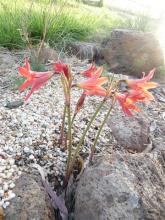
cheers
fermi
Mark McDonough
Re: Don't forget the red ones!
Thu, 02/24/2011 - 8:33pmVery nice Fermi, I would love to have Rhodophiala blooming in my garden!
Mark McDonough
Re: Don't forget the red ones!
Sun, 02/27/2011 - 11:48amColor is certainly subjective. I find it interesting in the Flora of China, not sure if it is a translation issue or not, that pink flower color is invariably listed as "pale red". Going back to Antennaria, for most of the deeper color forms of A. rosea and A. dioica (including the nice one you show Trond) I would call them pink; a nice bright or rich pink, but definitely pink. There are some selections that, repeating my previous characterization, "approach" red.
I think the genus Penstemon has some interesting cases, such as with the shrubby Dasanthera species, where flower color traverses the pink to red spectrum. I hear people describe the flowers on Penstemon rupicola as red, or "cherry red", but to me they are definitely a rich pink. http://calphotos.berkeley.edu/cgi/img_query?enlarge=0000+0000+0809+1902
Penstemon newberryi has several forms, often the flowers are a rich intense pink, or "rose-red", but there are some true pure red flowered forms. Bob Nold's book on Penstemon mentions a cultivar of P. newberryi named 'Red Lassen' offered by Siskiyou Rare Plant Nursery; a cherry red selection. I once grew a form of Penstemon newberryi ssp. sonomensis from seed that had amazing blood red flowers, not pink in the slightest. Googling around, I found another cultivar at Yerba Buena Nursery named Penstemon newberryi sonomensis 'St. Helena'.
http://www.yerbabuenanursery.com/viewplant.php?pid=1503
http://www.yerbabuenanursery.com/images/new_botimages/large/1503_j.jpg
The CalFlora site has some nice photos Penstemon newberryi ssp. sonomensis, they look decidedly red. The subspecies is notoriously fussy in cultivation, but who wouldn't want to grow this beauty.
http://calphotos.berkeley.edu/cgi-bin/img_query?rel-taxon=contains&where...
http://calphotos.berkeley.edu/cgi/img_query?enlarge=0000+0000+0509+2901
Trond Hoy
Re: Don't forget the red ones!
Sun, 02/27/2011 - 12:32pmMark, Penstemon rupicola even I would call pink (or "rosa"). The P newberri cvs shown are red, as stated.
Pages