
Forums:
The rest of the North Americans here will not see this one in your native area...it is primarily European but makes it into northern Newfoundland. Trond is probably familiar with it. The foliage is quite sticky. It is hemi-parasitic like Castilleja so challenging in cultivation, not that I've tried to grow it.
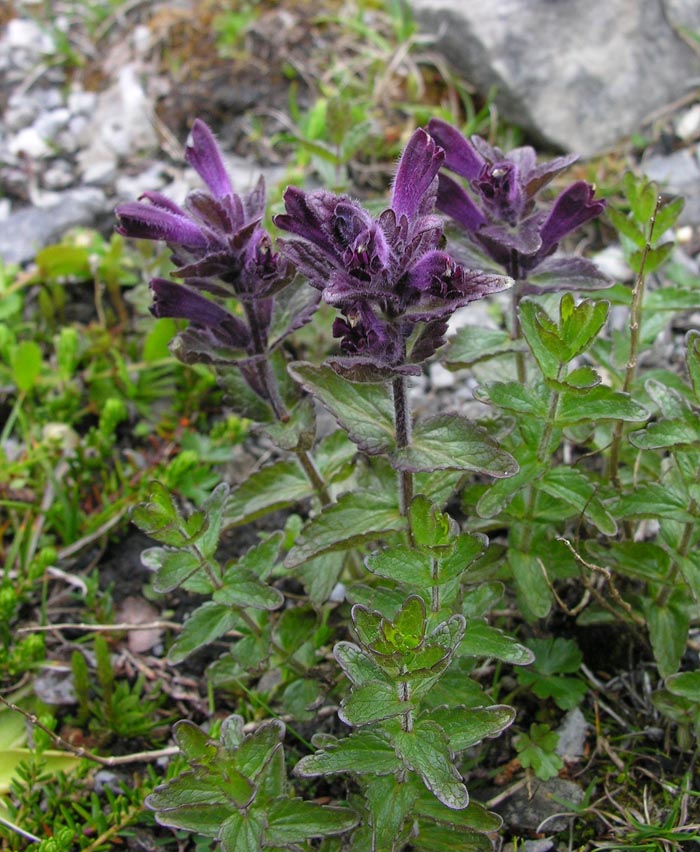
Comments
Lori S. (not verified)
Re: Bartsia alpina
Sat, 01/14/2012 - 3:25pmIt's very attractive, with the flower colour echoed on the leaf edges.
cohan (not verified)
Re: Bartsia alpina
Sun, 01/15/2012 - 1:01amGreat colour on this ..
Trond Hoy
Re: Bartsia alpina
Sun, 01/15/2012 - 1:41amYou bet! This is one of the commoner plants in the alpine meadows and Salix shrubbery in the mountains here. However, it is always nice to see them as they add some colour to the greenery.
I have never tried to grow it either.
Todd Boland
Re: Bartsia alpina
Sun, 01/15/2012 - 8:36amTrond, yours appear a little taller than ours but then, ours grow in open, exposed areas which no doubt stunts them to a degree.
cohan (not verified)
Re: Bartsia alpina
Sun, 01/15/2012 - 4:04pmThis is one I'd be happy to try :)
Trond Hoy
Re: Bartsia alpina
Sun, 01/15/2012 - 11:27pmTodd, in my opinion it is opposite: Your specimens appear more compact!
Cohan, that shouldn't be too difficult to meet! I'll look for seed in the summer ;)
Todd Boland
Re: Bartsia alpina
Mon, 01/16/2012 - 6:48amIt does parasitize other plants...apparently it can attach to a wide variety of plants but there is a preference for the Cyperaceae and Liliaceae.
cohan (not verified)
Re: Bartsia alpina
Wed, 01/18/2012 - 3:40pmThanks, Trond :)
We have a lot of native Cyperaceae, some very nice ones; I've been meaning to do garden experiments with them, and was thinking to use them for germinating Castilleja, Pedicularis etc...
Todd Boland
Re: Bartsia alpina
Thu, 01/19/2012 - 12:56pmI was told by Stephanie Ferguson, who grows spectacular Castilleja, that it is berst to partner them with an Asteraceae, especially Erigeron.
Lori S. (not verified)
Re: Bartsia alpina
Thu, 01/19/2012 - 3:50pmCorrect my increasingly poor memory if necessary, Todd, but was she not using a lot of Townsendia for that too? Wasn't there also a pairing of Gentiana with something else too?
cohan (not verified)
Re: Bartsia alpina
Fri, 01/20/2012 - 11:26amI remember Lori mentioning the Townsendia connection before.. I should look again at my Castilleja photos (local) I don't recall asters being prominent there, though you can't go far here without seeing some; Here they are in grassy areas with very mixed forbs and some woodies-- who knows what they are actually attaching to? (actually, I bet someone has studied it..lol)
Trond Hoy
Re: Bartsia alpina
Fri, 01/20/2012 - 1:27pmYou bet!
I found this: www.viscum.dk/abstracts/text/snylteplanter.pdf It is in Danish and is as easy to read as Norwegian ;)
Bartsia parasites sedges and Pinguicula + other dicots.
Pedicularis: Salix and Betula but probably also on its own root.
cohan (not verified)
Re: Bartsia alpina
Fri, 01/20/2012 - 11:09pmThere was just some discussion of Castilleja germination on Alpine-L, and it was said that Castilleja in fact does not need a host at all- gently rub off outer seed coat, cold stratify and that's it... Bob (penstemon) mentioned no host needed in the garden, though it helps (Jane Hendrix mentioned it is more an issue of adequate water).. they are both on this forum too, maybe they'll see this and comment...
I do notice with local Castilleja and Pedicularis that some plants are much more reddish in the foliage than others, and recall a suggestion somewhere that this relates to whether they have a host or not.. they do not ever grow alone here, nothing does, but maybe they are sometimes better connected than others..
Tim Ingram (not verified)
Re: Bartsia alpina
Sat, 01/21/2012 - 1:59amPaul Cumbleton at Wisley has had very good success cultivating Castilleja, and has written about this in The Plantsman (Vol. 7, p218). He finds that essentially careful attention to watering and regular feeding can substitute for any hosts. However, this is in pots and not in the garden. I would be fascinated to hear more of Stephanie Ferguson's experiences.
David and Stella Rankin (Kevock Plants) in Edinburgh have also grown both Castilleja and Pedicularis but I'm not sure they have succeeded in flowering the latter. (My own feeble attempts have been limited to Yellow Rattle - Rhinanthus - in the lawn!).
cohan (not verified)
Re: Bartsia alpina
Sat, 01/21/2012 - 6:32pmSomeone in Alpine-L has also mentioned the fertilising Castilleja to substitute a host, specifically a high nitrogen fertiliser, I think they mentioned doing it in garden beds as well...
I wonder, if planted as host-less seedlings in a bed with potential hosts, can they still attach, or does it need to be done at seed emergence stage?
Tim, what and how have you done with the Rhinanthus? We have some occasional plants locally, and I plan to sow some, I quite like them.. i think they are annual/biennial?
Anonymous (not verified)
Re: Bartsia alpina
Sat, 01/21/2012 - 7:55pmI have never tried to grow them. However, I did run into a patch at a preserve in Vermont. I thought people might like to see the photo I took.
James
Mark McDonough
Re: Bartsia alpina
Sat, 01/21/2012 - 8:06pmThe name Yellow Rattle seems to generally apply to Rhinanthus minor (little yellow rattle), check the links to learn more about this plant:
http://en.wikipedia.org/wiki/File:Yellow-rattle_close_700.jpg
http://www.google.com/search?q=yellow+rattle+rhinanthus+minor&hl=en&prmd=imvns&source=lnms&tbm=isch&ei=ZokbT7XPMuf40gG4tYDQBQ&sa=X&oi=mode_link&ct=mode&cd=2&sqi=2&ved=0CAkQ_AUoAQ&biw=1421&bih=561
http://plants.usda.gov/java/profile?symbol=RHMI13&mapType=nativity&photoID=
cohan (not verified)
Re: Bartsia alpina
Sat, 01/21/2012 - 9:24pmOurs looks a little different than James' image ( I see a number of species have been lumped into minor, so some variations are expected)- or maybe its a different stage- these are rather late and mostly finished flowering.. the second shot shows the habitat- growing with clovers, grasses, willows, etc, along both sides of a road, wet/wettish pastures on both sides.. alll this woody material was removed in the following winter; I'm sure I photographed the colony the next year again, but have not found the album!
Trond Hoy
Re: Bartsia alpina
Sat, 01/21/2012 - 10:50pmIt is about 45 species of Rhinanthus in Eurasia. All are annuals and hemiparasitic root-parasites that make many secondary haustoria to a lot of host plants. I have R. minor at my mountain cabin. I have several times "helped" them to new areas by sowing seed. Seems to work well enough. I have also tried sowing Pedicularis in situ but they are slower to establish and I am not sure I have succeeded yet.
cohan (not verified)
Re: Bartsia alpina
Sun, 01/22/2012 - 12:10amI'm always amazed that any plant can be an annual in my insanely short season-- well, the season is a few months, I guess, as long as the plants can take some frost for all but the middle of it!! I remain sceptical whether all the 'annuals' here really do all their work in one year, or get a head start the year before ( I know some do one or the other or both...)
Trond Hoy
Re: Bartsia alpina
Sun, 01/22/2012 - 12:53amCohan, your season must be longer and warmer than you think! After all, trees do grow there ;)
Your climate is similar in many ways to what we have at our mountain cabin - we call it mountain but actually it is below the treeline. Usually the snow disappear in May and is back in October - November. Frosty nights can occur every month in the year. The maximum temperature can go to 30C in the summer (more than at home) and the minimum is -35C in the winter.