From all the recent discussion about buckwheats, I know I've come to the right place to ask this question! :)
I have been puzzled for some time now about the ID of the Eriogonum that I see in the mountains here. I have thought that they are E. ovalifolium but... are they?
Given its provenance (common on a particular dry, windswept, alpine-zone ridge, and less common in the alpine zone elsewhere in more snow-prone/wetter areas where we hike), it seems to be either Eriogonum ovalifolium or E. androsaceum. (E. umbellatum also occurs in the area at slightly lower elevations, but I think I recognize that one. I know E. flavum reasonably well from the prairies and, while it can occur up into the alpine zone, I have never noticed it there.)
My local reference is Flora of Alberta by Moss and Packer. According to it, E. ovalifolium is found here on "dry plains and rocky outcrops to alpine elevations", while E. androsaceum is found on "rock slides and exposed summits at high altitudes"... so I don't perceive any absolute delineation of habitat from that.
The distribution maps show E. androsaceum present over a wider area along the western mountain border of Alberta, from the Athabasca River headwaters to the U.S. border. E. ovalifolium is also present only along the western mountain border of the province, but is much less widespread. It's present in a region around the North and South Saskatchewan River headwaters, and in another region around the Bow River headwaters and south to the U.S. border. So, both happen to occur in the areas where we hike.
E. androsaceum is described as: "Small plant, often forming dense mats; caudex tufted, scapes 2-10cm high, leaves oblanceolate to spatulate, 1-2 cm long, densely villose or becoming glabrate and green on the upper surface; involucres in a small umbel, sometimes reduced to as few as one; flowers sparingly pubescent" (Flora of Alberta, Moss and Packer, pg. 224).
E. ovalifolium is described as: "Low plant with short, closely branched caudex, thickly set with leaves and densely white-tomentose; leaves oval, orbicular or obovate, about 1cm long; scapes 5-15cm tall; involucres small, cup-like, usually clustered in a single close head; bracts very small, united at base; flowers white, 4mm long, the outer sepals oval to orbicular, the inner ones narrow, spatulate; in our area var. ovalifolium" (Flora of Alberta, Moss and Packer, pg. 224).
The key distinguishes them as follows: E. androsaceum - "flowers attentuate, with a stipe-like base"
E. ovalifolium - "flowers not attentuate, lacking a stipe-like base"; (Flora of Alberta, Moss and Packer, pg. 223).
Looking closely at some of my photos, I thought I could see a stipe-like base. Some flowers seemed to be attenuate (tapering to a narrow base), some not.
To confuse me further:
1) Flora of North America says that the variety that occurs here is depressum, rather than ovalifolium which it says has a yellow perianth. (I've only seen very pale yellow to cream to pink and peachy on the plants in question.)
http://www.efloras.org/florataxon.aspx?flora_id=1&taxon_id=250060170
http://www.efloras.org/florataxon.aspx?flora_id=1&taxon_id=250060437
http://www.efloras.org/florataxon.aspx?flora_id=1&taxon_id=250060439
2) EFlora of British Columbia shows drawings for both E. androsaceum and E. ovalifolium, and both appear to have a stipe-like base in the drawings. One of the photos for E. ovalifolium is from this area (Bragg Ck., AB) and is a match for my plants. There are no photos for E. androsaceum.
http://linnet.geog.ubc.ca/Atlas/Atlas.aspx?sciname=Eriogonum%20androsaceum
http://linnet.geog.ubc.ca/Atlas/Atlas.aspx?sciname=Eriogonum%20ovalifoli...
3) In the eriogonum reference below (which was being discussed in another thread: http://nargs.org/smf/index.php?topic=486.msg5001#msg5001 ), E. ovalifolium var. ovalifolium is also described as having yellow flowers (which I take to mean a strong yellow rather than a very pale yellow) but E. androsaceum is described as having pale yellow flowers.
http://www.plantsystematics.org/reveal/pbio/eriog/eriogarden.html
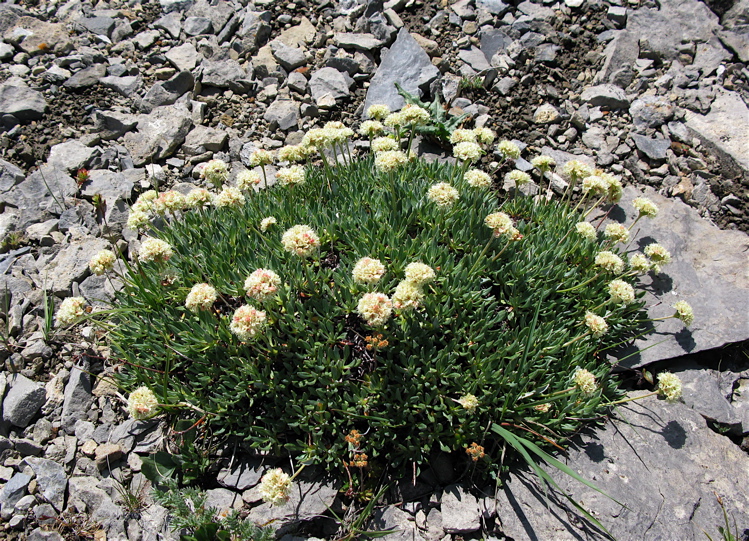
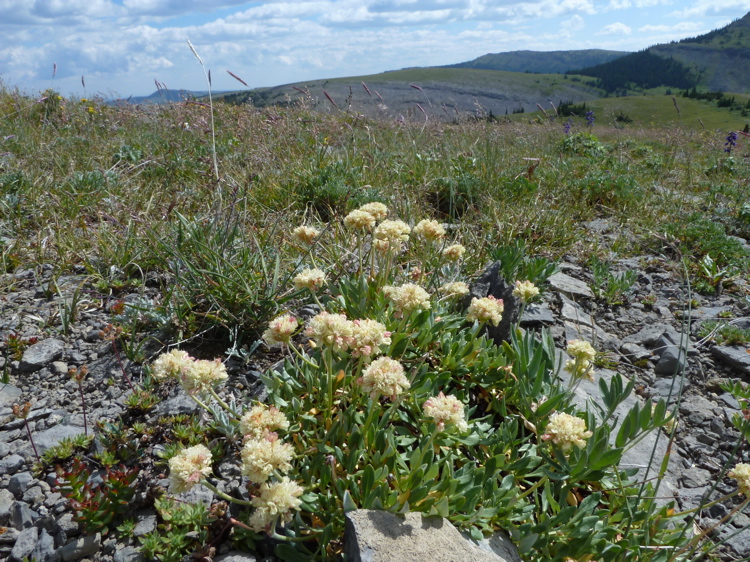
So, here are some photos... I am now leaning towards E. ovalifolium var. depressum, assuming the Moss/Packer reference was wrong about var. ovalifolium being the one that occurs here. Can anyone confirm the ID of these plants?
1-5) Eriogonum ovalifolium var. depressum?