Unfortunately, it's not one I'm familiar with (not that I am so familiar with any corydalis, actually). Maybe with bumping this up again, some of the folks from the Pacific northwest, where C. scouleri is native, might be able to comment.
folks from the Pacific northwest, where C. scouleri is native, might be able to comment.
Being one of the Pacific northwest natives (both the scouleri and myself), I also agree it looks like C. scouleri. In a good location (moisture with some sun), they can easily reach 4 feet.
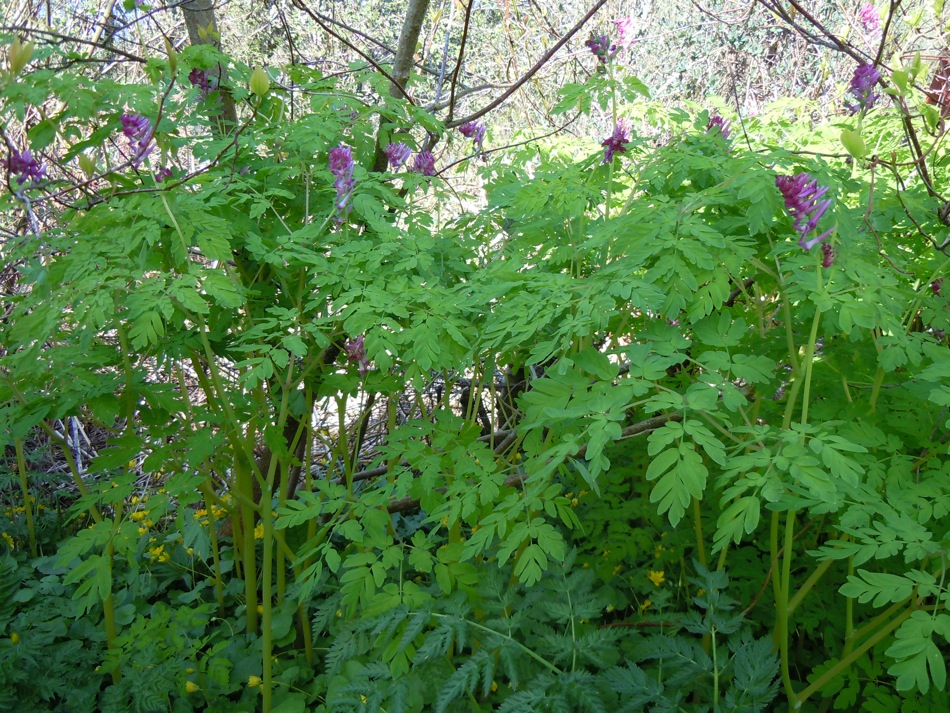
Corydalis scouleri: Extract from "Bleeding Hearts, Corydalis and their Relatives" Tebbit, Liden and Zetterlund-Timber Press 2008.
"A large stoloniferous perennial 50-120cm. tall. Stems rounded, hollow, usually with 3 leaves at or above the middle of the stem. Leaves (as in all members of the section Archaeocapnos) with rouned membbranous stipules, 3 or occasionally 4 times pinnately divided, green above, glaucus beneath. Racems simple or branched, narrow, usually with fewer than 25 flowers, but occasionally up to 35. Flowers held almost vertical, pale to deep purplish pink; outer petals lacking a rim but with conspicuous entire apical crests; spur 14-20mm long; inner petals 9-10mm long. Capsule strongly reflexed, obovate, explosively dehiscent. 2n=ca. 130-150. Self compatible to some degree, but normally cross-pollinated."
"Named in honour of John Scouler who at the age of 20 collected plants while working as the surgeon and naturalist on the 1824-1825 expedition to the Columbia River. William Hooker, who first decribed the species later worked at the University of Glasgow where Scouler was professor of geology"
Thanks all! Think it is right then. I don't get seed so I need another clone ;) It is a very fernyish plant and fits nicely among other woodland plants.
Trond, too bad we don't live near each other or we could exchange pollen of Corydalis scouleri. I too have only one clone so I never get any viable seed either. It's native to Oregon but I don't know exactly where it grows. I guess I should tell my buddies in the Native Plant Society to keep an eye out for it.
And as we both know trying to send you a chunk of my clone, or vice versa, is a non starter. :D
Sending dried Lilium pollen through the mail is often successful. I don't know if it would work for Corydalis, but this is what I would do if you want to try: Remove ripening stamens and dry on paper tin foil for 2 days (3 to 4 days for Lilium spp.). Fold up tin foil and send.
Sending dried Lilium pollen through the mail is often successful. I don't know if it would work for Corydalis, but this is what I would do if you want to try: Remove ripening stamens and dry on paper for 2 days (3 to 4 days for Lilium spp.). Fold up paper and send.
Rick, that is a good idea!
Jan wrote:
Trond, too bad we don't live near each other or we could exchange pollen of Corydalis scouleri. I too have only one clone so I never get any viable seed either. It's native to Oregon but I don't know exactly where it grows. I guess I should tell my buddies in the Native Plant Society to keep an eye out for it.
And as we both know trying to send you a chunk of my clone, or vice versa, is a non starter. :D
Jan
Jan, don't remind me of that, I am still depressed :'(
But Rick's idea is a possibility, don't you agree? Or maybe powder in the mail is something some people are very suspicious of?
Hi, Trond, I can try to harvest pollen when the plants bloom. I believe you can also freeze lily pollen so I wonder if that would work for corydalis? I suppose we could try it unless we get lucky and our plants bloom at the same time. We'd both want to label it carefully due to paranoid plant cops.
I was hoping to find a plant at our Western Winter Study Weekend but I was out of luck. There are a number of plant sales coming up in the Portland area so I'll be looking for it. I'll also ask my friends who do a lot of hiking to keep a look out for it. Maybe they can score some fresh seed.
Indeed you can freeze lily pollen. Once it is thawed, it is said to lose viability quickly. Some say refreezing thawed pollen is fruitless, while others say it can be done.
A correction to my last post: It's better to send pollen in folded tin foil. Paper might absorb moisture if the air is not dry, and that could mean death for the pollen. I suppose that optimally, a sealed container would be the ultimate.
Hi, Trond, I can try to harvest pollen when the plants bloom. I believe you can also freeze lily pollen so I wonder if that would work for corydalis? I suppose we could try it unless we get lucky and our plants bloom at the same time. We'd both want to label it carefully due to paranoid plant cops.
I was hoping to find a plant at our Western Winter Study Weekend but I was out of luck. There are a number of plant sales coming up in the Portland area so I'll be looking for it. I'll also ask my friends who do a lot of hiking to keep a look out for it. Maybe they can score some fresh seed.
Jan
Quite so! And Trillium seeds are germinating now as I told in another thread too ;)
I have several clones, and collect a large amount of seed from them. If you want some, send me a private message. But these plants are not easy to germinate. I would give them a couple of months of warmth, followed by winter temps for several months. But I would not let them freeze hard. They make a long taproot, and do not like high soil temperatures. Maybe the best thing is to sow them where you want the plants to remain. They need a lot of moisture until late summer. I grow them in my blueberry patch.
I have several clones, and collect a large amount of seed from them. If you want some, send me a private message. But these plants are not easy to germinate. I would give them a couple of months of warmth, followed by winter temps for several months. But I would not let them freeze hard. They make a long taproot, and do not like high soil temperatures. Maybe the best thing is to sow them where you want the plants to remain. They need a lot of moisture until late summer. I grow them in my blueberry patch.
;D
Hi Gene, what kind of blueberry is that? Does it mean that the soil is very acidic?
I have several clones, and collect a large amount of seed from them. If you want some, send me a private message. But these plants are not easy to germinate. I would give them a couple of months of warmth, followed by winter temps for several months. But I would not let them freeze hard. They make a long taproot, and do not like high soil temperatures. Maybe the best thing is to sow them where you want the plants to remain. They need a lot of moisture until late summer. I grow them in my blueberry patch.
;D
Hi Gene, what kind of blueberry is that? Does it mean that the soil is very acidic?
They are the common edible blueberries. Soil is quite acidic, but I apply a little lime every year.

Comments
Lori S. (not verified)
Re: Corydalis scouleri?
Mon, 02/20/2012 - 4:04pmUnfortunately, it's not one I'm familiar with (not that I am so familiar with any corydalis, actually). Maybe with bumping this up again, some of the folks from the Pacific northwest, where C. scouleri is native, might be able to comment.
It does look like it:
http://www.pnwflowers.com/flower/corydalis-scouleri
http://linnet.geog.ubc.ca/Atlas/Atlas.aspx?sciname=Corydalis%20scouleri
http://linnet.geog.ubc.ca/ShowDBImage/gallery.aspx?page=0&specrep=0&code...
http://calphotos.berkeley.edu/cgi/img_query?query_src=photos_index&rel-t...
Mark McDonough
Re: Corydalis scouleri?
Mon, 02/20/2012 - 6:42pmI agree it does look right. Wow, that's a Corydalis on steroids (size-wise)!
Lockwood (not verified)
Re: Corydalis scouleri?
Mon, 02/20/2012 - 7:19pmBeing one of the Pacific northwest natives (both the scouleri and myself), I also agree it looks like C. scouleri. In a good location (moisture with some sun), they can easily reach 4 feet.
Julie
deesen (not verified)
Re: Corydalis scouleri?
Tue, 02/21/2012 - 11:15amCorydalis scouleri: Extract from "Bleeding Hearts, Corydalis and their Relatives" Tebbit, Liden and Zetterlund-Timber Press 2008.
"A large stoloniferous perennial 50-120cm. tall. Stems rounded, hollow, usually with 3 leaves at or above the middle of the stem. Leaves (as in all members of the section Archaeocapnos) with rouned membbranous stipules, 3 or occasionally 4 times pinnately divided, green above, glaucus beneath. Racems simple or branched, narrow, usually with fewer than 25 flowers, but occasionally up to 35. Flowers held almost vertical, pale to deep purplish pink; outer petals lacking a rim but with conspicuous entire apical crests; spur 14-20mm long; inner petals 9-10mm long. Capsule strongly reflexed, obovate, explosively dehiscent. 2n=ca. 130-150. Self compatible to some degree, but normally cross-pollinated."
"Named in honour of John Scouler who at the age of 20 collected plants while working as the surgeon and naturalist on the 1824-1825 expedition to the Columbia River. William Hooker, who first decribed the species later worked at the University of Glasgow where Scouler was professor of geology"
Richard T. Rodich
Re: Corydalis scouleri?
Tue, 02/21/2012 - 1:20pmI just ordered that book through our Chapter's bulk order.
Am looking forward to it very much.
Trond Hoy
Re: Corydalis scouleri?
Wed, 02/22/2012 - 12:59amThanks all! Think it is right then. I don't get seed so I need another clone ;)
It is a very fernyish plant and fits nicely among other woodland plants.
deesen (not verified)
Re: Corydalis scouleri?
Wed, 02/22/2012 - 2:12amPicked mine up from a Garden Centre sale table. Cost me £3 (nearly $5) very good value. ;D
Michael J Campbell (not verified)
Re: Corydalis scouleri?
Wed, 02/22/2012 - 3:18amYou never lost it David,old habits die hard, eh. ;D ;D ;D ;D ;D
deesen (not verified)
Re: Corydalis scouleri?
Wed, 02/22/2012 - 8:44amA Yorkshireman never looses the habit of finding a bargain Michael ;D
Trond Hoy
Re: Corydalis scouleri?
Wed, 02/22/2012 - 9:43amWhen you speak of it, Michael and David, I think I have a copy of that book too! Have to take a look when I'm back home ;-)
Jan Jeddeloh
Re: Corydalis scouleri?
Sat, 03/03/2012 - 5:16pmTrond, too bad we don't live near each other or we could exchange pollen of Corydalis scouleri. I too have only one clone so I never get any viable seed either. It's native to Oregon but I don't know exactly where it grows. I guess I should tell my buddies in the Native Plant Society to keep an eye out for it.
And as we both know trying to send you a chunk of my clone, or vice versa, is a non starter. :D
Jan
Richard T. Rodich
Re: Corydalis scouleri?
Sat, 03/03/2012 - 9:25pmSending dried Lilium pollen through the mail is often successful. I don't know if it would work for Corydalis, but this is what I would do if you want to try:
Remove ripening stamens and dry on
papertin foil for 2 days (3 to 4 days for Lilium spp.). Fold up tin foil and send.Trond Hoy
Re: Corydalis scouleri?
Sun, 03/04/2012 - 11:37amRick, that is a good idea!
Jan, don't remind me of that, I am still depressed :'(
But Rick's idea is a possibility, don't you agree? Or maybe powder in the mail is something some people are very suspicious of?
Jan Jeddeloh
Re: Corydalis scouleri?
Tue, 03/13/2012 - 8:43pmHi, Trond,
I can try to harvest pollen when the plants bloom. I believe you can also freeze lily pollen so I wonder if that would work for corydalis? I suppose we could try it unless we get lucky and our plants bloom at the same time. We'd both want to label it carefully due to paranoid plant cops.
I was hoping to find a plant at our Western Winter Study Weekend but I was out of luck. There are a number of plant sales coming up in the Portland area so I'll be looking for it. I'll also ask my friends who do a lot of hiking to keep a look out for it. Maybe they can score some fresh seed.
Jan
Richard T. Rodich
Re: Corydalis scouleri?
Wed, 03/14/2012 - 7:10pmIndeed you can freeze lily pollen. Once it is thawed, it is said to lose viability quickly. Some say refreezing thawed pollen is fruitless, while others say it can be done.
A correction to my last post:
It's better to send pollen in folded tin foil. Paper might absorb moisture if the air is not dry, and that could mean death for the pollen. I suppose that optimally, a sealed container would be the ultimate.
Trond Hoy
Re: Corydalis scouleri?
Thu, 03/15/2012 - 1:49pmQuite so! And Trillium seeds are germinating now as I told in another thread too ;)
Gene Mirro (not verified)
Re: Corydalis scouleri?
Sun, 04/22/2012 - 6:06pmI have several clones, and collect a large amount of seed from them. If you want some, send me a private message. But these plants are not easy to germinate. I would give them a couple of months of warmth, followed by winter temps for several months. But I would not let them freeze hard. They make a long taproot, and do not like high soil temperatures. Maybe the best thing is to sow them where you want the plants to remain. They need a lot of moisture until late summer. I grow them in my blueberry patch.
Trond Hoy
Re: Corydalis scouleri?
Mon, 04/23/2012 - 11:39am;D
Hi Gene, what kind of blueberry is that? Does it mean that the soil is very acidic?
Gene Mirro (not verified)
Re: Corydalis scouleri?
Mon, 04/23/2012 - 1:28pmThey are the common edible blueberries. Soil is quite acidic, but I apply a little lime every year.
Trond Hoy
Re: Corydalis scouleri?
Wed, 04/25/2012 - 2:45amGene, you know what's common blueberries there isn't the same as is common here ;)
Gene Mirro (not verified)
Re: Corydalis scouleri?
Wed, 04/25/2012 - 6:03amLots of information here: http://en.wikipedia.org/wiki/Blueberry