
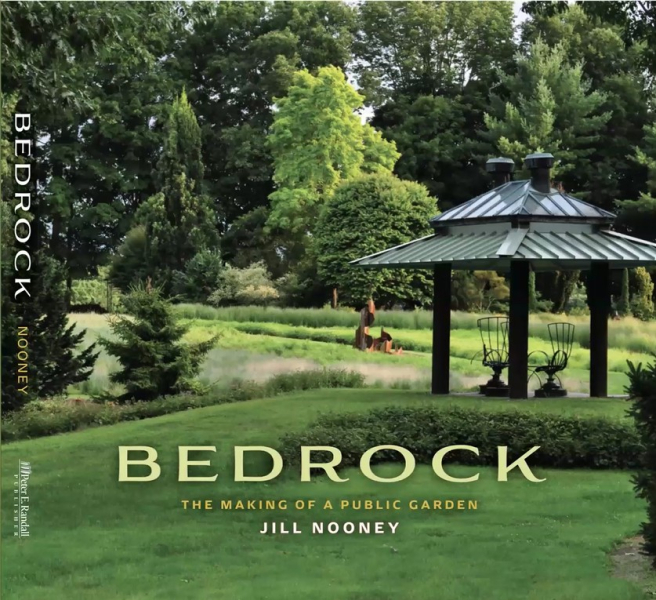
Bedrock: The Making of a Public Garden by Jill Nooney. Peter E. Randall Publisher, Portsmouth, New Hampshire, 2025. 224 pp. 290 full-color images. $50.00 list, $33.63 Amazon.
Bedrock is a public garden in Lee, NH, created over a forty-year period by Jill Nooney and her husband Bob Munger. This book is the story of their journey to create a unique set of gardens that display Nooney's large welded sculptures and garden design prowess, Bob's engineering genius, and lots of beautiful plants. Nooney admits to being an obsessive gardener and plant collector, who wants one of everything. Not just plants, but also woods, a rock garden, an allée, a conifer garden, a parterre, a Belgian fence, a stumpery, a tea house, ... the list goes on.
The book starts with a pictorial map that shows all the gardens and the main path that a visitor follows to visit them. It then describes each area, in the order in which they are encountered on that path. Nooney gives the initial impetus for the area, how Nooney and Munger created it, what challenges they overcame, how it fits with the rest of the gardens, and any modifications they made to the area when they transitioned Bedrock from a private paradise to a public garden. The accompanying pictures show some of the notable plants and the sculptures found in that area.
For example, the allée was added to provide a path from the pond to the torii, a traditional Japanese gate. The allée was originally planted with Sorbus alnifolia, the Korean mountain ash. Nooney details the problems they had with keeping the young trees and having to replace fourteen of them that died during a dry period. Fifteen years later they cut all of them down, having discovered that mountain ash seedlings were invading nearby woods. They replanted the allée with young whips of Chionanthus retusus 'Arnold's Pride,' a Chinese fringe tree. It took another ten years for the new trees to have a presence. The allée now provides a strong visual line through the garden, which they extended by removing a number of large trees by the pond and fifteen feet of stone wall.
Nooney recounts their trials and errors through all the decades of garden building, as well as their successes. When you look at the garden map and see the scope of the garden, it appears to be the work of hordes of gardeners and piles of money. But then you see the picture of Nooney trimming a tall section of hedge by standing on the roof of their golf cart. And there’s Munger on his knees rebuilding the stone of a water channel that had collapsed. Their two weeders of the “Grassy Acres” were found on Craig’s List.
Nooney shares her discovery that the rhododendrons that she ordered by mail based on catalog descriptions were not the shades of pink that she envisioned. Of course, this discovery took five years, as they were initially too small to bloom. And then some of them had to be moved later. She talks about the changes in her plans over the years, such as building the torii in a different location when she realized the scale of it was too large for the original site. She mentions some of the plants that were moved, paths that were reworked, rocks that were shifted. The garden was designed dynamically, as new ideas came to them.
The book also shows the immense fun that Nooney and Munger have had with their creation. Nooney's many sculptures made of found pieces of farm machinery and industrial scraps range in mood from amusing to majestic. Her pink flamingo wire silhouettes pose in front of a massive structure of undulating ribbons of steel, made from air compressor tanks. Some of the garden furniture is built from old tractor parts and other machinery. The spiral garden is surrounded by a hedge of silver roof circulators on culvert bases. Munger spent hours cleaning and assembling a horse skeleton, so he could hang it high in a tree. They included a Murphy bed in their Japanese tea house, so they have a place to sleep outdoors.
Most of all, the book details the importance given to the journey through the garden. Nooney says her principle of garden design is simply that "a garden needs somewhere to go, a way to get there, and things to see along the way." Bedrock provides a shining example of this philosophy. I can't wait to visit.
Deborah Banks maintains a large garden in the northern Catskill foothills above Oneonta, NY.