For a plant lover, a walk in a nature reserve is, first of all, a search for unusual plants. The Nockberge Mountains in the state of Carinthia in Austria are an ideal destination for that.
In 1976, UNESCO launched the concept of a biosphere reserve with the aim of preserving large areas of cultural and natural landscapes throughout the world. The state of Carinthia wanted to create a skiing paradise in the Nockberge that would attract tourists and bring in a lot of money, but it had not taken into account the locals. Through a referendum, in which 94% of the residents voted against this plan, the ski paradise was rejected. They did not want large-scale tourism that would affect the area, but rather ecotourism, although that word did not exist at the time.
The Nockalmstrasse, a scenic road through the area, was already built when the ski park plan was dropped and on January 1, 1987, and a large part of the region was named a national park. In 2012, it received the coveted status of Biosphärenpark (Biosphere park). Now it is an area for hikers and nature lovers instead of winter sports enthusiasts.
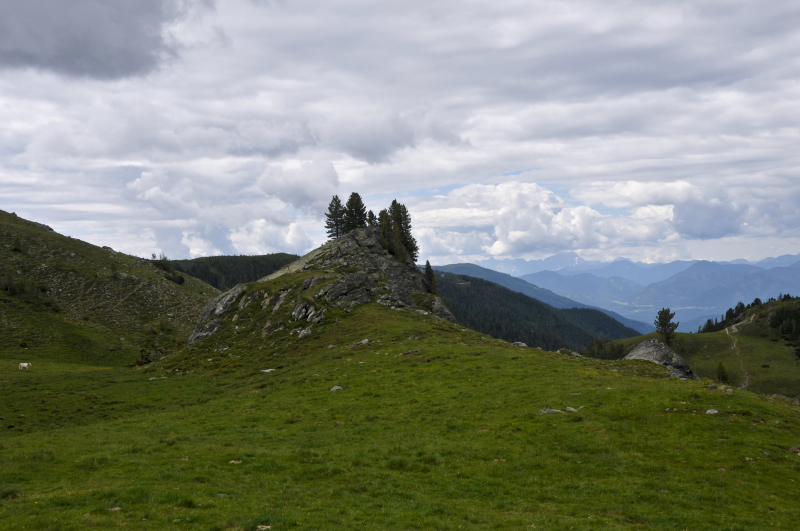
The Nockberge are not comparable to other mountains in the Alps. They are more like giant hills than mountains. The peaks are rounded and mostly grass-covered, and although the highest peaks are over 2400 meters (7875 ft) high, they still retain a hill-like appearance. Most of these mountains are acidic, but there is also a strip of limestone and dolomitic rock running north to south for up to three kilometers (1.9 miles). The rain that falls on this porous part sinks down and comes back to the surface at Bad Kleinkirchheim, the main village in this region. By then, the water has warmed up to 36°C (97°F). Bad Kleinkirchheim has been a spa town since the 17th century, but agriculture was the main source of income for the population until well into the 20th century. Only in the last few decades have people been living off tourism, because, although the intended ski paradise in the Nockberge never materialized, there are ski slopes around the village with a total length of 103 kilometers (64 miles) and it is also a popular vacation area in the summer months.
The Nockalmstrasse is a 35-kilometer (22-mile) toll road through the Nockberge. This road runs from Ebene Reichenau in the southeast to Innerkrems on the northwest side of the mountains. In 1981, this road, with a total of 52 hairpin bends, opened to traffic. It is truly a tourist route with many rest and parking areas and magnificent panoramas. Plan at least one day to drive this route and expect to make stops very often. From May to July, it is like a big flower festival, and you can often photograph beautiful flowers from the car, though it is much better to park somewhere and take long walks.
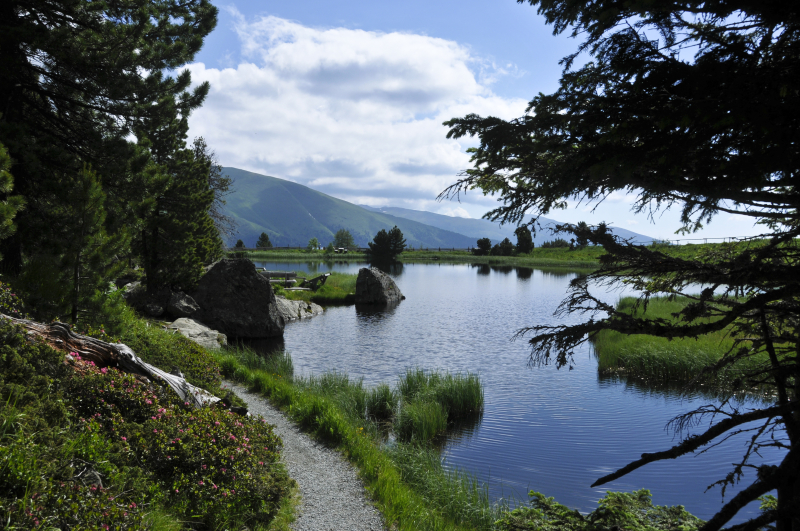
A very nice place is the area around the Wildebensee. This is an idyllic lake you can walk around in half an hour. You can see that cattle also come here regularly because in some places there is a lot of sorrel, Rumex alpinus, a sign that the soil here is enriched with manure. The ever-fascinating Veratrum album grows here and Rhododendron ferrugineum indicates that the rock and soil are acidic.
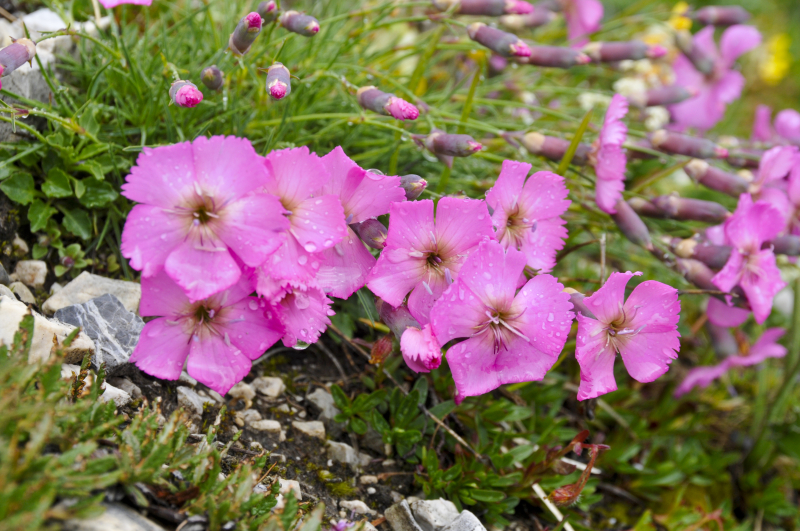
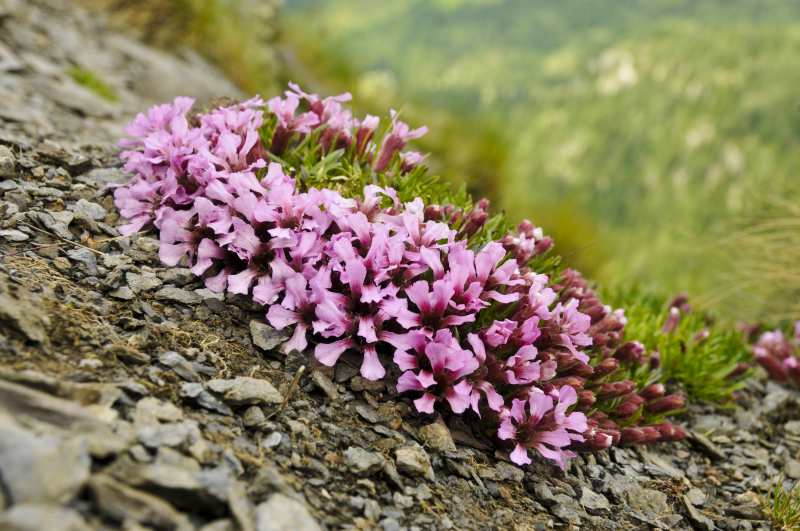
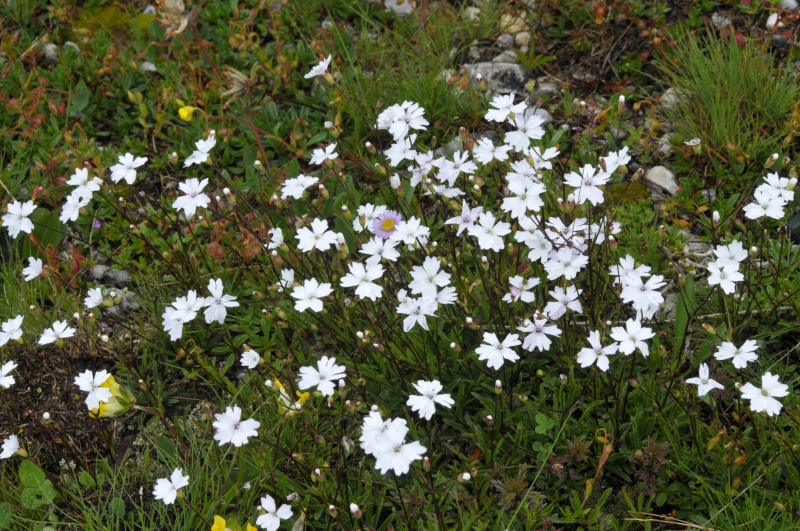
A typical representative of the eastern Alps is Saponaria pumila. It is a low soapwort species that is completely hidden under blooms during the flowering period and in the Nockberge it is very prominent. What a pleasure to look at all those different tufts of soapwort! Sometimes they are in narrow crevices in the rock, and sometimes just among the grass. With difficulty, we pull away from this gem and our gaze is drawn to a real carnation. The species we see here is Dianthus sylvestris subsp. sylvestris. It is a carnation with large pink flowers that usually grows in stony places along roadsides and in rubble slopes. It does not grow very tall and the stems are somewhat floppy so they often droop under the weight of flowers and buds.
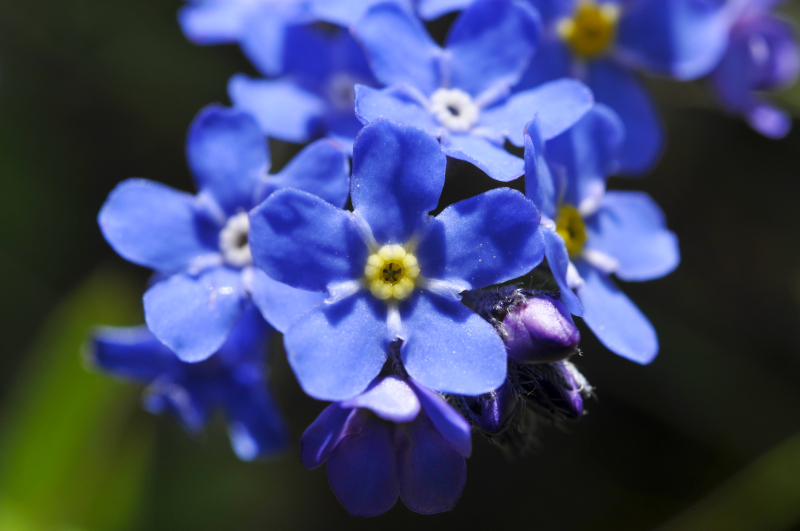
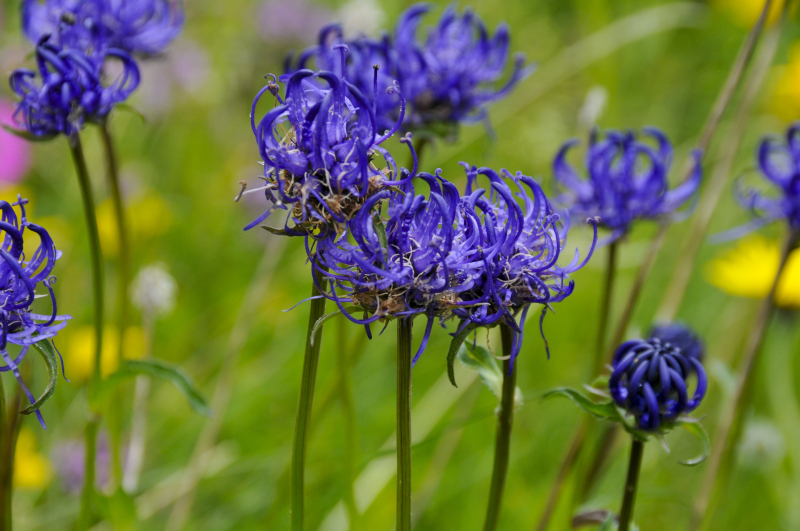
The sky blue of Myosotis alpestris or alpine forget-me-not is also not to be missed. It is unbelievable how blue it can be. Oh well, it’s just a forget-me-not, you don’t stop for that, do you? But sit down, take a closer look at the flowers and you’ll discover that some of them have a nice yellow throat and others have a white one. Once the flower has been pollinated, the yellow edge around the opening fades and that’s a sign to pollinators that there’s nothing left to get. You can walk from blue to blue because you also come across rampions in the Nockberge. You will find Phyteuma orbiculare, which grows up to 50 cm (20 in) high, and the only 15 cm (6 inch) high Phyteuma hemisphaericum both coloring the meadows with their blue flowers.
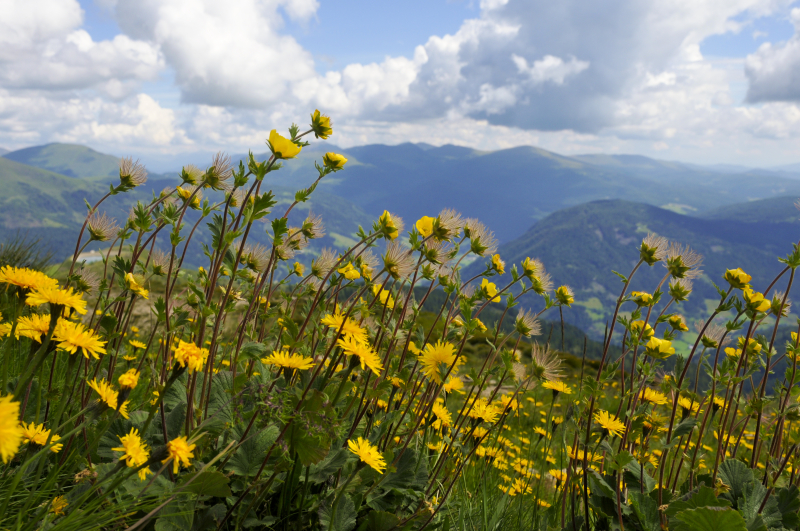
Along the paths, the alpine rock-clover, Lotus alpinus, grows everywhere. Because of the altitude, the poor growing areas, and the light, the flowers are much more intense in color than those of the common rock-clover we find in the lowlands. The flowers of Geum montanum are also yellow and, after flowering, the seed pods form a wild and photogenic capsule. In acidic and somewhat more humid places grows Tofieldia calyculata, an inconspicuous little plant that we encounter very often in the Alps. It is said to be an indicator for lime, though in reality can grow on all types of soil, provided it is not too dry. The capriciousness of the rocks and soil types in terms of acidity is evident when we suddenly see a stone that appears to be covered with Sempervivum montanum subsp. stiriacum, a house garlic species with striking red flowers that is bound to acidic soils.
A phenomenon of the Nockberge is Valeriana celtica subsp. norica, known there as speik or norischer speik. It is a small, inconspicuous plant that grows there in large numbers and whose spicy fragrance is everywhere in the summer months. The roots of this plant contain valerian oil and because of this medicinal and soothing oil, the plant was dug up en masse and exported. The lime-free alpine meadows between 1800 and 2000 m (5900-6500 feet) where this species can be found have even been given a special name, the Speikböden. In earlier times, the landlord had the exclusive right to have this speik harvested. Today, people who have a permit and can harvest the roots from mid-August until September 8th. The harvestable roots are taken away and the rest are carefully planted again. Only after four years can they be harvested again. Speik, sometimes also called speick, is still a popular product because it cannot yet be synthesized, and the soap and other products made from it fetch a good price. From mid-June onwards, flowering plants can be seen everywhere, but because the plant only grows to 15 cm (6 inches) in height and the flowers are small and inconspicuous, you have to look for them. Have you been to the Nockberge as a plant lover and not seen a speik? That is an unforgivable blunder! Everyone in the region knows the plant and in Bad Kleinkirchheim there is even a sculpture of it, four meters (13 feet) high.
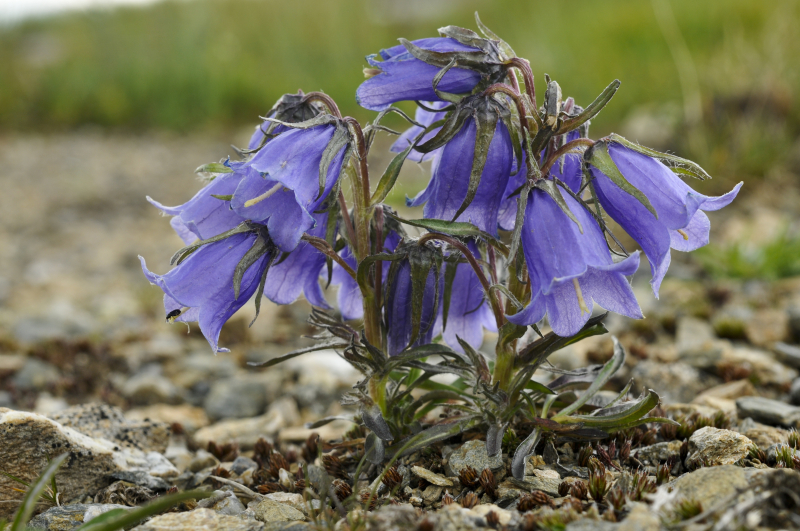
From Bad Kleinkirchheim you can take the Kaiserburgbahn to over 2,000 m (6560 feet) and there, from the end of May to the middle of July, are hundreds of plant photo models. A stone’s throw from the cable car the ground is speckled with one of the most beautiful bellflowers, Campanula alpina. This species is found only in the eastern Alps. This bellflower has a leaf rosette and above it a single stem on which sit the relatively large bell-shaped, pendulous flowers. The flowers are larger than those of the ubiquitous Campanula barbata, and the plant is taller and has more flowers than Campanula alpestris which grows on limestone in the southwestern Alps. This gem can be grown as a rock garden plant but you will not be able to enjoy it for very many years because it is not long-lived in the garden. Because this is an acidic area, you can also see Soldanella pusilla. It is a small one, but oh so beautiful! It is in full bloom at the edge of snow fields. Lie down next to the flowers on the ground and enjoy all those beautiful bells.
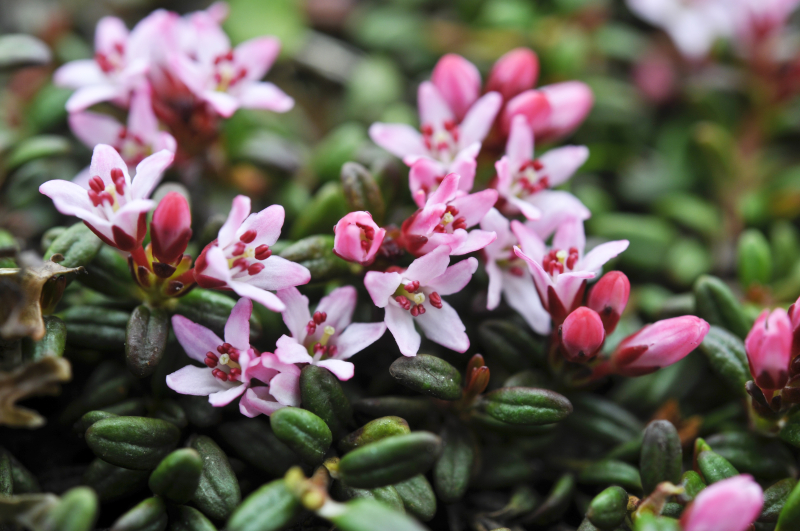
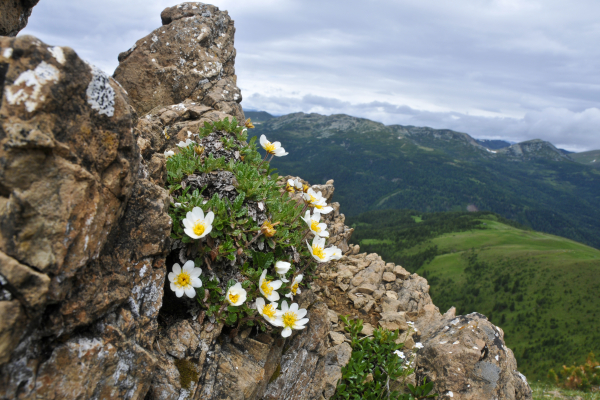
Even smaller is Loiseleuria procumbens (Syn. Kalmia procumbens). In places where the wind blows everything away even in winter this relative of the rhododendron still manages to hold its own. In June, this groundcover plant blooms with pink flowers which are followed by red seed pods. Dryas octopetala, or eighth star, can be seen everywhere, especially on limestone, but also on acidic soil. They are always photogenic when perched on a boulder and the white flowers stand out beautifully against the blue sky.
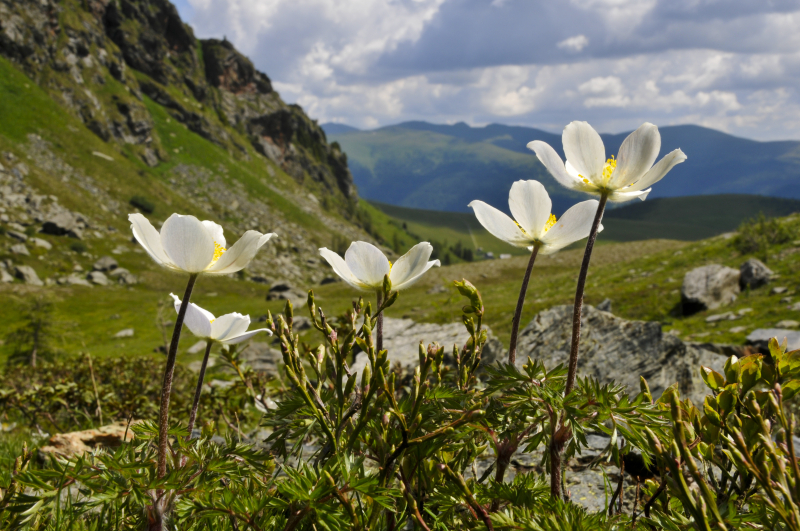
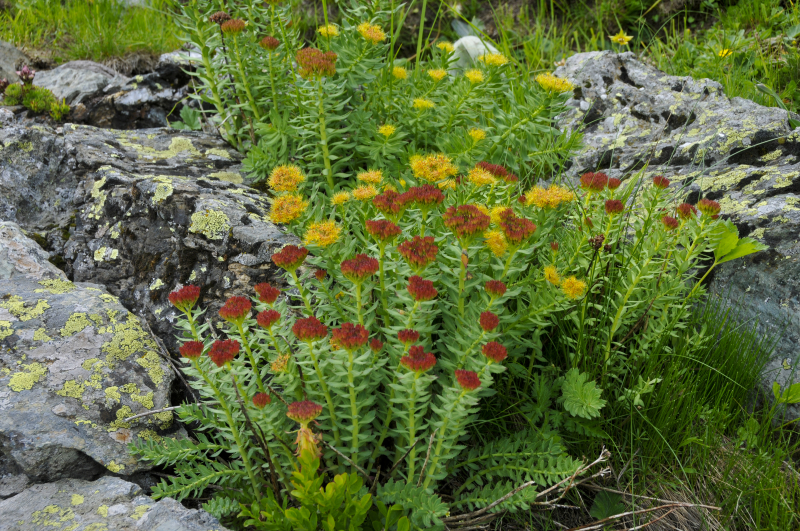
On the other side of the village, you can take the Brunnachbahn to 1900 m (6200 feet) in the Biosphärenpark and go for beautiful walks. The white-flowering Minuartia rupestris and Silene pusilla are common, but not conspicuous. They are completely outshown by the pasqueflower, Pulsatilla alpina subsp. austroalpina with white flowers on slender stems above a bed of finely divided leaves. They are truly everywhere and each group is more photogenic than the next. Near the hamlet of Valkert are large groups of rose root, Rhodiola rosea, known for its medicinal properties.
Steep mountain paths and deep ravines are a rarity in the Nockberge; however, a wide selection of flowering plants in large numbers is almost guaranteed in the period from late May to mid-July. With cable cars from Bad Kleinkirchheim you can quickly get to 2000 m (65000 feet) and once at the top, the hiking pace is at most one or two km per hour because the many plant species constantly force you to your knees. On these hikes, the plants are the goal and the distance covered is of secondary importance.