
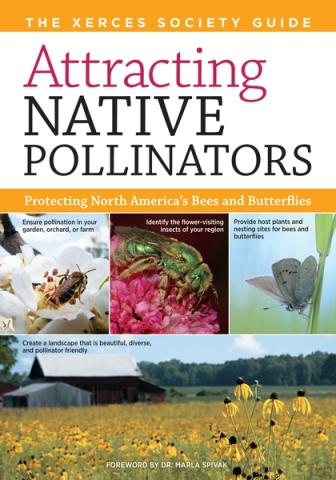
Attracting Native Pollinators: Protecting North America’s Bees and Butterflies, Eric Mader, Matthew Shepherd, Mace Vaughan, Scott Hoffman Black, and Gretchen LeBuhn, Storey Publishing, North Adams, Massachusetts (February 26, 2011), 384 pages, softcover; publisher’s price: $29.95; Amazon price: $19.77.
It is well known that insects pollinate the majority of flowering plants, but few of us realize that more than a third of our food supply results directly from such pollination. Obviously it is in our own self-interest to protect and encourage pollinators, a task this comprehensive book takes seriously.
Attracting Native Pollinators is published under the auspices of the Xerces Society, which is dedicated to the protection and understanding of invertebrates. Covering beetles, flies, wasps, and bees, this book is divided into four well-illustrated sections, the first of which discusses the role of pollinators in broad terms, how pollination is achieved, life histories of exemplary pollinators, and factors influencing their decline and conservation both in natural and man-made environments.
The second section is devoted to managing habitats for pollinators ranging from homes, schools, farms, wildlife management areas, urban parks, and even green roofs.
The third section is a bee primer, pointing out that bees are the most important of all pollinators, discussing their biology, and illustrating dozens of species. The authors admit—and truthfully so—that identifying bees is definitely not as easy as identifying birds, but they provide several key traits for at least telling them apart from wasps and flies.
The last section provides illustrated garden plans, regional plant lists, color photographs of pollinator-attracting plants, and a list of larval host plants for particular butterflies. There’s also an appendix that includes a glossary, index, and helpful resources for more information.
Providing a thorough introduction to the interactions of plants and their essential insect partners, Attracting Native Pollinators is suitable for novices, advanced gardeners, and those interested in the pursuit of sustainable horticulture or agriculture. It also serves as an important reminder of how much we depend upon the natural world for our own survival.
Reprinted by permission of the Garden Magazine of The American Horticultural Society.
Eric Grissell is the author of Insects and Gardens and Bees, Wasps, and Ants, The Indispensable Role of Hymenoptera in Gardens, and is a member of the Potomac Valley Chapter.